GOP Presidential Contenders Compete To Win Over “The Political Army Of The Lord”
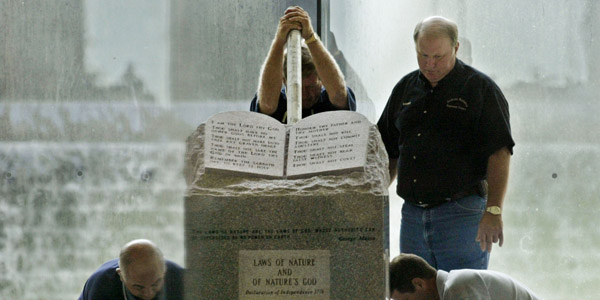
Workers remove a monument of the Ten Commandments from the rotunda of the Alabama Judicial Building after Superior Court Justice Roy Moore refused to take it down in 2003
So you can add another car to the crazy train that is the 2012 Republican presidential nominating contest. No, I’m not talking about last week’s sensation, Donald Trump. He’s a pretty conventional figure compared to the latest would-be president, former Alabama Supreme Court Chief Justice Roy Moore, who is currently barnstorming through Iowa after announcing an exploratory committee.
You may remember Judge Moore as the man who was forced from his judicial post after refusing to remove a gigantic monument to the Ten Commandments from his courthouse. He was also known for abrasive comments from the bench about homosexuality as contrary to God’s will, which in Moore’s opinion was dispositive. A martyr for theocrats everywhere, Moore spent some time hauling his monument around Alabama before launching two notably unsuccessful gubernatorial races — coming in a bad second in 2006’s Republican primary and a bad fourth in 2010 — and becoming a minor fixture at tea party events.
Moore was undoubtedly drawn to Iowa by that state’s furor over same-sex marriage, decreed legal by a 2009 state Supreme Court ruling. Iowa’s powerful Christian Right movement has made overturning that decision Job One, beginning with a successful effort in 2010 to remove three of the seven jurists responsible for it. It’s one of the few places left where Republicans don’t try to ignore the whole issue of gay rights as a divisive loser of an issue (which is why presidential wannabees like Tim Pawlenty have anachronistically come out against the repeal of “don’t ask, don’t tell). For Moore, it must have felt more like “home” than home.
Before writing off Moore as a kook trying to horn in on the spotlight of a presidential race, consider the company he’s keeping on his tour of the first-in-the-nation-caucuses state: former state legislator Danny Carroll. Carroll was co-chairman (with three-time gubernatorial candidate Bob Vander Plaats) of Mike Huckabee’s successful 2008 Caucus campaign, and more recently, signed on as a lobbyist for Vander Plaats’ new Christian Right umbrella group, The Family Leader. He’s a reasonably big deal in Iowa GOP circles, and by no means someone who howls at the moon.
For all I know, Carroll sees something in the crusty Alabama judge that others haven’t seen. Or maybe Judge Moore is a convenient stalking horse for Huckabee, designed to keep The Faithful loose and out of anyone else’s camp, in case Huck ultimately decides to run.
Regardless of Carroll’s (or Moore’s) personal motives, it’s likely the national Republican chattering class will dismiss the Judge’s campaign as a joke even worse than Trump’s. Or, it may be said, there is now such a crowd on the far right that opportunities are opening up for more moderate possibilities like Romney, T-Paw or an establishment-backed candidate-yet-to-be-named.
But I’d like to suggest another theory: the Christian/tea party right in Iowa is big enough, powerful enough, and politically sophisticated enough to hold its own caucus-within-a-caucus (well, caucuses, to be technical about it), an intramural contest to determine which candidate will actually represent the cause when Iowa Republicans make their final commitments before Caucus Night. Proven zealots like Michele Bachmann, Herman Cain, and now Moore, will joust with more suspect supplicants like T-Paw, Newt Gingrich — and maybe even Donald Trump! — over the next few months, with someone emerging as the designated favorite of the political army of the Lord. That is arguably what happened in Iowa in 2008, when Huckabee and Sen. Sam Brownback fought to become the Christian Right alternative to Mitt Romney, with Huckabee becoming The Man only after he out-organized Brownback at the State Party Straw Poll in Ames during the summer.
Moore’s candidacy may not ultimately have any direct influence on what happens next winter in Iowa, when conservative evangelicals and conservative Catholics get together to shape the 2012 Republican nominating process.
But he could indeed intensify the competition for Christian Right voters. And just as importantly, he could definitely serve as a symbol of the ideological and psychological gap between rigorous conservative activists and the mainstream political commentariat. Most of the latter think Moore is a crazy person. But most of the Iowa audiences before which Moore speaks will consider him an authentic if polarizing voice expressing the Word of God. That’s a pretty big gulf in perception, but also a pretty good reflection of the real differences Americans experience in how they view their leaders.
By: Ed Kilgore, Managing Editor of The Democratic Strategist and Senior Editor, Progressive Policy Institute. Article published in The Atlantic, April 20, 2011: Photo by Tami Chappell (Reuters)
Put-up-Or-Shut-up Time For Republicans On Health-Care Reform
It’s put-up-or-shut-up time for Republicans. They managed to make it through the health-care debate without offering serious solutions of their own, and — perhaps more impressive — through the election by promising to tell us their solutions after they’d won. But the jig is up. They need a health-care plan — and quickly.
The GOP knew this day would come. In May 2009, Republican message-maestro Frank Luntz released a polling memo warning that “if the dynamic becomes ‘President Obama is on the side of reform and Republicans are against it,’ then the battle is lost.” Repeal, Luntz argued, wouldn’t be good enough. It would have to be “repeal and replace.” And so it was.
That, however, is easier said than done.
To understand the trouble the Republicans find themselves in, you need to understand the party’s history with health-care reform. For much of the 20th century, Democrats fought for a single-payer system, and Republicans countered with calls for an employer-based system. In February 1974, President Richard Nixon made it official. “Comprehensive health insurance is an idea whose time has come in America,” he said, announcing a plan in which “every employer would be required to offer all full-time employees the Comprehensive Health Insurance Plan.”
In a moment of historically bad judgment — Ted Kennedy later called it his greatest political regret — Democrats turned him down. They thought they could still get single payer. They were wrong.
By the 1990s, they had learned from their mistake. Bill Clinton took office and, after a wrenching year of negotiations, announced legislation similar to Nixon’s.
”Under this health-care security plan,” Clinton said, “every employer and every individual will be asked to contribute something to health care.”
But Republicans again balked, calling instead for a system of “individual responsibility.” Senate Republicans quickly offered two bills — the horribly named Health Equity and Access Reform Act and the Consumer Choice Health Security Act — based on the idea that every person who has the means to buy health insurance should have to do so. We now call that concept “the individual mandate.”
Both bills attracted 20 or more co-sponsors. Neither passed, as Republicans yanked their compromise legislation the moment Democrats became desperate enough to consider it. The individual mandate, however, didn’t go away. It kicked around conservative health-care policy circles, racking up endorsements from the conservative Heritage Foundation and the libertarian magazine Reason. A year later, the mandate showed up in a law that then-Gov. Mitt Romney signed in Massachusetts. And then it was in the bipartisan proposal that Utah Republican Bob Bennett and Oregon Democrat Ron Wyden introduced in the Senate. And next, it was the centerpiece of the Democrats’ health-care reform push. Consensus, it seemed, was at hand.
Or not. Republicans turned on the individual mandate again. Senators who’d had their names on a bill that included an individual mandate — Orrin Hatch, Chuck Grassley, Bob Bennett, Mike Crapo, Bob Corker, Lamar Alexander, Olympia Snowe and Kit Bond, to name a few — voted to object, calling the policy “unconstitutional.” Romney had to explain away his signature accomplishment as governor of Massachusetts. And Republicans found themselves without a fallback.
The party’s current mood on health-care policy is perhaps best expressed by the efforts that Michael Cannon, an influential health-care wonk at the libertarian Cato Institute, has made to enlist members in his “anti-universal coverage club.”
Enter Wyden-Brown, an Affordable Care Act amendment that the White House has made a big show of endorsing: It says that any state that can produce a credible plan to cover as many people, with as comprehensive insurance, at as low a cost as the Affordable Care Act can wriggle out of all the law’s mandates but still receive all the law’s money. Vermont’s governor, for one, is stoked: He wants to try a single-payer proposal.
Most conservatives have been actively hostile. They make some fair technical points. The law envisions the secretary of Health and Human Services handing out the waivers, while the Heritage Foundation’s Stuart Butler would prefer to see a bipartisan commission in charge. But most take aim at the proposal’s basic goals: that care has to be as universal, as good and as cheap.
Cannon, for instance, frets that there’s no conservative policy that “would cover as many people as a law that forces them to buy coverage under penalty of law.” Butler worries that it “locks the states into guaranteeing a generous and costly level of benefits.”
But as the New Republic’s Jonathan Cohn points out, under the Affordable Care Act, a family of four could shell out $12,500 out of pocket for medical costs. How much stingier should the insurance be?
And Cannon is right that conservatives don’t have solutions to provide coverage as universal as what the Affordable Care Act would. But whose fault is that?
Conservatives once offered solutions competitive with what the Democrats were proposing, but over the past 30 years, they’ve abandoned each and every one of them to stymie Democratic presidents. Confronted with a challenge to provide broader access to better health care at a lower cost, they’re reduced to complaining that those aren’t the right goals for health-care reform. But we’ve yet to see how “less comprehensive insurance for fewer people” would play in Peoria. My hunch is it wouldn’t play very well.
For decades, Republicans have chosen stopping Democratic presidents over reforming the American health-care system. Now that reform has passed, the solution for members of the GOP is to press the rewind button. They’re about to find out that it’s not enough.
On that much, Luntz and I agree: If the public comes to see the GOP as opposed to reform, “the battle is lost” — at least if you believe “the battle” is to beat the Democrats rather than provide quality health insurance to every American.
By: Ezra Klein, Columnist, The Washington Post, March 8, 2011
Share This Blog


 Unknown Feed
- An error has occurred; the feed is probably down. Try again later.


You must be logged in to post a comment.