The “Deficit Problem” Isn’t Financial: It’s Political
The federal budget deficit and its cumulative cousin, the national debt, are much more political and media phenomena than they are financial. Which isn’t to say that they don’t exist. Obviously, they do. But they have been invested with apocalyptic significance mainly for political purposes: to scare people and to coerce them into reducing the size and the scope of government.
The truth is that massive deficits are almost exclusively a Republican creation. But Republicans were conspicuously silent in the decades of their big run-up, when the deficits were providing the hollow illusion of easy prosperity. The other truth is that it is only deficits that can get the economy out of the ditch that Republicans left it in when Bush slunk out of office.
But as Republican Senate leader Mitch McConnell has said, “Our first priority is to make sure Obama is a one-term president.” That is the real reason Republicans are born-again fiscal fundamentalists: deficits are the only thing that might actually turn the economy around and that is exactly what the Republicans are so intent on avoiding.
The first tip-off about the fake hysteria surrounding the deficits is that all the Chicken Littles crying the end of the world were silent when the real run-up was being conducted. Look at the history.
Ronald Reagan inherited a national debt of $1 trillion. He cut taxes on the rich and exploded government spending so that in just twelve years, by the end of the Bush I administration, the debt had quadrupled to $4 trillion.
Where were the Nervous Nellies back then? And Republicans have apotheosized Reagan into some kind of secular saint, a totally schizophrenic adulation if we are to believe their current hair-on-fire shtick about the toxicity of debt.
Bill Clinton reversed Reagan’s supply side economics. He raised taxes on the wealthy and cut government spending to the lowest percent of GDP in 40 years. As a result, he paid down the deficit every year he was in office, even delivering a budgetary surplus in each of his last three years. He handed a $136 billion surplus to George W. Bush in 2001.
If Republicans were truly sincere about their putative religious aversion to deficits, they would idolize Clinton, who paid them down, and demonize Reagan who ran them up. It says everything about their honesty that they do exactly the opposite.
Bush II, of course, returned to the same voodoo economics that Reagan and his father had embraced. He aggressively cut taxes on the rich (his “base” as he called them) and exploded government spending. He ran deficits every single year of his presidency, doubling the national debt in only eight years.
Again, where were the Heraldic voices of doom when their country really needed them? They were nowhere to be found. In fact, Bush’s vice president, Dick Cheney, brushed off Treasury secretary Paul O’Neil’s concerns about the hemorrhage with his famous dictum, “Deficits don’t matter. Reagan proved that.” Remember?
So, the choice to get all apoplectic about government borrowing is exactly that — a choice, and a political one at that. It is a choice Republicans conveniently never invoke when the deficits are their own, as they almost always are. Again, look at the history.
A Republican has occupied the White House for 28 of the last 42 years and never once in all of those years did any one of them ever produce a single balanced budget. Not once. They are financial phonies. Fiscal frauds.
And how ironic is it that these same Cassandras who are prophesying the end of the world are just as adamant that Bush’s tax cuts for the very rich must be preserved at all costs. Over the next ten years, those tax cuts will cost the government $700 billion in lost revenues, a seven hundred billion dollar, dollar-for-dollar increase in the deficit.
So, they can’t have it both ways. If the deficits do, in fact, pose an existential threat to the republic, then the government had better bring in more revenues from whatever source it can. But it looks like the deficits aren’t quite so onerous that we should bring in revenues from the only source that could actually pay them, the very rich. Funny thing, huh?
It is this duplicity on both history and policy that so clearly betrays Republican hypocrisy. They’re not interested in reducing deficits. They’re interested in reducing the size, the scope, and the efficacy of government, for government is the only agent left in the country with the capacity to stand up to the big corporations, to stop their sociopathic looting of the economy and their suicidal predations on the environment.
Republicans are also determined to undermine, even destroy, anyone who stands in the way of their agenda. Scott Walker, governor of Wisconsin, is the archetypal poster-child for this role.
Wisconsin’s legislative fiscal analyst had reported that the state had a $120 million surplus before the governor gave $140 million in tax breaks to corporations. So now, being shocked — SHOCKED — to discover a deficit, Walker claims he needs to dismantle public sector unions.
It’s like that iconic parable describing chutzpah: the child who kills his parents and then throws himself on the mercy of the court because he’s an orphan. But wait! It actually gets worse. The unions responded with substantial give-backs to help control the state government’s costs. Walker’s response? He’s not interested.
You see, the deficit is not, in fact, the problem. It’s just the fiscal train wreck that Republicans, from Wisconsin to Washington, have engineered to justify dismantling the social safety net and breaking the resistance of those people who will not submit themselves to living as serfs.
Finally, beyond the sham of their real history, beyond two-faced policies, there is the simple, conveniently overlooked matter of economics itself.
Ninety percent of the Obama deficits can be traced directly to actions of the Bush administration that carry over to the present. These include two sets of tax cuts for the rich, two seemingly unending wars, a $600 billion give-away to the pharmaceutical industry, and The Greatest Economic Collapse Since the Great Depression. That is what Obama inherited from Bush, together with a $1.3 trillion deficit. Again, look at the data.
Bush’s Great Recession started in December 2007, 13 months before Obama took office. In January 2009 when Obama was sworn in, the economy was losing 780,000 jobs a month. A month later, in February 2009, he pushed through a $787 billion stimulus package. Job losses bottomed out two months later, in April, and by November the economy was not only not losing jobs any more, it was creating them.
Did the turn-around require deficits? Of course it did! The economy had imploded and Bush was only too happy to toss the turd to his successor. And where else was the impetus going to come from to actually re-start demand? The alternative would have been an accelerating death spiral into complete economic collapse. We did that once under the tutelage of Republican economics. It was called The Great Depression.
Now, to be sure, the current recovery is fragile. Eight million jobs were lost in the Bush Recession. They haven’t been replaced. Eight trillion dollars of home equity was destroyed and it may not be replaced for decades. Fifty million people are living in poverty. Consumer spending makes up some 70% of the economy. So, as long as consumers are so battered, spending is going to be weak.
And businesses are certainly not taking up the slack. Though their balance sheets are glutted with some $2 trillion made from shifting jobs to China, investment in the U.S. economy as a percent of GDP is at 12%, the lowest it’s been in the last 40 years.
Are Obama’s policies beyond reproach? Not by a long shot. He should have pushed for a much larger stimulus package and not caved to Republican demands to extend the Bush tax cuts. He shouldn’t have gone along with Bush’s larcenous give-aways to the banks and should have done much more to constrain the soaring costs of health care which are the real source of the economy’s debt problems.
But right now it is federal government spending that is keeping the economy afloat, the more so as states and cities, which cannot run deficits, are cutting their spending. In fact, the surest way to sink the economy would be to pull the plug on federal government spending. Which says more about the real motives of the latter-day deficit hawks than all of their insufferably strident sanctimony combined.
Yes, in the long run, the debts will have to be repaid. But the best way to assure that that can happen is to get the economy moving again, to get people working and paying taxes, just like Roosevelt did the last time Republicans drove it over a cliff. But rebuilding is going to require some deficit spending, at least in the short run.
Republicans don’t abhor deficits. They love them. That is the real “money-where-your-mouth-is” truth that all of their pious posturing cannot disguise. Their own history couldn’t be more persuasive on that point. What they abhor is deficit spending that will help the economy on a Democrat’s watch. Their aversion to deficits isn’t economic, it’s political. And their motives aren’t exemplary. They’re despicable.
By: Robert Freeman, CommonDreams.org, originally posted February 27, 2011
GOP Desperate to Sink Finance Reform — Sound Familiar?
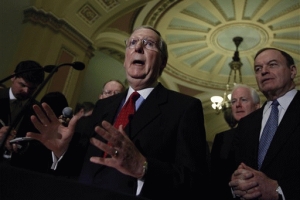
Sen Mitch "Let's scrap this one too" McConnell
Senate Minority Leader Mitch McConnell (R-Ky.) flew to New York two weeks ago for a private, behind-closed-doors meeting with hedge fund managers, bankers, and other Wall Street elites. It was after this meeting — where McConnell reportedly sought campaign contributions — that the Republican Senate leader returned to D.C. determined to kill the legislation that would bring some accountability to the same industry whose recklessness nearly destroyed the global financial system.
McConnell was asked on CNN this morning what, specifically, was said at the gathering about the Wall Street reform bill. The conservative Kentuckian was evasive — imagine that — and instead of answering the questions, he talked about scrapping the legislation altogether.
“We ought to go back to the drawing board and fix it.”
It’s like deja vu all over again — Democrats tackle a pressing national issue, negotiate with Republicans in good faith, craft a reasonable, middle-of-the-road legislative package that deserves bipartisan support, lobbyists tell Republicans to kill it, and McConnell voices his support for killing the legislation and going “back to the drawing board.”
Is it me or does this sound familiar?
McConnell’s principal (but not principled) concern is over the legislation’s liquidation fund, which would impose a fee on large financial institutions, collecting money that would be used to cover the costs of closing firms that fail. McConnell, who doesn’t know what he’s talking about, has characterized this provision as “institutionalizing bailouts.”
Fine, the Obama administration said. If it will help create bipartisan support for the bill, and end talk of a Republican filibuster, the provision on the liquidation fund can be scuttled. So, problem solved? Hardly.
[W]hen asked if he would support the bill if Democrats removed that fund, McConnell told CNN’s “State of the Union” he would still have other issues with the legislation, though he did not say what those qualms were.
Again, we’ve seen these genuinely stupid tactics before.
“Republicans can’t support the reasonable legislation Democrats want because it has a provision we’re pretending not to like.”
“Fine, we’ll get rid of the provision.”
“Republicans still can’t support the legislation, and we don’t want to tell you why.”
I know Republicans want to be taken seriously on public policy, but I can’t figure out why anyone would.
By: Steve Benen-Washington Monthly-April 18, 2010
Americans Can Speak for Themselves on Federal Health-Care Reform
Have you voted on any of the Democratic health-care-reform plans? Me neither.
No such vote was ever taken. But with coordination that the Rockettes would envy, Republicans insist that “the American people have spoken” on the matter, and they want the proposals killed.
House Republican Leader John Boehner: “The American people have spoken, loudly and clearly: They do not want Washington Democrats’ government takeover of health care.”
Senate Republican Leader Mitch McConnell: “The American people do not want this bill to pass.”
Republican National Committee Chairman Michael Steele: “The American people have spoken. The White House hasn’t heard their message.”
Quite a coincidence, these guys saying the same thing on the same day. No matter. What they’re saying is nonsense.
All politicians try, but Republicans excel, at creating a fantasy public always marching behind their baton. What the GOP leaders lack in veracity, they make up for in confidence.
They base their public mind-reading on polls showing displeasure with the Democrats’ reform legislation (or what the public thinks is in it). They ignore polls that don’t.
Some Americans are unhappy with the lack of a public option in the Senate bill, others with its inclusion in the House version. Many already have their government-guaranteed health coverage and don’t want to share.
Almost everyone detests the “Cornhusker kickback,” a special deal arranged by Nebraska’s Democratic senator, Ben Nelson.
And how does one count strong opinions by those who don’t have the foggiest idea what’s really in the bills — but who are taking their talking orders from partisan yakkers?
It’s worth noting that President Obama’s proposal, based on the Senate bill, does not include a public option. It eliminates the Cornhusker kickback. It eases up on the controversial tax on so-called Cadillac health plans. And in an appeal to older voters, it does away with the Medicare drug benefit’s “doughnut hole.”
The public option has been the most demagogued item in the entire health-care debate — not because it’s a bad, or even radical, idea but because the deep-pocketed insurance industry opposes it.
Republicans have been portraying it, a government-run insurance plan to compete with private options, as a socialist Satan intent on destroying the American Way. The public option has been burning at their stake for so long, it’s a wonder there’s even an ash left of support for it. But a recent Newsweek poll has 50 percent of Americans still favoring a public option and 48 percent opposed. That the administration refused to strenuously defend a cost-saving device that always enjoyed widespread backing is something I’ll never understand (and may never forgive). Nonetheless, health-care reform must pass, with or without the public option.
The last time “the American people” came close to officially speaking on this subject was in November 2008, when they elected a Democratic president and expanded the Democratic majorities in both the House and the Senate.
It’s mind-boggling that any sophisticated analyst would attribute Republican Scott Brown’s surprise victory in the Massachusetts special senatorial election to public rejection of government-guaranteed health care. As a Massachusetts state senator, Brown voted for a universal coverage plan that’s a lot less conservative than what’s on deck in Washington.
The Newsweek poll also asked for feelings about the job that Obama and Republicans and Democrats in Congress were doing on health care reform. Some 52 percent disapproved of Obama’s performance, 61 percent disapproved of the congressional Democrats’, and 63 percent disapproved of the congressional Republicans’.
No one is walking away from this with an Academy Award, but what’s coming out of Republican leaders’ mouths clearly isn’t what’s coming out of the American people’s. The people will speak definitively on Nov. 2.
By: Froma Harrop-Syndicated Columnist-The Seattle Times-Feb 25, 2010 3:54 pm
Share This Blog


 Unknown Feed
- An error has occurred; the feed is probably down. Try again later.
 mykeystrokes.com
You must be logged in to post a comment.