Obama Isn’t Trying To Start ‘Class Warfare’ — He Wants To End The Republican War On The Middle Class
History will record that on September 19, 2011, the Republicans made a huge political miscalculation — a miscalculation that could potentially doom their chances for victory next year.
If I were a Republican, the last thing I’d want to talk about is “class warfare.”
For 30 years — whenever they have been in power — Republicans and their Wall Street/CEO allies have conducted a sustained, effective war on the American middle class.
Much of the success of their war has resulted from their insistence that it didn’t exist. They have talked instead about how the economy needs to reward all those “job creators” whose beneficence will rain down economic prosperity on the rest of us.
They fund right-wing organizations that divert our attention by whipping up worry that gay marriage will somehow undermine heterosexual relationships. They start wars that help pad the bottom lines of defense contractors but do nothing to make us safer.
And all the while they quietly rig the economic game so that all of the growth in the Gross Domestic Product goes into the hands of the top two percent of the population — while they cut our pay, destroy our unions and do their level best to cut our Social Security and Medicare.
There has been a “class war” all right — a war on the middle class. And the middle class has been on the losing end.
Today the truly rich control a higher percent of our wealth and income than at any other time in generations. Income inequality is higher than at any time since 1928 — right before the Great Depression.
According to the Economic Policy Institute, “the richest five percent of households obtained roughly 82 percent of all the nation’s gains in wealth between 1983 and 2009. The bottom 60 percent of households actually had less wealth in 2009 than in 1983… ”
Today, 400 families control more wealth than 150 million Americans — almost half of our population.
American workers have become more and more productive — but they haven’t shared in the income generated by that increased productivity, so now they can’t afford to buy the products and services they produce.
The success of the Wall Street/CEO/Republican war on the middle class rests, in part, in the old frog in boiling water story. If you put a frog in a pot of boiling water, they say, the frog will jump right out. But if you put a frog in a pot and gradually turn up the heat until it boils you end up with a cooked frog.
Republican policies have gradually shifted wealth, income and power from the middle class — and those who aspire to be middle class — into their own hands and for obvious reasons they haven’t wanted to focus too much attention on “class warfare.”
So now if the Republicans want to talk about “class warfare” — in the words of George Bush — “bring ’em on.”
In fact, President Obama isn’t proposing to start a “class war” — he wants to end the war on the middle class.
Among other things, he has proposed that America live by the “Buffett Rule” — by Warren Buffett’s suggestion that he and his fellow billionaires should have to pay effective tax rates at least as high as their own secretary’s.
Obama pointed out yesterday that requiring hedge fund managers to pay effective tax rates as high as plumbers and teachers was not “class warfare.” The choice is clear: either you increase taxes on the wealthy — or dramatically cut Medicare, Medicaid and Social Security benefits. It is, as the President said, “simple math.”
Whereas Republican proposals to rein in the deficit by cutting Social Security, Medicare and Medicaid benefits are intended to continue this war on the middle class, the President’s plan — in stark contrast — addresses the three factors that actually caused the deficit in the first place.
From 1993 until 2000, Bill Clinton had successfully pushed back much of the Republican anti-middle class agenda. When he left office, America had a prosperous, growing economy, increasing middle class incomes, and budget surpluses as far as the eye could see.
Bush changed all that. The anti-middle class warriors were back in power, and they took the offensive. They passed massive new tax breaks for the rich, and set out to break unions.
Three Bush/Republican policies led directly to today’s deficit:
• Giant tax cuts for the wealthy;
• Two unpaid-for wars that will ultimately cost trillions;
• Trickle-down economic policies that did not create one net private sector job and ultimately caused the financial collapse that led to the Great Recession.
The Obama deficit proposal reduces the deficit by directly addressing these three factors — that actually caused the deficit — rather than demanding that the budget be balanced by taking even more out of the pockets of ordinary Americans.
A trillion dollars — 1.2 trillion with interest — is cut by ending the Wars in Iraq and Afghanistan. Those who argue that you shouldn’t count these reductions toward deficit reduction, because Obama already planned to end these wars, are ignoring the fact that they were a big reason why we have a deficit in the first place.
Second, Obama’s proposal eliminates the Bush tax cuts for the rich — and demands that millionaires, billionaires, oil companies, and CEO’s who fly around in corporate jets, pay their fair share.
Finally, the Obama plan includes a robust jobs package to jumpstart the economy and put America back to work. The Republicans have no jobs plan at all — none whatsoever. In fact, their plan is to simply let the Wall Street bankers and CEO’s continue to siphon as much as possible from the pockets of ordinary Americans.
The combination of Obama’s jobs and budget plans have set the stage for a clear, sharp battle for the soul of America. They have posed a stark contrast that is not framed as a battle over conflicting policies and programs — but as a struggle between right and wrong.
That battle will continue throughout this fall — and into next year’s elections.
These proposals, coupled with the President’s urgent, passionate advocacy, have transformed the political landscape.
The major iconic fights that will dominate American politics over the next 14 months will be the President’s jobs proposal, his call on millionaires and billionaires to pay their fair share, and the Democratic defense of Social Security, Medicare and Medicaid.
Democrats and Progressives have the high political ground on every one of these defining issues — and I don’t just mean slightly higher political ground — I mean political ground like Mount Everest.
By huge margins, Americans prefer to raise taxes on millionaires and billionaires rather than cut Social Security and Medicare. The choice is not even close — in most polls something like 8 to 1.
And who can possibly question that the number one priority of voters everywhere in America is jobs?
The Republican policies that led to the Great Recession did more damage than anyone knew. Many Republicans actually thought they would benefit politically by the long, slow economic slog that ensued in its aftermath. After all, no sitting President had won re-election in a century when the economy was not good or materially improving — except one.
Harry Truman won re-election in the midst of a bad economy in 1948 by running against the “Do-nothing Republican Congress.”
President Obama’s jobs and budget proposals have set the stage for just that kind of battle.
His proposals have simultaneously energized the progressive base and appealed to middle class swing voters — especially seniors — who agree entirely that the government should keep its hands off the Social Security and Medicare benefits they have earned, and turn instead to taxes on millionaires and billionaires to close the budget deficit that the Republican “class warfare” policies have created.
And it won’t hurt that these proposals have prompted the Republicans to turn the spotlight on the subject of “class warfare” itself. They should be careful what they wish for.
By: Robert Creamer, Strategist and Author, Published in HuffPost, September 20, 2011
How To Fight The Tax Cut Wars
The next big fight in Congress revolves around extending the Bush tax cuts. Unlike issues like climate change or stimulus, where the public does not accept the Democrats’ basic analysis of the problem, on the tax cuts the Democrats hold the whip hand. The question is whether they emerge with a political win, a public policy win, or both.
Let’s review a few basic facts about the Bush tax cuts. When Republicans took control of government in 2001, their top priority was reducing tax rates on high income earners. Since tax cuts for the rich were unpopular, they had to pair those cuts with middle-class tax cuts in order to make them politically salable. That’s how they pressured Democrats into supporting them. By packaging the whole thing together, they could accuse Democrats of opposing tax cuts for the middle class if they voted no.
Now, ten years later — and what a decade of bountiful economic growth we’ve enjoyed with the energies of investors and entrepreneurs finally unleashed from restrictive Clinton-era tax rates! — the Bush tax cuts are scheduled to expire. Republicans want to extend the whole thing. Democrats just want to extend the parts that benefit people who earn less than $250,000 a year.
Now, here’s the underlying dynamic. Raising taxes on the middle class is unpopular. But raising taxes on the rich is wildly popular. The truth is that neither party cares very much about the portion of the Bush tax cuts that benefit the middle class. Republicans just threw that in to sell the upper-bracket tax cuts, which is what they care about. Democrats might prefer a more progressive tax code with lower middle-class taxes, but most of them would rather have the revenue instead. But Democrats promised not to raise taxes on people earning less than $250,000 a year — a promise they felt they had to make in order to win. And they can’t break that promise without suffering political consequences.
Republicans, on the other hand, don’t want to pass an extension of the middle-class Bush tax cuts without the upper-bracket tax cuts. That would leave the federal tax code more progressive than it was under Bill Clinton — you’d have a combination of Clinton-era tax rates on the rich and Bush-era tax rates on the middle class. Conservatives have been fretting about such a result for more than a year, warning ominously about a country in which half the population pays no income tax. (They’d still pay other taxes, but the central Republican goal is to minimize the progressivity of the tax code.)
So we’re down to a game of chicken. Here’s why the Democrats hold the whip hand. They can pass an extension of the middle-class Bush tax cuts through the House. If Republicans let the bill pass, then they’ve lost their leverage to extend the unpopular Bush upper-income tax cuts. If they filibuster it, then Democrats can blame them for raising taxes on middle-class Americans. It would let Democrats out of their pledge. (Hey, they tried to keep the middle-class tax cuts.) Then nothing would pass, and we’d instantly revert to Clinton-era rates across the board.
What kind of effect would that have on the deficit? A huge one:
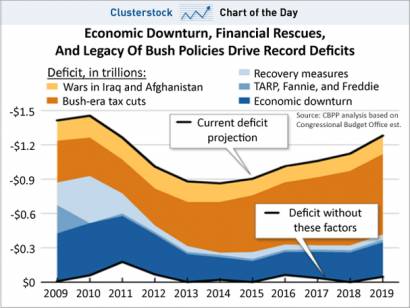
That dark orange stripe is the portion of the deficit attributable to the Bush tax cuts. That would be wiped out. Ending the tax cuts would basically solve the medium-term deficit problem.
The key factor here is that, just as Republicans got to frame the debate in 2001 by combining the tax cuts into an up or down vote, Democrats can frame the debate now by separating the policies Republicans pretend to care about from the ones they actually care about. Republicans want to have a vote on the whole collection of Bush-era tax cuts. Democrats shouldn’t give it to them. You hold a separate vote on the middle class portion and dare them to oppose it.
This seems to be the plan:
“The Senate will move first, and it will be a test to see whether Republicans filibuster” to block the bill in a bid to also win tax cuts for higher earners, said Rep. Chris Van Hollen of Maryland, head of the House Democrats’ re-election effort.
“If you can’t get it out of the Senate, then you take it to the election,” Mr. Van Hollen said in a recent interview. “You say to the American people that Republicans want to continue to hold middle-class tax relief hostage for an extension of tax breaks for [the well-to-do]. That will be the debate.”
Republicans have followed a strategy of opposing nearly everything the Democrats do. It’s worked very well. But the peculiar dynamic of this debate puts the Republicans in a position where they can’t win, and obstructing the Democrats is probably their worst move.
By: Jonathan Chait, Senior Editor, The New Republic-July 26, 2010
Share This Blog


 Unknown Feed
- An error has occurred; the feed is probably down. Try again later.
 mykeystrokes.com
You must be logged in to post a comment.