“Keeping Desperation As High As Possible”: Why The Greedy Upper Class Loves The GOP
Last week, Reihan Salam took a whack at America’s upper class in Slate. His charge? That the upper class uses its considerable political clout to protect itself from competition and keep its own incomes high, thus making life harder on everyone else further down the economic ladder. And he’s not wrong!
But Salam is also a conservative, with a conservative’s standard desire for low taxes, few regulations, and a skimpy social safety net. And what he conveniently leaves out of his screed is the fact that these preferences are themselves the ultimate expression of upper-class greed and self-dealing.
Let’s start with what Salam gets right. He points out that licensing and accreditation laws protect professions like dentists, lawyers, electricians, hairstylists, and the like from competition, which raises the costs of services they provide and prevents other workers from breaking into the market. The local land-use restrictions and zoning regulations that many in the upper class favor drive up housing prices, which makes it harder for the lower class to live in good neighborhoods with good schools, or to benefit from the economic development that comes with gentrification. The upper class seems implicitly content with an immigration status quo that maximizes competition in working-class jobs while minimizing it among high-skill professions. And of course there was the recent collapse of President Obama’s proposal to raise new tax revenue from 529 college savings accounts, a self-interested revolt of the upper class if ever there was one.
However, if you read between the lines, Salam isn’t really talking about the upper class writ large here. He’s talking about the liberal upper class. The issues he cites are mainly a big deal in cities, where liberals cluster. And conservative commentary in general these days has a tendency to talk about the American upper class as if it’s populated entirely by liberal yuppies who love yoga, organic food, Neil deGrasse Tyson, and abortions, and who think that guns are barbaric and that religion is backwards.
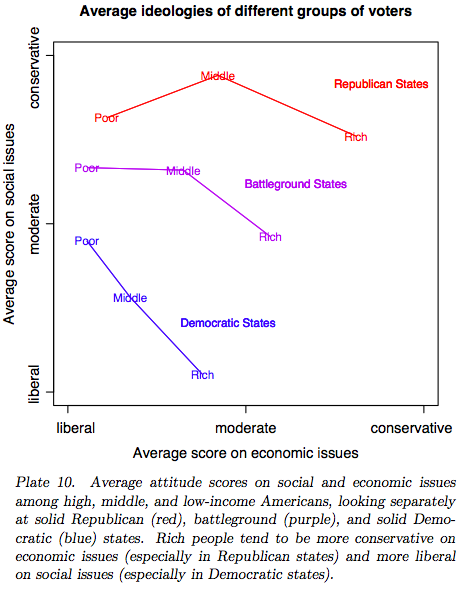
As it happens, however, the GOP relies on the upper class even more than Democrats. Median household income in the United States is $52,250, and if you look at the 2012 election, voters below that mark broke hard for Obama, with those above going for Mitt Romney by lesser margins. This trend of the Democrats getting way more votes below the median income level has roughly held for decades. These days, strong support for Republicans really doesn’t kick in until you get close to $75,000, or roughly the top third of the income ladder.
The difference between the parties is not that one relies on the wealthy and one doesn’t. Both parties lean heavily on those voters and divvy them up in various ways. (Mainly through cultural and social issues.) But the Democrats’ coalition also includes a fair portion that’s lower and working class, that’s still fighting for attention in the party, and that occasionally gets it. Conversely, lower- and working-class voters are mostly just absent from the GOP.
This matters because the upper class also has a pretty distinctive set of economic policy preferences. According to a recent study by Pew, the most financially secure Americans — roughly a fourth to a third of the population, by Pew’s definition — disproportionately say that government can’t afford to do more to help the needy, and that poor people “have it easy” thanks to government benefits. The less financially secure think the opposite. Large majorities of those making below $75,000 say the thing that bothers them the most about taxes is that the wealthy don’t pay their fair share. Large majorities of Americans oppose cuts to everything from Social Security and Medicare to aid for the poor. They support making union organizing easier and more federal spending on education.
Hell, 57 percent of the Republican or Republican-leaning voters who do make less than $30,000 think government doesn’t do enough to support poor people.
The reason the GOP can get away with being on the opposite side on all these matters is the fact that the voting population skews upper class: Even Democrats in the top third of the income distribution are noticeably more economically right-wing than poorer Democrats or Republicans, and Republicans in the top third are really economically right-wing.
There’s a pretty straightforward argument for why the upper class tilts in this direction. As Salam notes, the policy preferences of the upper class that really stick in his craw boil down to protecting their incomes and thus making the goods and services they provide more expensive for everyone else. But the flip side of that is making sure the goods and services everyone else provides — and thus their incomes — come cheap. That’s where the GOP comes in.
The essence of worker bargaining power is the ability to tell an employer “no.” That forces business owners to offer a better deal, driving up wages and benefits. A broad and generous welfare state gives workers leverage in that regard. It also helps boost aggregate demand, getting us closer to the full employment that really gives workers an edge. In short, the income of the working class is inversely proportional to its level of economic desperation. The effect of conservatives’ preferred economic policies — from slashing spending to imposing work requirements for aid — is to keep that desperation as high as possible. And of course, the upper class certainly doesn’t want to shoulder the taxes necessary to make such a system work.
The thing to remember is that, when it comes to what to do with the working class, the interests of the upper class and the super-rich cohere. Whether you’re a corporate CEO, a small-business owner, or just a well-heeled professional who consumes a lot of high-end goods and services, it benefits you to keep the labor of everyday Americans as cheap, compliant, and disposable as possible. It’s true, as Salam notes, that the truly rich aren’t quite as desperate to defend their interests as the upper class is; if you’ve got Mitt Romney’s dough, you can put up with more taxes, regulations, and workers demanding dignified pay and good benefits.
But that just bolsters the point that the fervent bastion of the economic right is the upper class. They’ve got the most to gain by slashing taxes, cutting regulations, scrapping government aid programs, and busting unions.
As Salam acknowledges, he doesn’t want high taxes on the wealthy, or for America to go down the road of the big European welfare states. His fellow reform conservatives and the Republican Party agree with him in this regard. Salam then says of the upper class: “I sensed that their gut political instincts were all about protecting what they had and scratching out the eyeballs of anyone who dared to suggest taking it away from them.”
But aren’t conservative economic policies the perfect expression of that exact impulse?
By: Jeff Spross, The Week, February 3, 2015
“The GOP; Still The Party Of Stupid”: Scott Walker’s Speech Was A Little More Than A Series Of Red-Meat Appetizers And Entrees
Mitt Romney definitely had his down sides as a candidate: the retread factor, and, as I noted two weeks ago, the fact that he made all those dramatic and (apparently) wrong predictions about the future of the economy. But I will say this for him. He did pass the this-guy-looks-and-sounds-like-a-plausible-president test. I always thought that was his greatest strength. He’s central casting.
None of these remaining people looks much like a president, with the exception of Jeb Bush; and more to the point, they don’t sound like presidents either. They sound like they’re running for RNC chairman at best, or more likely leader of the Tea Party caucus. So despite all this spin from conservatives about what a strong field this is, as usual the opposite is the truth. It’s an astonishingly weak field, unified not only in their opposition to Barack Obama and the federal government but also in their hostility to actual ideas that might stand a chance of addressing the country’s actual problems.
I’ve just been reading through their “books.” Yes, I know. You’re welcome. They’re ridiculous. I can’t say this with 100 percent certainty, but I may not have seen the word “wages” once. I certainly didn’t see a discussion of wage stagnation anywhere. That’s just one of a hundred examples I could cite.
It’s not so much that they come up short in terms of personal resumes. God knows, the current incumbent had a short one. Being a sitting or former governor, or a sitting senator—those are qualification enough. And I don’t doubt that they’re intelligent people.
But the problem in the first instance isn’t them. Let me put it this way. The greatest cardiologist in the world could move to town. But if everybody wants to eat chili-cheese fries all day and nobody wants to have bypass surgery, there’s still going to be a lot of heart disease.
You follow me? There could be a man in this presidential field who is the political equivalent of that cardiologist—Lincoln and TR and Reagan all rolled into one, with a little bit of Thatcher on the side and what the hell, a tiny dash of Clinton, just for crossover appeal. And it wouldn’t matter. He wouldn’t be able to demonstrate the breadth of his vision, because that isn’t what the GOP base of today wants.
I finally sat myself down and watched that Scott Walker speech from last week that everyone is raving about. If this was the standout speech, I sure made the right decision in not subjecting myself to the rest of them. It was little more than a series of red-meat appetizers and entrees: Wisconsin defunded Planned Parenthood, said no to Obamacare, passed some kind of law against “frivolous” lawsuits, and moved to crack down on voter “fraud””—all of that besides, of course, his big move, busting the public-employee unions. There wasn’t a single concrete idea about addressing any of the major problems the country faces.
Walker’s blandishments toward the base were bland enough to get under the skin even of James Pethokoukis, the conservative economics writer who laid into the Wisconsin Governor for one particular bit of surreality:
Opportunity is equal? The data, unfortunately, do not seem to support Walker’s optimistic claim. First, there are other countries, such as Sweden and Canada, where the chances of escaping the bottom are just as good as in the United States. Second, American mobility rates have been stagnant over the past 40 years. Third, mobility rates vary greatly by race with 74 percent of white sons making it out of the bottom fifth versus 49 percent of African-American sons. Fourth, even the smartest kids have only a 1-in-4 chance of making it from the bottom fifth to the top fifth.
That’s a conservative writer, remember. And he’s right, obviously. But try to imagine Walker or any GOP candidate acknowledging these complications. That opportunity is not equal in America! That Sweden and Canada are our equals! That it’s harder on black people! That candidate would be hooted out of the Republican Party faster than you can say Charles Murray.
Walker, I see, has surged in a new Iowa poll, while the only one who at least looks like president, John Ellis Bush, has taken a tumble and is viewed more negatively by potential caucus-goers than he once was (46 favorable, 43 unfavorable). We can’t say for sure why Bush has fallen, but it seems clear that Walker has gained on the strength, so to speak, of his empty-calorie bromides.
He’s gained because those items— kicking Planned Parenthood, denying your own citizens subsidized health-care coverage, pretending that voter fraud is a thing—are what pass for ideas in today’s GOP. Walker is even more vacuous on foreign policy, as Martha Raddatz revealed yesterday, twisting him around like a pretzel with a couple of mildly tough questions on Syria. The Democratic Party has its problems, but at least Democrats are talking about middle-class wage stagnation, which is the country’s core economic quandary. Rick Santorum is, in fairness, but a) his solutions are the same ones conservatives have been advertising for years (lower taxes, less regulation, more two-parent families) and b) he’s not going anywhere in the polls so far, undoubtedly precisely because he’s trying to drop the homosexuality-is-bestiality shtick and talk about actual economic problems.
But you can’t really discuss economic problems as a Republican presidential candidate, because in the pond of voters where you’ll be fishing, “America” has no such problems. Some people—roughly 47 percent of them—have economic problems, but that’s all their fault, you see. So these candidates are about to spend a year pandering to that. That will make them weak in more ways than one.
By: Michael Tomasky, The Daily Beast, February 2, 2015
“Wall Street’s Threat To The American Middle Class”: Do We Really Need To Be Reminded About What Happened Six Years Ago?
Presidential aspirants in both parties are talking about saving the middle class. But the middle class can’t be saved unless Wall Street is tamed.
The Street’s excesses pose a continuing danger to average Americans. And its ongoing use of confidential corporate information is defrauding millions of middle-class investors.
Yet most presidential aspirants don’t want to talk about taming the Street because Wall Street is one of their largest sources of campaign money.
Do we really need reminding about what happened six years ago? The financial collapse crippled the middle class and poor — consuming the savings of millions of average Americans, and causing 23 million to lose their jobs, 9.3 million to lose their health insurance, and some 1 million to lose their homes.
A repeat performance is not unlikely. Wall Street’s biggest banks are much larger now than they were then. Five of them hold about 45 percent of America’s banking assets. In 2000, they held 25 percent.
And money is cheaper than ever. The Fed continues to hold the prime interest rate near zero.
This has fueled the Street’s eagerness to borrow money at rock-bottom rates and use it to make risky bets that will pay off big if they succeed, but will cause big problems if they go bad.
We learned last week that Goldman Sachs has been on a shopping binge, buying cheap real estate stretching from Utah to Spain, and a variety of companies.
If not technically a violation of the new Dodd-Frank banking law, Goldman’s binge surely violates its spirit.
Meanwhile, the Street’s lobbyists have gotten Congress to repeal a provision of Dodd-Frank curbing excessive speculation by the big banks.
The language was drafted by Citigroup and personally pushed by Jamie Dimon, CEO of JPMorgan Chase.
Not incidentally, Dimon recently complained of being “under assault” by bank regulators.
Last year JPMorgan’s board voted to boost Dimon’s pay to $20 million, despite the bank paying out more than $20 billion to settle various legal problems going back to financial crisis.
The American middle class needs stronger bank regulations, not weaker ones.
Last summer, bank regulators told the big banks their plans for orderly bankruptcies were “unrealistic.” In other words, if the banks collapsed, they’d bring the economy down with them.
Dodd-Frank doesn’t even cover bank bets on foreign exchanges. Yet recent turbulence in the foreign exchange market has caused huge losses at hedge funds and brokerages.
This comes on top of revelations of widespread manipulation by the big banks of the foreign-exchange market.
Wall Street is also awash in inside information unavailable to average investors.
Just weeks ago a three- judge panel of the U.S. court of appeals that oversees Wall Street reversed an insider-trading conviction, saying guilt requires proof a trader knows the tip was leaked in exchange for some “personal benefit” that’s “of some consequence.”
Meaning that if a CEO tells his Wall Street golfing buddy about a pending merger, the buddy and his friends can make a bundle — to the detriment of small, typically middle-class, investors.
That three-judge panel was composed entirely of appointees of Ronald Reagan and George W. Bush.
But both parties have been drinking at the Wall Street trough.
In the 2008 presidential campaign, the financial sector ranked fourth among all industry groups giving to then candidate Barack Obama and the Democratic National Committee. In fact, Obama reaped far more in contributions from the Street than did his Republican opponent.
Wall Street also supplies both administrations with key economic officials. The treasury secretaries under Bill Clinton and George W. Bush – Robert Rubin and Henry Paulson, respectfully, had both chaired Goldman Sachs before coming to Washington.
And before becoming Obama’s treasury secretary, Timothy Geithner had been handpicked by Rubin to become president of Federal Reserve Bank of New York. (Geithner is now back on the Street as president of the private-equity firm Warburg Pincus.)
It’s nice that presidential aspirants are talking about rebuilding America’s middle class.
But to be credible, he (or she) has to take clear aim at the Street.
That means proposing to limit the size of the biggest Wall Street banks; resurrect the Glass-Steagall Act (which used to separate investment from commercial banking); define insider trading the way most other countries do – using information any reasonable person would know is unavailable to most investors; and close the revolving door between the Street and the U.S. Treasury.
It also means not depending on the Street to finance their campaigns.
By: Robert Reich, The Robert Reich Blog, January 26, 2015
“Bobby Jindal’s Public Humiliation”: Why There’s A Nasty Side To His Thirst For Power
Of the many rituals that accompany U.S. politics, one of the least-important but most-discussed is the spectacle of watching a hopeless, clueless and joyless presidential campaign falter on the runway before swiftly concluding in a fiery crash. Every four years, there’s at least one — and often more than one — such campaign. The candidate is usually already a figure of derision among the press, and it’s often not clear to outsiders whether even they truly believe they will, or even should, become the president. The whole quadrennial enterprise tends to be either a guilty pleasure or a cause for sorrow, depending on how idealistic (and sadistic) you are already.
Some recent examples: In 2004, Democratic Rep. Dennis Kucinich was the at least somewhat earnest candidate that the press preemptively dismissed, while Rev. Al Sharpton was the one whose sincerity was widely questioned. Kucinich reprised the role somewhat in 2008, but had competition from former Alaska Sen. Mike Gravel; Sen. Joe Biden, meanwhile, was the guy the press didn’t take seriously enough to let voters decide for themselves. On the Republican side in 2008, Rep. Ron Paul ran a heartfelt campaign that the media deemed unserious, while one-time ambassador Alan Keyes provided comic relief. And in 2012, one of the media’s favorite punching bags, Rep. Michele Bachmann, was a kind of right-wing Kucinich, while pizza mogul Herman Cain left many wondering whether he was engaged in an elaborate form of performance art.
At this point, it’s too early to know for sure who will fill these designated roles in the 2016 presidential race. And if former Secretary of State Hillary Clinton nabs the Democratic nomination with little effort, as many expect, the potential cast of characters will be smaller than is the norm. Still, it’s starting to look like there will be at least one presidential candidate who will waste everyone’s time by pursuing the White House. I’m thinking, of course, about the nascent presidential campaign of Gov. Bobby Jindal, who has begun flirting with some noxious forces in our society, and who is otherwise completely undeserving of anyone outside of Louisiana’s attention. Jindal will never be president — but whether his campaign is remembered as a routine failure, or a shameful disgrace, is far less certain.
Most of the worst stuff Jindal’s done lately has flown under the radar, so here’s a primer for those of you who haven’t paid much attention to the Louisiana pol since 2009, when he blew his State of the Union response by reminding everyone of “30 Rock’s” Kenneth. While Jindal still hasn’t formally announced his intention to run for president — and hasn’t even launched the pro forma exploratory committee, either — his desire to live at 1600 remains one of Louisiana’s “worst-kept” secrets. Yet ever since that embarrassing introduction to the television-watching public, Jindal’s had a problem: beyond his own ambition, a reason for him to run has been hard to find. And with each new iteration of a pre-campaign shtick, Jindal gets worse and worse.
Initially, Jindal wanted to be seen as a new kind of Republican, a GOPer for the Obama era. Needless to say, Jindal’s Indian ancestry was a component of this framing. But so was his allegedly fearsome intellect, which earned him degrees from Brown and Oxford and made him a Rhodes scholar. When his disastrous TV debut necessitated he shed that persona in favor of another, however, Jindal decided to go the other way, presenting himself as the ultimate anti-tax governor. He proposed Louisiana scrap income taxes altogether, but in part because his plan made up the revenue difference with sales taxes, which disproportionately hit the middle and working classes, the policy achieved little beyond sinking his approval rating. It remains low to this day.
After President Obama’s reelection in 2012, Jindal seemed to think he had another chance to claim the mantle of Sensible Republican. He charged out of the gate in 2013 with a call for the GOP to “stop being the stupid party,” which was, as you might imagine, not particularly well-received by the people who thought he was calling them stupid. Having seen his latest attempt fizzle out nearly as soon as it had started, Jindal proceeded to lay low for a while, but did little to change the perception that he still intended to run for president. Over the past few weeks, though, we’ve gotten a sense of what the latest version of Bobby Jindal might look like. And it isn’t pretty.
Lately, the man who urged his fellow Republicans to stop being stupid has grabbed headlines by pandering to the Islamophobic sentiment that’s widespread among the fundamentalist Christian bloc of the GOP base. The first sign was Jindal’s embrace of a paranoid fantasy that’s increasingly popular among far-right Christians, the supposed prevalence in the United Kingdom and Europe of “no-go” zones. These zones, according to the McCarthyite narrative, are neighborhoods or regions that have become so dominated by Muslim immigrants (and, of course, Shariah Law) that non-Muslims dare not enter them. The whole idea is a hysterical exaggeration, so much so that even Fox News has apologized for disseminating it. But Jindal has refused to downplay the no-go threat, despite being unable to point to any real examples.
If Jindal had left it there, you could have chalked it up as a momentary lapse in judgment, coupled with the typical arrogance of powerful men who are not accustomed to admitting they’re wrong. But he didn’t leave it there; he took it much further. He not only went on to flaunt his defiance on Fox News, promising he would never “tiptoe around the truth” when it came to “radical Islamic terrorism,” but also made clear that his turn to angry tribalism was no accident by grousing that he was “ready for us to stop calling ourselves hyphenated-Americans.” What connection there was between these two fearful mental spasms (it would be too charitable to call them thoughts) was unclear — until, that is, Jindal was able to get to what seemed to be his real message, which was little more than a nativist rant:
My parents came over here 40 years ago, they wanted their kids to be Americans, they love India, they love our heritage, if they wanted us to be Indians, they would have stayed in India. We also need to be teaching our kids in civics, in our schools about American Exceptionalism. We need to insist on English as our language in this country. I have nothing against anybody who wants to come here to be an American, but if people don’t want to come here to integrate and assimilate, what they’re really trying to do is set up their own culture, their communities, what they’re really trying to do is overturn our culture.
Unsurprisingly, the governor’s attempt to explicitly intertwine the conservative base’s dual fears of Muslims and immigrants was met with cheers from some of the more xenophobic and fear-stricken of conservatism’s leading lights. National Review’s Andrew McCarthy, for example, took a break from promoting torture to praise Jindal for his “Reaganesque” vision and willingness to call out the Islamic enemy within. But if Bobby Jindal wants his impending campaign for president to resonate outside the confines of National Review, his new persona is his most embarrassing miscalculation yet. Pretending to be a combination non-white Joe Arpaio and Christian Pamela Geller may do wonders for Jindal’s standing among the religious fundamentalists in the GOP, but to those of us who think America has more serious concerns than creeping Shariah, it makes him look like a fool. At best.
By: Elias Isquith, Salon, January 30, 2015
“Efforts To Reposition Themselves”: Can Republicans Create Their Own Credible Economic Populism In Time For 2016?
When Republicans trooped to Iowa over the weekend for Steve King’s “Freedom Summit,” it was as much of a dash to the right as you would have expected from an event hosted by perhaps the most fervently anti-immigrant member of Congress, in a state whose presidential caucus was won by Rick Santorum in 2012 and Mike Huckabee in 2008.
But something else was going on, even there: the search for an economic populist message that might resonate with the general electorate.
Republicans haven’t yet figured out how to present this message, or exactly what policy proposals it ought to be based on. But they’re obviously trying. Here’s part of the New York Times’ report from the event:
A few candidates advanced a concern about income inequality that is percolating within the party, discussing wage stagnation, an issue that has largely belonged to Democrats. Mr. Christie spoke of the anxiety of the middle class. He said that any Republican coalition needed to include the “proud yet underserved and underrepresented working class in this country.”
“The rich are doing just fine,” Mr. Christie said.
Rick Santorum, the winner in the 2012 Iowa caucus, noted that for years Republicans had extolled entrepreneurs and business owners, adding that it made more sense politically to “be the party of the worker.”
“What percentage of American workers own their own businesses?” he asked. “Less than 10.”
Former Gov. Mike Huckabee of Arkansas, who won the 2008 caucus here, stressed that the falling unemployment rate did not represent an economic recovery for many people. “A lot of people who used to have one good-paying job with benefits now have to work two jobs,” he said.
You may notice that none of these critiques are about Barack Obama, unless you’re arguing that he failed to make things better. That’s because when you start to talk about persistent economic anxiety, you inevitably reach back beyond this administration to problems that developed over decades. Santorum’s message is perhaps the most bracing for Republicans to hear; after years of holding up business owners as the most virtuous and admirable among us, the ones for whose benefit all government policy should be made, it would be awfully difficult for Republicans to decide that bosses aren’t the ones they should be advocating for.
And of course, Democrats are going to do what they can to make any populist turn impossible for Republicans. President Obama and his congressional allies will be releasing a steady stream of executive actions and new proposals on things like paid sick leave, boosting overtime pay, and other measures, which Republicans will inevitably oppose, leaving them arguing against benefits for workers.
Which is why it’s important for Republicans to have their own policy proposals if they’re to convince voters that they’re the ones to trust on economics. Republican arguments used to always be about growth, as though that were all that mattered: cut taxes and regulations, the economy will grow, and we’ll all live happily ever after. But with the economy growing steadily and economic anxiety persisting, they have to argue that growth is not enough.
The current Republican efforts to reposition themselves on economic questions remind me a little of how Democrats used to talk about national security before the Iraq War went south and discredited Republican wisdom on the issue. Democrats were always defensive about it, and when they tried to come up with a new message for whatever campaign was looming, the point was never to win the argument over national security. They just wanted to minimize the damage the issue could do to them, or at best, fight to a draw so that the election would hinge on issues where they were stronger.
If Republicans are to do that now on economics, it isn’t a bad start to say their focus has to shift to what people who aren’t wealthy or business owners (or both) care about. Now they just have to come up with an answer to this question: Okay, so what are you going to do about it?
Many Republicans would probably prefer to stick to a populism without economics, one that uses issues like immigration or the latest culture war flare-up to convince voters that Democrats are part of a hostile “elite,” while the GOP is the party of the common man and woman. This has certainly worked before. But the problem for them is that they are now on the wrong side of majority opinion on many of those cultural issues. Which only means that, when it comes to their new-found economic populism, there will be, if anything, more pressure to get specific.
By: Paul Waldman, Senior Writer, The American Prospect; The Plum Line, The Washington Post, January 27, 2015
Share This Blog


 Unknown Feed
- An error has occurred; the feed is probably down. Try again later.
 mykeystrokes.com