Health Reform at Work Today and Tomorrow: Improvements That Began Last Year Will Continue
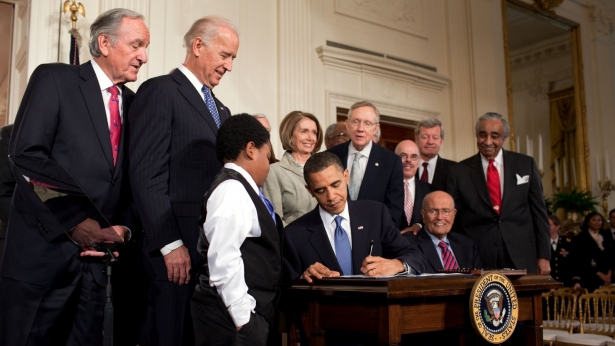
President Barack Obama is applauded as he signs the health care reform bill, on March 23, 2010, in the East Room of the White House in Washington. The bill includes many benefits for Americans who have health insurance today and those who have struggled to find and maintain health coverage.
2010 was a momentous year for the American health care system. In March, Congress passed—and President Barack Obama signed—landmark legislation that reforms the health insurance market, provides all Americans with affordable access to health coverage, and reduces the growth of health care costs.
The Department of Health and Human Services and other parts of the executive branch have begun to implement the new law in the subsequent 10 months. The Affordable Care Act, or ACA, includes many benefits for Americans who have health insurance today and those who have struggled to find and maintain health coverage. Many of these benefits came on-line in 2010.
Signature achievements include:
- Establishing pre-existing condition insurance plans in every state so that individuals with health problems who cannot find coverage in the regular market have a reliable source of coverage
- Requiring employer-sponsored health plans to offer coverage to the young-adult children of policyholders
- Helping employers with unpredictable health care spending for retired workers
- Providing more than 1 million rebate checks to Medicare enrollees who incurred high out-of-pocket prescription drug spending in 2010
- Prohibiting health insurance plans from denying coverage to children with pre-existing conditions
- Protecting individuals with high health care costs from the financial risk of absurdly low annual and lifetime limits on their benefits
- Prohibiting health insurance plans from rescinding coverage when a policyholder gets sick
These changes bring a new degree of stability and security to millions of Americans’ health coverage. And even more improvements are around the corner. Beginning this month, seniors will enjoy meaningful new benefits and significant improvements in their prescription drug coverage, while individuals and businesses will receive premium rebates from their insurance company when the insurers incur excessive administrative costs.
Specific improvements in 2011 include:
- Closing the Medicare prescription drug coverage gap. Seniors and people with disabilities who obtain prescription drug coverage through Medicare Part D will enjoy a new discount on brand-name and generic prescription drugs when they hit the so-called “doughnut hole” in their Part D benefits. Since the beginning of the program, enrollees have hit a gap in coverage when their total drug spending—including out-of-pocket costs and expenses covered by their Medicare Part D plan—exceeds a preset limit (currently $2,830). Patients then pay the total cost of their prescription drugs, without help from their drug plan, until their total drug expenses hit an upper limit and coverage kicks in again. With the new discount, people with drug spending high enough to hit the coverage gap will save almost $500 on average this year, while people with very high drug costs will save more than $1,500.
- Launching new prevention benefits for Medicare enrollees. Good coverage of preventive services helps seniors and other Medicare enrollees better manage their health. New benefits include coverage without cost-sharing for recommended preventive services (those that receive an “A” or “B” rating from the U.S. Preventive Services Task Force) and new coverage for a personal prevention plan.
- Increasing access to primary care. Medicare will pay primary care providers a 10 percent bonus payment, which offers a new incentive for physicians, nurses, and others to provide primary care services.
- Requiring insurers to provide high value for premium dollars. Beginning in 2011, insurers will pay rebates to policyholders—individuals and employers—when plan spending on clinical services falls below 80 percent of premium revenue in the individual and small group market, and 85 percent of premium revenue in the large group market.
Looking ahead, ACA provisions that will touch real people every day will continue coming on-line through 2011. These include providing more consumer information on healthy food choices by requiring chain restaurants and vending machines to provide nutritional data no later than March, and improving long-term care by sending enhanced federal Medicaid payments to support new state investments in community-based long-term care services starting in October. Tangible improvements will continue beyond this year, such as fully closing the coverage gap in Medicare Part D and improving Medicaid coverage for preventive care.
The Affordable Care Act’s most striking impact will come in 2014 when new health insurance exchanges launch, premium subsidies become available, and Medicaid coverage expands to include all low-income individuals regardless of family composition, age, or disability status.
These headline-grabbing changes in our health care system may be a few years down the road. But millions of Americans are already benefiting from the Affordable Care Act—and millions more will receive better care in the near future thanks to the changes in the new law.
By Karen Davenport | January 13, 2011-Center For American Progress. Photo: AP/Charles Dharapak
‘Death Panels’ and Maxwell’s Silver Hammer: End-of-Life Planning Scare Resurfaces

Hammer or death mallet? You be the judge...
A hammer is supposed to be used to pound nails. But as the Beatles pointed out more than 40 years ago, it can also be used as a murder weapon. Nobody, however, is calling for a ban on hammers or calling them “death mallets.”
Maybe that’s why the resurrection of the “death panel” canard, as applied to end-of-life planning, seems so unnecessary. Here’s how the New York Times started its story a few days ago:
“When a proposal to encourage end-of-life planning touched off a political storm over ‘death panels,’ Democrats dropped it from legislation to overhaul the health care system. But the Obama administration will achieve the same goal by regulation, starting Jan. 1.”
The only opponent quoted in the story was this:
Elizabeth D. Wickham, executive director of LifeTree, which describes itself as “a pro-life Christian educational ministry,” said she was concerned that end-of-life counseling would encourage patients to forgo or curtail care, thus hastening death.“The infamous Section 1233 is still alive and kicking,” Ms. Wickham said. “Patients will lose the ability to control treatments at the end of life.”
Which, with all due respect, was no more accurate a summary of “Section 1233” or the new regulation than “death mallets” would be to describe hammers.
Don’t believe me? Section 1233 was contained in one early draft of the health care reform bill. Here’s the text of that version of the bill (search for “advance care planning consultation”). It would have allowed Medicare to pay for one such consultation every five years, if the patient wanted it.
Such consultation was to include: an explanation of advance care planning, advance directives, health care proxy, list of resources for further information, explanation of palliative and hospice care, explanation of the advantages of an up-to-date advance treatment order. It would have required training for health care providers (you’d be shocked at what some doctors don’t know about this stuff). And would have required standardization of information and forms used.
It also listed some of the conditions that could be included in a directive. And said that Medicare would pay for more frequent consultations if there were a significant change in condition.
Overly detailed and controlling? Maybe so. Death panels? Not hardly. Limit a patient’s ability to control treatments at the end of life? Not in any clause or sub-clause I can find.
Jump to the new regulation. (It’s in here.) The relevant passage is a lot shorter than the killed section of reform legislation. It adds “voluntary advance planning upon agreement with the individual” to the items that Medicare will pay for during an annual physical. Here’s the whole thing:
“Voluntary advance care planning” means, for purposes of this section, verbal or written information regarding the following areas: (1) An individual’s ability to prepare an advance directive in the case where an injury or illness causes the individual to be unable to make health care decisions. (2) Whether or not the physician is willing to follow the individual’s wishes as expressed in an advance directive.”
That’s it. No panels, death or knotty pine. Just a conversation with your doctor if you want it. No loss of patient control unless the patient is in a condition where conscious control is impossible — in which case the whole point of the planning is to ensure that the patient’s wishes be followed.
Since the New York Times figures Wickham has enough clout to stand in for all opponents, I tried to contact her. No joy. I checked her organization’s website for more insight into her objections. I found that LifeTree is not a generically Christian group, but one that has Catholic roots, starting with the blessing of the bishop of Raleigh, N.C.
So I shifted my search to the National Catholic Bioethics Center, figuring I’d find a reasoned critique that would likely be in accord with the beliefs of LifeTree. I found Marie T. Hilliard, the center’s director of bioethics and public policy. She was more than willing to engage me in civil discussion.
The Catholic Church is in favor of end-of-life planning, she said.
“The issue is not whether a discussion by a health care practitioner with a patient on end-of-life care issues is a good. It is a good,” she said. “And encouraging providers to have truly informing discussions on this issue also is a good.”
So what’s Hilliard’s beef with the regulation? She fears the way that written “orders for life-sustaining treatment” (called “POLST” or “MOLST”) could be abused. A form signed today might not include the actual situation that pops up years down the road.
In other words, a patient could complete a POLST/MOLST form indicating the patient did not want life sustaining treatment, which could be an antibiotic or a blood transfusion or proportionately beneficial assisted nutrition and hydration, before any of the facts that would be appropriate to such decision-making were in play.
The new regulation actually addresses at least one of her concerns in that it makes the consultation available annually, rather than using the bill’s five-year rule. And a standardized form can certainly include the vast majority of situations a patient is likely to encounter. The version prepared by the Rabbinical Council of America, for instance, covers persistent vegetative state, coma, lesser brain injuries along with a terminal illness, and brain injury without a terminal illness along with 31 possible procedures.
But there are conditions and procedures the form does not address. Would a longer form, with more choices, make the possibility of error less likely? Or would a form that’s much longer make it less likely that someone would be willing to fill it out at all?
Hilliard also raises a “slippery slope” argument, suggesting that widespread use of such forms would be employed to put pressure “on persons with disabilities and their families to forgo life sustaining health care treatments.”
To which argument I have consistently replied that if you have a doctor who wants you or your loved one dead, your problem is bigger than a signed form.
Hilliard recommends the use of “health care agents,” a sort of human advance directive. This could be a family member or some other designated person who has the authority to speak for the patient.
The concept was actually included in the killed portion of the health care reform bill, referred to as a “health care proxy.” Perhaps it should have been included in the new regulation.
I think Hilliard and I both agree that the biggest problem with end-of-life planning is that far too often it’s done poorly.
We have a 24/7 consultation line on medical ethics; (1,400 calls per year) and the most frequent call we receive is on end-of-life care, NOT because there is not an advanced directive, often because there is and it does not address the situation at hand, and no helpful discussion had been held with the health care agent. Then there is the question of whether or not the health care agent is locked in by the letter of the law, knowing that the spirit of the will of the patient may be violated.
And that’s for people who have directives or health care agents. Imagine the situation for the far greater number of people who never address these issues until there’s a crisis.
I have some personal experience in this matter. My dad died earlier this year. He was 92. Several years before, my wife had prodded him (and the rest of us) to fill out advance-care directives. Her career has been in long-term health care and she’d seen too many families torn apart by being forced to consider these decisions only under the most terrible stress.
Because we’d talked about the topic once, nudged into it by filling out the directive, we found it easier to return to the subject over the years as my dad’s condition faltered. We and his doctors were all clear about what he wanted — right up to the point when he decided he’d had enough. I cannot imagine how much more difficult those final days would have been without those previous conversations.
But most families do not have the advantage of having an elder-care expert “on staff.” If this regulation prods more doctors into a difficult conversation, if it prods more people into thinking about these issues when they have the luxury of time for reflection, that seems like a good idea to me.
Can such a process be abused? There is no system created by humanity that cannot be turned to evil ends. And yet most of us own a hammer.
By: Jeffrey Weiss-Correspondent-Politics Daily, January 2, 2011; Photo- Getty Images
Rep. Paul Ryan-The Flimflam Man
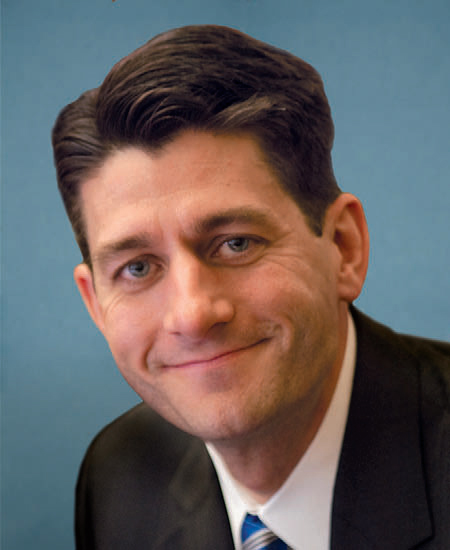
Rep. Paul Ryan
One depressing aspect of American politics is the susceptibility of the political and media establishment to charlatans. You might have thought, given past experience, that D.C. insiders would be on their guard against conservatives with grandiose plans. But no: as long as someone on the right claims to have bold new proposals, he’s hailed as an innovative thinker. And nobody checks his arithmetic.
Which brings me to the innovative thinker du jour: Representative Paul Ryan of Wisconsin.
Mr. Ryan has become the Republican Party’s poster child for new ideas thanks to his “Roadmap for America’s Future,” a plan for a major overhaul of federal spending and taxes. News media coverage has been overwhelmingly favorable; on Monday, The Washington Post put a glowing profile of Mr. Ryan on its front page, portraying him as the G.O.P.’s fiscal conscience. He’s often described with phrases like “intellectually audacious.”
But it’s the audacity of dopes. Mr. Ryan isn’t offering fresh food for thought; he’s serving up leftovers from the 1990s, drenched in flimflam sauce.
Mr. Ryan’s plan calls for steep cuts in both spending and taxes. He’d have you believe that the combined effect would be much lower budget deficits, and, according to that Washington Post report, he speaks about deficits “in apocalyptic terms.” And The Post also tells us that his plan would, indeed, sharply reduce the flow of red ink: “The Congressional Budget Office has estimated that Rep. Paul Ryan’s plan would cut the budget deficit in half by 2020.”
But the budget office has done no such thing. At Mr. Ryan’s request, it produced an estimate of the budget effects of his proposed spending cuts — period. It didn’t address the revenue losses from his tax cuts.
The nonpartisan Tax Policy Center has, however, stepped into the breach. Its numbers indicate that the Ryan plan would reduce revenue by almost $4 trillion over the next decade. If you add these revenue losses to the numbers The Post cites, you get a much larger deficit in 2020, roughly $1.3 trillion.
And that’s about the same as the budget office’s estimate of the 2020 deficit under the Obama administration’s plans. That is, Mr. Ryan may speak about the deficit in apocalyptic terms, but even if you believe that his proposed spending cuts are feasible — which you shouldn’t — the Roadmap wouldn’t reduce the deficit. All it would do is cut benefits for the middle class while slashing taxes on the rich.
And I do mean slash. The Tax Policy Center finds that the Ryan plan would cut taxes on the richest 1 percent of the population in half, giving them 117 percent of the plan’s total tax cuts. That’s not a misprint. Even as it slashed taxes at the top, the plan would raise taxes for 95 percent of the population.
Finally, let’s talk about those spending cuts. In its first decade, most of the alleged savings in the Ryan plan come from assuming zero dollar growth in domestic discretionary spending, which includes everything from energy policy to education to the court system. This would amount to a 25 percent cut once you adjust for inflation and population growth. How would such a severe cut be achieved? What specific programs would be slashed? Mr. Ryan doesn’t say.
After 2020, the main alleged saving would come from sharp cuts in Medicare, achieved by dismantling Medicare as we know it, and instead giving seniors vouchers and telling them to buy their own insurance. Does this sound familiar? It should. It’s the same plan Newt Gingrich tried to sell in 1995.
And we already know, from experience with the Medicare Advantage program, that a voucher system would have higher, not lower, costs than our current system. The only way the Ryan plan could save money would be by making those vouchers too small to pay for adequate coverage. Wealthy older Americans would be able to supplement their vouchers, and get the care they need; everyone else would be out in the cold.
In practice, that probably wouldn’t happen: older Americans would be outraged — and they vote. But this means that the supposed budget savings from the Ryan plan are a sham.
So why have so many in Washington, especially in the news media, been taken in by this flimflam? It’s not just inability to do the math, although that’s part of it. There’s also the unwillingness of self-styled centrists to face up to the realities of the modern Republican Party; they want to pretend, in the teeth of overwhelming evidence, that there are still people in the G.O.P. making sense. And last but not least, there’s deference to power — the G.O.P. is a resurgent political force, so one mustn’t point out that its intellectual heroes have no clothes.
But they don’t. The Ryan plan is a fraud that makes no useful contribution to the debate over America’s fiscal future.
By PAUL KRUGMAN-Op-Ed Columist and Nobel Prize Winner-Economics, The New York Times-Aug 5, 2010; Photo- Wikipedia
The Impact of Health Reform on Health System Spending
The health reform legislation passed in March 2010 will introduce a range of payment and delivery system changes designed to achieve a significant slowing of health care cost growth. Most assessments of the new reform law have focused only on the federal budgetary impact. This updated analysis projects the effect of national reform on total national health expenditures and the insurance premiums that American families would likely pay. We estimate that, on net, the combination of provisions in the new law will reduce health care spending by $590 billion over 2010–2019 and lower premiums by nearly $2,000 per family. Moreover, the annual growth rate in national health expenditures could be slowed from 6.3 percent to 5.7 percent.
Overview
To judge the merit of the comprehensive health reform legislation recently signed into law by President Obama, it is essential to understand its impact on the affordability of insurance coverage and overall health care spending. Most assessments of the new law consider the federal budget only. For example, the Congressional Budget Office “scored” the federal budget impact of the Patient Protection and Affordable Care Act, as modified by the Reconciliation Act (Affordable Care Act), finding a modest deficit reduction in the first 10 years of implementation.
But the federal budget impact is not the same as the health system impact. A portion of the federal funds would be used to reduce costs for people who already have health insurance coverage but struggle to afford it, while very small businesses would receive help in paying insurance premiums. To estimate health spending accurately, we need to separate out the costs into new health care spending and transfers of existing spending from the private sector to the government. Furthermore, CBO assigned very little savings to system reform efforts, rendering its overall analysis incomplete.
The Office of the Actuary within the Centers for Medicare and Medicaid Services, meanwhile, estimated the health system impacts of the Affordable Care Act and determined there would be a small increase in medical spending as a result of the reform. But, again, this analysis is limited, since it gives almost no weight to proposals for improving the information available to providers and modifying the financial incentives in the current system.
This study considers the new law, as enacted in March 2010, to project the impact of major health reform on national health expenditures and the insurance premiums that families will likely pay, accounting for the full range of impacts the legislation is likely to induce. As part of our analysis, we provide estimates of the effect of key provisions on health spending by government, employers, and households. We build on our earlier analysis of the draft legislation, taking account of the provisions in the final law.
Impact of reform on national health expenditures
Health care reform will affect national health expenditures through five major channels.
Impact of new coverage
Extending health insurance coverage to essentially all Americans will increase medical spending, at least in the short run. (Some argue that increased coverage will lower spending over time by making it possible to pursue more-aggressive cost-containment policies without risking access to care for the uninsured, but in this analysis we do not consider such effects.) From previous studies, data are available to estimate the magnitude of the increase in spending. Hadley and colleagues, for example, estimated that each uninsured individual who gains coverage will incur annually an additional $1,600 of medical care expenses—an increase of 70 percent. The Congressional Budget Office estimated that spending for uninsured individuals, if they become insured, will increase by 25 percent to 60 percent. The actual increase will depend in part on the rates that are paid to health care providers for treating currently uninsured patients.
For our estimates, we increase the $1,600 figure over time with expected increases in medical costs. We then multiply the revised amounts by the number of newly insured resulting from health reform to produce a total estimate. Fully phased in, incremental coverage costs about $75 billion per year to cover 60 percent of the uninsured, or 2 percent of total health care spending. This is comparable to Davis and Schoen’s projection that covering all of the uninsured would add 3 percent to medical spending, and Schoen, Davis, and Collins’s finding that covering all of the uninsured would add 2 percent to medical spending. This methodology suggests that the new law will lead to a 10-year cumulative medical spending increase of $415 billion over the period 2010–2019. This estimate is shown in the first row of Exhibit 1.
Savings in public programs
The new health reform law contains a number of changes to Medicare and Medicaid payments. Many of these are traditional payment changes—for example, reductions in the amount paid to Medicare Advantage managed care plans to a level comparable with the cost of covering beneficiaries under traditional Medicare, or smaller increases in Medicare inpatient payments to account for a likely increase in productivity and to reduce bad debts. Our estimates of the medical spending impact of these changes come from CBO. While this is a good place to begin, it should be noted that CBO has often misestimated, or failed to estimate, the behavioral consequences of such changes in the past.
We consider all such changes, with a few exceptions: 1) we exempt the net savings associated with health care modernization (Section 1104 and Title III, subtitle A, of the reform bill), which is treated separately; 2) we omit the sections associated with coverage expansions, which are accounted for above; and 3) we omit savings from the Community Living Assistance Services and Supports (CLASS) Act, which are a collection of premiums in anticipation of future spending. CBO estimates that the net impact of the remaining proposals in the reform law is to reduce Medicare and Medicaid spending by $416 billion over the 2010–2019 period. This estimate is depicted in the second row of Exhibit 1.
The reduction in Medicare and Medicaid spending is approximately on par with the increase in medical costs associated with covering the uninsured. The net impact of covering the uninsured and reducing traditional program payments (and other taxes from outside the health care system) is a decrease in spending of $1 billion over 2010–2019. This roughly parallels the analysis from the Office of the Actuary, which estimated that national medical expenditures under the new law will increase by $311 billion over 2010–2019. The difference of about $30 billion per year is very small on the scale of health expenditures (less than 1 percent per year), and it indicates that our analysis matches that of the actuary when no other cost changes are considered.
Our analysis assumes that a reduction in Medicare and Medicaid payments will not be offset by higher prices to private payers and, equivalently, that fewer uninsured patients will not yield savings to existing payers because of the reduced need of payers to shift costs onto covered patients. This assumption is common to other estimators and is consistent with empirical research.
Insurance exchanges
Currently, nearly 13 percent of insurance premiums are accounted for by administrative costs. These costs range from about 5 percent in large firms and firms that are self-insured to 30 percent for individuals. Higher costs for marketing, underwriting, churning, benefit complexity, and brokers’ fees explain the bulk of the difference.
The new reform law establishes insurance exchanges that will group individuals and small firms into larger entities and thus drive down those administrative costs. The exchanges also will minimize marketing costs through more transparent posting of premiums, facilitated enrollment (assistance with the application process and screening for eligibility), and stronger oversight of industry practices.
If all individuals and small firms were to receive the same premiums as large firms or self-insured firms do, the costs of insurance administration would decline to less than 10 percent. In analyzing the experience of other countries, The Commonwealth Fund estimated that administrative costs could fall to 8 percent or lower under a robust exchange system. We assume more modest savings, such that administrative costs fall to 10 percent of total premiums—a rate also assumed to remain constant over time, even though this implies administrative costs increase along with national health spending. We assume such savings begin in 2014, the year the exchanges will become operational, and are phased in over three years. The reduction in health spending associated with reduced insurer administration is $211 billion over 2010–2019.
CBO estimates $27 billion in administrative savings owing to insurance exchanges over 10 years. CBO assumes premium reductions of between 1 percent and 4 percent for small groups in the exchanges, and no savings for large groups, for an average of about 0.4 percent. We assume additional savings above this amount, totaling $184 billion over 2010–2019 (see third line of Exhibit 1).
Health system modernization
The reform law includes numerous provisions intended to improve the information available to patients and providers and the incentives facing medical care providers, and thus make medical care more efficient. The Commonwealth Fund has summarized these provisions. Within the Medicare and Medicaid programs, these include:
- Payment innovations, including higher reimbursement for preventive care services and patient-centered primary care, bundled payment for hospital, physician, and other services provided for a single episode of care, shared savings or capitation payments for accountable provider groups that assume responsibility for the continuum of a patient’s care, and pay-for-performance incentives for Medicare providers
- An Independent Payment Advisory Board, with the authority to make recommendations that reduce cost growth and improve quality in both the Medicare program and the health system as a whole
- A new Innovation Center within the Center for Medicare and Medicaid Services, charged with streamlining the testing of demonstration and pilot projects in Medicare and rapidly expanding successful models across the program
- Profiling medical care providers on the basis of cost and quality, making that data available to consumers and insurance plans, and providing relatively low-quality, high-cost providers with financial incentives to improve their care
- Increased funding for comparative effectiveness research
- Increased emphasis on wellness and prevention.
The exact amount that will be saved from these provisions collectively is uncertain. Partly as a result of this uncertainty, CBO and the Office of the Actuary assume only minor savings. For example, CBO estimated that the major parts of the law including these provisions will cost $10 billion over the 2010–2019 period, while the Office of the Actuary determined savings of only $2 billion.
Other estimates, however, suggest that an aggressive approach to health care modernization could result in significantly greater cost reductions. Beeuwkes-Buntin and Cutler estimated a 1.5-percentage-point reduction in cost increases annually from significant health care reform, or more than $700 billion in the 10-year window. These savings would come from two primary sources. First, administrative expenses incurred by provider groups would decline as electronic medical records, and incentives to use them appropriately, are widely disseminated. The potential for administrative savings has been stressed by both provider groups and insurers, and they are distinct from the reduction in insurance administration noted above. Second, reform would lead to fewer and less-costly acute care episodes. Potentially substantial savings could be had by preventing certain illnesses from recurring through better coordination of care and by rationalizing what is done when a person becomes sick by bundling payments, paying more for quality care, and sharing savings with accountable provider organizations.
Similarly, Hussey, Eibner, Ridgely et al. estimate that savings of more than 10 percent are possible, largely from payment reforms like bundled-payment systems. Realizing these savings over a decade implies cost reductions of nearly 1.5 percentage points annually. A more conservative mid-range set of assumptions suggests that such reforms could reduce growth in national health expenditures by about one percentage point per year.
The combination of provisions in the new law will achieve substantial savings in total health spending. A Commonwealth Fund report indicates that similar provisions will slow annual growth in national health expenditures from 6.5 percent to 5.6 percent over the period 2010–2020. Thus, cost reductions on the order of 1.0 percentage points are realistic. We assume such savings are first realized in 2014, to allow time for payment changes to be designed and implemented and exchanges to become operational.
The public and private savings from health system modernization are $406 billion over the 10 years (see fourth line of Exhibit 1). These savings are smaller in the early years but increase over time.
Taking account of these different factors, on net the new law will reduce health care spending by $590 billion over 2010–2019. Exhibit 2 shows the changes by year, highlighting significant savings potential as payment and system reforms are fully phased in.
We find that the annual rate of growth in national health expenditures falls from 6.1 percent before reform to 5.7 percent after reform. When the current projection is corrected to reflect underutilization of services by the uninsured, the reform package lowers the annual rate of growth from 6.3 percent to 5.7 percent, a reduction of 0.6 percentage points per year (Exhibit 3).
The savings we estimate are comparable to the reports by CBO and the Office of the Actuary, with the exception that we also include reasonable impacts of system modernization incentives and efforts to streamline sales of insurance.
Impact on the federal budget
The Congressional Budget Office estimates that the reform law will reduce the federal deficit by $143 billion over the 10 years, 2010–2019. Our estimates of the federal deficit impact differ from CBO’s in two ways. First, we include savings to Medicare and Medicaid resulting from health system modernization. In addition, reductions in employer spending for health insurance lead to increases in wage and salary payments, which are taxed by the federal government. While CBO accounted for some of this effect in recent estimates, further reductions in employer spending for health insurance can be expected from modernization and lower administrative costs. We assume that 90 percent of private health insurance savings are passed on to employees through increased wages, which are taxed at an average marginal rate of 28 percent.
The net effect is a federal deficit reduction of $400 billion over 2010–2019 (Exhibit 4). This reduction results from several factors. As estimated by CBO, the federal cost of insurance coverage expansion is $788 billion. Savings from payment and system reform provisions are projected to generate $682 billion—more than is estimated by CBO, owing to the reasonable estimates of health system modernization provisions. Our federal tax revenue projection mirrors that of CBO’s, though we also add in the additional revenue from employer savings and increased wages from modernization and lower administrative costs—projected to raise $86 billion over the 10-year, 2010–2019 period.
Impact on Medicare
Prior to reform, Medicare expenditures were projected to grow by 6.8 percent annually from 2010 to 2019 (Exhibit 5). The payment and system reform savings estimated by CBO total $397 billion when CLASS and non-Medicare provisions are removed. Applying these net Medicare savings bends the Medicare spending curve and reduces the projected annual growth rate to 5.5 percent. When additional savings from health system modernization are accounted for, the annual growth rate is reduced to 4.9 percent and total 10-year savings reach $524 billion.
Impact on premiums for private coverage
Reducing insurer administration and modernizing the delivery of health care services will each result in reductions in private insurance premiums. Private premiums might be affected by other provisions as well. For example, an excise tax on high-premium health insurance plans, set to take effect in 2018, will introduce a strong financial incentive for insurers to trim benefits and reduce costs below a tax-free threshold of $10,200 for individual coverage and $27,500 for family coverage. Indexing this cap to the overall rate of inflation in the economy plus one percentage point will encourage insurers to seek out value and efficiency continually, thus placing downward pressure on premiums over time.
Health reform might also alter the generosity of the average insurance benefits offered, which may raise premiums for certain groups. In the current market, many people have coverage that is extremely limited, with deductibles totaling many thousands of dollars and entire classes of services that are excluded. Such people will face premium increases under reform, although the quality of the coverage will be significantly improved and out-of-pocket expenses reduced.
The Congressional Budget Office estimates that such changes will increase nongroup premiums. For purposes of this analysis, we exclude changes in premiums associated with better coverage, since one would need to consider the impacts of the enhanced coverage and correspondingly lower out-of-pocket spending to be able to gauge the impact of the changes accurately.
In addition, health reform might change the risk pool and thus affect the average cost of enrollees. Limiting age-based underwriting without providing offsetting subsidies to young adults would drive many within this population out of the insurance market. Close-to-universal coverage, in contrast, might bring more young people into the market, thus lowering premiums. Because of the issues associated with changes in out-of-pocket spending when people move in and out of coverage, this effect is, again, omitted.
We estimate the impact of insurance exchanges and system reform on average premiums using a method analogous to the one proposed above. In particular, we consider how reductions in administrative loads and more-efficient care delivery will affect average market premiums. The basis for the premium estimates is the average employer premium in 2006, as determined by the Medical Expenditure Panel Survey. This premium is then trended forward using the projected growth of premiums under the different scenarios.
Exhibit 6 shows the premium estimates. Without reform, premiums are expected to increase from $13,305 in 2010 to $21,458 in 2019. Relative to this increase, premiums under reform increase only three-quarters as much. By 2019, family premiums are nearly $2,000 lower. Adding reductions in out-of-pocket costs and lower taxes for Medicare and Medicaid will result in estimated savings for the typical family of over $2,500 that year. Again, these are conservative estimates: a recent analysis by the Business Roundtable prepared by Hewitt, for example, found that such legislative reforms could potentially reduce the trend line in employment-based health care spending by about $3,000 per employee by 2019.22
Explaining the difference with other estimates
The estimated health system savings we present are larger than those forecast by the Congressional Budget Office and the Centers for Medicare and Medicaid Services Office of the Actuary, which are similar to each other. The common assessments of CBO and the CMS actuary are not surprising, since most of the evidence upon which they are based comprises peer-reviewed studies that utilize carefully controlled comparison groups (either randomized trials or the natural equivalent). Within that genre, the dominant published themes are the inexorable nature of technology-led medical care cost increases, and the resulting need for unalterable demand- or supply-side constraints to confront that trend.
Although there is significant evidence in the literature that medical care providers are responsive to financial incentives, there is not much evidence in the published literature on policy reforms short of severe constraints that save large amounts of money. And for every study that shows savings from baseline, there is another study that does not. Thus, the common assessment is that there is little efficacious that can be done.
There is, however, a less formal, but no less important, literature that sees the world very differently. Business scholars, including Michael Porter and Elizabeth Teisberg, and Clay Christenson, Jerome Grossman, and Jason Hwang, all note the enormous inefficiency in health care relative to other industries: excessive administrative spending, wasted time and money, and resources spent not reducing costs but simply passing them along to others. These scholars highlight the enormous potential for productivity improvement that reform can drive if it makes health care operate more like other industries.
Through their experiences, health care practitioners reach a similar conclusion. Physicians on the frontlines of medicine, including Guy Clifton, Arthur Garson, Atul Gawande, and Arnold Relman, see the waste that exists and hold a common view on why it exists—principally, misaligned incentives. They show how health care would be better and cheaper were it not for a health care system that discourages such improvements. Echoing the story of misaligned incentives are journalistic accounts showing how the health system fails patients, physicians, and society as a payer. Each case cries out for reforms that would change the underlying perverse incentives.
A number of case studies lend support for the potential of reform. The experiences of Geisinger Health System, HealthPartners, Denver Health, and other health care delivery organizations demonstrate that health can be improved and costs lowered. They also point to the components that are most critical for system improvement. While these studies are often published in the professional literature, their authors do not employ the careful comparison groups that would make the results compelling to the most skeptical reviewers. Thus, case study findings are not given as much emphasis as they otherwise might.
While views differ as to appropriate evidence standards, the situation we analyze is one where there are essentially no clinical trials and where effects of multiple large policy changes may differ substantially from the effects of small trials of single interventions. In such a situation, it is imperative to cast a wider net than traditional evidence standards do. Our decision to be more inclusive in the use of evidence is the primary reason why our results diverge from those of CBO and the CMS Office of the Actuary.
Conclusion
The new health reform law introduces a range of payment and delivery system changes likely to result in a significant slowing of health care cost growth. First, the law calls for the creation of health insurance exchanges that offer a choice of plans and the ability, for the first time, to truly compare plan premiums. The exchanges will have authority to reject plans with excessive premium increases and to set caps on insurance profits and overhead of no more than 15 percent of premiums for large firms and 20 percent of the premiums for small firms and individuals, producing savings to employers and workers that might reach 15 percent to 20 percent by 2019.
The law also begins to change how providers are paid and care is delivered, so that they are rewarded not for the volume of services they provide but for the value they offer. It accelerates the testing, adoption, and spread of innovative payment methods to control growth in volume of services. The law also includes extensive provisions to report data on quality and cost and to enhance choice. Finally, the law directs investments in primary and preventive care, among other changes, that have the potential to yield substantial savings.
In addition to significant payment and delivery system reform, the Affordable Care Act will extend coverage to an estimated 32 million previously uninsured Americans by 2019. Improving access to care should return substantial improvement in overall population health, increase workforce productivity, and reduce the significant financial risk uninsured and underinsured individuals and families now face in the unreformed market.
Even with these improvements in coverage, we estimate that the combination of provisions in the new law will save $590 billion or more in national health spending over 2010–2019 and lower premiums by nearly $2,000 per family. The annual growth rate in national health expenditures will be slowed from 6.3 percent to 5.7 percent.
Congress and the President have enacted a historic health care reform law that will help ensure that all families are able to get the care they need, as well as financial security and relief from rising premiums. The legislation is a significant first step toward bending the health care cost curve for the federal government and families, and it will yield real economic benefits.
By David M. Cutler, Karen Davis, Kristof Stremikis | May 21, 2010-Center for American Progress
Who Does Health-care Reform Help?
Jon Cohn spent part of Saturday wandering through the patches of protesters on Capitol Hill. What surprised him, however, was that the protests seemed less about health-care reform than about redistribution itself. To the protesters, Jon says, health-care reform is “about having their money taken for the sake of somebody else’s security. When they hear stories of people left bankrupt or sick because of uninsurance, they are more likely to see a lack of personal responsibility and virtue than a lack of good fortune.”
I see this a lot in my inbox, too. So it’s worth taking a moment to talk about whom health-care reform is really meant to help. There are three major subsidies operating in the health-care system. The first, and most obvious, is Medicare, which covers the elderly. Then there’s Medicaid, which covers some of the very poor. But then there’s the one that people normally forget: The tax break for employer-sponsored health-care insurance. At $250 billion a year, it’s much more expensive than health-care reform, and it subsidizes people with good jobs that offer health-care benefits.
Health-care reform is focused on another group: the working class. People with jobs, but not jobs that are good enough to offer them health-care benefits. People with paychecks, but who aren’t making quite enough money to bear the cost of insurance. People who’re buying insurance on their own, which means they don’t get the good deals that big employers get, and they don’t get a giant tax break to help them out. But these aren’t lazy people, or layabouts. These are people who’ve been left behind in the system. We spend a lot more money to give a lot more help to a lot of folks who need it less than this group does.
That accounts, at least, for the spending side of health-care reform. The new rules on insurers go to help another group: People with bad luck. A preexisting condition is not the fault of the individual. What it means is that they got sick or injured at some point in the past, they get their insurance on their own rather than as part of a bigger group (like an employer’s pool, or Medicare), and they’re not being fraudulent in their dealings with the insurer. When someone who has coverage and then gets sick finds their policy rescinded, that’s also usually not their fault. They had the bad luck to get sick, and the bad luck to have an insurer looking for a loophole to deny them coverage, and then the bad luck to have their insurer actually find one.
These are the folks health-care reform is meant to help. The fact that they can’t afford insurance, though, isn’t evidence of some abdication of personal responsibility. It is evidence that they’re not old, or very poor, or employed by a large corporation that offers health-care insurance. Sickness and health might be capricious, but access to health care doesn’t have to be. It isn’t in other countries, and if Democrats win the vote tonight, it won’t be in ours, either.
By: Ezra Klein | March 21, 2010; 12:18 PM ET
Share This Blog


 Unknown Feed
- An error has occurred; the feed is probably down. Try again later.
 mykeystrokes.com
You must be logged in to post a comment.