Age Gap: The GOP’s Generational Weapon In The Medicare Fight
To senior citizens at town hall meetings angry or worried about their plan to convert Medicare to a private insurance scheme, Republicans have a simple answer: It’s not about you. You’ll be fine. This is for “the next generation.”
The next generation is everyone 55 or under, since the plan would not start for ten years and would affect only newly eligible seniors. The stated logic of the ten-year delay is that it takes time to put the system in place and that people need time to plan. But if “premium support” (a euphemism right up there with “enhanced interrogation”) were ever going to work, it could be implemented as quickly as the Affordable Care Act (four years) or Medicare’s prescription drug coverage (two years). Presumably, the delay is mostly a political kludge, intended to avoid a backlash from those now or soon to be dependent on Medicare by affecting only those young enough to be giving little thought to retirement health coverage.
But the line they chose is more than a gimmick: The 55-and-over cutoff marks a sharp and significant generational divide. Those over 55 will continue to benefit from one of the triumphs of social insurance in the Great Society, while the rest of us will be on our own, with a coupon for private health insurance. If you consider what it means to be 55 years old in 2011, you’ll see the significance of the line.
Today’s 55-year-old was born in 1956. That’s not generally considered a major break in the generations. It’s smack in the middle of the Baby Boom (the peak of the boom, in fact), with almost a decade to go before the first Gen-Xers were born, dreaming of Winona Ryder. But the difference between early and later Boomers, especially in their experience of the economy, is dramatic.
A baby born in 1956 would have graduated from high school in about 1974, from college in 1978 or so. Look at almost any historical chart of the American economy, and you see two sharp breaks in the 1970s. First, in 1974, household incomes, which had been rising since World War II, flattened. Real wages started to stagnate. The poverty rate stopped falling. Health insurance coverage stopped rising. Those trends have continued ever since.
Second, a little later in the decade, around the time today’s 55-year-olds graduated from college (if they did—fewer than 30 percent have a four-year degree), inequality began its sharp rise, and the share of national income going to the bottom 40 percent began to fall. Productivity and wages, which had tended to keep pace, began to diverge, meaning that workers began seeing little of the benefits of their own productivity gains. The number of jobs in manufacturing peaked and began to drop sharply. Defined benefit pensions, which provide a secure base of income in retirement, began to give way to 401(k)s and similar schemes that depend on the worker to save and the stock market to perform. While the benefits of higher education rose, college tuitions started to rise even faster. Those trends, too, have continued.
If there was ever going to be a generational war in this country, that high school class of ’74 would be its Mason-Dixon line. It’s the moment when Bill Clinton’s promise—“if you work hard and play by the rules you’ll get ahead”—began to lose its value. Today’s seniors and near-seniors spent much of their working lives in that postwar world, with their incomes rising, investments gaining, their health increasingly secure, and their retirements predictable. Everyone 55 and younger spent his or her entire working life in an economy where all those trends had stalled or reversed. To borrow former White House economist Jared Bernstein’s phrase, it was the “You’re On Your Own” economy. Finally, those 55-year-olds are spending several of what should be their peak earning years, years when they should be salting away money in their 401(k)s and IRAs, in a period of deep recession and very slow recovery.
The Ryan plan, in other words, delivers to the older generation exactly what they’ve had all their lives—secure and predictable benefits—and to the next generation, more of what they’ve known—insecurity and risk. It’s hardly the first generational fight the GOP has started. The previous one was just last fall, when they campaigned for Medicare, and against the $500 billion in cuts (mostly by getting rid of the overgenerous subsidies to private insurers in an experimental program) passed as part of the Affordable Care Act. With an off-year electorate that was overwhelmingly older, they could put all their bets on the older side, knowing that seniors would see little benefit from the Affordable Care Act and were naturally worried about any change to the health system they enjoyed.
Heading into the 2012 election, however, the electorate is likely to shift back to one in which younger and middle-aged voters vote in proportion to their share of the population, so a “Mediscare” campaign won’t work. This time, the GOP hopes to play both sides of the generational war, gambling that while seniors want security, younger voters never expected the certainty of Medicare, just as they don’t expect reliable pensions or Social Security benefits, and thus will embrace a plan that sounds innovative, flexible, and market-based. Contending that the only alternative to premium support is the end of Medicare entirely, they are offering a generation that is accustomed to getting less than their parents a little bit, rather than nothing.
This strategy is a variation on the generational conflict the Bush Administration tried to launch in 2005 over Social Security privatization. Although it never reached the level of specificity that Ryan achieved, the calculus was the same: Younger voters would welcome the opportunity to take advantage of the stock market for their retirement, rather than the stodgy and predictable system their parents and grandparents liked.
That wager didn’t work, however: It turned out that older voters were terrified of Social Security privatization and younger voters unenthusiastic. Within five months, the radical move that every pundit thought was a near-certainty when George W. Bush declared “I’ve got political capital and I intend to use it,” had disappeared, never even introduced as legislation. And despite this week’s relaunch of the Ryan plan, it’s likely to end in the same result. If Social Security is any precedent, younger voters will be indifferent, while older voters won’t believe they’re exempt. The Republicans will again walk away from the conflict, hoping to get credit for being “serious” without bearing a political price for the error.
For Democrats, the defeat of the Ryan plan, like the failed Social Security privatization before it, will be regarded as a great victory, and an opportunity to get a fresh start with worried older voters. But they should not ignore the generational divide revealed by Ryan’s cutoff. If progressive politics has nothing to offer the late Boomers and the generations that follow except the same old programs, and nothing that responds to their distinctive experience of the economy, then eventually they’ll fall for one of these gimmicks from the right.
By: Mark Schmitt, The New Republic; Senior Fellow, Roosevelt Institute, May 20, 2011
The Republican “Need for Greed” Meets the Fockers
The bet was audacious from the beginning, and given the miserable, low-down tenor of contemporary politics, not unfathomable: Could you divide the country between greedy geezers and everyone else as a way to radically alter the social contract?
But in order for the Republican plan to turn Medicare, one of most popular government programs in history, into a much-diminished voucher system, the greed card had to work.
The plan’s architect, Representative Paul Ryan of Wisconsin, drew a line in the actuarial sand: Anyone born before 1957 would not be affected. They could enjoy the single-payer, socialized medical care program that has allowed millions of people to live extended lives of dignity and decent health care.
And their kids and grandkids? Sorry, they would have to take their little voucher and pay some private insurer nearly twice as much as a senior pays for basic government coverage today. In essence, Republicans would break up the population between an I’ve Got Mine segment and The Left Behinds.
Again, not a bad political calculation. Altruism is a squishy notion, hard to sustain in an election. Ryan himself has made a naked play for greed in defending the plan. “Seniors, as soon as they realize this doesn’t affect them, they are not so opposed,” he has said.
Well, the early verdict is in, and it looks as though the better angels have prevailed: seniors are opposed. Republicans: Meet the Fockers. Already, there is considerable anxiety — and some guilt — among older folks about leaving their children worse off financially than they are. To burden them with a much costlier, privatized elderly health insurance program is a lead weight for the golden years.
This plan is toast. Newt Gingrich is in deep trouble with the Republican base for stating the obvious on Sunday, when he called the signature Medicare proposal of his party “right-wing social engineering.” But that’s exactly what it is: a blueprint for downward mobility.
Look at the special Congressional election of next Tuesday. What was supposed to be a shoo-in for Republicans in a very safe district of upstate New York is now a tossup. For that, you can blame the Medicare radicals now running the House.
And a raft of recent polls show that seniors, who voted overwhelmingly Republican in the 2010 elections, are retreating in droves. Democratic pollster Geoffrey Garin says the Ryan plan is a “watershed event,” putting older voters in play for next year’s presidential election.
Beyond the political calculations, all of this is encouraging news because it shows that people are starting to think much harder about what kind of country they want to live in. Give the Republicans credit for honesty and showing their true colors. And their plan is at least a starting point compared with those Tea Party political illiterates who waved signs urging government to keep its hands off their government health care.
When the House of Representatives voted to end Medicare as we know it last month, it was sold as a way to save the program. Medicare now covers 47.5 million Americans, but it won’t have sufficient funds to pay full benefits by 2024, according to the most recent trustee report. Something has to be done.
Many Republicans want to kill it. They hate Medicare because it represents everything they are philosophically opposed to: a government-run program that works and is popular across the political board. It’s tough to shout about the dangers of universal health care when the two greatest protectors (if not creators) of the elderly middle class are those pillars of 20th-century progressive change, Social Security and Medicare.
For next year’s election, all but a handful of Republicans in the House are stuck with the Scarlet Letter of the Ryan Plan on their record. Soon, there will be a similar vote in the Senate. It will not pass, but it will show which side of the argument politicians are on.
There is a very simple way to make Medicare whole through the end of this century, far less complicated, and more of a bargain in the long run than the bizarre Ryan plan. Raise taxes. It hasn’t sunk in yet, but most American pay less taxes now than anytime in the last 50 years, according to a number of measurements. And a majority of the public now seems willing to pay a little extra (or force somebody else to pay a little extra) to keep a good thing going. Both Ronald Reagan and George H.W. Bush raised taxes, by the way.
Given a choice between self-interest and the greater good, voters will usually watch out for themselves — unless that greater good is their own family. For Republicans intent on killing Medicare, it was a monumental miscalculation to miss that logical leap.
By: Timothy Egan, Opinion Writer, The New York Times, May 17, 2011
Health Care Hypocrisy: How Paul Ryan And House Republicans Are Contradicting Themselves Over Medicare
In the debate over the House Republicans’ budget plan championed by Representative Paul Ryan, it’s been remarkable to watch the contortions and contradictions in the GOP on the issue of health care. The cornerstone of the Republican critique of the Affordable Care Act over the past year or so has been that it would lead to rationing. While Republicans initially manufactured lies about this issue—anyone remember death panels?—they eventually focused on one provision in the bill that was focused on cutting costs: the Independent Payment Advisory Board (IPAB). As specified in the legislation, the IPAB is a 15-member board of medical experts who are appointed by the president, confirmed by the Senate, and tasked with cutting costs in the Medicare system, unless Congress acts to alter the proposal or discontinue automatic implementation. The legislation also specifies that a goal of such cost-cutting should be to actually improve access for beneficiaries. At a time when rising health care costs are a concern for families’ pocketbooks and the federal budget, the IPAB was a means to maintain public oversight of Medicare but insulate it from the normal politics of congressional decision-making, thus helping ensure that best medicine was the driver of cost reductions.
Republicans, however, viciously attacked the IPAB as being a bunch of unelected bureaucrats making decisions to cut costs at the expense of the quality of care seniors would receive. The rhetoric became quite heated: Congressman Phil Roe went so far as to call the IPAB the “real death panel.” Other Republicans, like Representative John Fleming, likened the IPAB to communism, saying, “It will take you back to the old Soviet Union, that’s the way they did things—with a central planning committee that set prices, targeted costs.”
Now, more than a year after health care reform passed, Paul Ryan, facing stiff opposition to his plan to end Medicare as we know it, has taken to attacking the IPAB as a way to rebut his critics. He’s arguing that, while his plan would keep Medicare the same for current beneficiaries, the IPAB “puts a board in charge of cutting costs in Medicare” that will “automatically put price controls in Medicare” and “diminish the quality of care seniors receive.” It’s this sort of dishonest vitriol that has led to 73 House Republicans, as well as some Democrats, to cosponsor legislation to eliminate the IPAB.
What’s fascinating about the posture of these cosponsors is that it runs into direct conflict to the vote the House took mere days ago on the overall Ryan budget, which passed thanks to broad Republican support. Indeed, the budget, which the co-sponsors voted for, changes Medicare into a voucher program in which seniors can only choose from among private insurance options, eliminating the public insurance that is currently at the heart of Medicare. In other words, rather than public officials, elected or unelected, making decisions as to what is covered in Medicare, the Republicans just voted to more or less privatize the program. So, , after all of their complaining about how the IPAB moved too far away from public accountability, they’ve just proposed eliminating all such accountability, insisting instead that private insurance companies know best.
Would Americans really feel better with insurance companies deciding whether they or their parents get the care they need? Probably not. The truth is that Republicans are not actually worried about accountability or giving Americans more health care options. They are not even worried about cutting costs: Medicare has a much lower cost per beneficiary than private health care now, so it makes no sense to privatize it in order to lower costs. What they are worried about is public health care; they can’t stand it—and are even willing to contradict themselves and hand people’s health over to unelected, private insurers to defeat it.
By: Neera Tanden, Chief Operating Officer, Center for American Progress, April 30, 2011
GOP Medicare Proposal Doesn’t Work Like Members of Congress’ Health Care As Republicans Claim
The Center for American Progress has previously pointed out that the House Republican budget for fiscal year 2012 forces future beneficiaries out of Medicare into more expensive private plans. One of the ways Republicans are trying to sell their Medicare proposal is by claiming that beneficiaries would “be enrolled in the same kind of health-care program that members of Congress enjoy.” That claim is false. In fact, if the rate of growth under this Medicare proposal were applied to federal employees’ most popular health option, the Blue Cross Blue Shield Standard Option, federal workers, including members of Congress, with family coverage would have to pay another $3,330 for the care they enjoy today. Those with individual coverage would have to pay another $1,555.
Most federal workers receive their health coverage through the Federal Employees Health Benefits Plan, or FEHBP. The government contributes a portion of their health premium. That portion is set by law and applied to the weighted average of actual premiums charged in any given year. Beneficiaries make up the rest of the cost.
The Republican budget replaces the traditional fee-for-service Medicare for future beneficiaries with a voucher to private insurance companies that is established on very different terms. Unlike FEHBP, which has a consistent government contribution based on actual premiums charged in any given year, the amount of the voucher is determined independent of actual premiums. Its growth is instead tied to the rate of the consumer price index for all urban consumers, or CPI-U. Because health costs have typically increased faster than inflation, the level of government support from the voucher would become a lower share of actual premium costs over time. In other words, Medicare beneficiaries would be left holding the bag.
What would happen if FEHBP operated like the GOP Medicare proposal?
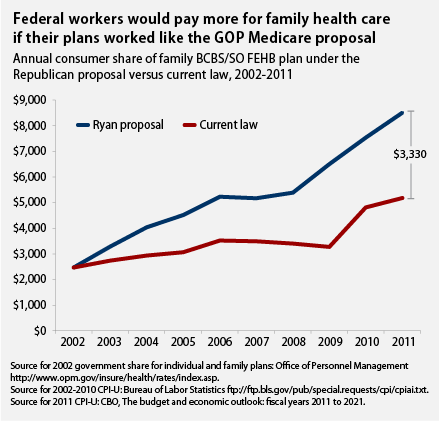
We examined what would happen if FEHBP had operated like the Republican Medicare proposal over the last decade. We used data from the Office of Personnel and Management to look at the annual premiums for federal workers enrolled in the Blue Cross Blue Shield Service Benefit Plan (Standard Family and Standard Individual). We chose this plan because nearly 60 percent of those enrolled in FEHBP have Blue Cross Blue Shield, and the Standard Option is the most popular FEHBP plan. We increased government support for the individual and family plans by the rate of growth in the CPI-U index from 2002 to 2011. We then compared the difference between the government’s share and the actual total premium in each year—which is the amount the beneficiary would pay—under the Republican proposal and the real FEHBP.

The result: A typical federal worker, or member of Congress, enrolled in family coverage in the Blue Cross Blue Shield Standard Option, would have had to pay an additional $3,330.36 for the same level of coverage they have today. Those with individual coverage would have had to pay $1,555 more.
By: Nicole Cafarella, Payment Reform Manager and Policy Analyst and Tony Clark, Policy Analyst, Center for American Progress, April 27, 2011
RyanCare vs. The Public Option
If you want to understand why the budget debate so infuriates people who actually care about deficits — and, in particular, people who actually care about health-care spending — consider this: The central health-care reform in Paul Ryan’s budget, the one that’s got him so many plaudits for courage, would actually increase costs. The health-care reform that progressives have been pursuing for more than two years would cut them. And yet calling for Medicare to be privatized and voucherized is considered serious, while calling for a public option is considered tiresome. But let’s go to the tape.
Back during the health-care reform fight, the Congressional Budget Office looked at the likely effect of adding a public option that paid Medicare rates. “In total, a public plan based on Medicare rates would save $110 billion over 10 years,” the agency concluded. Importantly, the savings would come because premiums would be lower. The basic mechanism here is not complicated: Just as you get better deals by shopping at a mega-retailer like Wal-Mart, you get better deals by working with a mega-insurer like Medicare. Size matters.
As for Ryan’s plan, CBO’s take was just the opposite. “Under the proposal,” they said, “most elderly people would pay more for their health care than they would pay under the current Medicare system.” That is to say, health-care costs go up. Now, federal health-care spending goes down, as seniors are paying 70 percent of their costs out-of-pocket rather than 30 percent. Or, in CBO-ese, Medicare beneficiaries “would bear a much larger share of their health care costs than they would under the current program.” Of course, back in the real world, seniors are going to react poorly to being unable to afford health-care insurance, and those savings won’t manifest.
But even putting that aside, it makes for a very stark contrast. The progressive reform that won’t happen would cut health-care costs. The conservative reform that won’t happen would increase health-care costs. One idea makes insurance cheaper and one makes it more expensive. And yet the idea that makes insurance cheaper is pretty much off the table, while the idea that makes it more expensive — and that almost certainly wouldn’t work — is considered a very serious proposal worthy of brow-furrowing debate.
By: Ezra Klein, The Washington Post, April 25, 2011
Share This Blog


 Unknown Feed
- An error has occurred; the feed is probably down. Try again later.
 mykeystrokes.com
You must be logged in to post a comment.