“Under The Money Tree”: Corporations Aren’t The Only Ones Benefiting From Low Corporate Taxes
If you are Exxon Mobil, Verizon or General Electric, chances are filing taxes over the past few years has been significantly less painful than for the average American.
And Sunlight Foundation senior fellow Lee Drutman says that’s because everyday Americans don’t have lobbyists on the hill fighting for them.
“If you think you wound up paying too much in taxes this year, maybe you ought to hire a lobbyist or two or 20,” Drutman writes in a recent report. A Sunlight Foundation study shows that of the country’s 200 largest corporations, the eight companies that dished out the most money for lobbying on Capitol Hill between 2007 and 2010 saw major savings in corporate taxes. Six of the companies even saw a more than 7 percent drop in their tax rate over the years.
AT&T for example, a company that spent more than $70 million on federal lobbying saw a 40.4 percent decrease in their rate, a more than $7 billion savings on corporate taxes. Northrop Grumman’s tax rate also decreased from nearly 33 percent to just over 20 percent after they doled out $57 million for lobbyists to pitch their causes on Capitol Hill.
All together the “Big Eight” paid $540 million for federal lobbying and saved over $11 billion in taxes. Drutman estimates the return on investment to be roughly 2,000 percent.
With all of the changes in tax code, it’s easy to see how companies can save so much in just a few years.
“In 2005, the President’s Advisory Panel on Tax Reform counted approximately 15,000 separate changes to the tax code since 1986,” Drutman said.
And the CCH Standard Federal Tax Reporter, the country’s written tax code document, has more than doubled from 33,000 pages in the mid-1980s to more than 72,000 pages today.
However, corporations are not the only ones benefiting from low corporate taxes.
Drutman says that congressmen who sit on the House Ways and Means Committee, the congressional arm in control of tax regulation, receive about $250,000 more in fundraising contributions than their fellow lawmakers.
“Being on Ways and Means is like having Christmas every day,” says Jeffrey Berry, a political science professor at Tufts University and expert on influence in politics. “They barely have to raise any money. It rains down upon them. They are standing under the money tree.”
By: Lauren Fox, Washington Whispers, U. S. News and World report, April 17, 2012
“Rmoney”: Mitt Is The Lobbyists’ Candidate
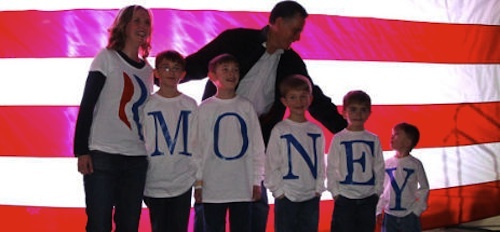
When you think of Mitt Romney, you probably think of a tall, robotic fellow with no discernible strong beliefs or stances (at least, none that can survive longer than a week at a time). That’s terribly unfair, and you should be ashamed for thinking it. He may have started out as an empty husk devoid of strong personal beliefs, but thanks to a crack team of industry insiders, he now is quite filled with opinions. Coincidentally, they happen to be the opinions of an army of top lobbyists in Washington, and the companies they lobby for. Funny how that works.
[Mitt Romney’s] kitchen cabinet includes some of the most prominent Republican lobbyists in Washington, including Charles R. Black Jr., the chairman of Prime Policy Group and a lobbyist for Walmart and AT&T; Wayne L. Berman, who is chairman of Ogilvy Government Relations and represents Pfizer, the drug manufacturer; and Vin Weber, the managing partner for Clark & Weinstock. […]Other lobbyists serve on one of Mr. Romney’s policy advisory teams, have hosted fund-raisers for his campaign or have joined the many influential Republicans whose endorsements Mr. Romney’s campaign has hailed.
Want to know what Mitt Romney’s true policies are? Well, you should have attended Mitt Romney’s $10,000-and-up policy round table, where industry lobbyists led “discussions” on what his policies towards those industries should be:
Mr. Romney’s campaign held an elaborate “policy round table” fund-raiser at a Washington hotel, featuring panel discussions run by lobbyists and former cabinet officials or members of Congress.James Talent, a former senator who runs the lobbying and public affairs firm Mercury Public Affairs, led a panel on infrastructure, according to an invitation. William Hansen, a former deputy secretary of education who is president of the lobbying firm Chartwell Education Group, led the education panel.
Wow. I can’t imagine why anyone would be cynical about American politics these days, can you?
The entertaining thing about this story is just how many large companies are represented. Among those specifically mentioned (and kudos to the three reporters for linking the lobbyists with actual clients, which is rather important information for readers) are Walmart, AT&T, Pfizer (drugs), Microsoft, Altria (tobacco), General Dynamics, Dominion (power), Barclays (finance), Allegheny (steel) and Peabody Energy (coal). Lobbyists are cutting the checks; lobbyists are bundling other people’s checks; lobbyists are holding the panel discussions about how the candidate can best serve the specific industries they represent; lobbyists make up the inner circle of “policy makers,” advising the candidate as to what his own core positions should be.
As for the candidate himself, he’s almost irrelevant at this point. You might as well nominate a bunny named Mr. Buttons: If you surround it with the exact same lobbyist-advisors, you’ll end up with the exact same policies. Sigh, if only we could teach that bunny to hold a pen—but for now we’ll have to settle for our current crop of Republican candidates, all of whom have near-identical policy prescriptions, all of which favor the exact same subset of people and the exact same handful of industries. Go figure.
I’ve given up on the notion that we can keep lobbyists from capturing our politics. I’ve also given up on the notion that we can prevent interests like the oil sector or our current handful of top financial companies from tailoring the American government specifically to serve their needs. Want more profits? Want less environmental protections? Want to crush some emerging industry that threatens to make yours less profitable? Just buy a few congressman, or a senator, or a president. At a few million here and there, it’s cheaper than advertising, and the results are far more secure.
So I’m in the Bill Maher camp on this one. Lobbyists and industries want to buy our politicians? Fine, I give up, let them. Just pass a law saying the candidate has to wear those corporate logos on their jackets whenever they appear on the campaign trail or when they are in office. The more money is contributed, the bigger the logo has to be. Top presidential candidates will look like military dictators-in-training, with badges and medals and ribbons sticking out from them in every direction, and just from looking at them we’ll be able to tell who they serve, and in what proportions. That would certainly be more educational than any rhetoric coming from the candidates themselves.
By: Hunter, Daily Kos, February 15, 2012
Romney For Sale: Mitt Hosts $10K “Policy Roundtables”
Giving a preview of how he would govern as president, Mitt Romney hosted a series of “policy roundtables” with top dollar donors Thursday at the JW Marriott hotel in Washington, DC. Once again demonstrating that he is much more concerned with helping the very rich than the very poor, the panels were open to all interested parties — who were willing and able to raise $10,000for his campaign, each.
The roundtable topics included education, energy, financial institutions and markets, defense/homeland security/foreign policy, health care, and infrastructure. Unsurprisingly, the panels were chaired and hosted by a few prominent Republican politicians and several wealthy investors and industry insiders. They roundtable leaders and industry finance chairs included:
– L.E. Simmons (energy), who has has “guided the investment of over $1.6 billion in private equity capital used to build energy service and equipment companies.”
– Patrick Durkin, managing director of Barclay’s Capital and a top Romney lobbyist-bundler.
– Richard Breeden, a hedge fund manager and a former SEC chairman under President George H. W. Bush.
– Tom Farrell, president and CEO of Dominion Power.
– Former Sen. Jim Talent (R-MO) (infrastructure), now a “distinguished fellow” at the right-wing Heritage Foundation.
– Former HHS Secretary and ex-Utah Gov. Mike Leavitt (R), now head of a “health care intelligence business.”
If the number $10,000 seems familiar, perhaps it was because he offered to make a bet with then-primary opponent Gov. Rick Perry (R-TX) for that amount in a disagreement over his previous positions on federal health insurance mandates. Now, Romney is asking the wealthiest 1 percent to make a similar-sized bet on him. And, according to one of the event’s co-chairs, the event raised $1.5 million for Romney’s campaign.
By: Josh Israel, Think Progress, February 11, 2012
“Influence-Peddlers”: How Bain’s Lobbying Saved Mitt Romney Millions
Private equity titans like Bain Capital used K Street to preserve the GOP front-runner’s favorite—and most lucrative—tax loophole.
With the sting of defeat in the South Carolina primary still fresh at last week’s Republican presidential debate in Tampa, Mitt Romney slammed Newt Gingrich for his record as a consultant—or “historian,” in Newt-speak—for government mortgage-backer Freddie Mac.
But perhaps Romney should think twice before setting his sights on the former speaker’s lobbying-related past. That’s because the ex-governor has benefited handsomely from the influence-peddling of Bain Capital, the private equity firm he cofounded in 1983. Though he’s been gone from Bain for over a decade, Romney continues to rake in millions from accounts with the firm—and in 2007, he took Bain’s side in a key lobbying battle with Washington—one that saved him millions of dollars.
2007, as it turns out, was something of a watershed for private equity lobbying: In that year, lobbying expenditures for the industry practically tripled. The spike was the result of an industry-wide effort to preserve a number of tax giveaways for the finance industry and its CEOs—including the carried interest rule, a tax loophole that allows Romney and other private equity mavens to reduce their taxes by millions of dollars. Carried interest refers to the commission that private equity and hedge fund executives receive for managing investors’ money. Although commissions may seem like ordinary income to the rest of us, the carried interest loophole allows some money managers to claim this income as long-term capital gains, which are taxed at a rate much lower (15 percent) than the top tax rate for normal income (35 percent).
After Democrats won control of both the House and the Senate in the 2006 midterm elections, they advanced several pieces of legislation that threatened to end this lucrative quirk of the tax code and other tax policies that favor the rich. Mitt Romney, who made just over $20 million in investment income in 2010, wasn’t having any of it. During an August 2007 appearance on Kudlow & Company, Romney was asked what he thought of the effort to close the loophole. He wasn’t happy. “I want people to be able to save their money and invest in America’s economy tax-free,” Romney said. “I want to lower taxes. I want to lower marginal rates across the board. I want to lower taxes for corporations,” he told Kudlow.
Bain was doing its part to make Romney’s vision a reality. The firm spent $300,000 between August of 2007 and April of 2008 lobbying the House and Senate on bills that threatened the carried interest loophole. Along with other private equity titans like Kohlberg Kravis Roberts and Apollo Management, Bain and its ilk paid lobbying shops, public relations firms, and trade groups like Ogilvy and the Private Equity Growth Capital Council an estimated $15 million between January 2009 and April 2010 to convince lawmakers to keep the loophole alive. The force of those combined lobbying efforts kept the carried interest loophole wedged open, denying the federal government some $10 billion in revenues in the process. “Everyone who has looked at this boondoggle [of carried interest] thinks it’s an egregious giveaway,” Jacob Hacker, the co-author (with Paul Pierson) of Winner-Take-All Politics, says. “It still lives because of the lobbying of the industry, and in particular the PEGCC.”
From 1998 to 2006, private equity and investment firms spent $3 million a year lobbying Congress, according to the Center for Responsive Politics. Bain got into the game in 2007, registering with prominent Washington lobbying firms Public Strategies, Inc. and Akin Gump Strauss Hauer & Feld. To date, Bain has paid some $3 million to these firms to make sure corporate taxes stay low and CEOs remain fat and happy.
As the New York Times reported several weeks ago, Bain was a member of the Private Equity Growth Capital Council up until last year, when it abruptly ended its $1-million-a-year membership with the powerful trade group. Its reasons for doing so remain unclear. (PEGCC did not respond to a request for comment.)
Investment fund managers and former CEOs like Mitt Romney suggest that taxing their carried interest as income would crimp investments, and, ultimately, kill jobs. But as Howard Gleckman, a tax policy expert at the Urban Institute, has found, there is little evidence to support that claim. “Losing a couple percentage points off your returns isn’t going to change things very much,” Gleckman says. “Taxing carried interest as if it were wages…wouldn’t really affect these deals very much.”
Now that a small sample of Romney’s tax returns is out in the open, voters may be asking more questions about how policies like the carried interest rule work. Josh Kosman, author of The Buyout of America: How Private Equity Is Destroying Jobs and Killing the American Economy, says that’s terrifying for the private equity world. “The private equity industry exists because of tax gimmicks,” Kosman argues. “They want to convince people they create value because if anyone started looking at it, the tax rates don’t make any sense, and they cost the government a lot of money.”
As Hacker explains, today’s favorable tax treatment towards capital gains dates back to the late 1970s, when the lobbying might of business groups like the US Chamber of Commerce successfully sliced the tax on capital gains in half. The Tax Reform Act of 1986 brought the rate back into line with the rate on ordinary income, but business lobbies spent the next decade knocking it back down. “For an industry that’s held up as a paragon of individual entrepreneurship, private equity is strikingly dependent on favorable tax policies,” Hacker said.
Of course, private equity isn’t the exclusive terrain of one party or the other. As Hacker and Pierson outlined in their book, Sen. Charles Schumer (D-N.Y.) has been one of the carried interest loophole’s most ardent defenders. And as Kosman points out, four of the past eight Treasury secretaries have direct ties to the private equity industry.
All of this, of course, could pose a huge a problem for Romney—so much so that his campaign recently suggested that he might be open to reconsidering the carried interest loophole if he were to be elected president. Although Bain did not start lobbying until some eight years after Romney left, his just-released tax records indicate that he still collects significant investment income from the firm. Bain’s gain, then, has clearly been Romney’s as well—and the candidate has publicly endorsed the same policies the company has backed.
So when Bain’s lobbyists have tried to sway the political system in Washington, Romney has gained. Maybe he ought to be careful when denigrating the influence peddlers in the nation’s capital.
By: Siddhartha Mahanta, Editorial Fellow, Mother Jones, January 30, 2012
A “Historian” By Any Other Name: Freddie Mac Hired Newt Gingrich As It Reshaped Strategy
Within months after taking over as chief lobbyist at mortgage lender Freddie Mac in 1999, Mitchell Delk hired a prominent Washington insider to advise him on how to build support among conservatives on Capitol Hill: Newt Gingrich, the former speaker of the House of Representatives.
A key part of Delk’s strategy, as outlined in Federal Election Commission records, was to build goodwill in Congress by holding fundraising events for influential members of House and Senate committees that had oversight of Freddie Mac.
Gingrich had experience in such matters as an architect of GOPAC, one of the Republican Party’s most important political action committees.
Gingrich’s activity at Freddie Mac has been under scrutiny during his run for the 2012 Republican presidential nomination, as rivals have accused him of lobbying for Freddie Mac.
The former speaker has rejected such allegations, and his first $300,000-a-year contract with Freddie Mac, released this week by his campaign, states that he would not “engage in lobbying services of any kind.”
But the contract, together with the FEC records describing Delk’s revamping of Freddie Mac’s lobbying shop, sheds light on how Gingrich could avoid the lobbyist label and still be valuable to the mortgage lender as a strategist.
Gingrich’s contract says the former House speaker would work with Delk and other Freddie Mac officials on “strategic planning and public policy.”
And, it calls on Gingrich to contribute to the lender’s “corporate planning and business goals.”
“He was a consultant for us, and … not a lobbyist,” Freddie Mac spokesman Doug Duvall said, declining to comment further on the lender’s arrangement with Gingrich.
Gingrich’s campaign has offered few specifics about his work for Freddie Mac, for which he earned as much as $1.8 million during two contract periods. It said late last year that part of his job was to help Freddie Mac build bridges to conservatives.
He has called himself a “historian” who advised the mortgage lender on issues such as its lending policies.
Gingrich joined Delk’s government affairs shop at a time when the former Freddie Mac senior vice president was hiring several former members of Congress and congressional aides for his lobbying team.
At the time, conservative Republicans on Capitol Hill were seeking regulations to rein in the profits of government-sponsored lenders such as Freddie Mac.
Delk, who did not respond to phone calls seeking comment, successfully fought back against such legislation by hiring dozens of outside consultants and spending as much on lobbying as many major corporations.
FEC INVESTIGATION
However, his lobbying team came under investigation by the FEC in 2003.
The FEC probe found that under Delk’s guidance, Freddie Mac improperly used corporate resources to put on 85 fundraising events that raised about $1.7 million for federal candidates.
The majority of the events were for Republicans, the FEC found.
FEC investigators concluded that at least one major contribution to a Republican entity came directly from Freddie Mac funds and that some fundraisers were held in Freddie Mac’s offices – both violations of FEC rules.
In 2006, Freddie Mac agreed to a $3.8 million settlement for violating federal election rules, the largest civil fine the FEC had ever levied.
Delk, who resigned from Freddie Mac in 2004, was not charged in the case. Delk’s lawyer in the case, Ken Gross, said Gingrich’s name “never came up in connection with (the FEC) case.”
Vin Weber, a former Republican representative from Minnesota who also was hired as a Freddie Mac consultant, said he never worked directly with Gingrich on Freddie Mac matters.
He said the mortgage lender did not want congressional arm-twisting but hoped to “create a positive buzz for Freddie Mac.”
Weber said someone like Gingrich could provide an important service without lobbying.
“I wouldn’t ask him to pick up the phone (to call a member of Congress), because that is really not necessary. He is circulating all the time with members of Congress,” said Weber, who is supporting Mitt Romney in this year’s race for the Republican presidential nomination.
Former New York Representative Susan Molinari, another Romney supporter, also was hired by Freddie Mac during Delk’s tenure. She did not return phone calls or emails.
Republican Michael Oxley, who was House Financial Services Committee chairman and attended at least 19 Delk fundraisers, said that at the time he did not know Gingrich worked for Freddie Mac.
Oxley “may have seen him from time to time at a social thing,” said Peggy Peterson, a spokeswoman for Oxley.
Gingrich signed a second contract with Freddie Mac in 2006. The lender ended its relationship with outside consultants in 2008, when the U.S. Treasury placed Freddie Mac and Fannie Mae in conservatorship.
Republicans have blamed the government-sponsored lenders, which sustained $14.9 billion in losses when the U.S. housing market crashed, for a major role in the subprime lending crisis.
By: Marilyn Thompson and Samuel Jacobs, Reuters, January 28, 2012
Share This Blog


 Unknown Feed
- An error has occurred; the feed is probably down. Try again later.
 mykeystrokes.com
You must be logged in to post a comment.