“The ‘Texas Miracle’ Fraud”: Turns Out It Involves Taxing The Poor To Help The Rich Get Richer
Remember “The Texas Miracle”? It was the story of how Rick Perry was going to be president because his state, Texas, was doing so much better than all the other states. Texas was doing so well, we were told, because it was very conservative: Low taxes, light regulation, and few pesky unions. We were supposed to compare Texas to California, which, we were told, was an apocalyptic mess because it was run by liberals.
Then we sort of stopped hearing about The Texas Miracle for a while, because Rick Perry forgot how to count and it no longer seemed like he was personally responsible for managing the economy of his vast state, but conservatives still enjoy telling themselves that Texas proves that their economic policy preferences are objectively superior to those of liberals. Except, well, maybe Texas isn’t that miraculous.
At Washington Monthly, Phillip Longman argues that Texas’ growth is fueled primarily by the energy boom and by population growth. And that population growth is not happening because people from other states are fleeing to Texas to avoid high taxes and onerous regulations, but because of immigration from Mexico and a high birthrate. More importantly (and probably obviously, to people who care about such things), the spoils of the Texas miracle have not been shared equally: Economic mobility is higher in California’s major urban areas than in those of Texas. Plus: “Texas has more minimum-wage jobs than any other state, and only Mississippi exceeds it with the most minimum-wage workers per capita.” Texas is falling behind various states in terms of per capita income.
As Longman concludes:
But regardless of its sources, population growth fuels economic growth. It swells the supply and lowers the cost of labor, while at the same time adding to the demand for new products and services. As the population of Texas swelled by more than 24 percent from 2000 to 2013, so did the demand for just about everything, from houses to highways to strip malls. And this, combined with huge new flows of oil and gas dollars, plus increased trade with Mexico, favored Texas with strong job creation numbers.
But for some, the good news on Texas continues apace. J.D. Tuccille, at the libertarian magazine Reason’s Hit & Run blog, points to a paper from the Federal Reserve Bank of Dallas showing that Texas created more high-wage jobs than low-wage ones between 2000 and 2013. Tuccille also points out that “in 2012, ’63,000 people moved from California to Texas, while 43,000 in Texas moved to California.’” (That… actually seems pretty statistically insignificant when we’re talking about the two most populous states in the union, each with more than 25 million residents, but ok, sure.)
Even if it is the case that the Texas miracle is driven primarily by a resource boom and population growth, conservatives and libertarians could still argue that Texas is booming because of their preferred policies. They support exploiting natural resources, and libertarians, at least, support open borders. To use another example, while it’s a fact that North Dakota’s economic boom is happening almost solely because North Dakota happens to be on top of tremendous amounts of very valuable natural resources that recently became easier to extract, conservatives would argue that they are the ones who support drilling that oil, damn the environmental consequences.
But here’s one important fact that Texas’ conservative and libertarian boosters reliably fail to mention (perhaps because they don’t know it): If you’re not rich, Texas is not actually a low-tax state. In fact, most Texans pay more taxes than most Californians. That seems strange and incorrect at first — Texas doesn’t even have an income tax! — but it’s true. Thanks to sales and property taxes, Texas is among the states with the ten most regressive tax systems. Texans in the bottom 60 percent of income distribution all pay higher effective tax rates than their Californian counterparts. Texas’ top one-percent are the ones enjoying the supposed low-tax utopia, paying an effective rate of 3.2 percent. The rate for the lowest 20 percent is 12.6 percent. Kevin Drum has a helpful chart.
This is not unusual for a conservative state. As the Institute on Taxation and Economic Policy says: “States praised as ‘low tax’ are often high tax states for low and middle income families.” So… is this part of the conservative policy package that we are supposed to introduce everywhere to spur growth? Slash taxes for the rich and raise taxes on… the poor and middle class? It seems like it might be difficult to campaign on that.
When “growth” is its own self-justifying goal, creating an economy that only delivers for a privileged few doesn’t really seem like a problem. Still, don’t move to Texas expecting a better life, unless you own a petrochemical refinery.
By: Alex Pareene, Salon, March 7, 2014
“The Right Defends A New Jim Crow”: 50 Years Since The Civil Rights Act, Wingnuts Still Don’t Get It
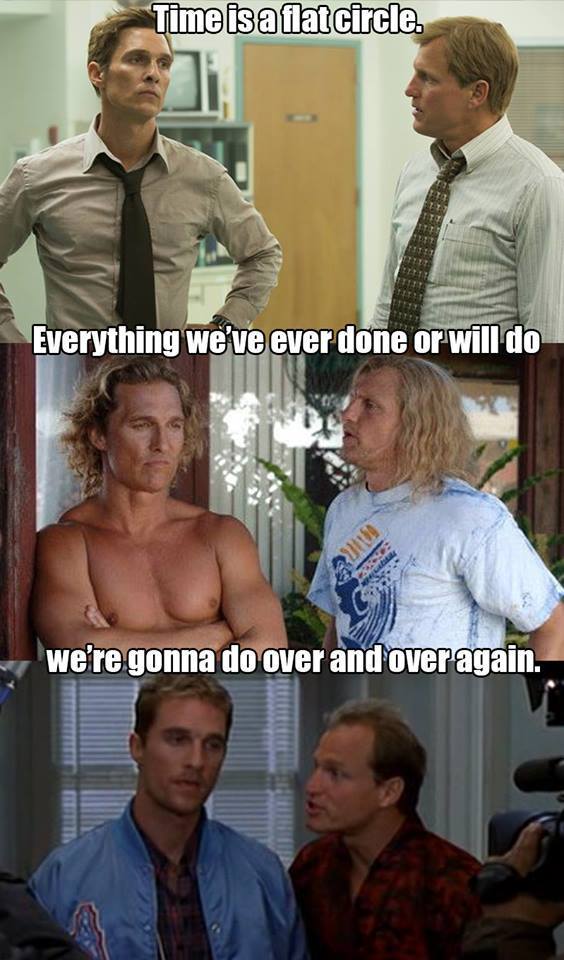
Watching the debate over Arizona’s SB 1062 (better known as the state’s anti-gay Jim Crow law) unfold this past week, I couldn’t help but think of the already iconic line from Matthew McConaughey’s “True Detective” character Rust Cohle: “Time is a flat circle.” As is always the case with the nihilistic and willfully esoteric Cohle, it’s not entirely clear what he’s trying to say with the metaphor, but we get the gist: Like Nietzsche’s “eternal return,” Cohle’s flat circle theory holds that all of us are destined to relive every moment of our conscious lives, forever. It’s as if we all were stuck in the late Harold Ramis’ “Groundhog Day,” but instead of repeating a single day, we repeat our entire lives.
Beyond the fact that, like many others, obsessing over “True Detective” has increasingly become the chief way I spend my free time, Arizona’s brief foray into the politics of segregation reminded me of the flat circle quote because I had recently seen Bryan Cranston’s Broadway debut, “All the Way,” in which the “Breaking Bad” star plays former president Lyndon B. Johnson during the historic period between Kennedy’s assassination and Johnson’s reelection, a time when the 36th president was working feverishly to ensure the passage of the Civil Rights Act of 1964. The play is good and Cranston is great, but what was most striking throughout was how much Johnson’s opponents then sounded like SB 1062’s supporters today. It was, as Cohle would say, some “heavy shit.”
The similarities weren’t merely superficial, either. Sure, the play, written by Pulitzer prize-winning playwright Robert Schenkkan (who obviously did his homework), was littered with hysterical charges of “fascism” and “socialism” and “big government” from no-name Dixiecrats that most of us never knew or were happy to forget. And of course these moments brought to mind much of the anti-Obamacare rhetoric that has emanated from conservatives during the past five years. But the parallels went deeper than that. It wasn’t just the language that sounded so familiar, but the logic behind it, too. Whether conservatives were defending Jim Crow proper or the Southwest’s latest variant, their worldview, all these years later, was disturbingly unchanged.
To explain what I mean, allow me to cite two of conservatism’s leading lights: Kentucky Sen. Rand Paul and all-around media mogul Glenn Beck.
As the opposition to SB 1062 increased in fervency and numbers, the usually loquacious Paul was, unlike his fellow Senate Republican John McCain (who opposed the bill), deafeningly mute. Anyone familiar with Paul’s history knows why: Because the obvious presidential aspirant wanted to avoid reminding people of the unfortunate 2010 interview with Rachel Maddow in which he stated that, even today, he would not support the government-run dismantling of Jim Crow. “I don’t want to be associated with those people,” Paul said, referring to white supremacists who’d bar blacks from their restaurants, “but I also don’t want to limit their speech in any way…” Paul’s orthodox libertarianism told him that the freedom to discriminate was too valuable, too sacred, to let the federal government stand in its way. Like Sen. Barry Goldwater did in 1964, when he voted against the Civil Rights Act, Paul argued that the Constitution had no room for anti-discrimination.
Roughly four years later, Glenn Beck made a similar argument, this time in defense of SB 1062. After doing his best impression of Hamlet, grappling aloud with his competing interest to not be a bigot while on the other hand maintaining allegiance to his understanding of liberty, Beck cut to the chase, telling his coworkers that he could only support Arizona’s bill, because “freedom is ugly.” Like Paul, Beck was sure to make clear that he held no sympathy for anyone who would ban LGBTQ people from their premises. But also like Paul, Beck had no choice but to conclude that the freedom to ostracize and discriminate was, in part, what the American experiment was all about. “I don’t like that world,” Beck said, “but that’s freedom! That’s freedom! Freedom is ugly. It’s ugly.”
High-profile though they may be, Beck and Paul are hardly the only conservatives who still cling to a vision of freedom that many Americans wrongly thought was swept into Reagan’s “ash-heap of history” decades before. Tucker Carlson — who, if Paul is to be Goldwater, we must describe as today’s version of the braying, segregationist Dixiecrats — was adamant in his defense of SB 1062, saying on Fox News that opponents of the bill were advocating for “fascism” and had gone “too far” in their quest to prevent state-sanctioned bigotry. “Everybody in America is terrified to tell the truth,” Carlson warned, “which is, this is insane, this is not tolerance, this is fascism.” Tellingly, when his sparring partner, Fox’s house liberal, Alan Colmes, asked Carlson whether he would have supported the Civil Rights Act, the editor of the Daily Caller could only respond by saying, “Don’t bring [that] into this,” with a sneer.
Even conservatives who are more intellectually inclined than Beck, Paul and Carlson put forward a defense of SB 1062 that could easily and quickly be adopted to oppose the federal government’s dismantling of Jim Crow. Ilya Shapiro of Cato, libertarianism’s premiere think tank and ostensible guardian of liberty for all, wrote, “I have no problem with SB 1062.” Repeating an argument that was offered by Goldwater, Paul, Beck and Carlson, Shapiro maintained that those who would be discriminated against, were SB 1062 to pass, should simply trust that the free market would punish bigots and, eventually, guarantee their liberty. “[P]rivate individuals should be able to make their own decisions on whom to do business with and how – on religious or any other grounds,” Shapiro wrote. “Those who disagree can take their custom elsewhere and encourage others to do the same.”
The fact that this very same logic recently undergirded a century of Jim Crow seemed to escape Shapiro. Either that or he, like W. James Antle III of the American Conservative, was content to dismiss comparisons to Jim Crow on the grounds that Arizona is not the Jim Crow South and 2014 is not the mid-’60s. “People often argue for or against the civil-rights laws of the 1960s on the basis of abstract principles,” Antle wrote, “but they were in fact a reaction to a very specific set of circumstances.” (This is an argument that, more than anything else, raises the question as to whether this is the first time Antle’s come into contact with an analogy.) Perhaps Shapiro, like Antle, was content to support the bill not because it wouldn’t give the government’s imprimatur to homophobia, but because such an outcome is, in their minds, “not very likely.” After all, what’s a little discrimination in the grand scheme of things?
If we put all these and many other conservative defenses of SB 1062 together, it’s hard not to reach a clear and unsettling conclusion: While conservatives themselves have largely given up the racism that coursed through a previous generation’s defense of Jim Crow, conservatism itself has learned no enduring lesson from the Civil Rights Movement and has made no ideological adjustments as a result. Indeed, National Review’s Kevin Williamson recently declared that Goldwater’s brief against the Civil Rights Act “has been proved correct” for worrying that “expanding the federal mandate … would lead to cumbrous and byzantine federal micromanagement of social affairs.” Going further, National Review’s editors, writing on the 50-year anniversary of the March on Washington (which NR at the time opposed) would only concede that the magazine was wrong to oppose the Civil Rights Movement because its principles “weren’t wrong, exactly” but were instead “tragically misapplied.”
For all of her many flaws, Jan Brewer decided on Wednesday to refrain from applying her conservative “principles” in such a “tragic” manner, opting instead to veto the bill and maybe — just maybe — push her party that much closer to joining the rest of us in the 21st century. And while many conservatives received the veto as a crushing disappointment, or even a step toward “slavery,” I’d caution my right-wing fellow citizens against slipping into outright despair. If the events in Arizona have taught us nothing else, they’ve shown that time is indeed a flat circle; future right-wingers will have plenty of chances to keep getting this most basic question of freedom terribly, terribly wrong.
By: Elias Isquith, Salaon, March 1, 2014
“Good Luck With That”: Rand Paul Wants To Spark A “Transformation” Of The GOP
Kentucky Senator Rand Paul thinks someone needs to utterly transform the Republican Party — and he knows just the man to do it.
Joining Glenn Beck on Thursday, Paul tried to deflect the right-wing pundit’s pleas to run for the White House in 2016 and focus instead on the state of the Republican Party overall. And far as Paul’s concerned, things aren’t looking too good.
“I think Republicans will not win again in my lifetime for the presidency unless they become a new GOP, a new Republican Party,” Paul said to Beck. “And it has to be a transformation. Not just a little tweaking at the edges.”
While Paul refrained from explicitly claiming he intended to usher in such transformational change, he did say there was “a struggle going on within the Republican Party” and that he intended to “struggle to make the Republican Party a different party, a bigger party, a more diverse party and a party that can win national elections again.”
Paul would go on to implicitly compare himself to Ronald Reagan, saying, “But I was there in 1976, when Reagan fought Ford. I was at the convention as a 13-year-old kid. And everyone told Reagan to sit back and shut up, they told him it wasn’t his time and it wasn’t going to be his time and the establishment wanted Ford. And it was an evenly divided party, it was bitterly fought; but in the end, Reagan won and the party became a better place — at least for a while.”
Paul wasn’t too specific on just what this new Republican Party would look like, but he did say the GOP needed “a better message and a better presentation” when reaching out to minority communities. “To me,” Paul continued, “it’s the ideas of liberty and presenting them to everyone, not just white folks with ties on.”
Whether a revamped message and presentation would include new policies was left unclear. (Paul’s voting record, however, would suggest the answer to be: not so much.)
By: Elias Isquith, Salon, February 14, 2014
“Cultivating The Right Wing”: Rand Paul Woos The Base With Hot Monica Lewinsky Talk
What on earth is Rand Paul thinking, bringing up Monica Lewinsky? On cable TV, they shake their talking heads: ancient history, irrelevant, etc. Quite true, it’s all those things. But in terms of intra-GOP presidential-positioning politics, I think it’s actually quite shrewd, and another sign that he is not to be underestimated in terms of possibly nabbing the GOP nomination. Unfortunately for Paul—although fortunately for America—it’s only shrewd in terms of intra-GOP politics. Among the rest of the electorate, responses will range from indifference to hostility, and the “GOP War on Women” narrative won’t suffer a scratch.
Here’s what Paul is doing. First, he’s getting right with the base. As a devolutionist-libertarian, he takes some unorthodox positions from the conservative point of view—his neo-isolationist, anti-neocon foreign policy views, his comparatively soft-line views on same-sex marriage (he’s not for it, but he’d leave it to the states). There are reasons, in other words, for hard-shell conservatives to give him the gimlet eye.
Given that, what are some ways to make conservatives think you’re “one of us” without having to alter those positions, which he surely knows would be a disaster for him, destroying the very basis of his appeal as principled and so on? Find something conservatives hate and say you hate it too. What bigger something than the Clintons? Well, there’s Obama, but hating on him is old hat. Dredging up Lewinsky, on the other hand, shows that some care was taken to cultivate conservatives. As Paul knows, Clinton-hatred is still mother’s milk for that crowd.
He is also, as Peter Beinart noted, aiming specifically at the Christian Right. He’s been doing this for some time now, talking, for example, of the persecution of Christian minorities around the world. His father never bothered much with evangelicals, an error the son, recognizing their importance in the Iowa GOP caucuses, clearly hopes not to make.
I think there’s a final reason, which emotionally is the most important of all. When Muhammad Ali was Cassius Clay, when he was still months away from a title shot against champ Sonny Liston, he’d knock out the latest second-rater in three rounds and then, when they stepped into the ring to interview him, carry on about how all he wanted was a fight with Liston: “I want that big brown bear!” The more he talked, the more promoters and fans were able to visualize a Clay-Liston fight.
The more Paul talks about the Clintons, the more he sets up the mental picture in the brains of Republican primary voters of him being the logical guy to step into the ring with them. After all, they’ll think, he’s sure not afraid of them!
It’s very smart (all this assumes of course that Hillary Clinton runs and is the Democratic nominee). All the other Republican candidates laying into the Clintons will look like Johnny-come-latelys. Paul spoke up first.
But the good it does him ends there. Here we return to the age-old Republican blind spot on issues relating to groups that don’t vote for them. Republicans think they can make everything better with words and symbolism. Just get our candidates to stop saying these stupid things like Todd Akin did. Speak respectfully. Sensitively. Appoint more women to high-profile thingies. It’ll be fine.
That isn’t how politics works. How politics works is that people actually care about substance to a surprising degree, and they know which party is representing their interests and which party is not. And women, by 12 percentage points at last count, know that Republicans are not. All right, it’s slightly more complicated than that—married women vote Republican, as do white women. But last I checked, African American women and Latina women and single women are women, too, and each of them has the same one vote that a married white woman has.
And overall—don’t take it from me, take it from the numbers—the women of America have decided that the GOP isn’t on their side. And it’s not because of the offal that flows out of the mouths of Todd Akin and company, really. It’s because of policies. And Rand Paul supports every one of those party policies.
Funny, but his libertarianism does not extend to giving a woman the right to decide whether to have an abortion. It did, however, in March 2012, extend to the “freedom” of religious institutions that were fighting the expanded requirement for contraceptive coverage under the Affordable Care Act. You may remember the Blunt Amendment, which sought vast conscience exemptions from the coverage requirement. Paul voted for it.
I could keep going and going. Just last month, Paul floated the idea of a federal cap on welfare benefits for women who have more children. It is true that 16 states have such caps, and it’s not necessarily an ill-intentioned thought that saying “no more money for another child” might produce the desired effect of women not having those children. The problem is that in real life there seems to be no correlation. So the net effect is really just to increase the number of women and children living in poverty.
Then there’s little gem of a quote: “The whole thing with the War on Women, I sort of laughingly say, ‘yeah there might have been,’ but the women are winning it.” He said this two weeks ago. Let’s just say I doubt many professional women would agree.
If Paul really thinks that he can get women to overlook this record (and there’s much more) and decide to vote for him because Bill Clinton made some yakahoola with an intern, he’s as clueless as Reince Priebus is with his Latino and gay outreach. This is a case where the better scenario is that he’s just being cynical for the sake of snagging GOP votes. If he actually believes what he’s saying—well, God help us, but it does make him a natural to become the nominee of that party.
By: Michael Tomasky, The Daily Beast, February 12, 2014
“What Republicans Say Versus What Republicans Mean”: A Classic Exercise In Political Disguise And Deceit
Now that the State-of-the-Union cameras are off, House Republicans are eager to discard their frozen smiles and return to their jobs of undermining virtually every goal President Obama set out in his speech on Tuesday night. They made that clear in a letter that the top four House officials sent to the president today, which purports to seek agreement on four points in the speech. It actually does quite the opposite.
The letter is a classic exercise in political disguise and deceit. The real aim of House Republicans is to reduce or remove the influence of the federal government in the marketplace and in the lives of Americans. But that’s not a usable political motto, since most people — except for the most rigid Tea Partiers or libertarians —still expect Washington to work for their benefit. So to preserve the standing of the Republican Party, its leaders have to make it sound as if they share the public’s desire, while concealing their own.
The four leaders — Speaker John Boehner, Majority Leader Eric Cantor, Majority Whip Kevin McCarthy, and Cathy McMorris Rodgers, the conference chairwoman — wrote that if Mr. Obama truly wants to have “a year of action,” as he said in his speech, he can work with them to enact four bills the House has already passed. They all sound lofty until you actually read them, which is the reason the president has no intention of signing any of them.
Skills training. The president wants more training to match up workers and students to the needs of employers, and called on Vice President Joe Biden to oversee reform of existing training programs. The House training bill, passed last March, would actually eliminate many of the best programs, particularly those that involve labor organizations, and would not replace them. Requirements to direct training to low-income workers– the people who need new skills the most — would be dropped. Instead, the bill would freeze funding for seven years and send much of the remaining federal training money to the states, which cannot be counted on to build reliable programs. The bill’s real intention is to cut spending and weaken labor.
Natural Gas. The president said he would help businesses build factories that use natural gas, which causes less pollution than coal or oil, while strengthening protection of air, water, and federal lands. The Republican letter says nothing about the environment, but does push a bill the House passed in November to automatically allow construction of gas pipelines if the federal government takes too long to issue permits. Almost all pipelines are approved or disapproved within a year, which is apparently too long for the House’s business supporters. The bill’s real intention is to remove federal oversight of the pipeline industry.
Workplace flexibility. The president called for better maternity and paternity leave policies, and an end to restrictions on personal time that he said belonged in a “Mad Men” episode. The Republican response is that businesses should be able to choose whether to give overtime or compensatory time to hourly employees. The House bill, passed in May, would remove the worker protection in place since 1938 that requires extra pay for overtime work. Employees would be able to request comp time, but employers wouldn’t have to give them time off when requested, and wouldn’t have to pay them for comp time that wasn’t used. The bill’s real intention is to give more power to employers and less to workers.
Medical research. Republicans slashed important research in the sequester — the National Institutes of Health has been cut by $4.2 billion since 2011 — and the president urged that the money should be restored. The letter points to a House bill passed last month that would give $126 million to the N.I.H. over ten years for pediatric research. But it would get that money by eliminating public funding for political conventions. The House is free to stop cutting research and put all the money it wants into the N.I.H. The bill’s real intention is to force the political parties to rely on corporations to pay for their conventions, giving businesses far more leverage.
The letter makes no mention of the other popular ideas that Republicans have no intention of approving, including raising the minimum wage, extending unemployment insurance and making preschool universal. The party is on retreat today to come up with disguises for blocking those ideas, too.
By: David Firestone, The New York Times, January 30, 2014
Share This Blog


 Unknown Feed
- An error has occurred; the feed is probably down. Try again later.
 mykeystrokes.com