The Right Wing Can’t Survive Without Stoking Anger
What’s going to be fascinating to watch in the weeks and months ahead is how the Right adjusts to the new “kinder, gentler” rhetorical environment everyone – but them – is demanding.
If you have been a student of the new Right you understand that the gains they’ve made in American politics have come in direct proportion to a rising level of anger. Some of that anger was there just waiting for affirmation, but much more of it has been ginned up by rightwing talkers like Limbaugh, Beck and FOX News.
The anti-government mantra now hammered home 24/7/365 by these demagogic forces provided both cover and opportunity for rightwing politicians in Congress. It did so by rounding up the lower-common denominator types at the grassroots level by affirming their unease and distrust of a changing nation and world they simply cannot understand, much less accept.
Money and votes followed; money from corporate sources that always fund efforts to neuter government regulations and regulators, and votes from a class of voters only Barnum and Bailey could appreciate.
But, what if now the voices stoking all this rightwing blind fury are forced to clean up their acts? And, gasp, forced to stick to provable facts rather than the ones they manufacture to fuel more anger? What then?
Of course no one gives up a “good thing” if they can avoid it, and initially the Right will try blunt any trajectory towards tolerance and moderation.
Then there are the genuinely loony members of Congress who rode the Right’s Anger Express to elected office. You know – like this one.
What I expect to see and hear in the days and weeks just ahead is a new — and frankly jarring — argument from the Right; civility in politics is a liberal plot. A plot against who? Well against the Right, of course. There’s nothing a zealot likes more than to claim the cloak of persecution. It’s always the last refuge of scoundrels, be it demagogic politicians or Christians, Jews, Muslims or Scientologists. Call them on their nonsense and they scream “persecution.”
In this case the Right is going to be forced to take a position that unmasks them once and for all. Without their patented violent, hate-inciting rhetoric, the Right has nothing to offer America. Nothing.
Which explains why they’re going to fight — not for civility — bit for more incivility.
Imagine that.
By: Stephen Pizzo-Guest Columnist; The BuzzFlash Blog, January 13, 2011
Obama’s Silent Majority
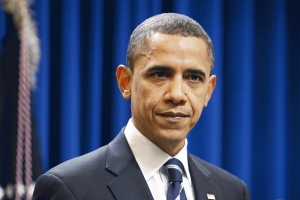
Preident Barack Obama

Preident Barack Obama
You’d never know it from cable news, but the average liberal Democrat actually likes the job the president is doing
Everyone knows that progressives have been growing increasingly disillusioned with Barack Obama since, well … even before he took office. He’s compromised too much, fought too little, sold out on one big issue after another, and fallen horribly, tragically short of the transformational goals that defined his 2008 campaign.
And now that he’s gone and cut a deal with Mitch McConnell (of all people!) to keep the Bush tax cuts in place for the wealthiest Americans for the next two years (at least), the left’s anger is louder than ever. No wonder Time’s Mark Halperin says the president’s base is “shattered.” And no wonder the media is filled with speculation about a potential challenge to the president in the 2012 Democratic primaries. Really, has there ever been a president who’s succeeded so thoroughly in taking the very people who put him in office and turning them against him?
It’s a fun topic for cable news and the blogosphere, where liberal commentators and activists routinely brand the president a Judas and threaten to support a primary challenger in 2012. And it’s a fun topic in the “mainstream media,” which takes all of this racket as confirmation that Obama is rapidly losing — or has already lost — his base.
There’s just one problem: The premise on which all of this is based is totally and completely wrong. Liberal commentators and activists and interest group leaders may be seething over Obama, but their rage has not trickled down to the Democratic voters (and, in particular, the Democratic voters who identify themselves as liberals), even though they’ve been venting their grief for the better part of two years.
As I noted earlier this week, Obama’s approval rating among Democrats has held steady at or near the 80 percent level throughout all of the turmoil of 2010. This puts him in as strong a position with his own party’s voters as any modern president has been at this same point in his presidency (with the exception of George W. Bush, whose numbers remained unusually high for well over a year after 9/11). Look closer and you’ll also find that Obama’s approval rating among Democrats is actually highest among those who call themselves liberals — an 83 percent score in the most recent round of Gallup polling, completed a few days ago. Among moderate Democrats, he clocks in at 75 percent, and among conservative Democrats, 69 percent. Again, these numbers have more or less held steady all year. To the extent Obama has a serious problem with Democrats, then, it’s with those who are on the right, not the left. This is hardly what you’d expect for a president who, according to the dominant narrative, has spent his presidency poking a stick in the left’s eye by cutting deals with conservative Democrats and Republicans.
Obama, in other words, seems to have developed his own silent majority. Rank-and-file liberal Democrats may not agree with everything he has done, but they do not share the sense of abandonment and betrayal that has defined liberal commentary throughout so much of his presidency. The party’s liberal base still very much likes him; it’s the elites who have turned on him.
The biggest reason for this disconnect, I would suggest, is that the liberal Democratic base liked Obama, both personally and ideologically, from the very beginning. Virtually from the moment he electrified the 2004 Democratic convention, liberals latched on to him as one of their own — and they haven’t (and don’t want to) let go.
This is not an unheard of phenomenon in politics, and it’s one of the reasons I’ve been so keen on comparing Obama’s political appeal to that of Ronald Reagan. Rank-and-file conservatives felt as strongly about Reagan in the 1980 campaign (and in 1976, for that matter) as liberals did about Obama in 2008. And they stayed true to him even when conservative elites concluded two years into his term that Reagan was a sellout.
Indeed, in the wake of this week’s drama over the Bush tax cuts, it’s worth recalling a similar moment in Reagan’s presidency, when congressional Democrats forced him into a tax hike in the summer of 1982. Like Obama now, Reagan had no leverage: The economy was spiraling out of control, voters were abandoning him, and Democrats were having great success (or seeming to have great success) hammering him over the exploding deficit. Thus did Reagan agree to a tax hike package that increased revenues by nearly $100 billion over the next three years — the largest tax increase in history, right-wing activists and commentators screamed. To these conservative elites, it was simply the latest act of betrayal by their one-time hero. When the GOP was drubbed in that fall’s midterms, they claimed vindication (see — not conservative enough!) and talked openly of challenging Reagan in the 1984 primaries. But rank-and-file conservative voters didn’t listen. They still liked the Gipper, still thought he was one of them, and still backed him in polling. It’s the same story today for Obama with rank-and-file liberals.
If Obama had been introduced to the Democratic base differently — that is, if they’d been suspicious and resistant to him and he’d landed in the presidency in spite of their skepticism — the objections of liberal elites might be far more damaging.
Here a parallel can be drawn to George H.W. Bush, who was introduced to the GOP’s “New Right” base in 1980 as the moderate, Gerald Ford-ish establishment Republican running against Reagan. Thus, the New Right, which essentially took control of the GOP for good with Reagan’s ’80 triumph, never really trusted Bush. Eight years of loyal service as Reagan’s V.P. was enough to win Bush the right’s benefit of the doubt in 1988, but when he “caved” as president — as he did on the S&L bailout, the 1990 tax hike, and a host of other issues — it merely brought back to the surface all of the right’s old attitudes toward him. So when the triumph of the Gulf War faded in 1991, there was room for Pat Buchanan to run to Bush’s right in the 1992 primaries. Buchanan didn’t win any states, but he did secure enough support — especially in New Hampshire — to severely embarrass the president. Obama’s history with liberals, though, is much different from Bush’s history with conservatives.
This isn’t to say that it’s impossible for Obama to lose the Democratic base; it’s just that there’s a lot more goodwill toward him among that base — and a lot more willingness to rationalize his “betrayals” as sensible pragmatism in the face of the other party’s obstructionism — than most people recognize.
At his press conference Tuesday, Obama noted that many of the “purist” liberals now blasting his tax cut deal also savaged his final healthcare compromise earlier this year, which wiped out the public option. It’s an apt comparison. And it’s worth remembering that the cries of betrayal back then did nothing to lessen rank-and-file’s assessment of Obama’s job performance — probably because the main thing they saw was that Obama, unlike every president before him, had actually gotten healthcare done.
By Steve Kornacki-Salon: Wednesday, Dec 8, 2010
Is The Tea Party Just a Big Scam?

E. J. Dionne
Is the tea party one of the most successful scams in American political history?
Before you dismiss the question, note that word “successful.” Judge the tea party purely on the grounds of effectiveness and you have to admire how a very small group has shaken American political life and seized the microphone offered by the media, including the so-called liberal media.
But it’s equally important to recognize that the tea party constitutes a sliver of opinion on the extreme end of politics receiving attention out of all proportion with its numbers.
Yes, there is a lot of discontent in America. But that discontent is better represented by the moderate voters who expressed quiet disillusionment to President Obama at the CNBC town hall meeting on Monday than by tea party ideologues who proclaim the unconstitutionality of the New Deal and everything since.
The tea party drowns out such voices because it has money—some of it from un-populist corporate sources, as Jane Mayer documented last month in The New Yorker—and has used modest numbers strategically in small states to magnify its impact.
Just recently, tea party victories in Alaska and Delaware Senate primaries shook the nation. In Delaware, Christine O’Donnell received 30,563 votes in the Republican primary, 3,542 votes more than moderate Rep. Mike Castle. In Alaska, Joe Miller won 55,878 votes for a margin of 2,006 over incumbent Sen. Lisa Murkowski, who is now running as a write-in candidate.
Do the math. For weeks now, our national political conversation has been driven by 86,441 voters and a margin of 5,548 votes. A bit of perspective: When John McCain lost in 2008, he received 59.9 million votes.
Earlier this year, much was made of the defeat of Sen. Bob Bennett, a Utah conservative insufficiently conservative for the tea party. Bennett lost not in a primary but at a Republican convention attended by all of 3,500 delegates.
Even in larger states, the tea party’s triumphs were built on small shares of the electorate. Rand Paul received 206,986 votes in Kentucky where there are more than 1 million registered Republicans and nearly 2.9 million registered voters. Sharron Angle won with 70,452 votes in Nevada, a state with more than 1 million registered voters.
The media have given substantial coverage to tea party rallies and even small demonstrations. But how many people are actually involved in this movement?
Last April, a New York Times/CBS News poll found that 18 percent of Americans identified themselves as supporters of the tea party movement, but slightly less than a fifth of these sympathizers said they had actually attended a tea party rally or meeting. That means just over 3 percent of Americans can be characterized as tea party activists. A more recent poll by Democracy Corps, just before Labor Day, found that 6 percent of voters said they had attended a tea party rally or meeting.
The tea party is not the only small group in history to wield more power than you’d expect from its numbers. In 2008, Barack Obama did very well in party caucuses, which draw many fewer voters than primaries. And it was Lenin who offered the classic definition of a vanguard party as involving “people who make revolutionary activity their profession” in organizations that “must perforce not be very extensive.”
But something is haywire in our media and our politics. Jill Lepore, a Harvard historian whose new book is “The Whites of Their Eyes: The Tea Party’s Revolution and the Battle Over American History,” observed in an interview that there is a “hall of mirrors” effect created by the rise of “niche” opinion media. They magnify small movements into powerhouses while old-fashioned journalism, which is supposed to put such movements in perspective, reacts to the same niche incentives.
There is also the decline of alternative forces in politics. The Republican establishment, such as it is, has long depended far more on big money than on troops in the field. In search of new battalions, GOP leaders stoked the tea party, stood largely mute in the face of its more outrageous untruths about Obama—and now has to defend candidates like O’Donnell and Angle.
And where are the progressives? Sulking is not an alternative to organizing, and weary resignation is the first step toward capitulation. The tea party may be pulling a fast one on the country and the media. But if it has more audacity than everyone else, it will, I am sorry to say, deserve to get away with it.
E.J. Dionne, Jr. is is a Washington Post columnist, a senior fellow at the Brookings Institution, and a professor at Georgetown University. He is the author of, most recently, Souled Out: Reclaiming Faith and Politics After the Religious Right. Original Post: The New Republic, September 23, 2010.
Share This Blog


 Unknown Feed
- An error has occurred; the feed is probably down. Try again later.
 mykeystrokes.com

You must be logged in to post a comment.