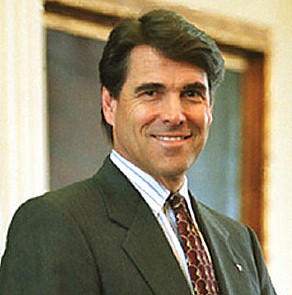
“To Dude Or Not To Dude?”: Rick Perry Wants YOU To Want Him To Run For President
In San Antonio on Monday, Texas Gov. Rick Perry will share his “exciting future plans.” Not to be confused with his past plans, I guess, or his not-so-hot ones. Unfortunately, I’m pretty sure these don’t involve accepting the $90 billion or so in federal money to expand Medicaid that would insure a million more Texans in a state that’s first in job creation but second in the number of children without health insurance.
When I asked a few Texans what they figured their governor would announce, though, I did get some exciting replies: Secede from the union? Change the part in his hair? Break in some new boots? And those were the Republicans, who have nothing but praise for their longest-serving governor — just as long as they’re speaking for attribution.
Perry did succeed in turning his state’s governorship from one of the weakest in the country to one of the strongest by applying a strict personal loyalty test to those he appointed to every seat on every board.
As a result, he’s always been more feared than loved. But after his bellyflop of a presidential run, some of his power to intimidate seems to have worn off. Texas House Speaker Joe Straus — a Republican, of course — publicly criticized Perry’s remarks about Wendy Davis, the state senator who successfully filibustered an anti-abortion bill, as damaging to their party.
I think Perry was actually trying to pay Davis a compliment. ““Who are we to say,” he asked, “that children born in the worst of circumstances can’t lead successful lives? Even the woman who filibustered the Senate the other day was born into difficult circumstances. She’s the daughter of as single woman, she was a teenage mother herself. She managed to eventually graduate from Harvard Law School and serve in the Texas Senate. It’s just unfortunate that she hasn’t learned from her own example that every life must be given a chance to realize its full potential, and that every life matters.” Which I took to mean that had her single mom chosen not to have her, the world would have been deprived of her intelligence and fortitude.
I’m not surprised, however, that Texas Republicans are telling pollsters they don’t want Perry to run for president again in ’16: Just 18 percent of Republican primary voters want him to go for it, while 69 percent say they hope he doesn’t.
Even among Texans, he’s the sixth-choice Republican presidential candidate right now, after Ted Cruz, Jeb Bush, Rand Paul, Chris Christie and Paul Ryan. And though his job approval rating in the state has improved substantially lately, more still disapprove than give him a thumbs up, and 60 percent of respondents in a recent PPP poll said they do not think he should run for a fourth term as governor, either, compared to the 30 percent who say he should.
That doesn’t mean Texas is likely to turn blue any time soon, however, because it’s still an awfully conservative state — and one that’s gotten more so in recent years, with Obama taking 44 percent of the vote in ’08 and 41 percent in ’12.
Longtime Democratic consultant Marc Campos, of Houston, who calls Perry “Governor Dude,” is less sure than some others in the state about how the governor will come down on the question of “to dude or not to dude” for a fourth term. “Oops means oops,” Campos jokes, referring not only to Perry’s inability to remember the name of the third federal agency he’d vowed to cut, but also to Perry’s presidential chances if he does run again in ’16.
Yet Campos assesses his own party’s chances of taking the governorship next year no less realistically, quoting Rocco Lampone’s line in “The Godfather Part II” that shooting Hyman Roth would be “difficult, not impossible. It would have to be a hardly-any-room-for-error type of campaign,” he says, and darn well funded.
As the Dallas Morning News’s Wayne Slater points out, Davis has doubled her name ID lately, yet is still unlikely to prevail over Perry, who won by 13 points in ’10 as the least popular Republican on the ballot. Though 38 percent of Texans are Latino, turnout continues to be a problem, with Hispanics accounting for more than a third of the population, yet only about a fifth of the vote. And the recent Supreme Court decision undermining the Voting Rights Act clears the way for a Texas voter ID law that Democrats fear will further suppress turnout.
Rep. Joaquin Castro, whose twin, Julian Castro, the mayor of San Antonio, would have the best chance of besting Perry if he does run again, according to a recent poll, told me that “realistically, our window” for turning Texas blue “is eight to 12 years.”
Perry might actually speed that process along if he does decide to run for re-election, and the state’s Republican attorney general, Greg Abbott, opposes him in a primary. If that happens, Castro says, it will be expensive, brutal, and “a replay of what happened to the once-dominant Democratic Party” in Texas in the ’80s, with more infighting than punches thrown at the other party.
No one can say that Perry suffers from a lack of confidence, though, and it wouldn’t be like him to worry about that. Just before he was elected to his third term, Perry told me that walking away after only two would have been “like Van Gogh walking away when he’s two-thirds finished with a masterpiece.” On Monday, we’ll learn if he feels any brush work remains undone.
By: Melinda Henneberger, She The People, The Washington Post, July 3, 2013
“White Sale”: The “Missing White Voter”
I’ve been writing about this for the last week in the context of Sean Trende’s analysis of ethnic and racial voting data. But MSNBC’s Benjy Sarlin has an excellent summary of the gradual but steady conversion of conservative gabbers from the belief that securing a higher share of the Latino vote is an ontological necessity for the GOP to the very, very different conviction that the GOP’s salvation lies in an enhanced appeal to the same white voters that already compose nearly all of its “base.”
After November’s stunning loss, an array of influential Republicans argued that immigration reform was the party’s best chance to claim Latino voters before they become permanent Democrats. But in a mere eight months, a counter-narrative has taken hold in conservative circles, nurtured by a shrewd group of anti-immigration lobbyists and Tea Party enthusiasts. The new argument sees immigration reform at best as a divisive distraction from the GOP’s real problem of countering “white flight” from the polls. At worst, they view it as an electoral apocalypse, a seventh seal behind which lies an unbroken line of future Democratic presidents.
Sarlin sees this “counter-narrative” largely as a backlash against “Republican establishment” voices telling conservatives something they really, really didn’t want to hear (it’s no accident that Rush Limbaugh was among the first and most consistent in rejecting the Latino Imperative proposition). But he notes that some influential figures, particularly on Fox News, have switched from one theory to another as conservative opposition to immigration reform has intensified:
[T]he anti-immigration argument appears to be gaining converts fast. On election night, Fox News anchor Brit Hume called the “demographic” threat posed by Latino voters “absolutely real” and suggested Mitt Romney’s “hardline position on immigration” may be to blame for election losses. On Monday, Hume declared that argument “baloney.” The Hispanic vote, he said, “is not nearly as important, still, as the white vote.”
Sean Hannity, a reliable bellwether on the right, has been on a similar journey since the fall. He announced the day after President Obama’s re-election that he had “evolved” on immigration reform and now supported a “path to citizenship” in order to improve relations with Hispanic voters. Hannity has now flipped hard against the Senate’s bill. “Not only do I doubt the current legislation will solve the immigration problem,” he wrote in a June column, “but it also won’t help the GOP in future elections.”
Hannity and Hume didn’t arrive at their latest destination by accident. They’re just the latest figures on the right to embrace the compelling new message that’s whipping Republicans against immigration reform while still promising a better tomorrow for the GOP’s presidential candidates.
Sarlin notes the particular role played by the highly-reputed number-cruncher Sean Trende and the influential conservative journalist Byron York (who unlike Trende has been crusading against the Gang of Eight immigration bill) in making this inherently attractive-to-conservatives argument (I’ve called it a bottomless crack pipe for the Right) respectable. Their work is particularly popular, unfortunately, among those who deliberately ignore what Trende and York say about the kind of white voters who “went missing” in 2012 and the unconventional things Republicans need to do to appeal to them:
York and Trende have some nuanced ideas about how the GOP can accomplish what Romney failed to do, many of which involve tacking left on the economy. But to the talk radio right, the main takeaway is that there are several million angry white votes ripe for the taking if the party can swing even more to the right.
White voters stayed home, Limbaugh said in May, because “they didn’t think the Republican Party was conservative enough….”
“Their idea seems to be gaining currency,” Frank Sharry, executive director of immigration advocacy group America’s Voice, told MSNBC. “Right after the election most of the conservative commentariat said they had to do something to get right with Latino voters. Now there seems to be this bizarre conversation that could only happen in the conservative bubble about how Romney didn’t win because he didn’t mobilize enough white voters.”
Underlying these claims is a belief that Romney lost because he was a blue-blooded moderate who failed to connect to conservative white voters on a visceral level. Nominate an American bad-ass in 2016 and those missing whites will reappear in a hurry.
Bingo. It’s more or less the same rationalization conservatives offered for losing in 2008, as well: a nominee too moderate for the “conservative majority” who was laboring under the false premise that his past support for comprehensive immigration reform would win him Latino support.
The bottom line here is that selling conservatives on a particularly self-serving version of the “missing white voter” theory is the easiest sale imaginable, and they are accordingly buying it like hot cakes. That’s bad news for those who favor immigration reform, and even worse news for those who dream of a political environment in which racial and ethnic conflict is not constantly lurking in the background.
By: Ed Kilgore, Contributing Writer, Washington Monthly Political Animal, July 2, 2013
“Either Way, They Could Be Screwed”: The GOP Might Just Stick With This “Party Of White People” Thing
Since the 2012 election, most (not all, but most) Republicans have agreed that if they’re going to remain viable in presidential elections in coming years, the party will have to broaden its appeal, particularly to Latino voters. There has been plenty of disagreement about how to go about this task. Especially over comprehensive immigration reform, which many Republicans see as too high a policy price to pay to achieve some uncertain measure of good will from those voters. But outside of conservative talk radio, there weren’t many voices saying that they should junk the whole project. Every once in a while some voice from the past like Phyllis Schlafly would come out and bleat that the party should focus on the white folk who make up the party’s beating heart, but to many it seemed like the political equivalent of your racist great aunt saying at Thanksgiving that she doesn’t feel comfortable around those people.
But as immigration reform wends its tortured path through Congress, more mainstream Republicans are having second thoughts. In fact, significant backlash is brewing, not just to this bill but to the whole idea of Republicans working to appeal to minorities. Benjy Sarlin at MSNBC has an excellent article explaining how this backlash is spreading, noting that even some people who six months ago were blaming Mitt Romney’s position on immigration reform for his loss are now saying that the only viable path to victory is getting turnout up among white voters.
I’ll get to why this is a very bad idea in a moment, but the logic at work isn’t completely crazy. After all, by now the Republican party going after minority votes is like the fast-food joint that puts a salad on its menu amid all the bacon cheeseburgers and chili fries. It’s there so they can say they’re offering something for people with different tastes, but they don’t expect anyone to order it. And when Rush Limbaugh warns that a path to citizenship for undocumented immigrants will create millions of new Democratic voters, he’s probably right to a degree. Under the bill the Senate passed it would be 13 years before any undocumented immigrant could earn citizenship and vote, but as Sarlin discusses, the argument some Republicans make that Latinos are “natural conservatives” has always been weak.
After every election, a significant number of people within the losing party argue that the problem wasn’t one of persuasion but one of turnout. They just didn’t get enough of their voters to the polls, so they don’t have to change what they’re arguing. There’s often some truth to it; when only 50 to 60 percent of eligible voters are coming to the polls, turnout on your side could always be higher. But the problem the GOP now faces is that the way you relate to one group of voters affects how other voters perceive you.
This was something George W. Bush and Karl Rove understood well when they built his 2000 campaign. Bush’s “compassionate conservatism” consisted mostly of things like pulling African-Americans on stage with him and putting lots of pictures of Latinos on his web sites. It got him a few extra votes among minorities, but that was always just a bonus. The real target was moderate white voters, who saw it and learned, in the phrase reporters repeated over and over, that Bush was “a different kind of Republican.” He wasn’t like those mean-spirited old white guys who seemed to dominate the GOP, and they’d be comfortable voting for him.
By the same token, if you decide that you’re going to focus your efforts on turning out the white vote, you won’t only be sending a message to Latinos (and African Americans, and the fast-growing Asian American population) that you’re not interested in them, you’ll also be sending a message to moderate whites that your party might not be the kind of place they’d feel comfortable. This goes double for young white voters, who have grown up in a much more diverse culture than their parents and grandparents, and aren’t going to be so hot on joining the Party of White People.
This is a dilemma for Republicans. Both paths are strewn with obstacles and dangers. Whichever one they choose, there’s likely to be trouble.
By: Paul Waldman, Contributing Editor, The American Prospect, July 2, 2013
“John Boehner’s Dilemma”: Your Choice Mr. Speaker, Tea Party Uprising Or Latino Uprising
On immigration, Speaker John Boehner is caught between two unpleasant possibilities: A Tea Party uprising or a Latino uprising. Eventually, he’s going to have to choose which presents a bigger risk to his party.
So far, all of his rhetoric and body language suggests he is trying to protect his House Republican caucus from a Tea Party uprising that would take out incumbents in Republican primaries, and perhaps himself from a challenge to his speakership.
Even though the Senate passed landmark immigration reform with a supermajority of 68 votes, Speaker Boehner is refusing to bring the Senate bill to the House floor. He is insisting the House pass its own legislation with “majority support of Republicans,” a needless standard designed to produce a far more right-wing bill than the Democratic-led Senate can tolerate, increasing the chances of a deadlocked House-Senate negotiation.
If it even gets that far. Considering how House Republicans recently failed to come together to pass a farm bill, it’s not a given the House can pass any immigration bill with Republican votes alone.
Failure to pass a final bill suits Tea Party Republicans just fine. But if Boehner buries a widely supported bipartisan Senate bill, the uprising he faces may be far worse.
On Sunday, Sen. Chuck Schumer (D-N.Y.) told CNN, “This has the potential of becoming the next major civil rights movement. I could envision in the late summer or early fall if Boehner tries to bottle the bill up or put something in without a path to citizenship … I could see a million people on the Mall in Washington.”
This is not idle musing. This has already happened.
In December 2005, the House passed legislation that would turn undocumented workers into felons. A wave of mass protests by Latinos swept the country the following spring, lasting for three months. Half a million poured into the streets of Los Angeles, and 400,000 marched in downtown Chicago. Seeing the strength of the Latino vote, the Senate quickly backed off of the House approach and in May 2006 passed an immigration bill providing a pathway to citizenship for the undocumented.
Neither the House nor Senate bills became law. But back in 2006, with conservative Republicans controlling both chambers, gridlock was a win for the protesters. Today, with immigration advocates so close to winning historic reform, gridlock would be a devastating blow.
And if the highest-ranking Republican in the country was the clear roadblock, the Republican Party in general would be on the receiving end of visceral hatred, most likely voiced once again in the streets.
A wave of protests targeting Republicans that matched or surpassed the level of street heat generated in 2006 would be devastating to the Republican Party’s attempts to win back the Latino votes that proved decisive to Barack Obama’s 2008 and 2012 victories. With the Latino share of the electorate continuing to rise — most ominously for Republicans, in their lone bastion of strength, the South — killing immigration reform could fast-track a demographic disaster that would condemn Republicans to minority status for a generation.
In the end, Boehner will have to decide which uprising he wants to face least: A Tea Party uprising that could spell personal defeats for himself and his friends, or a Latino uprising that could spell the end of the Republican Party.
If he takes the long view, he will recognize that his speakership won’t last for long if his party crumbles all around him.
By: Bill Scher, The Week, June 28, 2013
“Supreme Conflicts”: The Peaks And Valleys That Illustrate Our Country’s Worse Divisions
Like most families, my brood is a complex configuration of souls, so I greeted this week’s flurry of Supreme Court decisions with a conflicted heart.
This is true for most anyone who paid attention to the court rulings, I imagine. This latest round reflects parts of our culture we either want to embrace or want to reject. No middle ground here. It’s all peaks and valleys, the perfect graphic to illustrate our country’s divisions these days.
Initially, I was overjoyed to hear that the court had struck down the federal Defense of Marriage Act — a ridiculously named law that did nothing but harm to innocent people and their families for 17 years. Finally, the U.S. government must recognize the legal marriages of same-sex couples, and the earth didn’t tremble, not even a little bit.
Immediately, my mind was flooded with the faces of so many gay men and women who populate our daily lives — good people, crazy loyal and with a patience no one has the right to ask of them.
My mood was quickly tempered by the wake-up jolt of reality. Thirty-nine states still treat their gay citizens like modern-day lepers, passing bills and referenda as redundant as they are hateful. The DOMA decision does nothing to stop states from continuing to discriminate against men and women whose only crime is to be different from the people who fear them for reasons they can’t explain, even to themselves.
A lot of people who oppose marriage equality like to blame God for their bigotry. In my version of heaven, I get to watch them try to explain themselves.
Meanwhile, down here on earth, every time I hear someone talk about how God hates homosexuality — that whole “love the sinner, hate the sin” malarkey — I think of my late mother, whose faith survived countless trials in her 62 years.
“Being a Christian means fixing yourself and helping others,” she used to say, “not the other way around.” That’s a lifetime of work summed up right there.
Nine years ago, my husband and I were married by a minister who still cannot wed her longtime partner simply because they live in Ohio instead of Massachusetts, say, or any other state in New England where same-sex marriage is legal.
To this day, friends and family who attended our wedding want to talk about how moved they were by Pastor Kate’s sermon at our service. To this minute, Pastor Kate cannot legally claim Jackie — beloved to all of us — as her spouse, even as she works for the United Church of Christ every single day.
God’s will, you understand.
Uh-huh.
Also this week, the Supreme Court gutted the Voting Rights Act by ruling that Section 4 of the 1965 law is now unconstitutional. This particular section provides a formula to determine which jurisdictions are subject to federal government clearance before they can change their voting laws.
Historically, the voters targeted by these attempts to reduce their numbers are people of color. Also historically, Republicans are behind these changes, but they pinky-swear that it has nothing to do with how few people of color vote for them.
I’ve lost count of how many times I’ve written about these Republican stunts to suppress the vote. I can’t think of anything more patriotic than helping every eligible voter cast a ballot.
As I age, however, and our children grow up and marry, my patriotic fervor has become to-the-bone personal.
Our 5-year-old grandson bears his mother’s family name, which is Puerto Rican. Our future son-in-law emigrated with his family from El Salvador when he was a child. Republicans are not, shall we say, big fans.
As Columbia University professor Rodolfo O. de la Garza explained in an op-ed in February for The New York Times, America’s Latinos are increasingly the new Republican target for all things sinister.
“The nation does not acknowledge the discrimination Latinos have undergone,” he wrote. “Today, many public officials from states across the nation seem to feel free to treat Latinos as unwelcome newcomers and view Latino voters with suspicion. Republicans are especially leery of Latino voters who are perceived to be noncitizens or, even worse, Democrats.
“Without the law’s threat of federal intervention, I fear that the promise of Latino political equality will stagnate.”
That’s my family he’s talking about.
Fortunately, by 2043, that will be most American families in this country, as the U.S. Census Bureau estimates that that’s the year the white majority will be history.
This white granny’s going to eat a really healthful diet between now and then, because I want to live to see that day.
By: Connie Schultz, The National Memo, June 27, 2013
Share This Blog


 Unknown Feed
- An error has occurred; the feed is probably down. Try again later.
 mykeystrokes.com