“Never Patriotic”: The Real Meaning Of The Confederate Flag
In the intensifying national debate over the Confederate flag, important clues about the seditious symbol’s true meaning are staring us in the face. Dozens of those clues were posted by an angry, glaring Dylann Storm Roof on the “Last Rhodesian,” website, where the alleged Charleston killer pays homage to certain flags – notably those of apartheid-era South Africa and Rhodesia, as well as the old Confederacy – while he enthusiastically desecrates another.
Pictures of Roof burning, stomping, and spitting on the Stars and Stripes are interspersed among the photos of him grasping and waving the Confederate battle flag, sometimes while holding a gun. “I hate the sight of the American flag,” he raged in a long screed on the site. “Modern American patriotism is an absolute joke.”
What this racial terrorist meant to express, in crude prose and pictures, is a lesson that the diehard defenders of the Confederate flag should no longer ignore: To uphold the banner of secession is to reject patriotism – and has never meant anything else.
For many years after the Civil War, the symbols of the Confederacy were not much seen outside local museums and burial grounds. The late general Robert E. Lee, a reluctant but justly revered war hero, rejected any post-war fetishizing of the Stars and Bars, which had actually originated as the battle flag of his Army of Northern Virginia. Lee believed it “wiser…not to keep open the sores of war, but to follow the examples of those nations who endeavored to obliterate the marks of civil strife and to commit to oblivion the feelings it engendered.”But such admonishments were cast aside by the exponents of white supremacy, whose own patriotism was certainly suspect. When the Ku Klux Klan and the Knights of the White Camelia were revived as racial terror organizations in the 1930s and 1940s, carrying out a spree of cowardly lynchings, their grand wizards found natural allies among the leaders of the German-American Bund — whose funding and fealty were eventually traced to Nazi headquarters in Berlin. Indeed, the Klansmen burned their towering crosses alongside swastika banners at rallies sponsored by the Bund to attack President Franklin D. Roosevelt.
In the years following the Second World War, the Dixiecrats led by South Carolina politician Strom Thurmond – and the “uptown Klan” known as the White Citizens Councils that supported Thurmond’s movement – appropriated the Confederate flag as their own standard. Among its greatest enthusiasts was a young radio reporter (and future U.S. senator) named Jesse Helms, whose fawning coverage of Thurmond’s 1948 third-party presidential bid marked him as a rising star of the segregationist right.
As for the White Citizens Councils, those local groups were ultimately reconstituted into chapters of the Council of Conservative Citizens – a notorious hate group that has embarrassed many Republican politicians caught fraternizing with its leaders, and that ultimately inspired Roof with its inflammatory propaganda about black crime and the endangered white race. Headquartered in St. Louis, MO, the CCC festoons itself and its works with the Dixie flag, as does the neo-Confederate League of the South, which still openly advocates secession.
Meanwhile, racist, anti-Semitic agitators such as David Duke and Don Black — both Southerners prominent in Klan and neo-Nazi organizations for decades — have never ceased to manifest their reverence for the Confederacy. Stormfront, the notorious neo-Nazi website founded by Black, continues to promote the mythology and symbolism of the Southern cause, declaring in a June 23 podcast that the Civil War had nothing to do with slavery — and that “the attack on southern symbols and heritage such as the Confederate Flag are actually part of an overall Jewish-led attack on European Americans.” Owing to Duke’s influence, in fact, the Confederate flag has served as a substitute for Nazi banners in demonstrations, often violent, by “white nationalists” in Europe — where the symbols of the Third Reich are widely outlawed.
Obviously, not every American who has displayed the Dixie flag endorses the treason and bigotry that it now represents to so many other Americans. There are sincere patriots, like former senator James Webb of Virginia, who still insist that it is only a remembrance of the valor of their ancestors. But over the decades, its appropriation by traitors and bigots has provoked little noticeable protest from the more innocent exponents of respect for Southern heritage. Today, the Charleston massacre has left it standing irrevocably for the most brutal and criminal aspects of that heritage – and it is more deeply irreconcilable with American patriotism than ever.
By: Joe Conason, Editor in Chief, Editors Blog, The National Memo, June 26, 2015
“Rachel Dolezal’s ‘Passing’ Isn’t So Unusual”: A Product of Our Own Contradictory Moment
Why do we care so much about Rachel Dolezal, the head of the Spokane, Wash., chapter of the N.A.A.C.P. who apparently misrepresented herself as African-American when, according to her parents, she is Czech, Swedish and German, with some remote Native American ancestry?
In one sense, it’s not at all surprising. Stories of white Americans “passing” as members of other racial and ethnic groups have often captivated the American public — though the cases that have most fascinated us have usually turned on the malicious hypocrisy of the protagonists. In 1965, The Times famously reported that Dan Burros, the Ku Klux Klan’s Grand Dragon in New York State and the former national secretary of the American Nazi Party, was once a Jew who not only was a “star” bar mitzvah student at his shul in Queens but also brought knishes to white-supremacist gatherings. In 1991, an Emory University professor drew headlines by unmasking Forrest Carter, the author of a best-selling Native American “memoir,” as Asa Earl Carter, an Alabama Klansman and a speechwriter for George Wallace, the state’s segregationist governor.
But nowhere in the details that reporters and Internet sleuths have uncovered about Dolezal is there any inkling of personal commitment to white supremacy; her work with the N.A.A.C.P., now finished, and as a professor of Africana studies suggests quite the opposite. Her story spins at a far lower orbit of oddity than the trajectories of Burros and Carter, yet she is attracting a similar level of attention. More puzzling still, her case has gone viral at a moment when we are learning that Rachel Dolezals have been much more common in this country’s history than we once might have thought.
The history of people breaching social divides and fashioning identities for themselves is as old as America. These stories were never exclusively about blacks who “passed” for white or Jews who, as my grandparents would say, “got over it” and found their way to the Episcopalian side of the ledger — people who felt compelled to shed their birth identities to reap the full rewards of white privilege. From the beginning of the American experience, the color line bent and broke in many directions, and for many reasons.
In 17th-century Virginia, as the genealogist Paul Heinegg has documented, most of the first free families of color descended from white women who had children with slaves or free black men. Because a 1662 Virginia law classified people as “bond or free only according to the condition of the mother,” the status of these families depended on the women’s affirming their whiteness as an official matter. But in everyday life, white mothers of black children were creating new ways for their families and themselves to parse slavery, freedom and race, akin to James McBride’s account in his memoir, “The Color of Water,” of how his mother described her own identity while raising 12 African-American children. When McBride asked her about her parents, she would respond, “God made me.” When he asked if she was white, her answer was, “I’m light-skinned.”
Over time, as racial categories ossified and state legislatures criminalized interracial sex and marriage — an idea that was ruled unconstitutional by the Supreme Court in the 1960s — people continued to define themselves outside the law’s oppressive reach. White people who fell in love with African-Americans could avoid sanction if they asserted that they, too, were black. In 1819, a Scottish immigrant named James Flint described witnessing a black man’s attempt to marry a white woman near Jeffersonville, Ind., just across the Ohio River from Louisville, Ky. The local justice of the peace refused to marry them, citing a legal prohibition, but then had second thoughts, suggesting, Flint wrote, “that if the woman could be qualified to swear that there was black blood in her, the law would not apply.” In a scene anticipating “Showboat” by a hundred years, the groom promptly took a lancet to his arm, and according to Flint, “the loving bride drank the blood, made the necessary oath and his honour joined their hands” and married them.
White people have claimed African-American identity across time, region and class. The historian Martha Sandweiss has documented the case of Clarence King, a celebrated explorer from an elite Newport, R.I., family who could trace his ancestry back to three signers of the Magna Carta. At the end of the 19th century, he led a double life as James Todd, a black Pullman porter whose wife was born a slave. It is not hard to find other examples, all the way up to the present.
This kind of “reverse passing” could occur because the gap between America’s rigid insistence on racial purity and the reality of pervasive mixing left a conceptual blur instead of any defensible boundary between black and white. American history is a history of dark-skinned white people and light-skinned black people. Innumerable men and women explained away their complexions with stories of Spanish, Portuguese, Italian and, in an 1874 Tennessee court case, Carthaginian ancestry. More whites have claimed Cherokee grandmothers than is demographically possible.
Conversely, for John Hope, the first African-American president of Morehouse College and Atlanta University; John Ladeveze, who helped bring the first challenge to segregated education after Plessy v. Ferguson; Charles Chesnutt, the acclaimed early twentieth-century African-American novelist; or the longtime N.A.A.C.P. head Walter White, it was a routine part of life to insist that you were black despite all indications to the contrary. In 1871, Charles Sauvinet, sheriff of Orleans Parish during Reconstruction, sued the owner of a bar for refusing him service because of his race. In court, Sauvinet’s fair complexion prompted a lawyer to ask on cross-examination something very similar to a Spokane TV news reporter’s question — “Are you African-American?” — that so flustered Dolezal. Sauvinet’s answer speaks volumes about the complexity of American racial experience. “Whether I am a colored man or not is a matter that I do not know myself,” Sauvinet said. “But I am, and was legally, for this reason: that . . . you had always refused me, though born and raised here, the rights of citizenship.”
In a sense, the controversy surrounding Dolezal is a product of our own contradictory moment, when Americans are at once far more open to racial boundary-crossing and as preoccupied with those same boundaries as ever. Part of what’s striking about Dolezal’s self-constructed identity is how anachronistic it appears in 2015 — more the stuff of fiction, as in the over-the-top plot conceit of Nell Zink’s “Mislaid,’’ than reality. There seems to be little reason that Dolezal would have needed to identify as black to live the life she has led. After all, white people can form meaningful relationships with African-Americans, study, teach and celebrate black history and culture and fight discrimination without claiming to be African-American themselves. Dolezal was pale with straight blond hair when she earned her master of fine arts degree from the historically black Howard University. She is hardly the first white woman to take an interest in ‘‘the Black Woman’s Struggle,’’ one course she taught at Eastern Washington University.
But Dolezal’s exposure also comes at a time when racial categories have never seemed more salient. The same social media that is shaming Dolezal has also aggregated the distressingly numerous killings of African-Americans by the police into a singular statement on racism and inequality. In this moment, when blackness means something very specific — asserting that black lives matter — it follows for many people that categorical clarity has to matter, too.
The drive for authenticity that Dolezal has prompted is bound to raise more questions than answers. The enormous wealth of historical and genealogical information that is currently being digitized, along with the increasing availability and decreasing cost of DNA analysis, is bending our critical lens for viewing race; the secrets that people took to their graves are no match for Ancestry.com. Among other revelations, the records are proving that an enormous percentage of black men — nearly a fifth, according to one recent study — passed as white in the late 19th and early 20th centuries, suggesting that millions of white Americans could conceivably have African-American ancestry. A tan and curls do not make someone black. Nor does a graduate degree from Howard or a leadership position in the N.A.A.C.P. But it’s becoming harder to say what, exactly, does, even as racism remains real and deadly.
By: June 16, 2015
“A History Lesson We Adamantly Refuse To Learn”: Our Racist History Isn’t Back To Haunt Us. It Never Left Us
When, on Wednesday night, a 21-year-old white man named Dylann Roof entered the Charleston church founded by former slave Denmark Vesey on the anniversary of Vesey’s planned 1822 slave rebellion and shot and killed nine people, he provided the United States with the latest installment of a history lesson we adamantly refuse to learn: that our racist past is not past. It is present. It is unending. It is, in many ways that we seem congenitally unable to acknowledge, fundamentally unchanged.
In recent years, especially the years during which Barack Obama has occupied the White House, there have been many valuable meditations on the ways in which American policy structures that were shaped in and informed by the slave-holding and Jim Crow chapters of our nation’s story, continue to define today’s racial power imbalances. There’s been history, analysis, and contemporary commentary: Michelle Alexander’s indispensible The New Jim Crow, about our prison and legal systems; Isabel Wilkerson’s Warmth of Other Suns, about the Great Migration; Tom Sugrue’s books on integration and racism in northern cities and on housing policy in Detroit. At the Atlantic, Ta-Nehisi Coates has produced a body of work—culminating (for now) with his Case for Reparations—showing how we have gotten from “there” to “here,” contemporary America, with its persistently unequal scales of opportunity. Throughout our history, racism has indeed found fresh manifestations: from real estate restrictions and usurious interest rates to physical segregation to job discrimination to stop and frisk and police brutality.
There is usually the sense, however, that at least we’re changing, at least we’re moving in some direction, away from the where we started. Except on days like today, when the reminder is that we have not moved one bit.
In addition to new forms of subjugation and prejudice, we live in a country in which racist violence exists in precisely the same forms it always has—unabated, unreconstructed. We are not distant from the crimes and inhumanities and hatred of the past. We are still acting them out and still refusing to accept them for what they are: this country’s original and defining sin.
What happened on Wednesday night is violence enacted on different individuals than the violence enacted on four little girls who were killed in the bombing of the 16th Street Baptist Church in Birmingham in 1963, but it is a crime with the same shape and contours, a crime that leaves innocent people dead in their place of worship because of their race.
Too often, we look at iconic images of our racist past with a kind of antiqued horror. We recall with horror, if we’re old enough, how police turned dogs on innocent people. If we are younger, we suck in our breath and shake our heads with disbelief as we try to fathom a world inhabited by our parents, our grandparents, in which a city official, Bull Connor, ordered the use of fire hoses on peaceful protesters. But we also know that Bull Connor is long dead, a comfortable relic. We can just barely imagine that this happened to John Lewis. Lewis is now a long-serving congressman; his past is crucial, moving, but remote. That was then, look at him now.
But this—a white policeman shoving a 14-year-old girl’s face to the ground, stepping on her, kneeling on her at a pool party in McKinney, Texas—is also now. It’s this month. This, in Fairfield, Ohio, is not simply an altercation “between police and teens” as the caption says, but between a white police and black teens who scream in terror and anger. It is also this month, also at a community pool. Community pools, a locus for racial conflict. Does that sound distant? Or does it sound contemporary?
It is contemporary.
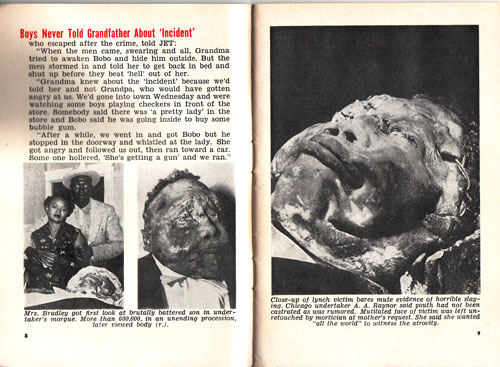
When we think of Emmett Till, the 14-year-old black boy murdered in Mississippi in 1963 after reportedly speaking to a white woman, we recall his open casket. His mother insisted on it, because she wanted the world to see the brutality that had been visited on her son because of the color of his skin. Look at this picture, printed on pages yellowed by all the years that have come between his death and today. Those years have made him famous; we take some cold comfort in the fact that though Till was robbed of the opportunity to love and thrive and work and change the world in life; his death profoundly altered it, kicking off the cycle of social progress that has brought us here, a world away from Money, Mississippi, 1955.
Now look at this image, of Frederick Jermaine Carter, a 26-year-old black man found hanging from a tree in a white suburb in Greenwood, Mississippi. It was taken ten miles south and 55 years after Emmett Till was killed. Carter died in 2010.
Yes, southern (and northern) trees still bear strange fruit. In March of this year, Otis Byrd, a man who had served time for killing a white woman, was found hanging from a tree in Claiborne County, Mississippi. (A special investigation ruled that there was no evidence proving his death a homicide.) Less than a year ago, the body of 17-year-old Lennon Lacey—a young man in a relationship with a white woman—was found hanging from a swing-set in Bladenboro, North Carolina. His death was immediately ruled a suicide, despite a series of inconsistencies and a report from an independent examiner suggesting that given his height and weight, a self-hanging would have been impossible. This death recalled the 2000 hanging of Raynard Johnson from a pecan tree in Kokomo, Mississippi. Johnson, like Lacey, had been dating, and been harassed for dating, a white woman, and his death—on June 16, in advance of a local Juneteenth celebration—was promptly ruled a suicide.
There’s no way to know for sure whether these deaths were lynchings or suicides, but what they are not are echoes of some distant past. They are original sounds. They are simply later chapters in the story of Emmett Till and countless, less well known others. They are a story of violent white resistance to the perceived incursion of blackness on bodies—on women’s bodies and on the nation. These bodies are not just presumed to be white, but presumed to belong to white men, a dynamic made crystal clear by Dylann Roof’s reported locution, during his Wednesday murder spree: “You rape our women and you’re taking over our country. And you have to go.”
We can try to comfort ourselves, as a local news anchor tried earlier this year, by assuring viewers that the cross found burning on the front lawn of a black woman in Elizabethville, Pennsylvania, was “not like those huge crosses from the old days.”
But these are the old days. In February, a Tennessee man and member of a church affiliated with the Ku Klux Klan was fined and sentenced to jail for burning a cross in the yard of a black man in Minor Hill, Tennessee. In 2014 in White River Township, Indiana, a black man was awakened in the middle of the night to find a three-foot cross burning on his front lawn. This is today.
This is Eric Garner, being killed by cops. This is Walter Scott, being shot in the back and killed by a police man. This is Freddie Gray, howling with pain after having had his body broken by police, a week before his death. This is Tamir Rice. He was 12 when he was shot to death, in November of last year, by police.
As Jelani Cobb wrote on Wednesday, recent incidents can “seem like gruesome boomerangs of history until we consider the more terrible idea that they are simple reflections of the present.”
It’s not just a terrible idea, it is a terrible reality. The cold reality of our country right now. We are not post-civil rights. We are not post race. We are not better than we were. We do not inhabit a world in which stray instances of violence might recall a distant and shameful history. This shame is a flood that has never abated.
By: Rebecca Traister, The New Republic, June 18, 2015
“If You’re Scratching Your Head, You’re Not Alone”: Rubio Is Confused About Christianity, Marriage Equality, And The Constitution
Marco Rubio went on television with the Christian Broadcasting Network’s David Brody and suggested that Christianity is on the verge of being labeled “hate speech.”
If you’re scratching your head, you’re not alone.
Rubio’s rambling statement botched a simple understanding of constitutional law and free speech rights. Not to mention reality.
According to CBN’s transcript:
“If you think about it, we are at the water’s edge of the argument that mainstream Christian teaching is hate speech,” Rubio told CBN News. “Because today we’ve reached the point in our society where if you do not support same-sex marriage you are labeled a homophobe and a hater.”
“So what’s the next step after that?” he asked.
“After they are done going after individuals, the next step is to argue that the teachings of mainstream Christianity, the catechism of the Catholic Church is hate speech and there’s a real and present danger,” he warned.
Rubio appeared to be referring to the legal concept of “clear and present danger,” which the Supreme Court developed in the early 20th century, attempting to articulate the circumstances under which the government can proscribe political speech. Through the early 20th century the Court applied it in situations in which a person’s speech was deemed to be a threat to national security, sustaining a war effort, or to the stability of the government. But in the later part of the century, the Court abandoned it.
The Court last appeared to address this idea in 1969, in Brandenburg v. Ohio. In that case, it reversed the conviction of Clarence Brandenburg, a Ku Klux Klan leader, under an Ohio statute that criminalized “crime, sabotage, violence, or unlawful methods of terrorism as a means of accomplishing industrial or political reform” for a speech in which he said, “if our President, our Congress, our Supreme Court, continues to suppress the white, Caucasian race, it’s possible that there might have to be some revengeance taken.” The Ohio law, the Court held, violated Brandenburg’s free speech rights.
Although the Court’s opinion does not use the term “clear and present danger” and explicitly reject it, in his concurrence, Justice William O. Douglas noted his skepticism that it could be squared with the First Amendment at all. “Though I doubt if the ‘clear and present danger’ test is congenial to the First Amendment in time of a declared war,” he wrote, “I am certain it is not reconcilable with the First Amendment in days of peace.”
Returning to Rubio’s statement, he is vague about who is labeling Catholic teaching “hate speech.” Does he mean the government? Does he mean people on the internet? Under the First Amendment, the government cannot stop citizens from engaging in speech, even if a listener finds it hateful. If by “they” he means American citizens, the simple answer is “they” have a constitutionally protected right to criticize the Catholic church; the church also has a constitutionally protected right to its doctrine.
But if Rubio is suggesting that “they” are the government, I can’t begin to wrap my mind around the scenario he is suggesting. Is he suggesting the government will deem a church’s teaching “hate speech?” There’s no basis or precedent that would remotely suggest that the government could regulate religious speech (whether “mainstream Christian teaching” or other religious teaching) at all, much less deeming it “hate speech.” The Free Exercise Clause protects religious practice and religious speech. Under the Free Speech Clause, the government cannot proscribe “hate speech” or even define it. Under the Establishment Clause, the government cannot endorse (or renounce) a particular religion.
You can say gay people are intrinsically disordered. Or you can say they don’t have a constitutional right to get married. They can say you’re a homophobe. The government can’t stop any of you.
But Rubio blurs the issue by suggesting that a nebulous “they” will first “go[] after individuals,” after which there is a slippery slope to arguing that “the catechism of the Catholic Church is hate speech.” Although CBN transcribed his next words as “and there’s a real and present danger,” if you watch the video, he says, “and that’s a real and present danger.” Suggesting, therefore, not that he believes “they” will argue that Catholic teaching is a “real and present danger” (whatever that is) but that the nebulous “they” present a “real and present danger” to Christianity.
Rubio’s statement is simply a confused muddle of fear-mongering and constitutional misconception. Neither of which is very presidential.
By: Sarah Posner, Religion Dispatches, May 28, 2015
“Fighting The Extremists Within”: As Our History Shows, Best Way To Defeat ISIS Extremists Is For Muslim World To Organize Against Them
One of the things that I find interesting in the conservative outrage over President Obama’s remarks at the National Prayer Breakfast is that most of it is focused on his inclusion of the Crusades (and occasionally the Inquisition). It is an attempt to dismiss what the President said because the events he referred to happened such a long time ago.
All of that ignores that he also included the more recent events of slavery and Jim Crow (the latter of which was still alive and well during my lifetime). For those who suggest the Christian community did not sanction slavery, Ta-Nehisi Coates provides us with a quote from Confederate Vice President Alexander Stephens showing that the secession of the Southern States over the issue of slavery was defended based on their religious beliefs.
With us, all of the white race, however high or low, rich or poor, are equal in the eye of the law. Not so with the negro. Subordination is his place. He, by nature, or by the curse against Canaan, is fitted for that condition which he occupies in our system…
It is, indeed, in conformity with the ordinance of the Creator. It is not for us to inquire into the wisdom of His ordinances, or to question them. For His own purposes, He has made one race to differ from another, as He has made “one star to differ from another star in glory.” The great objects of humanity are best attained when there is conformity to His laws and decrees, in the formation of governments as well as in all things else. Our confederacy is founded upon principles in strict conformity with these laws.
Of course there were also Christians who were part of the abolitionist movement – initially a small minority confined mostly to the Quakers. But the question eventually came down to Christians vs Christians over the question of slavery – to the point of a Civil War.
When the issue of Jim Crow actually comes up in these recent discussions, it is usually conservatives appropriating the mantle of Rev. Martin Luther King as a Christian minister who led the Civil Rights Movement. For example, here’s Tucker Carlson:
And by the way, who ended slavery and Jim Crow? Christians. The Rev. Martin Luther King. Christians.
He’s right, of course. Rev. King based his objection to Jim Crow on his Christian faith. But as we saw with slavery, a lot of white Christians firmly planted themselves on the other side. And it wasn’t just the KKK with their burning crosses. I am reminded of the fact that Rev. King’s most famous written document – Letter from Birmingham Jail – was penned in response to eight white religious leaders in the South who objected to his activities.
What we see from both of these examples is that on the question of slavery and Jim Crow, there were Christians on both sides of the divide. After a lot of suffering and death, the “Christian extremists” in our country were defeated by those who held fast to a faith that practiced what it preached.
That is exactly what President Obama’s foreign policy is attempting to accomplish in the Muslim world today on the question of ISIS. Over and over again he has said that the people of Iraq are going to have to lead the way.
In other words, just as our history shows with slavery and Jim Crow, the best way to defeat ISIS extremists is for the Muslim world to organize against them. Conservative attempts to malign all Muslims for the actions of those extremists actually distract and block that from happening.
By: Nancy LeTourneau, Political Animal Blog, The Washington Monthly, February 14, 2015
Share This Blog


 Unknown Feed
- An error has occurred; the feed is probably down. Try again later.
 mykeystrokes.com