Climate of Hate: Who Could Not Have Seen This Coming?
When you heard the terrible news from Arizona, were you completely surprised? Or were you, at some level, expecting something like this atrocity to happen?
Put me in the latter category. I’ve had a sick feeling in the pit of my stomach ever since the final stages of the 2008 campaign. I remembered the upsurge in political hatred after Bill Clinton’s election in 1992 — an upsurge that culminated in the Oklahoma City bombing. And you could see, just by watching the crowds at McCain-Palin rallies, that it was ready to happen again. The Department of Homeland Security reached the same conclusion: in April 2009 an internal report warned that right-wing extremism was on the rise, with a growing potential for violence.
Conservatives denounced that report. But there has, in fact, been a rising tide of threats and vandalism aimed at elected officials, including both Judge John Roll, who was killed Saturday, and Representative Gabrielle Giffords. One of these days, someone was bound to take it to the next level. And now someone has.
It’s true that the shooter in Arizona appears to have been mentally troubled. But that doesn’t mean that his act can or should be treated as an isolated event, having nothing to do with the national climate.
Last spring Politico.com reported on a surge in threats against members of Congress, which were already up by 300 percent. A number of the people making those threats had a history of mental illness — but something about the current state of America has been causing far more disturbed people than before to act out their illness by threatening, or actually engaging in, political violence.
And there’s not much question what has changed. As Clarence Dupnik, the sheriff responsible for dealing with the Arizona shootings, put it, it’s “the vitriolic rhetoric that we hear day in and day out from people in the radio business and some people in the TV business.” The vast majority of those who listen to that toxic rhetoric stop short of actual violence, but some, inevitably, cross that line.
It’s important to be clear here about the nature of our sickness. It’s not a general lack of “civility,” the favorite term of pundits who want to wish away fundamental policy disagreements. Politeness may be a virtue, but there’s a big difference between bad manners and calls, explicit or implicit, for violence; insults aren’t the same as incitement.
The point is that there’s room in a democracy for people who ridicule and denounce those who disagree with them; there isn’t any place for eliminationist rhetoric, for suggestions that those on the other side of a debate must be removed from that debate by whatever means necessary.
And it’s the saturation of our political discourse — and especially our airwaves — with eliminationist rhetoric that lies behind the rising tide of violence.
Where’s that toxic rhetoric coming from? Let’s not make a false pretense of balance: it’s coming, overwhelmingly, from the right. It’s hard to imagine a Democratic member of Congress urging constituents to be “armed and dangerous” without being ostracized; but Representative Michele Bachmann, who did just that, is a rising star in the G.O.P.
And there’s a huge contrast in the media. Listen to Rachel Maddow or Keith Olbermann, and you’ll hear a lot of caustic remarks and mockery aimed at Republicans. But you won’t hear jokes about shooting government officials or beheading a journalist at The Washington Post. Listen to Glenn Beck or Bill O’Reilly, and you will.
Of course, the likes of Mr. Beck and Mr. O’Reilly are responding to popular demand. Citizens of other democracies may marvel at the American psyche, at the way efforts by mildly liberal presidents to expand health coverage are met with cries of tyranny and talk of armed resistance. Still, that’s what happens whenever a Democrat occupies the White House, and there’s a market for anyone willing to stoke that anger.
But even if hate is what many want to hear, that doesn’t excuse those who pander to that desire. They should be shunned by all decent people.
Unfortunately, that hasn’t been happening: the purveyors of hate have been treated with respect, even deference, by the G.O.P. establishment. As David Frum, the former Bush speechwriter, has put it, “Republicans originally thought that Fox worked for us and now we’re discovering we work for Fox.”
So will the Arizona massacre make our discourse less toxic? It’s really up to G.O.P. leaders. Will they accept the reality of what’s happening to America, and take a stand against eliminationist rhetoric? Or will they try to dismiss the massacre as the mere act of a deranged individual, and go on as before?
If Arizona promotes some real soul-searching, it could prove a turning point. If it doesn’t, Saturday’s atrocity will be just the beginning.
By: Paul Krugman: Op-Ed Columnist, New York Times-January 10,2011
John McCain & Lindsey Graham: The Mean Girls of the U.S. Senate
I have a theory about human social evolution: life doesn’t progress much after high school. This week, I can thank John McCain and Lindsey Graham for providing empirical data that supports this hypothesis.
Here’s how government should work: lawmakers ponder the great issues of the day in serious manner and then decide, according to their own beliefs and values, which policies are best for their constituents and the public. But in the past few days, we’ve seen government-by-hissy-fit, with Sens. McCain and Graham, the Batman and Robin of cranky self-proclaimed GOP mavericks, placing personal petulance ahead of the common good.
As the Senate on Saturday was in the process of repealing the “Don’t ask, don’t tell” policy that bans out-in-the-open gays and lesbians from serving in the military, McCain practically threw a tantrum on the Senate floor, decrying “this bizarro world” and denouncing senators in favor of repeal for “acting in direct repudiation of the message of the American people.” (Never mind that most polls show majority support for repealing DADT.) Looking as if steam would shoot out of his ears at any moment, McCain went on to exclaim that ending DADT would endanger “the survival of our young men and women in the military.”
Them are fighting words. But what made McCain’s over-the-top performance so bizarro itself was that only four years ago he had said that he would back repeal if military leaders endorsed it — and now the secretary of defense and the chairman of the joint chiefs of the military were supporting the change. Not only had McCain flip-flopped, he had become an angry crusader, seemingly full of rage at a policy initiative he once quasi-endorsed. How to explain this? It seemed more personal than policy — as in he really doesn’t fancy seeing a victory for President Obama, the fellow who prevented McCain from becoming BMOC.
Graham’s behavior was more outlandish. On Sunday, the South Carolina Republican said that he wouldn’t vote for the START treaty that will reduce U.S. and Russian nuclear arms because “this lame duck [congressional session] has been poisoned.” And what poisoned it? In part, Graham said, it was the passage of the “Don’t ask, don’t tell” repeal. Here was a U.S. senator saying he wouldn’t take up the critical issue of nuclear nonproliferation because he was peeved by the repeal of DADT, which sailed through on a 65-to-31 vote. Governing via tantrum?
It gets worse. The day before the Senate overturned DADT, Graham was complaining that the workload in the Senate was too much for him and he was too close to physical collapse to handle a vote on START:
It’s been a week from hell. It’s been a week where you are dealing with a lot of big issues from taxes to funding the government to special interest politics. And I’ve had some to think about START but not a lot and it’s really wearing on the body.
Poor Graham. Many Americans work more than one job just to feed their family and to keep from being tossed out of their home. Yet he was bellyaching about some end-of-the-year heavy-lifting that was occurring because the Senate, partly due to GOP obstructionism, had not finished its important business. By the way, the START treaty was signed by the United States and Russia in April; that had allowed Graham and other senators plenty of time to think about it. (Previous START pacts were ratified by the Senate after much less time for Senate consideration.) Graham was whining. Two words: man up.
And it gets worse. On Monday, the Huffington Post reported that early last week, McCain and Graham had tried to cut a deal with the White House: they offered to deliver enough GOP votes to ratify the START treaty, if Obama and the Democrats would sideline any vote on DADT. The White House said no, thanks. But this was a cynical maneuver on the senators’ part: if you don’t give us what we want (no DADT repeal), we won’t give you something you want (START ratification). Forget about the merits of the treaty. McCain and Graham, who fashion themselves serious students of national security, were engaged in playground politics concerning a nuclear arms treaty. They were willing to vote for it — only if the White House would appease them. The substance didn’t matter.
When McCain and Graham didn’t get their way, Graham groused he was too overwhelmed to deal with the treaty, and McCain tried to kill the agreement by offering an amendment that would force the United States and Russia to renegotiate the pact. The Senate rejected his amendment on Saturday. Which probably irritated the hell out of him. On Monday, Brent Scowcroft, who was national security adviser for President George H.W. Bush and who supports START ratification, accused McCain of assailing the treaty because of his anger over the repeal of DADT: “To play politics with what is in the fundamental national interest is pretty scary stuff.” I look forward to McCain yelling at Scowcroft to get off his lawn.
But McCain and Graham have not merely been grumpy old men. They have been behaving like mean girls — hatching plots, acting spoiled, wallowing in self-absorption and melodrama, and having cows when they don’t win. It’s a sorry spectacle, especially because both men in the past have tried to be reasonable adults within the Senate. Now they’re embarrassing themselves, as they flail about in a puddle of pique. The best news for them is that within days, school will be out.
By: David Corn, Washington Bureau Chief , Mother Jones Magazine; Politics Daily, December 21, 2010
McCain: I Was a ‘Maverick,’ Now I’m a ‘Partisan’
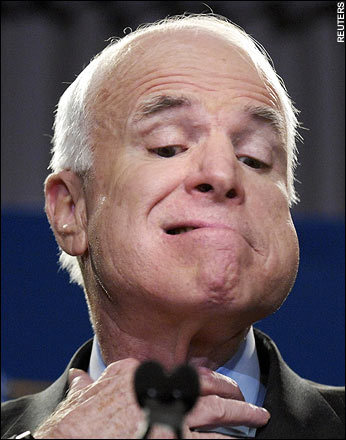
John McCain "the partisan"-even hard for him to swallow!
Arizona Sen. John McCain, trying to fend off a primary challenger trying to outflank him on the right, also found himself trying Sunday to put straight whether he was a “maverick” or not.
McCain’s “maverick” reputation and his past willingness to work with Democrats on issues like the environment, campaign finance reform and immigration before his run for President in 2008 often frustrated or angered fellow Republicans and he has lately made it appear like it’s a moniker he’d like people to forget.
McCain startled many political observers when he told Newsweek magazine “I never considered myself a maverick” — even as Sarah Palin was describing him that way in a campaign appearance late last month in Arizona for her old running mate.
When he appeared on Fox News Sunday, host Chris Wallace pressed McCain on the point, playing a 2008 campaign ad that called him “the original maverick” and showing McCain saying, ” If you want real reform and if you want change, send a team of mavericks. And what maverick really means, what this team of maverick really means, is we understand who we work for.”
Hayworth labels himself the “consistent conservative” on his campaign web site and he has had fun poking McCain over the “maverick” quote. Hayworth told the Politico, “To the extent that he can encourage amnesia in the electorate, that’s what he’s aiming to do.”
A Rasmussen Reports poll conducted April 13 showed that Hayworth had pulled within 5 points of McCain, with McCain leading him 47 percent to 42 percent among likely Republican voters. The margin of error was 4 points. The primary is August 24.
By: Bruce Drake, Contributing Editor-Politics Daily, April 18, 2010
We Gather to Mourn the Loss of John McCain’s Integrity

Maverick or Total Fraud?
We are gathered here today to pay our final respects to John McCain’s integrity.
It died recently — turned a triple somersault, stiffened like an exclamation point, fell to the floor with its tongue hanging out — when the senator told Newsweek, “I never considered myself a maverick.” This, after the hard-fought presidential campaign of 2008 in which McCain, his advertising team, his surrogates and his running mate all but tattooed the “M” word on their foreheads.
Indeed, not only did they call McCain a maverick, but so did the subtitle of his 2003 memoir. Heck, his campaign plane when he ran for president back in 1999 was dubbed Maverick One. Yet there he is in the April 12, 2010, edition of Newsweek, page 29, top of the center column: “I never considered myself a maverick.”
And his integrity kicked twice and was still.
The death was not unexpected. McCain’s integrity had been in ill health for a long time. Once, it had been his most attractive political trait, drawing smitten prose from political reporters and intrigued attention from voters sick of the same old, same old from politicians who would bend like Gumby for the electorate’s approval.
McCain’s integrity wouldn’t allow him to be that guy. He was this hard-bitten former Navy flier and heroic POW, impatient with the belittling demands of politics as usual, a fellow who would speak an impolitic truth or cross the aisle to work with the opposition because he had this quaint idea that the needs of the country superseded the needs of his party. Then came the GOP presidential primary of 2000 in which McCain was bested by one George Walker Bush and a load of dirty tricks. McCain took note. And his integrity took sick.
The illness began in that selfsame campaign.
By his own admission, McCain lied to voters about his opinion of the Confederate battle flag, fearing that calling it what it is — a flag of treason, racism and slavery — would cost him votes in flag-worshipping South Carolina.
In later years, he embraced right-wing religious extremists he had once condemned. And reneged on a promise that he’d be open to repealing “Don’t Ask, Don’t Tell” if military leaders advised it. And went from opposition of offshore oil drilling to “Drill, baby, drill!” And et cetera.
Two things here: One, all the nattering about flip-flops aside, there is nothing wrong with changing one’s opinion. It indicates a thinking mind.
Two, McCain is hardly unique. Indeed, they have a name for people who change their opinions in order to win votes: politicians.
But these are not just changes of opinion we’re talking about. Rather, they are betrayals of core principle. And while that might be politics as usual, there is a higher standard for the politician who has positioned himself as a man of uncommon integrity, a purveyor of straight talk in a nation hungry for same. When that man panders, the disappointment is keen.
So it stings to see McCain knuckle under to the ideological rigidity that makes it heresy to cross the aisle, question the orthodoxy or have an independent thought. There’s a sense of loss for those who ask of leaders, leadership. It reinforces the cynical notion that there is no one out there who is authentic.
One is reminded of that poignant scene in “The Truman Show” where Jim Carrey as Truman Burbank has just discovered his entire life was a made-for-TV fiction. “Was nothing real?” he asks. A voter who believed in John McCain, who regarded his iconoclastic singularity as a stirring example, might be forgiven for asking the very same thing.
“I never considered myself a maverick”?! Wow.
With those words, McCain completes his transmutation into an avatar of all that is wrong in American politics.
May his integrity rest in peace.
Miami Herald columnist Leonard Pitts Jr.’s column appears regularly on editorial pages of The Times. His e-mail address is: lpitts@miamiherald.com: AP photo by Michael Conroy
Share This Blog


 Unknown Feed
- An error has occurred; the feed is probably down. Try again later.
 mykeystrokes.com
You must be logged in to post a comment.