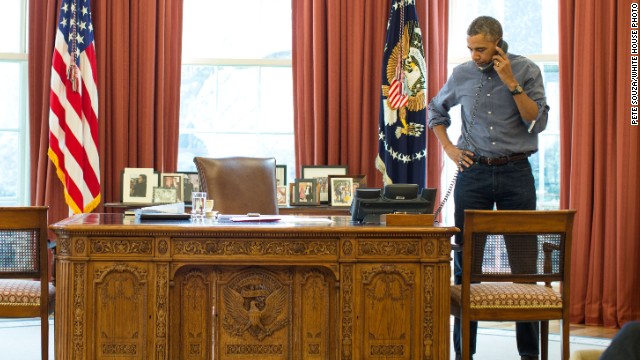
“One American Voice”: GOP Should Listen To Gates On Ukraine
The words of the late Sen. Arthur Vandenberg (R-Mich.) have been ringing my ears these past few days. The then-chairman of the Senate Foreign Relations Committee said in 1947 that “partisan politics [must stop] at the water’s edge.” Translation: No matter the domestic battles with the president, international crises demand we speak with one voice. Those days are long gone judging by the cacophony of ridicule of President Obama because of the actions taken in Ukraine by Russian President Vladimir Putin.
Sen. Lindsey Graham (R-S.C.) said on CNN, “We have a weak and indecisive president that invites aggression.” Sen. John McCain (R-Ariz.) slammed Obama on Monday for having “a feckless foreign policy where nobody believes in America’s strength anymore.” And Sarah Palin, the person McCain saw fit to make his 2008 vice presidential running mate said later that night, “People are looking at Putin as one who wrestles bears and drills for oil. They look at our president as one who wears mom jeans and equivocates and bloviates.”
My Post colleague David Ignatius’s column today was a needed tonic. He got former Defense Secretary Robert Gates on the phone to talk about Republican bashing of the president over Ukraine.
Gates, a Republican himself, urged the GOP senators to “tone down” their criticism and “try to be supportive of the president rather than natter at the president.”
Not only that, Gates told Ignatius that Putin “holds most of the high cards” and that “considerable care needs to be taken in terms of what is said, so that the rhetoric doesn’t threaten what policy can’t deliver.” Ah, such reasonableness from the GOP. Pity Gates, now the chancellor of the College of William and Mary, isn’t in the Senate.
In the end, even he shared my lament. “It seems to me that trying to speak with one voice — one American voice — seems to have become a quaint thing of the past,” Gates told Ignatius. “I regret that enormously.” At least I’m in good company.
By: Jonathan Capehart, Opinion Writer, The Washington Post, March 5, 2014
“Country First, Fellas, Country First”: Republicans Blow The Response To Putin’s Aggression
With nothing to offer beyond what the Obama administration is already pursuing in terms of tough economic recriminations in response to Russia’s offensive moves on the Crimean Peninsula, leading GOP elected officials took to the airwaves on Sunday to do what they always do when they have little in the way of constructive ideas—blame Obama.
The favored GOP meme pursued on the Sunday morning talk circuit revolved around suggestions that Obama’s tendency to draw “red lines”, only to back away from confrontation when possible, has led foreign leaders—including Russian strongman Vladimir Putin—to disrespect the American leader and presume they can do as they please without interference or response from the USA.
Appearing on CNN’s State of The Union, Senator Lindsey Graham had this to say when giving a bit of unsolicited advice to President Obama:
“Well, number one, stop going on television and trying to threaten thugs and dictators. It is not your strong suit. Every time the president goes on national television and threatens Putin or anyone like Putin, everybody’s eyes roll, including mine. We have a weak and indecisive president that invites aggression. President Obama needs to do something. How about this, suspend Russian membership in the G-8 and the G-20 at least for a year starting right now. And for every day they stay in Crimea, add to the suspension. Do something.”
Of course, had Senator Graham reserved comment in a manner more befitting of one who is alleged to be a seasoned statesman and foreign policy ‘expert’, he would have discovered—in but a few short hours—that the White House was way ahead of him. Indeed, the administration had already been hard at work lining up support from the G-8 to suspend preparations for the upcoming talks in Sochi, Russia and was doing so well before Graham threw in his two cents.
But then, I suppose that there is no such thing as statesmanship and commitment to the Commander–In-Chief during a foreign crisis when it is an election year, right Senator Graham?
In a joint statement from the G-8 countries issued on Sunday afternoon, the organization condemned Russia’s “clear violation of the sovereignty and territorial integrity of Ukraine” and informed Putin that the remaining G-8 nations were suspending their participation in preparing for the upcoming summit “until the environment comes back where the G-I is able to have meaningful discussion.”
We are now left to await the Republican effort to take credit for the American policy—despite the fact that achieving such an agreement had to take the White House considerably longer than the couple of elapsed hours between the GOP criticism-fest and the jointly made G-8 announcement.
Even more interesting is the fact that Graham’s idea of playing hardball with Russia, as expressed on CNN, involved suspending the nation from the G-8 group for at least a year plus however many days Russia remains in Crimea.
Meanwhile, Secretary of State John Kerry was on television suggesting that Russia’s actions could actually lead to a far, far tougher punishment for the Russians—the potential that the country could be permanently tossed out of the G-8. This would mean that, after years of effort on the part of Russia to become a member of the economic elite, they would permanently be booted from the fraternity of top players in the world’s democratic nations and left to take a seat at the loser table after once being a part of the “in crowd”.
The simple reality is that were you to apply any sort of logic to the scenario, it becomes more than clear that a ‘tougher’ US policy towards Russia before the Ukraine crisis might have given John McCain some emotional satisfaction, but would have had zero impact on Putin’s decision to move against Crimea. This is the reality due to a very simple reason—the Russians, Americans and Europeans all know that there is not a viable military option to be pursued in this situation.
While Vladimir Putin is many undesirable things, he is likely not an idiot. He knows his importance to Europe is waning now that Europe has developed other ways of obtaining natural gas. Where Europe might have been far more timid when it comes to administering some pain on Russia in the past, they are in a far better position to do so today given their growing ability to stick their noses up at Russian energy. And while Putin may not have known the degree to which the West might turn the economic screws on his country, he had to know that his actions in Ukraine would bring an economic response in some measure.
This being the case, just what do these Republicans believe would have been different had President Obama taken a harder line against Russia during his years in office?
Making the GOP reasoning all the more ridiculous is their willingness to pretend that any weakness Putin may have sensed was the fault of Barack Obama.
If, somehow, Putin was led to believe that there would be no significant economic price to pay in response to his actions—as noted, nobody, including those in the GOP who never met a war they didn’t like, believes there is a military option on the table—why would he be looking at Obama?
It wasn’t President Obama who failed to do much of anything at all when Russia invaded Georgia in 2008. That would be President George W. Bush. And while I know that the reaction to this statement on the part of some will be to carp that I am just one more Obama apologist who wants to blame Bush for everything, I’m afraid one cannot escape history—and history tells us in great clarity that, just six years ago, Putin experienced the opportunity to invade a neighboring nation without any real US or European response whatsoever.
It may be great political fodder for Republicans to blame a president that super-hawk John McCain has now called “the most naïve president in US history” but it certainly appears that it is actually the John McCain line of reasoning that has been hobbled by naivety. Your first clue that this is the case would be the unwillingness of any of the President’s critics to offer up anything in the way of a sophisticated explanation as to how things might have been different had Obama played it rough and tough with Putin.
Given that the White House is showing signs of taking a much harder line and showing a readiness to enforce economic and political sanctions against Russia that go beyond what most Republicans spent the weekend proposing, would it not have been the wise political move for Republicans to simply chill on the useless criticism as the “go to” response and get behind the President? It might, in fact, have very much helped Republicans running for office this year—like Lindsey Graham—to show their constituencies that they can be reasonable and supportive of the President during a crisis, thus adding credibility to their positions where they have opposed the President.
Of course, to do that requires an actual commitment to the advancement of the national interest rather than advancement of personal, political interests—and that is something that has long been in short supply in Republican circles.
Country first, fellas….country first.
By: Rick Ungar, Op-Ed Contributor, Forbes, March 3, 2014
“GOP Take-No-Risks Approach Is Unraveling”: Wacko Birds Cloud Republicans’ Election Euphoria”
Some Republicans envisioned a successful rope-a-dope strategy for this year’s elections: Don’t make mistakes, and let the Democrats stew in the juices of Obamacare and a strapped middle class.
That take-no-risks approach is unraveling. Congressional Republicans are offering proposals on major matters, and the party’s right wing — whose members Senator John McCain called “wacko birds” — is omnipresent in Washington and across the U.S.
Congressional Republicans have introduced initiatives on immigration, health care, and economic mobility and poverty that are creating policy and political fissures. There were four separate Republican responses to President Barack Obama’s State of the Union address last week.
House Speaker John Boehner wants his chamber to pass immigration reform. Any compromise that is acceptable to Hispanic and Asian-American groups draws fire from the party’s sizable nativist bloc and political consultants who don’t want to divert attention from their campaign against health care reform. The Speaker’s task is enormously complicated, the prospects uphill.
On health care, three leading Republican senators recently offered an alternative to the Patient Protection and Affordable Care Act, one they say is more market-centric. But fewer people would be covered, the prohibition on discriminating against people with pre-existing conditions would be weakened, and the authors already are backing away from a proposal to deny tax benefits for some employer-based plans. Many Democrats would relish a debate over the competing plan.
Florida senator Marco Rubio, a contender for the 2016 Republican presidential nomination, took on economic inequality by proposing to expand the earned income tax credit for poor people without children; Obama cited Rubio’s proposal while offering a similar one during his State of the Union address. Rubio deserves credit for trying, but he has gotten tripped up in the specifics: whether the costs should be offset by other reductions in the tax break for the working poor or whether the entire credit should be reshaped.
And the wacko birds are flocking, with a special eye on women and gays.
On women, former Arkansas governor Mike Huckabee wasn’t an outlier with his claim that Democrats believe women can’t control their libidos. Ken Buck, the right-wing Senate candidate in Colorado and a cancer survivor, inexplicably suggested pregnancy was like cancer. This is the same man who in a 2010 race — when his opponent was a woman — said people should vote for him because “I don’t wear high heels.” He also compared being gay to being an alcoholic.
Then there is the always -provocative Texas congressman Louie Gohmert, who said judges who rule in favor of same-sex marriage “need some basic plumbing lessons.” Or Randy Weber, his fellow Texas representative, who tweeted before the State of the Union that he was waiting for the “Kommandant-in-Chef,” who he called “The Socialistic dictator who’s been feeding US a line or is it ’A-Lying?’” Taxpayers pay Weber $174,000 a year.
Out in the provinces, the right-wing base is restless. The Arizona Republican Party recently censured McCain for leftist tendencies. In a few months, state party platforms will be drafted; keep your eye on Texas, where Republicans have called for the elimination of 16 federal cabinet departments or agencies and have come out against promoting “critical thinking” skills in education.
In Iowa, some activists are plotting to dump the state’s moderately conservative lieutenant governor, Kim Reynolds, at the party’s convention. Governor Terry Branstad, a Republican who is likely to be re-elected, is the longest-serving U.S. governor, and there are expectations he will leave during his next term. Unless the ultra-right-wingers have their way, Reynolds then would become the state’s first female governor (Iowans have never elected a woman to the Senate or House, either).
Democrats have their own crazies on the left, but they aren’t as prevalent or influential.
History and polling data suggest Republicans should do well in November, keeping their House majority and with an outside shot at taking control of the Senate. But some of these big issues and the wacko birds could unsettle these prospects.
By: Al Hunt, The National Memo, February 2, 2014
“Learning Lessons From The Umbrage Police”: The Media’s Morality Play And Melissa Harris-Perry
Here’s a can’t-miss prediction for 2014: Some time this year, a media figure will say something offensive about someone who does not share their political ideology. There will be a chorus of feigned outrage. Apologies will be demanded, then grudgingly offered. Those insincerely expressing their displeasure at the original statement will criticize the apology for its insufficient sincerity.
In fact, this little routine will happen multiple times this year (and next year, and the year after that). It will happen with both media figures and politicians. That’s just how we do it in America. There’s so much umbrage taken in politics that it practically constitutes its own industry.
Last week we saw one more of these cases, but it was different from most, in that the eventual apology not only contained what an actual apology should, it was obviously earnest as well. That’s so rare because the insult-apology morality play, in politics at least, is always enacted against a background of partisan contestation that discourages everyone from acting honestly.
To summarize briefly, MSNBC host Melissa Harris-Perry had a segment on her show with a roundtable of comedians in which she put up photos and asked them to come up with amusing captions. One photo was the Romney family Christmas card, with Mitt and Ann posing amongst their hundreds of grandchildren, including a new addition to the brood, an African-American baby adopted not long ago by one of the Romney sons. One of the comedians on the panel sang, “One of these things is not like the other…” and Harris-Perry joked that it would be amusing if one day the child grew up to marry Kanye West and Kim Kardashian’s baby, so Kanye and Mitt could be in-laws.
As far as these kinds of sins go, the brief exchange was pretty mild. It wasn’t as if Harris-Perry or her guest said something particularly cruel about the child; the joke was in the anomaly of a black child in the midst of a family as famously white as the Romneys (dressed on the card in matching pastel-and-khaki outfits, no less). That doesn’t mean it wasn’t problematic, just that we should be able to distinguish between the ill-considered quip and the truly hateful remark.
That broader context is something the rest of us can consider, but Harris-Perry chose not address it when she offered an on-air apology profoundly different from those we usually hear. She didn’t say “I apologize if someone was offended,” as people so often do (which actually means, “I get that you were offended, but I don’t think you should have been”). She didn’t try to minimize it; if anything, she might have made the offending segment sound more offensive than it was. She said it was wrong and took responsibility for it. And most importantly, she said this: “I am genuinely appreciative of everyone who offered serious criticisms of last Sunday’s program, and I am reminded that our fiercest critics can sometimes be our best teachers.”
There were many liberals on social media who expressed the opinion that Harris-Perry shouldn’t have apologized, mainly because it would only deliver succor to the enemies of liberalism, who are a dastardly bunch. But Harris-Perry’s words and evident sincerity made it clear that the apology wasn’t about conservatives, it was about her. She chose to do the right thing, to commit a morally righteous act even if people she doesn’t like would enjoy it.
In other words, she removed herself from the political calculation that asks of everything, “Which side is this good for?” That isn’t easy for someone involved in politics to do, because so many forces push you to see every controversy primarily from that perspective. Had Harris-Perry been focused on not giving her critics any satisfaction, or simply keeping up the fight, she might have given one of those familiar non-apology apologies. She might have said: Listen, imagining Mitt and Kanye at Thanksgiving together isn’t exactly like, say, that time during the Clinton presidency when John McCain asked the crowd at a Republican fundraiser, “Why is Chelsea Clinton so ugly? Because Janet Reno is her father.” That was truly despicable; what I did was a misdemeanor at best.
But she didn’t say those things; instead, she acted the way a good person would, the way most of us hope we’d act in an analogous situation in our own lives. She overcame the natural instinct to be defensive that we all share and to say that our good intentions should absolve us of blame. It’s ironic that we don’t expect that of those in public life, even though in general, the light of attention tends to encourage people to show their best selves. A slew of psychological studies have shown that when we know others are watching us, we’re more likely to act cooperatively, help people in need, and even to pick up after ourselves. When we’re in public we start seeing ourselves through others’ eyes and want to project an admirable persona. That’s why it’s sometimes said that character is what you do when no one’s watching.
For politicians and media figures, someone is always watching, and there’s a legion of people waiting to expose and punish you for the things you say. When you’re being taken to task by people who most assuredly do not have your best interests at heart, it’s awfully hard to ask yourself honestly whether, just this once, they might have a point.
As I’ve often said in comparing ordinary people to presidential candidates, if somebody followed you around recording everything you said for a year—heck, even for a day—there would undoubtedly be some things that passed your lips that would make somebody angry. Now that we have social media, it isn’t necessary to have your own TV show in order to risk a rain of criticism for the ugliness of your momentary thoughts. We all have to be accountable for what we say, but we can pass or fail the test that comes after you say something you shouldn’t have.
The web is full of “The Worst Apologies of 2013” lists (Paula Deen figures heavily), but to my mind, the best one came from Grist‘s David Roberts, who not only apologized for something insulting he said about someone on Twitter, but wrote a long and thoughtful post unpacking the whole episode. “As for the ‘political correctness police,’ well, I’m happy they got me,” he wrote. “That kind of social censure reinforces norms that badly need reinforcement in social media … If I’m briefly being made an example of, that’s as it should be—learn from the example!”
Learning from episodes like this one can be the hardest part, since the prevailing question is usually “Who won?” But maybe next time the umbrage machine fires up, we can ask what was revealed about everyone’s character, not just in what they initially said, but in how they responded to their critics.
By: Paul Waldman, Contributing Editor, The American Prospect, January 6, 2014
“Embracing Debunked Conspiracy Theories”: How The GOP Became A Party Of Benghazi “Truthers”
After a year of demanding answers about the terrorist attack that took place in Benghazi on September 11, 2012, the right wing got them in the form of a well-reported exposé by The New York Times‘ David Kirkpatrick.
And they don’t like these answers at all.
From the night of the murders, Republicans have been shamefully trying to politicize the attack that killed four Americans including Ambassador Chris Stevens, first as a means of stopping the re-election of President Obama, and then to damage the reputation of former secretary of state and possible candidate for president in 2016, Hillary Clinton.
Within hours of Stevens’ death, GOP nominee Mitt Romney accused the Obama administration of “sympathizing” with extremists, as the State Department tried to protect the lives of diplomatic personnel in the face of protests across Northern Africa ginned up in opposition to an offensive depiction of Islamic religious iconography being spread on YouTube. Sensing they had a crisis to parallel 1980′s taking of hostages in Iran, Republicans continued to wage a campaign designed to paint the Obama administration as weak on terror. The Romney campaign suggested that the president was refusing to label the attack as “terrorism” and Senators John McCain (R-AZ) and Lindsey Graham (R-SC) suggested former UN Ambassador Susan Rice was lying and covering up the involvement of al-Qaeda when she offered CIA-approved talking points that the video played a major role in the attack.
Kirkpatrick’s reporting substantiates just about everything Ambassador Rice said as she appeared on several Sunday morning news shows just days after the attack:
Months of investigation by The New York Times, centered on extensive interviews with Libyans in Benghazi who had direct knowledge of the attack there and its context, turned up no evidence that al-Qaeda or other international terrorist groups had any role in the assault. The attack was led, instead, by fighters who had benefited directly from NATO’s extensive air power and logistics support during the uprising against Colonel Qaddafi. And contrary to claims by some members of Congress, it was fueled in large part by anger at an American-made video denigrating Islam.
This reporting closely echoes the original investigation ordered by Secretary Clinton and led by Thomas Pickering, an esteemed diplomat who served under Presidents Ford, Reagan, George H.W. Bush and Clinton.
It was clear that the video played a role, even before Kirkpatrick’s report. But it was unclear if it was the actual motivation for the attack or just a major factor in the unrest destabilizing the region. The Times‘ Middle East correspondent clearly asserts it was central.
It was also unclear if al-Qaeda had played a role in the killings. But this new report likely won’t settle that question, despite Kirkpatrick’s certainty, because the makeup of the terror network is so murky. ”There’s a long-running debate among experts about whether al-Qaeda is more of a centralized, top-down organization, a network of affiliates with varying ties to a core leadership or the vanguard of a broader movement better described as ‘Sunni jihadism,’” Politico Magazine’s Blake Hounshell points out.
All of this leads to a question Secretary Clinton asked when testifying in front of a Senate committee.
“What difference – at this point, what difference does it make?” Clinton said.
Republicans argue that this question disrespects the lives of those four Americans who died in Benghazi. They assert that the president expressly told the military to “stand down” instead of trying to help the men. They accuse Clinton of purposeful negligence and evasion. These claims have all been debunked — there was no stand-down order and Clinton was not directly responsible for the security of an impromptu trip Stevens decided to take on his own, yet she still took responsibility for the tragedy.
The government failed to secure diplomatic resources, as it has under both Democratic and Republican presidents. The involvement of the CIA means that some of the story will likely remain cloaked in secrecy. But no misconduct has ever been proven.
The right wing clearly is not interested in answers, only raising questions—entirely for partisan purposes.
In the aftermath of 9/11, as the Bush/Cheney administration refused a bipartisan investigation of the attacks for a year, anyone who challenged the official story of the attacks and suggested government complicity was labeled a “truther,” a smear that helped cost Van Jones a job in the Obama administration more than a half-decade later.
Rep. Darrell Issa (R-CA), the chairman of the House Oversight Committee, told Meet the Press on Sunday, “What we do know is September 11 [2012] was not an accident.”
He defended his year-long investigation into the tragedy in Benghazi, asserting the same disproven speculation that he has helped fester for months, and concluding, “they went out on five stations and told the story that was, at best, a coverup for CIA, and at worst, something that cast away this idea that there was a real terrorist operation in Benghazi.”
The congressman is still suggesting the military may have purposely refused to help Americans under attack and the administration is covering up the truth, though what it offered, even in the fog of the immediate aftermath of the murders, closely matches some of the best reporting on the subject.
If Issa made those claims about the original 9/11 attacks, we know what he would have been called.
But since much of his party has embraced vague conspiracy theories that suggest the president of the United States either wanted a terrorist attack weeks before an election or “covered up” a terrorist attack that he called a terrorist attack several times before that election, he’s just another Republican.
By: Jason Sattler, The National Memo, December 30, 2013
Share This Blog


 Unknown Feed
- An error has occurred; the feed is probably down. Try again later.
 mykeystrokes.com