“The Facts Aren’t On Mitch McConnell’s Side”: Sorry, GOP, Tax Cuts Don’t Pay For Themselves
As they prepare to take control of Congress, Republicans are looking to change the rules of the game. To lend budget-busting tax cuts the illusion of fiscal responsibility, conservatives would codify the notion that these cuts pay for themselves into congressional accounting rules.
Democrats should not allow this to happen. But if conservatives insist on fudging the numbers, liberals shouldn’t shy away from making creative budgetary arguments of their own.
The accounting device promoted by the right is known as “dynamic scoring,” and it’s politically significant because of the basic policy positions of the two parties. Conservatives tend to favor tax cuts, which come at the expense of social services. Liberals tend to support increasing social services, which come at the cost of higher taxation.
But conservatives have an end-run around this dynamic. They point to the Laffer curve, an economic theory proposing that we can cut tax rates without sacrificing tax revenue, thus avoiding cuts to social services. This is because tax policy has dynamic effects on the macro-economy — that is, cutting tax rates incentivizes people (and particularly high-earners, who gain the most from tax cuts) to work harder, invest more, and generate more economic growth. As the economic pie grows larger, tax revenue can remain constant even as tax rates fall.
Though logical in theory, this idea hasn’t really been borne out in practice. The Bush administration repeatedly predicted that tax cuts would boost overall revenue, but they assuredly did not. And they still don’t, as Kansans have learned during Gov. Sam Brownback’s “real live experiment” in conservative economics, which has only blown a hole in the state budget.
This is because any potential dynamic effects of tax cuts take a long time to materialize, which makes these future benefits extremely difficult to quantify today. And as Congress’ authoritative accountant, the CBO is in the business of attaching hard numbers to would-be laws.
Understandably, the CBO has resisted the uncertain and speculative math of dynamic scoring. But the underlying argument still infuses and skews our political debate. Republicans feel less constrained when proposing tax cuts, while Democrats struggle to shore up revenue sources for government service proposals.
Ostensible fiscal conservatives like Sens. Mitch McConnell (Ky.) and John Kyl (Ariz.) argue that tax cuts need not be paid for at all because they are inherently good for the economy. “[T]here’s no evidence whatsoever that the Bush tax cuts actually diminished revenue,” McConnell contends, in spite of overwhelming evidence that these cuts diminished revenue at historic rates.
Yet these same Republican leaders still insist that spending on unemployment benefits be accounted for by cuts or tax increases elsewhere, even though there’s little compelling economic reason to treat tax cuts and social insurance transfers like unemployment benefits differently. Both policies promote economic growth by increasing disposable income and thereby boosting consumption.
Liberals have largely failed to point this out and haven’t effectively countered conservative attacks on these transfer programs. Contrary to what Speaker John Boehner (Ohio) says, there’s no evidence that unemployment benefits reduce work ethic. And other transfer programs can be carefully structured to minimize any potential work disincentives.
Liberals can do more than play defense in these debates. They, too, can conjure creative arguments for how targeted spending programs can “pay for themselves.”
Take liberal proposals for new or expanded transfer programs like refundable tax credits, child allowances, and other income subsidies. These relieve some of the strain on the budgets of low-income and middle-class Americans. More disposable income means more consumption, which generates higher economic growth and higher overall income, producing more tax revenue. By this logic, transfer programs could pay for themselves, too.
In fact, targeted transfers to the poor and middle class would likely give a stronger immediate jolt to the economy than would tax cuts for the wealthy. Compared with the wealthy, the poor spend a much higher share of each additional dollar of disposable income that they receive, providing greater stimulus to the economy. Policy measures that alleviate inequality are thus a boon for economic growth.
This isn’t to say that liberals should sit back and let dynamic effects fund their policy priorities. Any responsible party must provide revenue sources for new tax or spending programs. But drawing on this rhetoric would level the playing field of our skewed politics. The parameters of our current debate — where liberal proposals must be paid for while conservative ones don’t — are stacked against the interests of average Americans in favor of the wealthy.
Conservatives want to muddy the numbers for our lawmaking process. For the sake of a fair debate, liberals can and must show that two can play at that game.
By: Joel Dodge, The Week, December 19, 2014
Punishing the Jobless
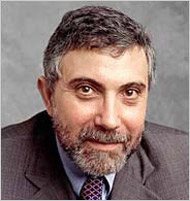
Paul Krugman-Nobel Prize Winner in Economics
There was a time when everyone took it for granted that unemployment insurance, which normally terminates after 26 weeks, would be extended in times of persistent joblessness. It was, most people agreed, the decent thing to do.
But that was then. Today, American workers face the worst job market since the Great Depression, with five job seekers for every job opening, with the average spell of unemployment now at 35 weeks. Yet the Senate went home for the holiday weekend without extending benefits. How was that possible?
The answer is that we’re facing a coalition of the heartless, the clueless and the confused. Nothing can be done about the first group, and probably not much about the second. But maybe it’s possible to clear up some of the confusion.
By the heartless, I mean Republicans who have made the cynical calculation that blocking anything President Obama tries to do — including, or perhaps especially, anything that might alleviate the nation’s economic pain — improves their chances in the midterm elections. Don’t pretend to be shocked: you know they’re out there, and make up a large share of the G.O.P. caucus.
By the clueless I mean people like Sharron Angle, the Republican candidate for senator from Nevada, who has repeatedly insisted that the unemployed are deliberately choosing to stay jobless, so that they can keep collecting benefits. A sample remark: “You can make more money on unemployment than you can going down and getting one of those jobs that is an honest job but it doesn’t pay as much. We’ve put in so much entitlement into our government that we really have spoiled our citizenry.”
Now, I don’t have the impression that unemployed Americans are spoiled; desperate seems more like it. One doubts, however, that any amount of evidence could change Ms. Angle’s view of the world — and there are, unfortunately, a lot of people in our political class just like her.
But there are also, one hopes, at least a few political players who are honestly misinformed about what unemployment benefits do — who believe, for example, that Senator Jon Kyl, Republican of Arizona, was making sense when he declared that extending benefits would make unemployment worse, because “continuing to pay people unemployment compensation is a disincentive for them to seek new work.” So let’s talk about why that belief is dead wrong.
Do unemployment benefits reduce the incentive to seek work? Yes: workers receiving unemployment benefits aren’t quite as desperate as workers without benefits, and are likely to be slightly more choosy about accepting new jobs. The operative word here is “slightly”: recent economic research suggests that the effect of unemployment benefits on worker behavior is much weaker than was previously believed. Still, it’s a real effect when the economy is doing well.
But it’s an effect that is completely irrelevant to our current situation. When the economy is booming, and lack of sufficient willing workers is limiting growth, generous unemployment benefits may keep employment lower than it would have been otherwise. But as you may have noticed, right now the economy isn’t booming — again, there are five unemployed workers for every job opening. Cutting off benefits to the unemployed will make them even more desperate for work — but they can’t take jobs that aren’t there.
Wait: there’s more. One main reason there aren’t enough jobs right now is weak consumer demand. Helping the unemployed, by putting money in the pockets of people who badly need it, helps support consumer spending. That’s why the Congressional Budget Office rates aid to the unemployed as a highly cost-effective form of economic stimulus. And unlike, say, large infrastructure projects, aid to the unemployed creates jobs quickly — while allowing that aid to lapse, which is what is happening right now, is a recipe for even weaker job growth, not in the distant future but over the next few months.
But won’t extending unemployment benefits worsen the budget deficit? Yes, slightly — but as I and others have been arguing at length, penny-pinching in the midst of a severely depressed economy is no way to deal with our long-run budget problems. And penny-pinching at the expense of the unemployed is cruel as well as misguided.
So, is there any chance that these arguments will get through? Not, I fear, to Republicans: “It is difficult to get a man to understand something,” said Upton Sinclair, “when his salary” — or, in this case, his hope of retaking Congress — “depends upon his not understanding it.” But there are also centrist Democrats who have bought into the arguments against helping the unemployed. It’s up to them to step back, realize that they have been misled — and do the right thing by passing extended benefits.
By PAUL KRUGMAN-Published: July 4, 2010 NYT Op-ED
Photo:Fred R. Conrad/The New York Times
Share This Blog


 Unknown Feed
- An error has occurred; the feed is probably down. Try again later.
 mykeystrokes.com
You must be logged in to post a comment.