Discrediting the Legislative Process Itself
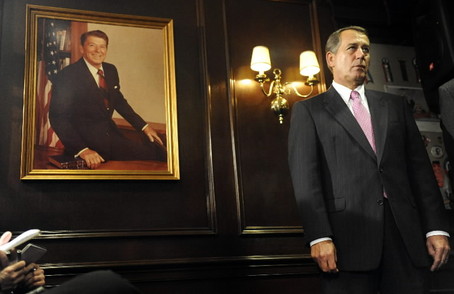
John Boehner-House Minority Leader of "No"
So far in the health-care debate, Republicans have attacked the legitimacy of private negotiations, parochial dealmaking, the budget reconciliation process, self-executing rules, the Congressional Budget Office’s analyses, and even the constitutionality of the legislation. It’s a good theory: Make people hate Washington and mistrust the legislative process and you’ll make people hate and mistrust what emerges from that process.
But it’s also dangerous. As Republicans well know, private negotiations between lawmakers, deals that advantage a state or a district, and a base level of respect for the CBO’s scores have long been central to the lawmaking progress. As the parties have polarized, reconciliation and self-executing rules (like deem and pass) have become more common — and the GOP’s own record, which includes dozens of reconciliation bills and self-executing rules, proves it.
The GOP’s answer to this is that health-care reform is important. Stopping the bill is worth pulling out all the stops. And I’m actually quite sympathetic to this view. Outcomes are, in fact, more important than process. But once you’ve taken the stops out, it’s hard to put them back in. Democrats will launch the very same attacks when they’re consigned to the minority, and maybe think up a few new ones of their own.
The result of this constant assault on how a bill becomes a law — a process that has never before been subject to such 24/7 scrutiny from cable news and blogs and talk radio — will be ever more public cynicism. Evan Bayh put it well in his New York Times op-ed. “Power is constantly sought through the use of means which render its effective use, once acquired, impossible,” he wrote. Republicans, who’re likely to return to power with a majority that’s well below 60 seats in the Senate and a 40-vote margin in the House, will soon find themselves on the wrong end of that calculus.
Photo credit: Melina Mara/Washington Post.
By Ezra Klein | March 19, 2010
Procedurally Correct: The House Can Decide How to Enact Health Reform

House Speaker Nancy Pelosi (D-CA) is considering asking the full House to vote on a package of amendments to the Senate-passed health care bill that would also contain language adopting the Senate bill
People who are opposed to health care reform are raising a real ruckus over a possible parliamentary maneuver being considered by Speaker of the House Nancy Pelosi (D-CA). She is thinking of asking the full House to vote on a package of amendments to the Senate-passed health care bill that would also contain language adopting the Senate bill. That may sound like a fairly exotic method of enacting important legislation, but is it inappropriate? My answer is no.
What this so-called “deeming” provision does is essentially join the two pieces of legislation into one. If the Senate had a different rule on debate this would happen in a conference committee. The House conferees would insist on amendments very similar to those now in the package that Pelosi is bringing to the floor, but the amendments and underlying legislation would all be wrapped together as a single conference report and voted up or down by both the House and Senate.
Because the 59 senators who support health care cannot shut off debate on such a conference report that option is not open, so the House has created this procedure as a substitute.
But, as some might ask, isn’t the 60-vote majority required to end a Senate filibuster part of the legislative process? Is it fair for the House to attempt to circumvent that process by joining two pieces of legislation—one that has already passed the Senate and the other that is being sent to the Senate for consideration?
The answer is yes. Although the filibuster is part of current Senate rules it has not always been. Further, while some continue to think that the 60-vote supermajority required to terminate debate in the Senate has constitutional origins, the Constitution in fact implies that such matters should be resolved by a simple majority—leaving the House free to take whatever view it chooses on the question of the 60-vote supermajority required by current Senate rules.
The possibly apocryphal story of George Washington and Thomas Jefferson arguing over the role of the Senate is often cited by defenders of the filibuster. Washington supposedly asked Jefferson, “Why did you pour that coffee into your saucer?” Jefferson responded, “To cool it.” Then Washington is said to have replied, “Even so, we pour legislation into the senatorial saucer to cool it.”
But the Senate rules did not permit a filibuster at the time this conversation allegedly took place. Filibusters were not allowed under Senate rules until 1806 and they were not practiced until the 1840s—when they were used largely against legislation to limit the practice of slavery.
The Constitution did structure the Senate in a way that it would counterbalance the possibility for erratic tendencies in the House, which elects all of its members every two years. Senators are elected for six-year terms so that only a third of the body is subjected to the scrutiny of the electorate in any one election.
The Constitution does specify that supermajorities are necessary for certain actions by the Senate. For instance, the Constitution requires that two-thirds of the Senate must vote to approve the overturn of a presidential veto or to ratify a treaty. In five other instances the Constitution requires the Senate to act by a supermajority, but for matters such as the passage of ordinary legislation like the health care bill the Constitution provides it to be determined by majority vote.
The House can’t completely circumvent the current Senate rules, but it can respond to the Senate passage of legislation that is unpopular with House members by packaging it as though it were a conference agreement and sending it forward saying that the body agrees to this legislation only if it is amended as specified by the amendments contained in the rest of the package. That is not simply permissible but it provides the House with the only means of voting on the issue that reflects the true sentiment of the body.
Further, it should be noted that use of self-executing or deeming resolutions is in fact not all that exotic and that the record of those feigning great dismay over its use have repeatedly used exactly the same procedure themselves—often with far less justification than can be provided in the current instance. House Minority Leader John Boehner (R-OH) calls the proposed procedure “the twisted scheme by which Democratic leaders plan to bend the rules.” Yet during the 109th Congress alone (a portion of which Rep. Boehner served as his party’s floor leader when his party was in the majority) deeming resolutions were used 36 times and Boehner supported all of them.
What the speaker is now considering as a means of resolving the long-protracted debate on health care is putting the two pieces of legislation that deal with health care together so the House can vote on them up or down as one package. That is the way our new policy on health care should be considered and it is highly regrettable that the archaic and undemocratic rules of the Senate don’t allow that as the order of business in both houses of Congress.
By:Scott Lilly-Senior Fellow at the Center for American Progress-March 17, 2010
Americans Can Speak for Themselves on Federal Health-Care Reform
Have you voted on any of the Democratic health-care-reform plans? Me neither.
No such vote was ever taken. But with coordination that the Rockettes would envy, Republicans insist that “the American people have spoken” on the matter, and they want the proposals killed.
House Republican Leader John Boehner: “The American people have spoken, loudly and clearly: They do not want Washington Democrats’ government takeover of health care.”
Senate Republican Leader Mitch McConnell: “The American people do not want this bill to pass.”
Republican National Committee Chairman Michael Steele: “The American people have spoken. The White House hasn’t heard their message.”
Quite a coincidence, these guys saying the same thing on the same day. No matter. What they’re saying is nonsense.
All politicians try, but Republicans excel, at creating a fantasy public always marching behind their baton. What the GOP leaders lack in veracity, they make up for in confidence.
They base their public mind-reading on polls showing displeasure with the Democrats’ reform legislation (or what the public thinks is in it). They ignore polls that don’t.
Some Americans are unhappy with the lack of a public option in the Senate bill, others with its inclusion in the House version. Many already have their government-guaranteed health coverage and don’t want to share.
Almost everyone detests the “Cornhusker kickback,” a special deal arranged by Nebraska’s Democratic senator, Ben Nelson.
And how does one count strong opinions by those who don’t have the foggiest idea what’s really in the bills — but who are taking their talking orders from partisan yakkers?
It’s worth noting that President Obama’s proposal, based on the Senate bill, does not include a public option. It eliminates the Cornhusker kickback. It eases up on the controversial tax on so-called Cadillac health plans. And in an appeal to older voters, it does away with the Medicare drug benefit’s “doughnut hole.”
The public option has been the most demagogued item in the entire health-care debate — not because it’s a bad, or even radical, idea but because the deep-pocketed insurance industry opposes it.
Republicans have been portraying it, a government-run insurance plan to compete with private options, as a socialist Satan intent on destroying the American Way. The public option has been burning at their stake for so long, it’s a wonder there’s even an ash left of support for it. But a recent Newsweek poll has 50 percent of Americans still favoring a public option and 48 percent opposed. That the administration refused to strenuously defend a cost-saving device that always enjoyed widespread backing is something I’ll never understand (and may never forgive). Nonetheless, health-care reform must pass, with or without the public option.
The last time “the American people” came close to officially speaking on this subject was in November 2008, when they elected a Democratic president and expanded the Democratic majorities in both the House and the Senate.
It’s mind-boggling that any sophisticated analyst would attribute Republican Scott Brown’s surprise victory in the Massachusetts special senatorial election to public rejection of government-guaranteed health care. As a Massachusetts state senator, Brown voted for a universal coverage plan that’s a lot less conservative than what’s on deck in Washington.
The Newsweek poll also asked for feelings about the job that Obama and Republicans and Democrats in Congress were doing on health care reform. Some 52 percent disapproved of Obama’s performance, 61 percent disapproved of the congressional Democrats’, and 63 percent disapproved of the congressional Republicans’.
No one is walking away from this with an Academy Award, but what’s coming out of Republican leaders’ mouths clearly isn’t what’s coming out of the American people’s. The people will speak definitively on Nov. 2.
By: Froma Harrop-Syndicated Columnist-The Seattle Times-Feb 25, 2010 3:54 pm
Share This Blog


 Unknown Feed
- An error has occurred; the feed is probably down. Try again later.
 mykeystrokes.com

You must be logged in to post a comment.