Mr. Speaker: What Comes After No?
The Republicans have vowed to “repeal and replace” President Obama’s historic health care reform law. Now that House Republicans have muscled through a symbolic repeal bill, they will have to deliver their own alternative plan. Don’t expect much.
By: New York Times- Editorial, The Opinion Pages, January 24, 2011
There are many more slogans than details. But it is already clear that their approach would do almost nothing to control skyrocketing health care costs and would provide little help to the 50 million uninsured Americans.
When Republican leaders talk of reducing medical costs they really mean reducing insurance premiums for some people, primarily by letting the young and healthy buy insurance in states that allow the sale of skimpy policies. That won’t help older and less healthy people and would probably drive up their premiums as they flock to states whose regulations guarantee them coverage.
The Republicans have offered no coherent plan for slowing the rapid rise in medical costs that is driving up insurance premiums, Medicare and Medicaid costs, and the federal deficit. The reform law, by contrast, has multiple provisions for changing the delivery of health care in ways that should reduce costs.
As for the Republicans’ calls to reduce waste and fraud in Medicare, reform the medical malpractice system, and expand high-risk pools to cover people with pre-existing conditions, most of these ideas are already in the reform law. They could surely be strengthened if both parties worked together.
Even as it denounces reform at every turn, the Republican leadership has figured out that many Americans want the many consumer protections that come with the new law. So, once reform is repealed, the leaders are vowing to reinstate such provisions as letting young people stay on their parents’ plans until age 26, preventing insurers from canceling policies after people become sick, and barring insurers from placing caps on what they will pay.
The problem is that such requirements will drive up the cost of insurance unless they are paired with a mandate (or comparable prod) requiring that everyone buy insurance so that healthy people offset the costs of less healthy beneficiaries. Yes, that’s the same mandate the Republicans have vowed to overturn.
Many Republicans have also vowed to restore more than $130 billion worth of unjustified subsidies to private Medicare Advantage plans that is needed to help pay for the expansion of coverage under health care reform.
In coming weeks, expect to see a lot more posturing on issues that might energize the party’s conservative base or poll well with people made skittish by months of Republican exaggerations about the new reform law. They have already introduced bills making it even harder for insurance policies in new insurance exchanges to cover abortions, never mind that the law already has incredibly strict provisions.
The Party of No will also try to use its new control of the House to block implementation of reform by withholding money needed to hire people to write necessary regulations. The House Republican Study Committee has proposed legislation that would prohibit using money in the annual budget to carry out any provision of the law or to defend it in court.
The Republicans need to explain how they plan to address the problems of covering the uninsured, wrestling down medical costs and controlling the deficit. Just saying no isn’t enough.
Size Matters: The GOP & Health Care
During the health care debate in 2009 and 2010, a serious issue emerged — the number of pages in congressional bills. I’m not kidding. The Republicans wanted short bills, and the health care reform bill was way, way too long (proving that it did too much and would end civilization as we know it). There was outrage across the country. Angry opponents of reform went to congressional town hall meetings brandishing huge stacks of paper. Then Minority Leader Boehner, foreshadowing his leadership priorities today, used a nationally televised address to condemn the length of the health care bill three times in as many minutes.
The extremists went wild. Rumors swept across the land. Some Tea Party types claimed the bill was 10,000 pages. Slate called the explosive stack-of-paper obsession “peculiar.” Ultimately, the New York Times set the record straight: “In the original version,” the Times said, “H.R. 3590 as passed by the Senate on Dec. 24, 2009, ran to some 2,400 pages, although with a very large font, triple spacing and huge left and right margins.” The newspaper went on to explain that, “With normal margins the document probably would shrink to about 500 pages or so.” Which meant the bill was not really that long when compared to other major bills, such as the financial reform law and past budget deals.
In the November mid-term elections, the Republicans ran on a platform of change, and change is what we got. Not only will the House Republicans vote to repeal the new health care law this week, they’re going to do so with a bill that’s only two pages long.
This is a triumph of conciseness, a 247-word beacon of brevity. The low word-count works especially well for the GOP, given the party’s unfinished “repeal and replace” campaign pledge. The Republicans addressed repeal, but they haven’t quite gotten to the “replace” part. That, we’re told, is a work in progress, and the question is being referred to various House committees to kick around for months.
In Sunday’s Washington Post, reporter Amy Goldstein noted that the Republican repeal vote is “the prelude to a two-pronged strategy that is likely to last throughout the year, or longer.” Great. Just what we need — another interminable debate on health care when the Republicans ought to be focusing on bipartisan solutions to create jobs. Rep. Fred Upton (R-Mich.), the new House Energy and Commerce Committee chairman, said it “may take time” for the GOP to develop a health care plan. Upton, who has been in Congress since 1987, has had only 24 years to come up with some health care ideas of his own. Instead, he hired Julie Goon, the former top lobbyist for the health insurance industry’s biggest trade group, as his special adviser.
I’m not sure what the Republican “replace” plan is (or how many pages it will be), but I know their two-page repeal bill is a bad deal for America’s families, seniors and small businesses.
The Republican repeal bill will take away dozens of benefits and important consumer protections that are making a real difference in peoples’ lives right now. When the Republicans vote for repeal, they’ll be taking away people’s newly won freedom from fear of insurers denying their care, dropping them when their sick and imposing double-digit premium hikes with impunity. They’ll be booting young adults off their parents’ health plans. They’ll be telling seniors they have to pay back the $250 donut hole checks they received to help buy prescription medications and give up their new 50% discount on brand-name drugs. The Republican repeal plan will force nearly 900,000 American families a year into bankruptcy because of huge medical bills. And it will take job-creating tax credits away from small businesses.
Speaker John Boehner and the Republicans don’t want the public to know the truth about the Affordable Care Act and what their repeal plan will take away from America’s consumers. And you can bet the debate about repeal will be filled with misleading information from Boehner and the new Republican majority. To help folks see beyond the rhetoric, Health Care for America Now made a chart that tells the truth. You can read and download a printable, high-resolution version with citations here and below.
The Republican Repeal Bill puts insurance companies back in charge of your health care.
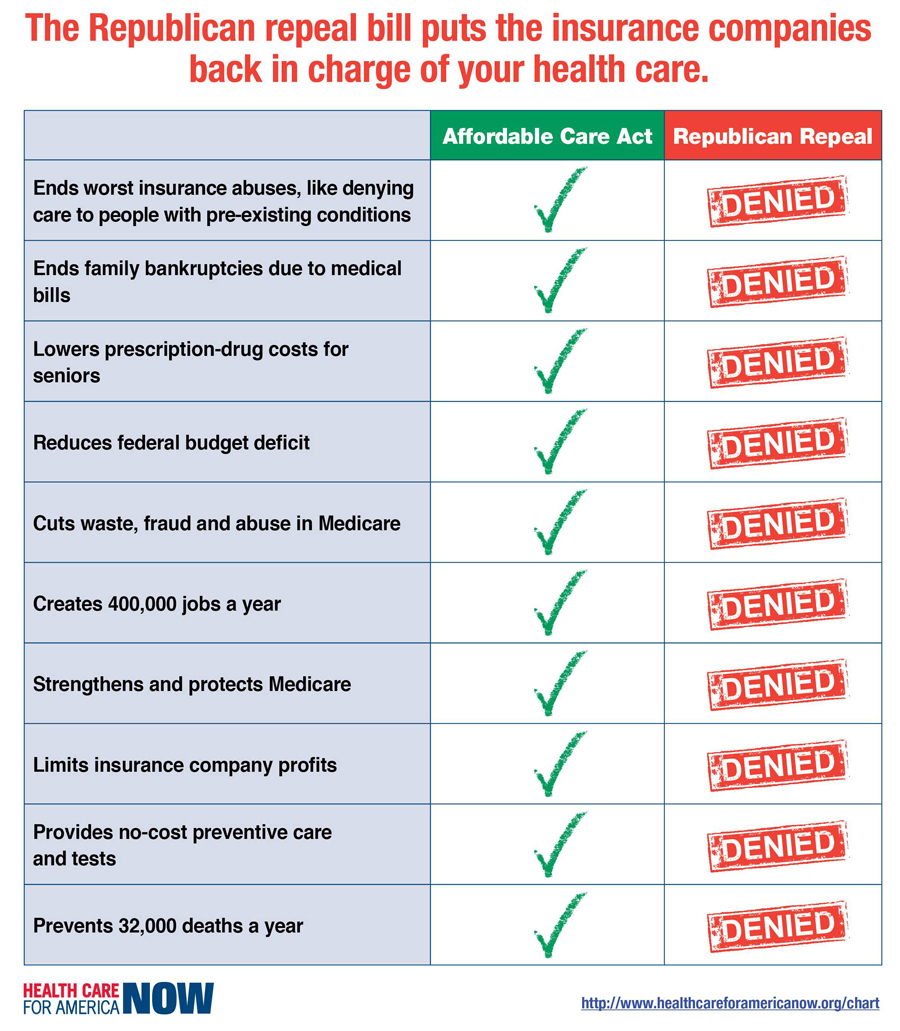
The Republican Repeal Bill
When Opposition to Health-Care Reform Stops Being Polite and Starts Getting Scary
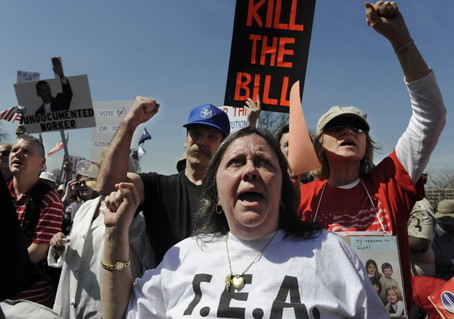
When do you cross the line?
In the Wyoming state legislature, 10 congressmen and three senators have co-sponsored “The Health Care Choice and Protection Act.” The intent? To make it a felony to implement the health-care reform law — which is, you’ll remember, the official law of the land. Here’s the relevant bit:
Enforcement of federal laws prohibited; offenses and penalties.
Any official, agent, employee or public servant of the state of Wyoming as defined in W.S. 6-5-101, who enforces or attempts to enforce an act, order, law, statute, rule or regulation of the government of the United States in violation of this article shall be guilty of a felony punishable by a fine of not more than five thousand dollars ($5,000.00), imprisonment in the county jail for not more than two (2) years, or both.
Any official, agent or employee of the United States government or any employee of a corporation providing services to the United States government that enforces or attempts to enforce an act, order, law, statute, rule or regulation of the government of the United States in violation of this article shall be guilty of a felony punishable by imprisonment for not more than five (5) years, a fine of not more than five thousand dollars ($5,000.00), or both.
There’s not much use in worrying about something like this as it wouldn’t survive two seconds in a court of law. But the sentiments are worth considering: The argument is that this legislation isn’t just policy that the authors disagree with, but rather a deeply, profoundly, un-American threat to liberty. It’s so un-American, in fact, that a plain reading of the Constitution makes clear that the Wyoming legislature, which has sworn to protect and defend the document, must “adopt and enact any and all measures as may be necessary within the borders of Wyoming to prevent the enforcement of the Patient Protection and Affordable Care Act and the Health Care and Education Reconciliation Act of 2010.”
Many of my friends on the right have legitimate technocratic differences with the Affordable Care Act. But many of the politicians they’ve stood with have not made a legitimate case against the bill. Rather, they’ve taken a bill that echoes past legislation Republicans have introduced and called it, as Sen. Jon Kyl did, “a stunning threat to liberty.” They’ve told their supporters, as Sen, Chuck Grassley did, that they’re right to fear that the health-care bill “determines if you’re going to pull the plug on grandma.” This is not merely legislation that they have some technical or philosophical disagreements with. It is, in the words of Speaker John Boehner, “a monstrosity.”
Given the extremism of the rhetoric at the top, is it any wonder that there is incredible fear trickling down to the grass roots? If those are the stakes, then of course criminalizing any implementation of the bill makes sense. Frankly, if those are the stakes, then violent resistance might be required.
Those aren’t the stakes, of course. They’re just the words. And words slip sometimes. Things come out too angry, or too quickly, or too sharply. I’ve had my share of experience with this. But words matter. And the Republican Party hasn’t been slipping up: It’s been engaged in a concerted campaign to scare the population into opposing health-care reform. That may be good politics, but it can have bad consequences.
By: Ezra Klein-Washington Post-January 7, 2011: Photo By: Melina Mara-Washington Post
PolitiFact’s Lie of the Year: ‘A government takeover of health care’
In the spring of 2009, a Republican strategist settled on a brilliant and powerful attack line for President Barack Obama’s ambitious plan to overhaul America’s health insurance system. Frank Luntz, a consultant famous for his phraseology, urged GOP leaders to call it a “government takeover.”
“Takeovers are like coups,” Luntz wrote in a 28-page memo. “They both lead to dictators and a loss of freedom.”
The line stuck. By the time the health care bill was headed toward passage in early 2010, Obama and congressional Democrats had sanded down their program, dropping the “public option” concept that was derided as too much government intrusion. The law passed in March, with new regulations, but no government-run plan.
But as Republicans smelled serious opportunity in the midterm elections, they didn’t let facts get in the way of a great punchline. And few in the press challenged their frequent assertion that under Obama, the government was going to take over the health care industry.
PolitiFact editors and reporters have chosen “government takeover of health care” as the 2010 Lie of the Year. Uttered by dozens of politicians and pundits, it played an important role in shaping public opinion about the health care plan and was a significant factor in the Democrats’ shellacking in the November elections.
Readers of PolitiFact, the St. Petersburg Times‘ independent fact-checking website, also chose it as the year’s most significant falsehood by an overwhelming margin. (Their second-place choice was Rep. Michele Bachmann’s claim that Obama was going to spend $200 million a day on a trip to India, a falsity that still sprouts.)
By selecting “government takeover’ as Lie of the Year, PolitiFact is not making a judgment on whether the health care law is good policy.
The phrase is simply not true.
Said Jonathan Oberlander, a professor of health policy at the University of North Carolina-Chapel Hill: “The label ‘government takeover” has no basis in reality, but instead reflects a political dynamic where conservatives label any increase in government authority in health care as a ‘takeover.’ ”
An inaccurate claim
“Government takeover” conjures a European approach where the government owns the hospitals and the doctors are public employees. But the law Congress passed, parts of which have already gone into effect, relies largely on the free market:
• Employers will continue to provide health insurance to the majority of Americans through private insurance companies.
• Contrary to the claim, more people will get private health coverage. The law sets up “exchanges” where private insurers will compete to provide coverage to people who don’t have it.
• The government will not seize control of hospitals or nationalize doctors.
• The law does not include the public option, a government-run insurance plan that would have competed with private insurers.
• The law gives tax credits to people who have difficulty affording insurance, so they can buy their coverage from private providers on the exchange. But here too, the approach relies on a free market with regulations, not socialized medicine.
PolitiFact reporters have studied the 906-page bill and interviewed independent health care experts. We have concluded it is inaccurate to call the plan a government takeover because it relies largely on the existing system of health coverage provided by employers.
It’s true that the law does significantly increase government regulation of health insurers. But it is, at its heart, a system that relies on private companies and the free market.
Republicans who maintain the Democratic plan is a government takeover say that characterization is justified because the plan increases federal regulation and will require Americans to buy health insurance.
But while those provisions are real, the majority of Americans will continue to get coverage from private insurers. And it will bring new business for the insurance industry: People who don”t currently have coverage will get it, for the most part, from private insurance companies.
Consider some analogies about strict government regulation. The Federal Aviation Administration imposes detailed rules on airlines. State laws require drivers to have car insurance. Regulators tell electric utilities what they can charge. Yet that heavy regulation is not described as a government takeover.
This year, PolitiFact analyzed five claims of a “government takeover of health care.” Three were rated Pants on Fire, two were rated False.
‘Can’t do it in four words’
Other news organizations have also said the claim is false.
Slate said “the proposed health care reform does not take over the system in any sense.’ In a New York Times economics blog, Princeton University professor Uwe Reinhardt, an expert in health care economics, said, “Yes, there would be a substantial government-mandated reorganization of this relatively small corner of the private health insurance market (that serves people who have been buying individual policies). But that hardly constitutes a government takeover of American health care.”
FactCheck.org, an independent fact-checking group run by the University of Pennsylvania, has debunked it several times, calling it one of the “whoppers” about health care and saying the reform plan is neither “government-run” nor a “government takeover.”
We asked incoming House Speaker John Boehner’s office why Republican leaders repeat the phrase when it has repeatedly been shown to be incorrect. Michael Steel, Boehner’s spokesman, replied, “We believe that the job-killing ObamaCare law will result in a government takeover of health care. That’s why we have pledged to repeal it, and replace it with common-sense reforms that actually lower costs.”
Analysts say health care reform is such a complicated topic that it often cannot be summarized in snappy talking points.
“If you’re going to tell the truth about something as complicated as health care and health care reform, you probably need at least four sentences,” said Maggie Mahar, author of Money-Driven Medicine: The Real Reason Health Care Costs So Much. “You can”t do it in four words.”
Mahar said the GOP simplification distorted the truth about the plan. “Doctors will not be working for the government. Hospitals will not be owned by the government,” she said. “That’s what a government takeover of health care would mean, and that’s not at all what we”re doing.”
How the line was used
If you followed the health care debate or the midterm election – even casually – it’s likely you heard “government takeover” many times.
PolitiFact sought to count how often the phrase was used in 2010 but found an accurate tally was unfeasible because it had been repeated so frequently in so many places. It was used hundreds of times during the debate over the bill and then revived during the fall campaign. A few numbers:
• The phrase appears more than 90 times on Boehner’s website, GOPLeader.gov.
• It was mentioned eight times in the 48-page Republican campaign platform “A Pledge to America” as part of their plan to “repeal and replace the government takeover of health care.”
• The Republican National Committee’s website mentions a government takeover of health care more than 200 times.
Conservative groups and tea party organizations joined the chorus. It was used by FreedomWorks, the Heritage Foundation and the Cato Institute.
The phrase proliferated in the media even after Democrats dropped the public option. In 2010 alone, “government takeover” was mentioned 28 times in the Washington Post, 77 times in Politico and 79 times on CNN. A review of TV transcripts showed “government takeover” was primarily used as a catchy sound bite, not for discussions of policy details.
In most transcripts we examined, Republican leaders used the phrase without being challenged by interviewers. For example, during Boehner’s Jan. 31 appearance on Meet the Press, Boehner said it five times. But not once was he challenged about it.
In rare cases when the point was questioned, the GOP leader would recite various regulations found in the bill and insist that they constituted a takeover. But such followups were rare.
An effective phrase
Politicians and officials in the health care industry have been warning about a “government takeover” for decades.
The phrase became widely used in the early 1990s when President Bill Clinton was trying to pass health care legislation. Then, as today, Democrats tried to debunk the popular Republican refrain.
When Obama proposed his health plan in the spring of 2009, Luntz, a Republican strategist famous for his research on effective phrases, met with focus groups to determine which messages would work best for the Republicans. He did not respond to calls and e-mails from PolitiFact asking him to discuss the phrase.
The 28-page memo he wrote after those sessions, “The Language of Healthcare 2009,” provides a rare glimpse into the art of finding words and phrases that strike a responsive chord with voters.
The memo begins with “The 10 Rules for Stopping the ‘Washington Takeover’ of Healthcare.” Rule No. 4 says people “are deathly afraid that a government takeover will lower their quality of care – so they are extremely receptive to the anti-Washington approach. It’s not an economic issue. It’s a bureaucratic issue.”
The memo is about salesmanship, not substance. It doesn’t address whether the lines are accurate. It just says they are effective and that Republicans should use them. Indeed, facing a Democratic plan that actually relied on the free market to try to bring down costs, Luntz recommended sidestepping that inconvenient fact:
“The arguments against the Democrats’ healthcare plan must center around politicians, bureaucrats and Washington … not the free market, tax incentives or competition.”
Democrats tried to combat the barrage of charges about a government takeover. The White House and House Speaker Nancy Pelosi repeatedly put out statements, but they were drowned out by a disciplined GOP that used the phrase over and over.
Democrats could never agree on their own phrases and were all over the map in their responses, said Howard Dean, former head of the Democratic National Committee.
“It was uncoordinated. Everyone had their own idea,” Dean said in an interview with PolitiFact.
“The Democrats are atrocious at messaging,” he said. “They’ve gotten worse since I left, not better. It’s just appalling. First of all, you don”t play defense when you”re doing messaging, you play offense. The Republicans have learned this well.”
Dean grudgingly admires the Republican wordsmith. “Frank Luntz has it right, he just works for the wrong side. You give very simple catch phrases that encapsulate the philosophy of the bill.”
A responsive chord
By March of this year, when Obama signed the bill into law, 53 percent of respondents in a Bloomberg poll said they agreed that “the current proposal to overhaul health care amounts to a government takeover.”
Exit polls showed the economy was the top issue for voters in the November election, but analysts said the drumbeat about the “government takeover” during the campaign helped cement the advantage for the Republicans.
Rep. Earl Blumenauer, an Oregon Democrat whose provision for Medicare end-of-life care was distorted into the charge of “death panels” (last year’s Lie of the Year), said the Republicans’ success with the phrase was a matter of repetition.
“There was a uniformity of Republican messaging that was disconnected from facts,” Blumenauer said. “The sheer discipline . . . was breathtaking.”
By: Bill Adair, Angie Drobnic Holan, PolitiFact-December 16th, 2010
Let’s Repeal 2010

Gail Collins-Photo:Tony Cenicola/The New York Times
This has been a bad summer for almost everybody — celebrities, shrimpers, Washington insiders, Tea Party outsiders, people who prefer pleasant weather. So far, my list of who did well only includes the Spanish soccer team and Paul the prophetic octopus. Plus, according to Senator Jim Bunning, George Steinbrenner. The Kentucky Republican praised the Yankee owner in the Senate Finance Committee for being “smart enough to die in 2010,” when the estate tax is temporarily suspended.
This week, Congress passed the huge reform of the financial industry that it had been working on for nearly two years. You’d think there would have been cheering from coast to coast, but the left was disheartened to discover that contrary to all previous precedent, Congress had passed a bill that was imperfect.
“Ending debate on the bill is finishing before the job is done,” said Senator Russ Feingold of Wisconsin, the only Democrat to vote no.
Great idea. I think I speak for us all when I say that there is absolutely nothing I would like better than additional talking in the Senate. It always seems to make things better. Meanwhile, down in the House, John Boehner, the Republican leader, raised the ante, calling for repeal.
Who says that Boehner just hangs out at bars and tanning parlors and doesn’t work hard? The man is tireless! Everybody else was exhausted, but he wanted to start over.
“There are common sense things we should do to plug the holes in the regulatory system … and to bring more transparency to financial transactions. Because transparency is like sunlight and sunlight is the best disinfectant,” he said.
This is an exciting new analogy for Boehner. Just a couple of weeks ago he was leading the opposition to a bill that would require groups that pay for political attack ads to reveal their true identities. Boehner called it a “back-room deal to shred our Constitution.” In this case, transparency was a dangerous concept that would strip away all protective covering and allow vicious ultraviolet rays to stream through the window and burn away our precious freedoms.
Most Republicans are not joining Boehner in his call to repeal the financial reform bill because they are too busy calling for the repeal of health care reform. “The bill should be scrapped and replaced with much better ideas,” said Mario Rubio, the Republican Senate candidate in Florida.
Rubio’s own idea is to eliminate the requirement that healthy people have insurance, but keep the part that says insurance companies have to cover people with pre-existing conditions. This sounds like the ideal solution — no one would have to buy insurance until they got sick, and then they could make the companies sell them a whole bunch of coverage. I don’t know why nobody thought of this before.
With all these great ideas around — debate more, start over, don’t clean the windows — it’s a wonder that Washington hasn’t become the image of Athens in the age of Pericles. But instead, all Barack Obama’s critics have been able to do is make the country feel gloomy about Barack Obama. He’s passed more major legislation than anybody since Franklin Roosevelt and he’s got popularity ratings that look more like Martin Van Buren’s.
This week, there was an enormous outcry at the news that the president was going to take his wife and children to Maine for the weekend. This is the third time he and his family went away for a weekend since the gulf oil crisis. Three weekends in three months!
“Presidents are certainly entitled to vacation, just like everybody else, but there is a fine line as to when presidents should do it, what they should and where they should do it,” a former member of George W. Bush’s staff told CNN. The staff member in question, Brad Blakeman, was in charge of appointments and scheduling. Surely there is nobody better qualified to discuss this important subject than the man who helped the previous president get out of town for a third of his entire time in office.
The Republicans have now set up a site called “Golf or Gulf” that lists all the things Obama has been doing for the last three months when he could have been sitting around worrying about the oil spill. He had Paul McCartney over to the White House. And he played golf 10 times!
Let’s repeal the oil spill and start all over. The right way to handle the disaster, it appears from the many, many critiques, would have been to:
— Call all the oil company executives together to come up with a plan.
— Denounce all the oil companies.
— Apologize to the oil companies.
— Tell Paul McCartney he cannot sing in the White House until all the pelicans are clean.
By GAIL COLLINS-Op-Ed Columnist/NYT
Published: July 16, 2010
Share This Blog


 Unknown Feed
- An error has occurred; the feed is probably down. Try again later.
 mykeystrokes.com
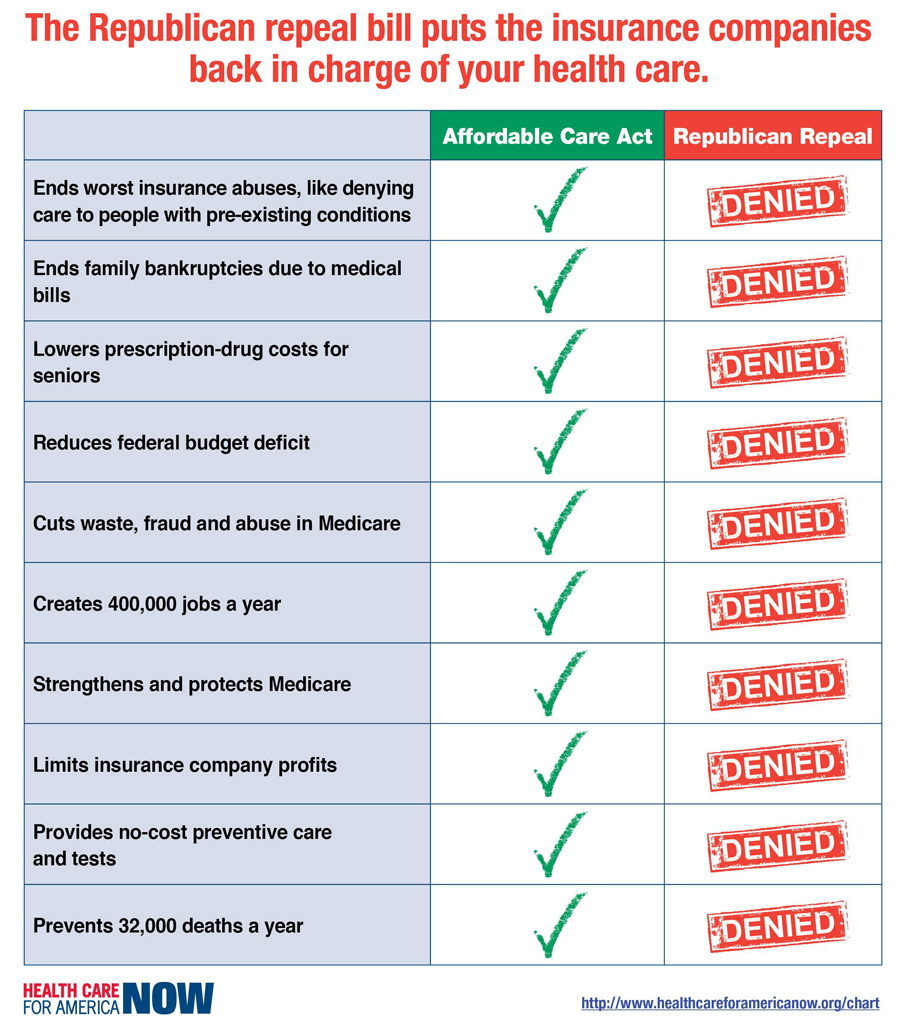
You must be logged in to post a comment.