How Conservative Attacks on Health Care Reform Will Affect You
Attempts to Repeal Affordable Care Act Have Serious Consequences
The Affordable Care Act provides Americans economic and health security with protections against exorbitant premium hikes, better health benefits, and slower growth in health care costs. Conservatives in the Congress are intent on taking these benefits away.
Conservatives are starting to implement their onslaught to repeal the Affordable Care Act this week as Republicans take control of the House of Representatives. They have scheduled a vote on January 12. If conservatives have their way and repeal the Affordable Care Act, we will go back to a health care system that failed millions of Americans: one with skyrocketing costs bankrupting families and our budget, fewer people with access to quality care, and more people at the mercy of the health insurance industry.
Increasing premiums for millions of Americans. Prior to passage of the Affordable Care Act, individuals and families were faced with skyrocketing premiums. Premiums for individuals increased 120 percent and family premiums increased 130 percent from 1999 to 2009. The Affordable Care Act controls these costs. In fact, the nonpartisan Congressional Budget Office or CBO looked at the law’s effect on premiums in 2016 and estimated that the health reform law would cut premiums for millions of Americans. These premiums cuts would be more substantial for those in the individual market, most of whom will receive subsidies to help cover the cost. According to the CBO, those receiving help in the individual market would see their premiums reduced by 56 percent to 59 percent less than they would pay without the law, while also enjoy better coverage than what they currently receive. Repealing the law means going back to a status quo of skyrocketing premiums that made health insurance out of reach and unaffordable for American families.
Costing 400,000 jobs annually. The Affordable Care Act helps create as many as 400,000 jobs annually over the next decade by lowering costs and helping promote a healthier workforce. It includes cost-containment measures to slow the rate of growth of health care spending. Small businesses in particular are helped through exchanges that allow them to pool resources to lower costs as well as tax credits to make it more affordable to offer their employees health coverage. These cost-reduction provisions free up money that otherwise would be spent on health care and allow companies to spend it hiring more workers. In addition, a healthier workforce is a more productive workforce. Those benefits disappear, as well as the jobs created along with it, if the law is repealed.
Increasing costs for seniors by as much as $1,500 in 2011. The Affordable Care Act eliminates the “donut hole” in the Medicare prescription drug program by 2020. Seniors with high prescription drug expenses before health reform had to pay full price for their prescription drugs—without any help from their drug plan—once their prescription drug spending reached a pre-defined limit. People who hit this limit in 2011 will get a 50 percent discount on their name-brand prescription drugs, saving some Medicare enrollees as much as $1,500 in out-of-pocket drug costs. Those savings will not be realized if the Affordable Care Act is repealed.
Hurting communities of color. Communities of color are more likely to be uninsured, and they suffer from higher rates of chronic illness than the rest of the population. The Affordable Care Act addresses these inequities by expanding health insurance coverage and improving access to primary care, including preventive services. These provisions will be eliminated if conservatives have their way and repeal the health reform law.
Increasing costs and deficits. The Affordable Care Act creates tools to control the growth in health costs while improving quality of care. Effective implementation can reduce administrative costs for small businesses and individuals, promote greater use of preventive care, and prevent unnecessary hospitalizations, saving as much as $2 trillion in total health spending over the next decade. In addition, the CBO estimated the law will reduce the federal budget deficit by $143 billion over the first 10 years and more than $1.2 trillion over the next two decades. Repealing the new law stymies these much-needed efforts and reverts to the unsustainable status quo of skyrocketing costs that were bankrupting our country. Make no mistake: The Affordable Care Act provides Americans economic and health security with protections against exorbitant premium hikes, better health benefits, and slower growth in health care costs. Conservatives in Congress are intent on taking these benefits away and going back to a health system that was failing America. And, to top it off, they’d keep their benefits, while taking away ours.
Americans deserve better. We need the Affordable Care Act.
By: Tony Carrk, Center For American Progress. Note: Originally Published January 5, 2011 prior to US House Vote on Repeal.
Charles Krauthammer Is the Fraud
Charles Krauthammer says that Obama has conned Republicans into agreeing to a second stimulus even bigger than the first. Democrats are too stupid to see this (and Republicans are even more stupid, presumably, since they are the victims).
Barack Obama won the great tax-cut showdown of 2010 – and House Democrats don’t have a clue that he did. In the deal struck this week, the president negotiated the biggest stimulus in American history, larger than his $814 billion 2009 stimulus package. It will pump a trillion borrowed Chinese dollars into the U.S. economy over the next two years – which just happen to be the two years of the run-up to the next presidential election. This is a defeat?
He’s right about the Democrats’ stupidity, but this is not Krauthammer at his most lucid.
Yes, Democrats are fools to tear their hair out over this deal, which gives them most of what they wanted: the middle-class tax rates, unemployment benefit extension, payroll-tax cut, and so on. They compound the idiocy by advertising higher taxes on the rich as their core objective. Forget relieving poverty, widening access to health care, improving opportunities for the disadvantaged. What matters more than any of that is sticking it to “millionaires and billionaires” (two-earner households making more than $250,000). You bet, the Democrats are acting like fools.But this stimulus is not bigger than the first, not even close. Two-thirds of its “cost” is keeping tax rates where they currently are. There is no new stimulus in failing to put taxes up–in forgoing a drastic fiscal tightening that nobody wanted and nobody expected. Unlike Krauthammer, I think further short-term stimulus makes sense, so I welcome the $300 billion (over two years) or so of extra stimulus in the deal. Oppose this if you like, but please don’t call it a bigger stimulus than the first.
In any event, the key question is this: does Krauthammer oppose the deal? Having declared Obama guilty of a massive swindle, and recalling that he is opposed to all of Obama’s sinister purposes, Krauthammer is obliged by his own logic to say what a bad thing the agreement must be. So what exactly did he want to happen? Presumably, raise everybody’s taxes next month, with an especially steep rise for $250,000+ households. Has he previously advocated this policy? Maybe he has, and I missed it; if so, I apologize. But if he agrees it makes sense for now to keep taxes where they are, which has been the Republicans’ defensible position, what is so bad about what just happened? Krauthammer is left opposing it because Obama was in favour. It is not every day that Krauthammer is backed into an absurd and dishonest position by his own logic.
What about the long-term deficit? This deal, if temporary, has little effect on that either way, and could easily be deficit-reducing if it avoids a second dip (as Krauthammer seems to concede it might). Obviously, the long-term deficit remains a huge concern. Tackling that requires prolonged Bowles-Simpson-type efforts that were not on the agenda for this deal. They should have been, but they weren’t. Was that a reason for rejecting the deal and letting taxes rise next month? I think not. Again, if that is the outcome Krauthammer wanted, then all right. But if that is not his position, then he is the fraud.
Read David Brooks instead.
BY: Clive Crook, Senior Editor of The Atlantic-December 11, 2010
Obama’s Silent Majority
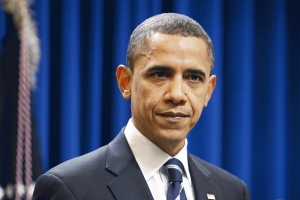
Preident Barack Obama

Preident Barack Obama
You’d never know it from cable news, but the average liberal Democrat actually likes the job the president is doing
Everyone knows that progressives have been growing increasingly disillusioned with Barack Obama since, well … even before he took office. He’s compromised too much, fought too little, sold out on one big issue after another, and fallen horribly, tragically short of the transformational goals that defined his 2008 campaign.
And now that he’s gone and cut a deal with Mitch McConnell (of all people!) to keep the Bush tax cuts in place for the wealthiest Americans for the next two years (at least), the left’s anger is louder than ever. No wonder Time’s Mark Halperin says the president’s base is “shattered.” And no wonder the media is filled with speculation about a potential challenge to the president in the 2012 Democratic primaries. Really, has there ever been a president who’s succeeded so thoroughly in taking the very people who put him in office and turning them against him?
It’s a fun topic for cable news and the blogosphere, where liberal commentators and activists routinely brand the president a Judas and threaten to support a primary challenger in 2012. And it’s a fun topic in the “mainstream media,” which takes all of this racket as confirmation that Obama is rapidly losing — or has already lost — his base.
There’s just one problem: The premise on which all of this is based is totally and completely wrong. Liberal commentators and activists and interest group leaders may be seething over Obama, but their rage has not trickled down to the Democratic voters (and, in particular, the Democratic voters who identify themselves as liberals), even though they’ve been venting their grief for the better part of two years.
As I noted earlier this week, Obama’s approval rating among Democrats has held steady at or near the 80 percent level throughout all of the turmoil of 2010. This puts him in as strong a position with his own party’s voters as any modern president has been at this same point in his presidency (with the exception of George W. Bush, whose numbers remained unusually high for well over a year after 9/11). Look closer and you’ll also find that Obama’s approval rating among Democrats is actually highest among those who call themselves liberals — an 83 percent score in the most recent round of Gallup polling, completed a few days ago. Among moderate Democrats, he clocks in at 75 percent, and among conservative Democrats, 69 percent. Again, these numbers have more or less held steady all year. To the extent Obama has a serious problem with Democrats, then, it’s with those who are on the right, not the left. This is hardly what you’d expect for a president who, according to the dominant narrative, has spent his presidency poking a stick in the left’s eye by cutting deals with conservative Democrats and Republicans.
Obama, in other words, seems to have developed his own silent majority. Rank-and-file liberal Democrats may not agree with everything he has done, but they do not share the sense of abandonment and betrayal that has defined liberal commentary throughout so much of his presidency. The party’s liberal base still very much likes him; it’s the elites who have turned on him.
The biggest reason for this disconnect, I would suggest, is that the liberal Democratic base liked Obama, both personally and ideologically, from the very beginning. Virtually from the moment he electrified the 2004 Democratic convention, liberals latched on to him as one of their own — and they haven’t (and don’t want to) let go.
This is not an unheard of phenomenon in politics, and it’s one of the reasons I’ve been so keen on comparing Obama’s political appeal to that of Ronald Reagan. Rank-and-file conservatives felt as strongly about Reagan in the 1980 campaign (and in 1976, for that matter) as liberals did about Obama in 2008. And they stayed true to him even when conservative elites concluded two years into his term that Reagan was a sellout.
Indeed, in the wake of this week’s drama over the Bush tax cuts, it’s worth recalling a similar moment in Reagan’s presidency, when congressional Democrats forced him into a tax hike in the summer of 1982. Like Obama now, Reagan had no leverage: The economy was spiraling out of control, voters were abandoning him, and Democrats were having great success (or seeming to have great success) hammering him over the exploding deficit. Thus did Reagan agree to a tax hike package that increased revenues by nearly $100 billion over the next three years — the largest tax increase in history, right-wing activists and commentators screamed. To these conservative elites, it was simply the latest act of betrayal by their one-time hero. When the GOP was drubbed in that fall’s midterms, they claimed vindication (see — not conservative enough!) and talked openly of challenging Reagan in the 1984 primaries. But rank-and-file conservative voters didn’t listen. They still liked the Gipper, still thought he was one of them, and still backed him in polling. It’s the same story today for Obama with rank-and-file liberals.
If Obama had been introduced to the Democratic base differently — that is, if they’d been suspicious and resistant to him and he’d landed in the presidency in spite of their skepticism — the objections of liberal elites might be far more damaging.
Here a parallel can be drawn to George H.W. Bush, who was introduced to the GOP’s “New Right” base in 1980 as the moderate, Gerald Ford-ish establishment Republican running against Reagan. Thus, the New Right, which essentially took control of the GOP for good with Reagan’s ’80 triumph, never really trusted Bush. Eight years of loyal service as Reagan’s V.P. was enough to win Bush the right’s benefit of the doubt in 1988, but when he “caved” as president — as he did on the S&L bailout, the 1990 tax hike, and a host of other issues — it merely brought back to the surface all of the right’s old attitudes toward him. So when the triumph of the Gulf War faded in 1991, there was room for Pat Buchanan to run to Bush’s right in the 1992 primaries. Buchanan didn’t win any states, but he did secure enough support — especially in New Hampshire — to severely embarrass the president. Obama’s history with liberals, though, is much different from Bush’s history with conservatives.
This isn’t to say that it’s impossible for Obama to lose the Democratic base; it’s just that there’s a lot more goodwill toward him among that base — and a lot more willingness to rationalize his “betrayals” as sensible pragmatism in the face of the other party’s obstructionism — than most people recognize.
At his press conference Tuesday, Obama noted that many of the “purist” liberals now blasting his tax cut deal also savaged his final healthcare compromise earlier this year, which wiped out the public option. It’s an apt comparison. And it’s worth remembering that the cries of betrayal back then did nothing to lessen rank-and-file’s assessment of Obama’s job performance — probably because the main thing they saw was that Obama, unlike every president before him, had actually gotten healthcare done.
By Steve Kornacki-Salon: Wednesday, Dec 8, 2010
Tax-Cut Deal: If It’s Good for Regular Americans, Isn’t That Good Enough for Now?
“Absolute disaster.” “Legislative blackmail.” “Almost moral corruptness.” We get it. Democrats in Congress really, really don’t like President Obama’s tax deal with the Republicans. But is it truly as apocalyptically bad as all that?
— Oh yeah, the rich. They’re getting a 35 percent inheritance tax and an exemption for individual estates under $5 million (Obama and Democrats say both are too generous), and — the part that makes Democrats question their reason for being — the lower Bush-era rates on income above $250,000.
When Democrats finally brought their tax cut package to the floor a few days ago, the Senate couldn’t overcome a filibuster threat. Time was running out. Obama said his top priority is to make sure 2 million long-term unemployed don’t lose their lifelines and “tens of millions of hardworking Americans are not seeing their paychecks shrink on January 1st just because the folks here in Washington are busy trying to score political points.” The agreement gives Washington time to have the political argument over taxes, he said, without doing harm to individuals or the economy as a whole.
Some liberal interest groups have pounced on Obama and branded the deal a complete sellout. “If Obama’s theory is that Independent voters will flock to presidential weakness, mission accomplished,” wrote Adam Green, head of the Progressive Change Campaign Committee. His evidence: An Associated Press dispatch Monday headlined “Republicans achieve top goal in Obama tax-cut plan.” Republicans “largely dictated the terms” of the compromise though they don’t control the House, Senate or White House, the AP said.
Never mind that Republicans would have preferred a permanent extension of the high-end tax cuts instead of the two years they got. Or that they agreed to extend unemployment benefits for an unprecedented 13 months, a $56-billion expense, and did not secure spending cuts to offset the cost. Their insistence on such an offset — even as they said there was no need to offset the 10-year, $700 billion cost of the high-end tax cuts — has repeatedly held up attempts to extend the benefits, including twice since Nov. 30.
By Tuesday, the AP had its economic team on the case. New headline: “Tax deal should help economy, analysts say.” Bill Scher of the very liberal Campaign for America’s Future implored Democrats to “do the deal. For the Jobless. For the Economy.” The liberal Center for American Progress (CAP) said the plan could save or create 2.2 million jobs. The group’s ThinkProgress blog says Obama’s priorities get far more money in the deal and help 32 times as many people as the GOP’s priorities.
Share This Blog


 Unknown Feed
- An error has occurred; the feed is probably down. Try again later.
 mykeystrokes.com

You must be logged in to post a comment.