Health Reform at Work Today and Tomorrow: Improvements That Began Last Year Will Continue
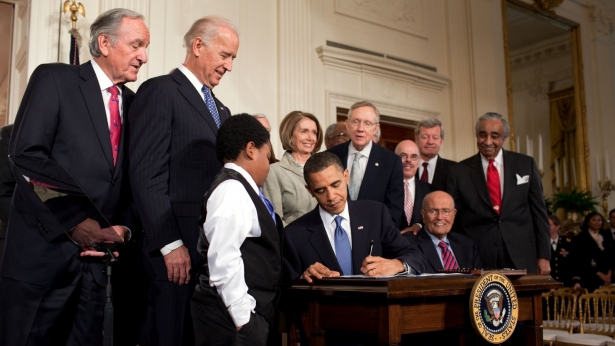
President Barack Obama is applauded as he signs the health care reform bill, on March 23, 2010, in the East Room of the White House in Washington. The bill includes many benefits for Americans who have health insurance today and those who have struggled to find and maintain health coverage.
2010 was a momentous year for the American health care system. In March, Congress passed—and President Barack Obama signed—landmark legislation that reforms the health insurance market, provides all Americans with affordable access to health coverage, and reduces the growth of health care costs.
The Department of Health and Human Services and other parts of the executive branch have begun to implement the new law in the subsequent 10 months. The Affordable Care Act, or ACA, includes many benefits for Americans who have health insurance today and those who have struggled to find and maintain health coverage. Many of these benefits came on-line in 2010.
Signature achievements include:
- Establishing pre-existing condition insurance plans in every state so that individuals with health problems who cannot find coverage in the regular market have a reliable source of coverage
- Requiring employer-sponsored health plans to offer coverage to the young-adult children of policyholders
- Helping employers with unpredictable health care spending for retired workers
- Providing more than 1 million rebate checks to Medicare enrollees who incurred high out-of-pocket prescription drug spending in 2010
- Prohibiting health insurance plans from denying coverage to children with pre-existing conditions
- Protecting individuals with high health care costs from the financial risk of absurdly low annual and lifetime limits on their benefits
- Prohibiting health insurance plans from rescinding coverage when a policyholder gets sick
These changes bring a new degree of stability and security to millions of Americans’ health coverage. And even more improvements are around the corner. Beginning this month, seniors will enjoy meaningful new benefits and significant improvements in their prescription drug coverage, while individuals and businesses will receive premium rebates from their insurance company when the insurers incur excessive administrative costs.
Specific improvements in 2011 include:
- Closing the Medicare prescription drug coverage gap. Seniors and people with disabilities who obtain prescription drug coverage through Medicare Part D will enjoy a new discount on brand-name and generic prescription drugs when they hit the so-called “doughnut hole” in their Part D benefits. Since the beginning of the program, enrollees have hit a gap in coverage when their total drug spending—including out-of-pocket costs and expenses covered by their Medicare Part D plan—exceeds a preset limit (currently $2,830). Patients then pay the total cost of their prescription drugs, without help from their drug plan, until their total drug expenses hit an upper limit and coverage kicks in again. With the new discount, people with drug spending high enough to hit the coverage gap will save almost $500 on average this year, while people with very high drug costs will save more than $1,500.
- Launching new prevention benefits for Medicare enrollees. Good coverage of preventive services helps seniors and other Medicare enrollees better manage their health. New benefits include coverage without cost-sharing for recommended preventive services (those that receive an “A” or “B” rating from the U.S. Preventive Services Task Force) and new coverage for a personal prevention plan.
- Increasing access to primary care. Medicare will pay primary care providers a 10 percent bonus payment, which offers a new incentive for physicians, nurses, and others to provide primary care services.
- Requiring insurers to provide high value for premium dollars. Beginning in 2011, insurers will pay rebates to policyholders—individuals and employers—when plan spending on clinical services falls below 80 percent of premium revenue in the individual and small group market, and 85 percent of premium revenue in the large group market.
Looking ahead, ACA provisions that will touch real people every day will continue coming on-line through 2011. These include providing more consumer information on healthy food choices by requiring chain restaurants and vending machines to provide nutritional data no later than March, and improving long-term care by sending enhanced federal Medicaid payments to support new state investments in community-based long-term care services starting in October. Tangible improvements will continue beyond this year, such as fully closing the coverage gap in Medicare Part D and improving Medicaid coverage for preventive care.
The Affordable Care Act’s most striking impact will come in 2014 when new health insurance exchanges launch, premium subsidies become available, and Medicaid coverage expands to include all low-income individuals regardless of family composition, age, or disability status.
These headline-grabbing changes in our health care system may be a few years down the road. But millions of Americans are already benefiting from the Affordable Care Act—and millions more will receive better care in the near future thanks to the changes in the new law.
By Karen Davenport | January 13, 2011-Center For American Progress. Photo: AP/Charles Dharapak
More Small Businesses Offering Health Care To Employees Thanks To Obamacare
The first statistics are coming in and, to the surprise of a great many, Obamacare might just be working to bring health care to working Americans precisely as promised.
The major health insurance companies around the country are reporting a significant increase in small businesses offering health care benefits to their employees.
Why?
Because the tax cut created in the new health care reform law providing small businesses with an incentive to give health benefits to employees is working.
We certainly did not expect to see this in this economy,” said Gary Claxton, who oversees an annual survey of employer health plans for the nonprofit Kaiser Family Foundation. “It’s surprising.”
How significant is the impact? While we won’t have full national numbers until small businesses file their 2010 tax returns this April, the anecdotal evidence is as meaningful as it is unexpected.
United Health Group, Inc., the nation’s largest health insurer, added 75,000 new customers working in businesses with fewer than 50 employees.
Coventry Health Care, Inc., a large provider of health insurance to small businesses, added 115,000 new workers in 2010 representing an 8% jump.
Blue Cross Blue Shield of Kansas City, the largest health insurer in the Kansas City, Mo. area, reports an astounding 58% increase in the number of small businesses purchasing coverage in their area since April, 2010-one month after the health care reform legislation became law.
“One of the biggest problems in the small-group market is affordability,” said Ron Rowe, who oversees small-group sales for the Kansas City operation for Blue Cross Blue Shied. “We looked at the tax credit and said, ‘this is perfect.”
Rowe went on to say that 38% of the businesses it is signing up had not offered health benefits before.
Whatever your particular ideology, there is simply no denying that these statistics are incredibly heartening. However, for those of you who cannot get past your opposition, even for a moment of universal good news, let’s break it down.
The primary, most enduring complaint of the opponents of the ACA has been that the law is deathly bad for small business.
Apparently, small businesses, and their employees, do not agree.
The next argument has been that the PPACA is a job killer.
If these small businesses found the new law to be so onerous, why have so many of them voluntarily taken advantage of the benefits provided in the law to give their employees these benefits? They were not mandated to do so. And to the extent that the coming mandate obligations might figure into their thinking, would you not imagine they would wait until 2014 to make a move as the rules do not go into effect until that time?
Of course, there is the nagging banter as to how Obamacare is leading us down the road to socialism.
Let it go, folks.
Private market insurance companies are experiencing significant growth because of a tax break provided by the PPACA. I may have missed the day this was discussed in economics class, but I’m pretty sure this is not a socialistic result of federal legislation.
When data like this appears, we have the opportunity to really find out who is talking smack for political benefit and who actually cares about getting affordable and available health care to America’s workers. Certainly, there will be elements of the new law that will not work out exactly as planned. That’s simply reality when it comes to any new piece of landmark legislation. But if you cannot celebrate what appears to be an important early success, you really should give some thought as to where your true interests and intents lie.
If you’re all about beating up on President Obama, you can conveniently forget this bit of data as if it never really happened. However, if your interest is to make health care available to more Americans, this should be a happy day for you – no matter what your ideological beliefs.
By: Rick Ungar, The Policy Page-Forbes, January 6, 2011
A World Without an Individual Mandate: Careful What You Wish For GOP
Health economist Jon Gruber runs the numbers on a world in which the individual mandate is struck down and not replaced by anything:
-Repeal of the requirement to buy insurance would mean more people would wait until they get sick to buy insurance in the new nongroup exchanges, which would increase the average premium by 27 percent in 2019.
-Retaining the law’s insurance reforms, but repealing the subsidies as well as the requirement to purchase insurance, would further discourage people from buying insurance when they’re healthy. Premiums in 2019 would cost twice as much as projected under the law as a result.
-Retaining the law but repealing the mandate would newly cover fewer than 7 million people in 2019 rather than the 32 million projected to be newly covered by the law. Federal spending, however, would decline by only about a quarter under this scenario since the sickest and most costly uninsured are the ones most likely to gain coverage.
-Retaining only the insurance reforms in the law — repealing both the mandate and the subsidies — would not increase the number of people with insurance, leaving 55 million people uninsured in 2019.
By Ezra Klein | December 13, 2010;
Health Reform-The perils of doing nothing – 17 cents of every dollar
desc
via NOW! Blog » The perils of doing nothing – 17 cents of every dollar.
My Family Has Health Insurance-What’s The Big Deal About This Health Care Reform Stuff?
desc
via Newsvine – My Family Has Health Insurance-What’s The Big Deal About This Health Care Reform Stuff?
I originally posted this article on Newsvine in August, 2009. Somehow it doesn’t seem that the message has hit home. Deny, delay and obstruct. We are now back to square one. It’s past time for the sleeping public to awaken.
Share This Blog


 Unknown Feed
- An error has occurred; the feed is probably down. Try again later.
 mykeystrokes.com
You must be logged in to post a comment.