The Real Threat to Health Care Reform….It’s Not The Supreme Court
Will the Supreme Court overturn the part of the health-care law that penalizes people who don’t buy insurance for themselves? A few months ago, the answer that experienced Court-watchers gave was “not a chance.” Orin Kerr, a law professor at George Washington University who once clerked for Justice Anthony Kennedy, said “there is a less than 1 percent chance that the courts will invalidate the individual mandate.” Now, the best we can say is, who knows?
As Slate’s legal columnist Dahlia Lithwick has said, the conventional wisdom has turned sharply. “Today,” she writes, “it is an equally powerful article of faith that everything rests in the hands of Justice Anthony Kennedy in what will surely be a 5-4 decision.”
That could mean we were wrong a few months ago, or it could mean we’re wrong now. But it doesn’t matter. Replacing the individual mandate wouldn’t be particularly hard. All we need is another policy that does the same thing – specifically, discourage free-riders who don’t want to buy insurance until after they get sick and thus leave the rest of us paying for them.
In fact, I can give you four credible alternatives in four sentences:
We could limit enrollment changes to once every two years, so people who decide to go without insurance can’t buy coverage the moment they get a bad report from their doctor.
We could penalize those who wait to buy coverage with higher premiums, which is what we do in the Medicare Prescription Drug Benefit.
We could have a five-year lockout, in which people who decide to go without coverage wouldn’t be able to access the subsidies or insurance protections for five years, even if they decided they wanted to buy insurance.
We could raise taxes by the same amount as the individual mandate penalty and give everyone who showed proof of insurance on their tax forms a “personal responsibility tax credit” of the same amount.
But all these ideas suffer the same problem: They’d need to pass through Congress. And Republicans in Congress don’t want to make the Affordable Care Act better. They want to repeal it.
This – and not the Supreme Court, or even any flaws in the design of the bill – is the real problem for the Affordable Care Act. Like any major piece of legislation, parts of it will work much better than we expect, and parts of it will disappoint us. Perhaps the experiment with paying hospitals a flat fee to treat a patient’s diabetes will prove a smashing success, leading to lower costs and higher-quality care. And perhaps the provision allowing individuals to publicly rate their insurers will prove a disaster, with companies paying the computer-savvy to rig the ratings.
In that world, the answer would be obvious: Expand the good and repeal the bad. Indeed, we should expect to do this over and over again. We’ll constantly need to double down on what works, remove what doesn’t, and add new ideas and refinements into the mix. Policymakers are never omniscient, but they are, at their best, persistent. And that’s how we’ll move from the inefficient and expensive health-care system we have to the efficient and affordable system we want: one tweak at a time.
That assumes, however, that both parties’ top priority is to get from the system we have to the system that the Affordable Care Act suggests we want: a system with lower costs and near-universal care. But is it?
Increasingly, it seems not. The Democrats have a deep and longtime commitment to health-care reform, one they’ve proven by moving continually right on the issue in a fruitless search for bipartisan support. They’ve given up on single-payer, on an employer mandate, on a public option. And they adopted the same structure that Mitt Romney signed in Massachusetts and that Republicans called for in 1994.
Republicans, meanwhile, have proven deeply and continually committed to opposing health-care reform bills pushed by Democrats. They abandoned Richard Nixon’s idea when Bill Clinton adopted it and Romney’s idea when President Obama endorsed it. In the most recent election, they ran on “repeal and replace,” but when they got to Congress, they voted on a bill that included the “repeal” but was silent on the “replace.” Even now, they’ve done nothing more than vaguely direct some committees to come up with some unspecified ideas at some unnamed date in the future.
Their inattention to “replace” is evidence that their top priority is “repeal.” But they don’t have the votes to repeal the bill. They might not have the votes to repeal it after 2012, either. But so long as they’re telling their base that they will repeal it, if not today then soon, they can’t participate in any significant reforms of the bill, as improving the legislation tacitly accepts its existence. “I think it’s clear that this is an area upon which we are not likely to reach any agreements with the president,” Senate Minority Leader Mitch McConnell told conservative radio host Laura Ingraham.
Democrats, meanwhile, aren’t becoming any friendlier to the GOP’s repeal efforts. Of the 13 House Democrats who voted against the law and survived the election, only three voted with the House Republicans to repeal the bill. In the Senate, not a single Democrat voted for repeal.
This raises the possibility that Congress will neither repeal the legislation nor commit itself to its success. Rather, Republicans will work to hobble it where they can, starving the law of the funds needed for its implementation, harassing the regulators charged with setting it up and stopping Democrats from improving on the law’s successes or responding to its inevitable failures. Democrats will work to ensure that the law survives, but they won’t have the votes to do much more than that.
Wounded, the law will limp along, protected from dying and prevented from thriving.
By: Ezra Klein-The Washington Post, February 8, 2011
How Conservative Attacks on Health Care Reform Will Affect You
Attempts to Repeal Affordable Care Act Have Serious Consequences
The Affordable Care Act provides Americans economic and health security with protections against exorbitant premium hikes, better health benefits, and slower growth in health care costs. Conservatives in the Congress are intent on taking these benefits away.
Conservatives are starting to implement their onslaught to repeal the Affordable Care Act this week as Republicans take control of the House of Representatives. They have scheduled a vote on January 12. If conservatives have their way and repeal the Affordable Care Act, we will go back to a health care system that failed millions of Americans: one with skyrocketing costs bankrupting families and our budget, fewer people with access to quality care, and more people at the mercy of the health insurance industry.
Increasing premiums for millions of Americans. Prior to passage of the Affordable Care Act, individuals and families were faced with skyrocketing premiums. Premiums for individuals increased 120 percent and family premiums increased 130 percent from 1999 to 2009. The Affordable Care Act controls these costs. In fact, the nonpartisan Congressional Budget Office or CBO looked at the law’s effect on premiums in 2016 and estimated that the health reform law would cut premiums for millions of Americans. These premiums cuts would be more substantial for those in the individual market, most of whom will receive subsidies to help cover the cost. According to the CBO, those receiving help in the individual market would see their premiums reduced by 56 percent to 59 percent less than they would pay without the law, while also enjoy better coverage than what they currently receive. Repealing the law means going back to a status quo of skyrocketing premiums that made health insurance out of reach and unaffordable for American families.
Costing 400,000 jobs annually. The Affordable Care Act helps create as many as 400,000 jobs annually over the next decade by lowering costs and helping promote a healthier workforce. It includes cost-containment measures to slow the rate of growth of health care spending. Small businesses in particular are helped through exchanges that allow them to pool resources to lower costs as well as tax credits to make it more affordable to offer their employees health coverage. These cost-reduction provisions free up money that otherwise would be spent on health care and allow companies to spend it hiring more workers. In addition, a healthier workforce is a more productive workforce. Those benefits disappear, as well as the jobs created along with it, if the law is repealed.
Increasing costs for seniors by as much as $1,500 in 2011. The Affordable Care Act eliminates the “donut hole” in the Medicare prescription drug program by 2020. Seniors with high prescription drug expenses before health reform had to pay full price for their prescription drugs—without any help from their drug plan—once their prescription drug spending reached a pre-defined limit. People who hit this limit in 2011 will get a 50 percent discount on their name-brand prescription drugs, saving some Medicare enrollees as much as $1,500 in out-of-pocket drug costs. Those savings will not be realized if the Affordable Care Act is repealed.
Hurting communities of color. Communities of color are more likely to be uninsured, and they suffer from higher rates of chronic illness than the rest of the population. The Affordable Care Act addresses these inequities by expanding health insurance coverage and improving access to primary care, including preventive services. These provisions will be eliminated if conservatives have their way and repeal the health reform law.
Increasing costs and deficits. The Affordable Care Act creates tools to control the growth in health costs while improving quality of care. Effective implementation can reduce administrative costs for small businesses and individuals, promote greater use of preventive care, and prevent unnecessary hospitalizations, saving as much as $2 trillion in total health spending over the next decade. In addition, the CBO estimated the law will reduce the federal budget deficit by $143 billion over the first 10 years and more than $1.2 trillion over the next two decades. Repealing the new law stymies these much-needed efforts and reverts to the unsustainable status quo of skyrocketing costs that were bankrupting our country. Make no mistake: The Affordable Care Act provides Americans economic and health security with protections against exorbitant premium hikes, better health benefits, and slower growth in health care costs. Conservatives in Congress are intent on taking these benefits away and going back to a health system that was failing America. And, to top it off, they’d keep their benefits, while taking away ours.
Americans deserve better. We need the Affordable Care Act.
By: Tony Carrk, Center For American Progress. Note: Originally Published January 5, 2011 prior to US House Vote on Repeal.
Mr. Speaker: What Comes After No?
The Republicans have vowed to “repeal and replace” President Obama’s historic health care reform law. Now that House Republicans have muscled through a symbolic repeal bill, they will have to deliver their own alternative plan. Don’t expect much.
By: New York Times- Editorial, The Opinion Pages, January 24, 2011
There are many more slogans than details. But it is already clear that their approach would do almost nothing to control skyrocketing health care costs and would provide little help to the 50 million uninsured Americans.
When Republican leaders talk of reducing medical costs they really mean reducing insurance premiums for some people, primarily by letting the young and healthy buy insurance in states that allow the sale of skimpy policies. That won’t help older and less healthy people and would probably drive up their premiums as they flock to states whose regulations guarantee them coverage.
The Republicans have offered no coherent plan for slowing the rapid rise in medical costs that is driving up insurance premiums, Medicare and Medicaid costs, and the federal deficit. The reform law, by contrast, has multiple provisions for changing the delivery of health care in ways that should reduce costs.
As for the Republicans’ calls to reduce waste and fraud in Medicare, reform the medical malpractice system, and expand high-risk pools to cover people with pre-existing conditions, most of these ideas are already in the reform law. They could surely be strengthened if both parties worked together.
Even as it denounces reform at every turn, the Republican leadership has figured out that many Americans want the many consumer protections that come with the new law. So, once reform is repealed, the leaders are vowing to reinstate such provisions as letting young people stay on their parents’ plans until age 26, preventing insurers from canceling policies after people become sick, and barring insurers from placing caps on what they will pay.
The problem is that such requirements will drive up the cost of insurance unless they are paired with a mandate (or comparable prod) requiring that everyone buy insurance so that healthy people offset the costs of less healthy beneficiaries. Yes, that’s the same mandate the Republicans have vowed to overturn.
Many Republicans have also vowed to restore more than $130 billion worth of unjustified subsidies to private Medicare Advantage plans that is needed to help pay for the expansion of coverage under health care reform.
In coming weeks, expect to see a lot more posturing on issues that might energize the party’s conservative base or poll well with people made skittish by months of Republican exaggerations about the new reform law. They have already introduced bills making it even harder for insurance policies in new insurance exchanges to cover abortions, never mind that the law already has incredibly strict provisions.
The Party of No will also try to use its new control of the House to block implementation of reform by withholding money needed to hire people to write necessary regulations. The House Republican Study Committee has proposed legislation that would prohibit using money in the annual budget to carry out any provision of the law or to defend it in court.
The Republicans need to explain how they plan to address the problems of covering the uninsured, wrestling down medical costs and controlling the deficit. Just saying no isn’t enough.
Size Matters: The GOP & Health Care
During the health care debate in 2009 and 2010, a serious issue emerged — the number of pages in congressional bills. I’m not kidding. The Republicans wanted short bills, and the health care reform bill was way, way too long (proving that it did too much and would end civilization as we know it). There was outrage across the country. Angry opponents of reform went to congressional town hall meetings brandishing huge stacks of paper. Then Minority Leader Boehner, foreshadowing his leadership priorities today, used a nationally televised address to condemn the length of the health care bill three times in as many minutes.
The extremists went wild. Rumors swept across the land. Some Tea Party types claimed the bill was 10,000 pages. Slate called the explosive stack-of-paper obsession “peculiar.” Ultimately, the New York Times set the record straight: “In the original version,” the Times said, “H.R. 3590 as passed by the Senate on Dec. 24, 2009, ran to some 2,400 pages, although with a very large font, triple spacing and huge left and right margins.” The newspaper went on to explain that, “With normal margins the document probably would shrink to about 500 pages or so.” Which meant the bill was not really that long when compared to other major bills, such as the financial reform law and past budget deals.
In the November mid-term elections, the Republicans ran on a platform of change, and change is what we got. Not only will the House Republicans vote to repeal the new health care law this week, they’re going to do so with a bill that’s only two pages long.
This is a triumph of conciseness, a 247-word beacon of brevity. The low word-count works especially well for the GOP, given the party’s unfinished “repeal and replace” campaign pledge. The Republicans addressed repeal, but they haven’t quite gotten to the “replace” part. That, we’re told, is a work in progress, and the question is being referred to various House committees to kick around for months.
In Sunday’s Washington Post, reporter Amy Goldstein noted that the Republican repeal vote is “the prelude to a two-pronged strategy that is likely to last throughout the year, or longer.” Great. Just what we need — another interminable debate on health care when the Republicans ought to be focusing on bipartisan solutions to create jobs. Rep. Fred Upton (R-Mich.), the new House Energy and Commerce Committee chairman, said it “may take time” for the GOP to develop a health care plan. Upton, who has been in Congress since 1987, has had only 24 years to come up with some health care ideas of his own. Instead, he hired Julie Goon, the former top lobbyist for the health insurance industry’s biggest trade group, as his special adviser.
I’m not sure what the Republican “replace” plan is (or how many pages it will be), but I know their two-page repeal bill is a bad deal for America’s families, seniors and small businesses.
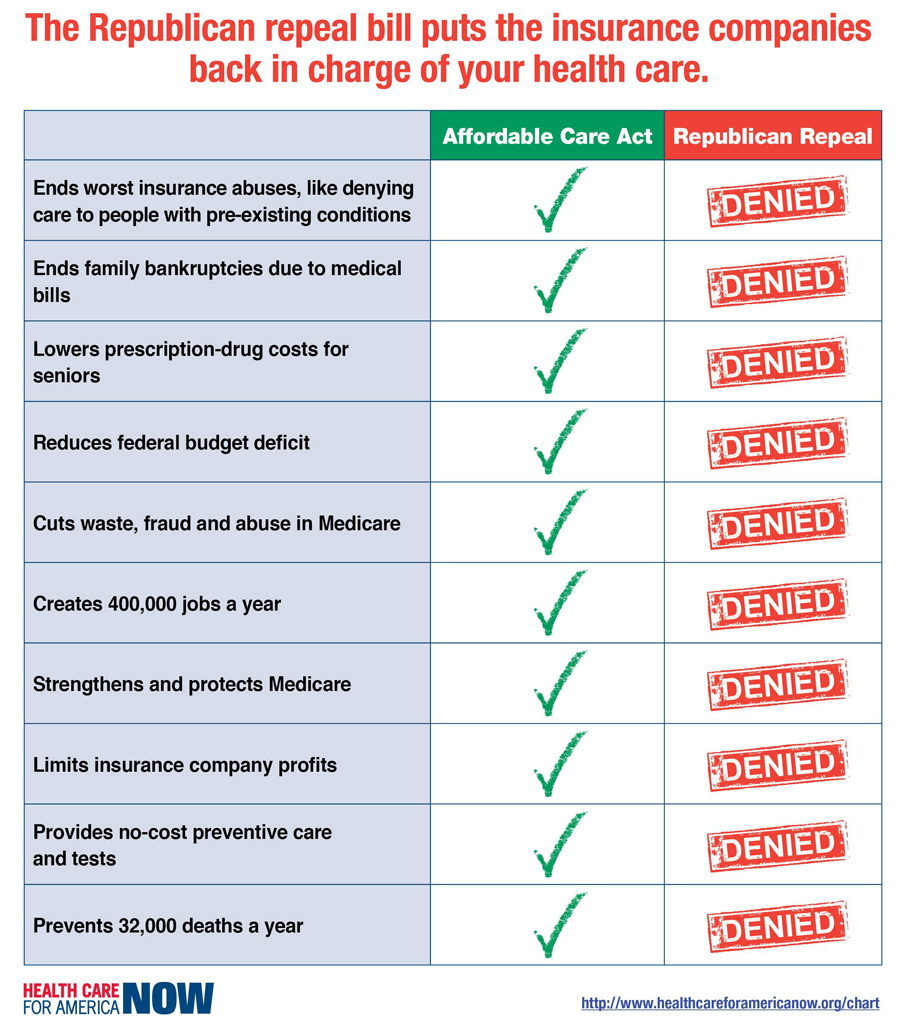
The Republican repeal bill will take away dozens of benefits and important consumer protections that are making a real difference in peoples’ lives right now. When the Republicans vote for repeal, they’ll be taking away people’s newly won freedom from fear of insurers denying their care, dropping them when their sick and imposing double-digit premium hikes with impunity. They’ll be booting young adults off their parents’ health plans. They’ll be telling seniors they have to pay back the $250 donut hole checks they received to help buy prescription medications and give up their new 50% discount on brand-name drugs. The Republican repeal plan will force nearly 900,000 American families a year into bankruptcy because of huge medical bills. And it will take job-creating tax credits away from small businesses.
Speaker John Boehner and the Republicans don’t want the public to know the truth about the Affordable Care Act and what their repeal plan will take away from America’s consumers. And you can bet the debate about repeal will be filled with misleading information from Boehner and the new Republican majority. To help folks see beyond the rhetoric, Health Care for America Now made a chart that tells the truth. You can read and download a printable, high-resolution version with citations here and below.
The Republican Repeal Bill puts insurance companies back in charge of your health care.
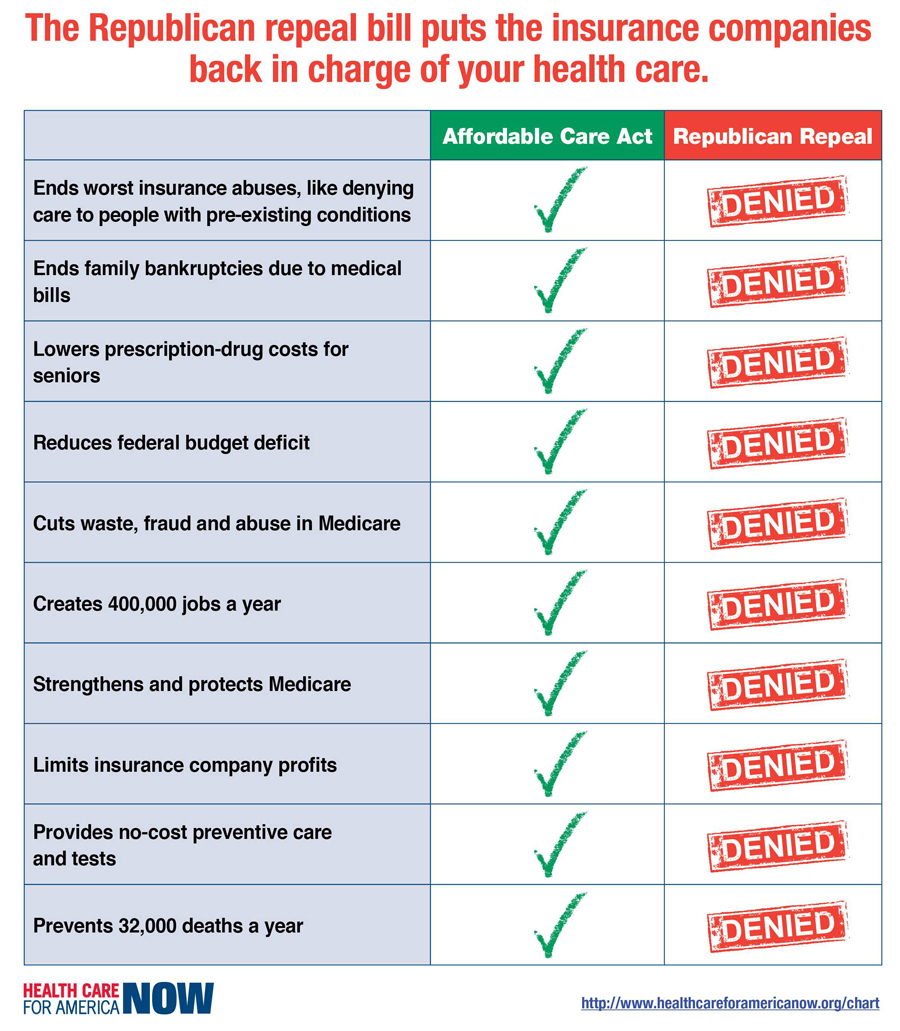
The Republican Repeal Bill
Be Careful What You Wish For: Repeal of the Affordable Care Act Would Be Harmful to Society and Costly for Our Country
The new Republican leadership of the House of Representatives says repeal of the recently enacted Patient Protection and Affordable Care Act is their top priority. The Republicans pushing for repeal, however, conveniently ignore the enormous step backward that repeal would represent for health care in our country, for the income security of our citizens, and for the fiscal health of our government.
The Affordable Care Act is not just a law designed to cover the majority of our nation’s uninsured, moving us into the league of industrialized nations which guarantee universal health coverage for its citizens. The law also takes the crucial first steps toward reining in our runaway health care costs. It ends discriminatory insurance practices that leave many of our citizens one bad gene, or badly timed accident, away from personal bankruptcy. It does so while introducing insurance market competition that will lead to lower health insurance premiums for some, and better coverage for others, in the so-called nongroup insurance market where workers without employer-provided health insurance turn for coverage. The Affordable Care Act does all this while significantly reducing our enormous federal budget deficit over the next 10 years.
Opponents of the new health reform law claim we can have many of the beneficial features documented above while repealing the parts they don’t like. This is a misleading and dangerous assertion. In fact, virtually none of the accomplishments of the new law are possible without the entire law’s infrastructure coming into place. That’s why all of the harms of repeal documented in this issue brief below will take place if the new law were to be scuttled.
To understand the consequences of repealing the Affordable Care Act, we can turn to two sources of objective information. The first is the careful and comprehensive effort put in by the Congressional Budget Office to evaluate the law’s impacts, including their recent report summarizing the effects of repealing the new law. The second is the closest case study we have where major elements of the new federal law are already in place—the state of Massachusetts, which passed a similar reform in early 2006. So let’s now turn to the different harms repeal of the health reform would deliver up to the American people.
Repeal means more uninsured, and worse public health
The first noticeable feature of a world without the new health reform law would be the much higher share of Americans without health insurance coverage. Absent the Affordable Care Act, CBO projects that 54 million people in our country, or almost 20 percent of our nonelderly population, will be uninsured by 2019. The new law will cover 32 million of those uninsured, according to CBO, or about 60 percent, with much of the remainder undocumented immigrants who are ineligible for coverage. This is more than a projection: It is also the same percentage share of the uninsured in Massachusetts who have been covered by that state’s health reform effort.
Clearly, repeal of the new law would have enormous negative consequences for our nation’s public health. Numerous studies document the dire health implications of uninsurance. An earlier study by the Institute of Medicine estimated that, in the year 2000 (when 38 million persons were uninsured), there were 18,000 deaths per year due to uninsurance. This suggests that repealing the Affordable Care Act could lead to 15,000 more deaths per year due to higher lack of insurance.
Repeal means increased financial risk for U.S. households alongside distorted labor markets
The impact of repeal extends well beyond those households who are uninsured. Indeed, repealing the new law would reach any household who faces the risk of losing their employer-sponsored health insurance. This is because the Affordable Care Act will fix the fundamental broken system of nongroup insurance in the United States.
Currently, individuals who do not have access to employer-provided group insurance coverage face a nongroup insurance market that is discriminatory and expensive. In most states individuals can be denied insurance coverage because they are ill or have their pre-existing illnesses excluded from coverage. Individuals who become ill can face personal bankruptcy as a result. Even when nongroup insurance is available, in most states insurance is priced according to individual health, with the oldest and sickest enrollees paying many multiples of younger and healthier enrollees.
There is a fundamental unfairness to a system under which individuals can face financial ruin because they have the wrong genes, or cross the street at the wrong time, but don’t happen to have access to insurance through their employer. Moreover, such a system significantly distorts our labor markets by forcing individuals to stay in jobs that offer health insurance rather than to move to newer and more productive positions where coverage is not available. Millions of U.S. workers are not moving to better jobs for them or starting new businesses because there is nowhere to turn for insurance coverage should they leave their jobs.
The Affordable Care Act would fix this flaw in our system. Insurance companies would no longer be allowed to price discriminate or deny coverage based on health or pre-existing conditions, and price differentials by age would be lowered. Individuals would be free to move to the job of their choice or to become entrepreneurs without fear of facing uninsurance.
Repealing the new health reform law would leave us in a world of broken nongroup insurance markets, with the attendant financial risk for individuals and the continued distortion to our labor markets. Why? Because without the comprehensive framework of the new law, it is incredibly costly to make insurance fairer in nongroup markets.
If insurance companies must charge the same price to people whether they’re sick or healthy, for example, then many healthy people will view this as a “bad deal” and not buy insurance. This results in higher prices because only the sick would buy insurance, chasing even more people out of the market. The result is a “death spiral” that leads only the sick to purchase insurance at very high prices. Several states tried such community rating reforms in their non-group markets over the past two decades, and the results were sharp rises in insurance prices and rapidly shrinking market size. The only way to make insurance market reform feasible is to pair it with large subsidies to purchase insurance and an individual requirement for coverage, as is the case with the Affordable Care Act.
Direct evidence for this point comes from Massachusetts. In the late 1990s the state moved to a nondiscriminatory nongroup market, but without the subsidies and the individual requirement that are central to the Affordable Care Act. The result was a collapse of the state’s nongroup market, so that by 2006 the state had by far the highest nongroup premiums in the nation. In 2006, the state implemented their comprehensive reform, which added to the insurance market reforms extensive low-income subsidies to purchase insurance and an individual requirement for coverage. This resulted in a 40 percent reduction in nongroup premiums in Massachusetts over a period where such premiums were rising by 14 percent nationally. That’s just one reason why the new law is called the Affordable Care Act.
Repeal means a noncompetitive and expensive nongroup insurance market
Another reason the Affordable Care Act works to bring down costs is because without it, a typical health insurance policy is much more expensive in the nongroup market than in the group market, partly because nongroup insurance markets are less competitive than group insurance markets in many states. There is no common marketplace where individuals can compare the prices of all the options that are available to them in the nongroup market. As a result, existing market participants keep prices high and new firms are unable to promote lower costs as a tool of market entry.
The Affordable Care Act addresses this problem in two important ways. The first is by introducing competitive insurance exchanges in every state. Individuals would be able to shop more effectively, comparing their nongroup options in a competitive and transparent environment. This approach has already had a notable success in Massachusetts, where the introduction of the state’s Connector health insurance exchange expanded the use of nongroup insurance and promoted the entry of a major new low-cost insurer into the state’s nongroup insurance market.
Without the Affordable Care Act states are unlikely to be able to establish transformative and competitive exchanges for the purchase of nongroup insurance. Many states have tried over the past 20 years to establish insurance exchanges and they have virtually all either failed or had little impact. This is typically because insurers were afraid that individuals would choose to buy from the exchanges only if they were sick, which meant prices in the exchange were high and demand for exchange products was low. With low demand, exchanges could not establish the economies of scale necessary for success.
The success of exchanges under the new health reform law will be due to the fact that individuals will be both required to purchase insurance and that insurance purchase will be subsidized only through the exchange. This will promote exchanges on a scale necessary to succeed in promoting competition in state insurance markets.
The second way that the Affordable Care Act addresses the high costs of nongroup insurance is through the introduction of new tax credits to make health insurance affordable through the exchange. The typical middle-class family in the United States would now be provided financial support to ensure that they would not have to spend an unfair amount for the insurance they need to protect their family.
The upshot: Repealing the new law would mean returning to an era where individuals can’t effectively compare their insurance options, guaranteeing continued noncompetitive and expensive insurance in this market. And it would mean that individuals would face the full prices in these noncompetitive markets without the necessary tax credits to make insurance affordable. Repeal, in short, would be unfair, ineffective, inefficient, and costly.
Repeal means free riders would continue to exploit the health care system
Another fundamental flaw in our current health care system before passage of the Affordable Care Act was that individuals could “free ride,” remaining uninsured until they need care and then turning to emergency rooms. Emergency rooms are required by law to provide care to all regardless of insurance coverage. The associated uncompensated care costs of treating these individuals amount to a more than $40 billion a year tax on the insured in the United States
The Affordable Care Act ends this free riding by requiring that individuals purchase insurance if it is affordable for them (which it will be for most due to the subsidies described earlier). This personal responsibility requirement, originally the brainchild of Republican experts, would end the unfairness of a system where emergency room health care providers are required to treat everyone but individuals are not in turn required to pay their fair share of the costs of treatment. Repealing the new law would mean returning to a world where individuals can simply wait until they are sick to get treated, passing the costs on to the rest of society that is paying their share.
Repeal means the continued decline of private insurance
There was an enormous erosion of private insurance coverage in the United States over the past decade. Employer-sponsored insurance fell by 15 percent and nongroup insurance has not grown to keep pace. The result today is an increase in both the ranks of the uninsured and the publicly insured.
The Affordable Care Act arrests this decline and promotes private insurance coverage. According to the CBO, the new law will lead to a small erosion in employersponsored insurance coverage, offset by a rise in nongroup insurance coverage that is almost five times as large. Overall, private insurance coverage in the United States will rise by 15 million people due to the Affordable Care Act.
Repeal would provide no cushion for our citizens to offset this rapid decline in employer-sponsored insurance coverage. Fifteen million fewer U.S. residents would have private insurance than without the law. The Affordable Care Act is not a government takeover of the U.S. health system; it is a means of using reformed private nongroup insurance markets to more effectively fight the steady decline in employer-provided group insurance. Repeal means a fundamental retreat from the promise of private health insurance coverage for our citizens.
Repeal means higher and more rapidly growing budget deficits
The Affordable Care Act delivers a unique dose of fiscal responsibility in an era of rapidly growing federal budget deficits. The new law offsets its new spending with even larger reductions in other spending and revenue increases. As a result, CBO estimates that the legislation will reduce the deficit by more than $100 billion by 2019, and by more than $1 trillion in the decade after that.
What is not widely appreciated is that deficit reduction due to the new health law will rise over time. The cuts in excessive spending and increases in revenues are back-loaded, not front-loaded as with so many other recent pieces of legislation. This is illustrated by the fact that the most recent CBO estimate shows that repeal would raise the deficit by $230 billion over the next decade. And, because the net budget savings from the new health law will grow over time, repeal would raise the deficit by much larger and ever growing amounts into the future.
Repeal would therefore mean undoing the enormous fiscal benefits of this legislation. Offsetting a more than $100 billion hole in the budget deficit by 2019 would require significant cuts elsewhere in the budget or other increases in revenues. And it seems highly unlikely that Congress would enact spending or revenue changes that would increase so rapidly over time. That means even fixes that offset the short-term costs of repealing the new law would not address the enormous long-term hole it would leave in our budget.
Repeal means a critical step backward on cost control
Reforming insurance markets and covering the uninsured are actually the relatively easy lifts for the new health reform law when compared to the more daunting and fundamental challenge—reducing the rate of growth in health care costs, which threatens to bankrupt our government and our nation. U.S. spending on health care is very high and a source of great concern but it is the growth rate of medical spending, not its level, that ultimately determines our country’s financial well-being. Absent the Affordable Care Act, if current trends persist we will be spending an unsustainable 38 percent of our GDP on health care by 2075 because the growth of health care costs would continue to outstrip the growth rate of the overall economy.
Addressing the rapidly rising costs of medical care, however, faces two daunting barriers. The first is scientific: There is tremendous uncertainty about how to lower health care costs without sacrificing health care quality. There is a broad consensus that there is significant waste in our health care system. But there is little consensus about the best way to address that waste without risking the enormous gains in population health due to health care improvements in recent decades. The second barrier is political: There are major entrenched interests that are threatened by fundamental health care reform and who will strongly oppose any such efforts.
In the face of these barriers, our political process has found it difficult to make progress on significant cost-control efforts over the past several decades. The Affordable Care Act represents the most important step forward in cost control in at least 30 years. The new law pursues many different approaches toward cost control, studying them to see which ones work best. This is through provisions that:
- Reduce consumer demand for excessive medical care through the “Cadillac tax” on high-cost insurance plans.
- Reduce health care provider payments by appointing a depoliticized board to make up-or-down recommendations to Congress on changes to Medicare’s provider payments.
- Set up dozens of health care pilot programs to test various approaches to revamping provider-payment incentives and organizational structure.
- Invest hundreds of millions of dollars in new comparative-effectiveness research.
- Launch pilot programs to assess the impact of various reorganizations of the medical malpractice process.
None of these approaches is guaranteed to work but together they represent a significant step toward fundamental cost control.
Importantly, they represent steps that are unlikely to happen if the Affordable Care Act is repealed. None of these ideas are new; most have been around for decades. But it was through the overall push for health reform that Congress was able to finally put them in place. Absent such a unifying framework, the barriers which have blocked cost-control efforts in the past will continue to stand in the way of moving forward on cost-control efforts.
Bottom line: Repeal is a dramatic step backward
The debate over repeal of the Affordable Care Act is characterized by enormous misinformation and confusion. Opponents of the legislation exploit this for political gains. A legitimate debate over the Affordable Care Act and the future of health care in America must recognize the fundamental improvements to our health care system put in place by this new law. Repealing would lead to:
- A society with poorer health and ultimately more deaths from lack of medical care
- A continued unfair and expensive nongroup insurance market that leads to economic instability, medical bankruptcy, and a less efficient job market where individuals are afraid to move to more productive job opportunities
- Continued free riding by those who pass billions of dollars in care costs onto the insured
- A massive decline in private insurance coverage
- Huge and unsustainable increases in budget deficits reaching trillions of dollars over coming decades
- A fundamental step backward in our efforts to control the health care costs which threaten to bankrupt our society
The Patient Protection and Affordable Care Act is aptly named. Repeal would mean less health care protection for more and more Americans at higher and higher costs to themselves, their families, and our nation. We simply cannot afford to repeal the new law.
By: Jonathan Gruber, Professor of Health Economics at the Massachusetts Institute of Technology and a member of the Massachusetts Health Connector Authority: January 19, 2011
Share This Blog


 Unknown Feed
- An error has occurred; the feed is probably down. Try again later.
 mykeystrokes.com
You must be logged in to post a comment.