“A Slave To The Right Wing”: Romney’s Health Care Dilemma Returns
Mitt Romney has been so busy securing his Republican base that he hasn’t had time to court independent voters, the ones who will actually decide this election. But now, probably by accident, he has an opportunity to show them that he’s something other than a slave to his party’s right wing. Will he take it?
When Romney spokesperson Andrea Saul committed the apparently unpardonable sin of praising the health care law Mitt Romney passed as governor of Massachusetts, was she making a horrible mistake that made everyone in Romney headquarters gasp in horror, or was she just reflecting what her candidate actually believes? The answer to that question would tell us where Romney is going to go from here on health care, and whether he may at long last try to find some issue on which he can convince voters he’s something more than a vessel for whatever his party’s right wing wants to do to the country.
Most everyone, myself included, initially assumed that Saul just spoke out of turn. After all, Romney had been trying to avoid any discussion of health care all through the primaries. And from a logical standpoint, there really is no good argument for him to make. Since what Romney did in Massachusetts and what President Obama did with the Affordable Care Act are identical in their major features, either they were both wise policy moves or they were both horrible mistakes, but it just can’t be the case that one was great and the other was a nightmare. That is, in fact, the argument Romney makes when he’s forced to talk about the Massachusetts reform, but you can tell he realizes how absurd what he’s saying is, and he wants to change the subject as soon as possible.
But Noam Scheiber argues that it’s oversimplified to just say that Romney has turned his back on Romneycare in order to assure Republicans that he hates Obamacare as much as they do:
As we await the Romney campaign’s decision about Saul’s fate, it’s worth reflecting on one under-reported aspect of this latest conservative blow-up: Saul was saying precisely what her superiors in the Romney campaign believe, not least of them Mitt Romney.
I spent a lot of time talking to Romney campaign officials while reporting my recent profile of Stuart Stevens, his chief strategist. The unmistakable impression I got from them is that, to this day, Romney remains extremely proud of having passed health care reform in Massachusetts.
And why wouldn’t he be? He approached a difficult problem, then came up with a solution acceptable to both parties, and by all accounts the resulting policy has been a success. There are only a small number of uninsured people left in Massachusetts, and the reform is widely popular within the state. It was without a doubt the most significant accomplishment of Romney’s one term as governor. The fact that he is running a campaign for president in which he dares not mention the best thing he did in the one job he had that was something of a preparation for the job he wants is quite insane.
Of course, it’s one thing for him to be justifiably proud of Romneycare, and it’s another for him to actually talk about it on the campaign trail. If he were to do that, it would require two things he has little desire to do: angering his base, and admitting, at least tacitly, that Barack Obama actually did something right. The former is really the biggest problem; there has not been a single occasion during this campaign (or the one he ran in 2008, for that matter), when Mitt Romney has said or done anything he thought might get the right wing of the Republican party upset. The chances that he’ll start now are slim to none.
By: Paul Waldman, Contributing Editor, The American Prospect, August 10, 2012
“The Little Man On The Wedding Cake”: Mitt Romney, Plain And Unpopular
Unlike Newt Gingrich, who can claim a regional base, Rick Santorum, who has a solidly defined political persona, or Ron Paul, who has something of a cult of personality, there’s nothing unique about Mitt Romney as a candidate. He is the definition of a generic Republican—a blank slate for the public to register its frustrations. Like Thomas Dewey—who played a similar role in the 1948 election—he is “the little man on the wedding cake.” Indeed, if there is anything close to a reason for his presidential campaign, it’s his vanilla appeal to the broad public, and undecided voters in particular.
Since the beginning of the year, however, that advantage has completely evaporated—the public has gone from slight approval of the former Massachusetts governor, to outright loathing.
In less than two months, Romney has gone from a positive rating of +8.5—43.5 percent favorable to 35 percent unfavorable—to an astonishingly negative one of -17.4, or 31.2 percent favorable to 48.6 percent unfavorable. What’s more, this comes as his name recognition has increased; the more Americans get to know Mitt Romney, the less they like him. This, it should be said, wasn’t true of John Kerry when he ran for the presidency in 2004.
Of course, because this poll measures all voters—and not just independents—this includes some Republicans who will return to the fold if Romney becomes the nominee. But the favorability gains that come with leading a unified party aren’t enough to overcome a deficit of this size. What’s more, it will do nothing for Romney’s standing with independents, which has also collapsed in the last two months. You can also expect these numbers to get worse for the former Massachusetts governor as he moves to bury Rick Santorum under a landslide of attack ads ahead of the Michigan primary. Voters aren’t keen on constant negativity, which has become Romney’s default position as the primaries drag on.
None of this is to say that Romney is doomed if he becomes the nominee, but the situation doesn’t look good. At this point, most Americans don’t trust him to stand up for their interests, a plurality of Americans don’t like him, and independents would rather stick to President Obama. It’s true that this could all change with a crisis in Europe or a war in the Middle East, but if that’s what you’re banking on, you’re not in a good place.
By: Jamelle Bouie, The American Prospect, February 16, 2012
What Does The Tea Party Want?….The New Litmus Test
Jim VandeHei and Mike Allen argue that the Tea Party redefined the purpose of the GOP as opposition to spending:
The Republican Party is undergoing a messy but unmistakable 20-month transformation from fanatically anti-Obama to fanatically anti-spending, providing top party officials a new and intriguing playbook for recapturing the White House in 2012.
To understand the current evolution, flash back to late spring of 2009. The GOP was disoriented and adrift, its leadership void filled by the bombastic voices of Palin, Beck and Rush Limbaugh. There was no common conservative cause, beyond fear and loathing of Obama. No wonder swing voters were so down on them.
But the tea party, treated at first by the media as exotics, forced Republicans to focus almost exclusively on the size of government. By the time the 2010 elections rolled around, tea party activists and most independent voters were completely aligned on the need to cut, cut, cut.
Midterm election results showed that this approach offers the GOP its best – and maybe only – hope of keeping the interests of independents and tea party activists aligned enough to beat Obama.
The new litmus tests for GOP presidential hopefuls are support for repealing “Obamacare” and taking a cleaver to government spending. If a presidential candidate could harness the smaller-government conservatism, temper it enough to avoid a blatant overreach and articulate a vision for a prosperous future for the country, it’s not hard to imagine swing voters finding such a person appealing.
There’s a superficial appeal to this story. But the evidence that Tea Party activists want to cut spending — at least actual spending programs — is sparse. Polls show that Tea Party supports overwhelmingly oppose cuts to Social Security and Medicare. The main thrust of Tea Party opinion is not the belief that Obama has spent too much money, but the belief that Obama has spent too much money on people unlike them:
More than half say the policies of the administration favor the poor, and 25 percent think that the administration favors blacks over whites — compared with 11 percent of the general public.
They are more likely than the general public, and Republicans, to say that too much has been made of the problems facing black people.
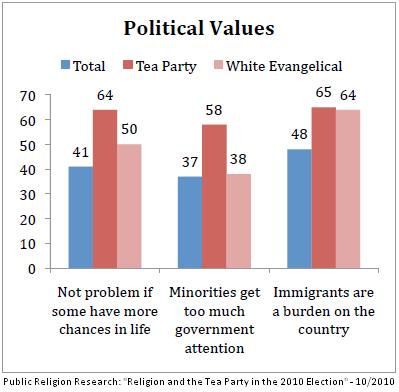
Here’s another cut, showing the Tea Party’s greater comfort with inequality of opportunity and stronger belief that the government devotes too many resources to minorities:
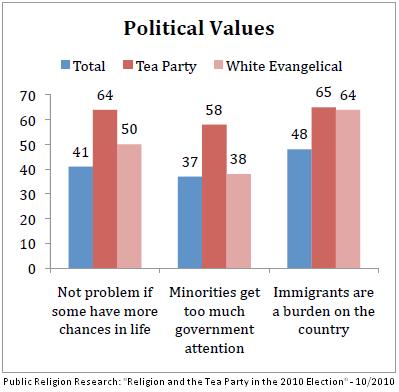
It’s a revolt against the composition of government much more than the level.
Now, it’s true that Republicans aren’t exactly translating this blueprint into action, but they’re not exactly flouting it, either. There is always a generalized antipathy toward spending amongst Republican and swing voters, but it disappears when the subject turns to actual government programs. Usually Republicans decide to just cut taxes for the rich instead. Here’s is the one part of the article proposing a defined policy change:
Even Ralph Reed, the Republican operative most tapped in to evangelicals, reflected the new GOP mindset when he gave this surprising wish list for the next presidential race: “In a perfect world, I’d like to hear the Republican nominee run on a platform that takes the capital gains tax to zero over five years.” Reed, who summoned several of the presidential candidates to Iowa for his Faith & Freedom Coalition this week, made it clear that Christian conservatives will still need to be catered to, but added that his side will understand the nominee’s need to focus on swing voters.
So an article putatively about the GOP redefining itself as an anti-spending party has one actual programmatic detail, and it’s: a zeroing out of the capital gains tax. In the name of appealing to swing voters — who, in fact, oppose tax cuts for the rich. Meet the new boss…
By: Jonathan Chait, The New Republic, March 14, 2011
Share This Blog


 Unknown Feed
- An error has occurred; the feed is probably down. Try again later.
 mykeystrokes.com

You must be logged in to post a comment.