“The Republican Congress Is A Mess”: Boehner; Senate Democrats Need To ‘Get Off Their …’
GOP House leaders emerged from a Republican Conference meeting Wednesday with a persistent refrain on Department of Homeland Security funding: The House has done its job; it’s time for the Senate to act.
During their weekly Republican leadership press conference, Speaker John Boehner repeatedly called on the Senate to take up the House-passed DHS funding bill, which Senate Democrats have repeatedly blocked the chamber from considering.
“You know, in the gift shop out here, they’ve got these little booklets on how a bill becomes a law,” a fired-up Boehner said, as camera shutters clicked away. “The House has done its job! Why don’t you go ask the Senate Democrats when they’re going to get off their ass and do something?!”
When Boehner was asked if this standoff with the Senate was how he planned for the DHS bill to play out — Senate Republicans now insist it’s on House Republicans to send over a new bill — Boehner said the process was working “exactly” the way he envisioned it.
“The House did its job,” Boehner said. “We won the fight to fund the Department of Homeland Security, and to stop the president’s unconstitutional actions. Now it’s time for the Senate to do their work.”
But if they don’t, does Boehner ever intend on throwing the Senate a lifeline?
“The House has done its job,” Boehner said. “It’s time for the Senate to do theirs.”
Time and again, Republican members trickling out of the Wednesday morning conference meeting stubbornly repeated some variation of Boehner’s new favorite line: The House did its job, now it’s the Senate’s turn.
During conference Wednesday, members heard from two of their former House colleagues now in the Senate: Cory Gardner of Colorado and Shelley Moore Capito of West Virginia.
But instead of Gardner and Moore Capito quelling the House insistence that the Senate act, the two freshmen senators got an earful that they weren’t doing enough.
According to Rep. Ron DeSantis of Florida, one member in the conference meeting told the senators they shouldn’t be letting the Senate go home on the weekend.
DeSantis said there were ways Republicans could pressure Senate Democrats — simultaneously noting he’s “not an expert on kind of how the Senate’s run” — and he said the sense among the public was that Senate Republicans weren’t doing enough.
In a mocking tone, DeSantis said the Senate’s attitude was, “‘OK, have a vote, OK, you don’t have 60, OK, we got to move on to something else now.’”
House members simply aren’t satisfied with the Senate’s effort on the House-passed DHS bill, which would block President Barack Obama’s executive action on immigration. And House Republicans aren’t moving off their position that the Senate take up their bill. That insistence was typified Wednesday in one particularly iron-willed exchange between Budget Chairman Tom Price and a reporter.
“The speaker’s position, and our position, is that the House has already acted; it’s time for the Senate to act,” the Georgia Republican said Wednesday morning.
Asked if the more likely option then was for a continuing resolution or for a shutdown, Price said the option was for the Senate to act.
Presented with Senate Majority Leader Mitch McConnell’s comments Tuesday that it was “obviously” up to the House to send over a new bill, Price was emphatic. “The House has acted,” he said, content to leave it at that.
But Rebecca Shabad, a reporter for The Hill, was not content to leave it at that. She asked if Price thought the House might have to act again. “It’s up to the Senate to act,” Price replied.
Asked again if a CR was more likely, given the short amount of time before a DHS shutdown on Feb. 28, Price resorted to a similar line. “The House has acted. It’s up to the Senate to act,” he said.
And that’s the official position from House Republicans: They’re not budging.
A similarly obstinate back-and-forth is playing out between Boehner and McConnell in the press. Boehner continues to insist the DHS funding bill is up to the Senate, while McConnell points to three failed votes to proceed to the legislation.
When Boehner was asked about the constantly evolving McConnell-Boehner relationship Wednesday, he didn’t say much.
“I love Mitch,” Boehner said. “He has a tough job to do, and so do I.”
And that was that.
Adam Jentleson, spokesman for Senate Minority Leader Harry Reid (D-NV) later issued the following statement on Boehner’s comments:
“We know Speaker Boehner is frustrated but cursing is not going to resolve the squabbling among Republicans that led to this impasse. Democrats have been clear from day one about the way out of this mess: take up the clean Homeland Security funding bill which Republicans signed off on in December – and which is ready to come to the Senate floor – pass it, and move on. If Republicans want to debate immigration policy next, Democrats are happy to have that debate.
“Neither Speaker Boehner nor Senator McConnell appears willing to do the right thing and stand up to the extremists in their caucus like Senator Ted Cruz who have led us here. As we speak, Senator McConnell is on the verge of wasting three entire weeks that could have been used to pass a clean Homeland Security bill simply because he is unwilling to stand up to Senator Cruz.
“The Republican Congress is a mess, pure and simple. Democrats are happy to help our Republican colleagues resolve their problems but the first step is for Republican leaders to do the right thing and pass a clean bill to fund Homeland Security.”
By: Matt Fuller, The National Memo, February 11, 2015
“A Juvenile GOP”: If The Party’s Aim Is To Show Americans It Is Ready To Govern, We Are Witnessing An Epic Fail
Bang. Bang. Crash. That was the sound of the Republican majority in Congress shooting itself in both feet, then tripping over them.
At a moment of heightened concern that terrorists in the Middle East might stage or inspire attacks on U.S. soil, the GOP-controlled House and Senate are unable to agree on a bill to fund the Department of Homeland Security. If the party’s aim is to show Americans it is ready to govern, we are witnessing an epic fail.
Rather than ensure the smooth operation of the agency charged with keeping the nation safe, Republicans would rather argue about a separate issue — immigration — and struggle over tactics for tilting at windmills. Meanwhile, a Feb. 27 deadline for passing an appropriations bill draws near. “I don’t believe we should shut down the Department of Homeland Security, given the threats that are obviously out there and the attacks on America,” Sen. John McCain (R-Ariz.) said Wednesday. But too few in his party are listening.
The problem is that Republican conservatives want to use the Homeland Security funding bill to reverse President Obama’s executive actions allowing millions of undocumented immigrants to stay without fear of deportation. A measure stripping out money to fund Obama’s initiatives easily passed the House, with its massive GOP majority and streamlined procedural rules. But the Senate is a different story.
It was obvious from the beginning that Majority Leader Mitch McConnell (R-Ky.) did not have the 60 votes needed to get the bill through the Senate. Nevertheless, McConnell has dutifully brought the bill up three times — and seen it rejected each time by Democrats, who quite reasonably demand a clean funding bill with no extraneous bells or whistles.
“Isn’t that the definition of insanity? Voting for the same bill over and over again?” McCain asked.
Indeed, the whole episode does seem pretty insane. House Speaker John Boehner (R-Ohio) knew the bill he sent to the Senate would be dead on arrival. McConnell knew he didn’t have the votes to pass it. And both leaders knew that if the legislation somehow made it through — perhaps when Democrats weren’t looking, or through divine intervention — there was no way Obama would ever sign it into law.
Boehner and McConnell appear to be trying to teach House Republicans a lesson in basic arithmetic. The class, however, is busy throwing spitballs.
The GOP majority in the House continues to value symbolic posturing over pragmatic action. Is this too sweeping a statement? Not if you consider what House Republicans were doing this week instead of working on a Homeland Security bill that might actually pass: Voting for the 56th time to repeal the Affordable Care Act, knowing full well that this attempt, like the previous 55, had no earthly chance of success.
GOP freshmen wanted to have their votes recorded in obeisance to what has become a Republican article of faith: Obamacare is evil incarnate. If I stipulate that the whole universe gets the message, would you guys please stop pretending that Obama is ever going to sign legislation abolishing the landmark health-care program that bears his name ?
Let’s see, what else have Republicans achieved since taking control of both chambers? Well, the House tried to pass a bill banning abortion after 20 weeks of pregnancy but had to pull the legislation at the last minute over a requirement that rape victims report their assault to police before qualifying for an exemption. Republicans did manage to pass a bill authorizing the building of the Keystone XL pipeline, but Obama promises a veto and the GOP doesn’t have the votes to override him.
If this is the pattern, it’s going to be a long couple of years.
Let me suggest a different approach. First, Republicans must cross a big hurdle: acknowledging that with Democrats able to block legislation in the Senate and Obama still resident in the White House, passing legislation will require compromise. Once you get beyond that, the rest is easy.
No, you can’t repeal Obamacare, but you might be able to make it work better for your constituents. No, you can’t undo Obama’s immigration actions without passing legislation that the Senate and the president find acceptable. No, you can’t hijack funding for a crucial government agency without suffering political damage — and ultimately folding because you don’t have the cards.
The GOP apparently hopes the display of juvenile behavior we’re witnessing will inspire voters to give the party even more power in 2016 by electing a Republican president. Good luck with that.
By: Eugene Robinson, Opinion Writer, The Washington Post, February 5, 2015
“McConnell Decries ‘Obstructionism’, Irony Dies”: How Perspectives Can Change When One Moves From The Minority To The Majority
On literally the first day of the new Congress, Politico asked Don Stewart, Senate Majority Leader Mitch McConnell’s (R-Ky.) spokesperson, what McConnell sees as his biggest challenge. “Democrat obstruction,” Stewart replied.
Putting aside the fact that he probably meant “Democratic obstruction,” the response was striking in its irony. McConnell, arguably more than any senator in the nation’s history, mastered the art of obstructionism, taking it to levels with no precedent in the American experiment. For his office to suddenly decry McConnell’s own practices was a reminder of just how much perspectives can change when one moves from the minority to the majority.
A month later, the posturing is almost amusing.
Senate Majority Leader Mitch McConnell (R-Ky.) accused Democrats Wednesday of knee-jerk obstructionist tactics, flipping a script that Democrats used many times in recent years.
McConnell criticized Democrats for filibustering a motion to debate a House-passed bill funding the Department of Homeland Security that contained language blocking President Obama’s executive actions on immigration.
“And now Americans are wondering: What could possibly lead Democrats to filibuster Homeland Security funding?” he said on the Senate floor.
I suspect Americans aren’t really wondering that at all – the question is actually pretty easy to answer, as the Majority Leader probably realizes – but it’s the broader context that’s truly amazing.
If we were to create some kind of electronic mechanism to measure hypocrisy on a dial, and we had the machine analyze Team McConnell’s whining, the box would have very likely caught on fire yesterday.
To be sure, when it comes to filibuster hypocrisy, there’s plenty of bipartisan chiding to go around. When a party is in the majority, its members discover the remarkable value of majority rule, a sacrosanct principle that senators ignore at the nation’s peril. When that same party is in the minority, its members magically conclude that tyranny of the majority is a scourge that must be tempered with overuse of “cooling saucer” metaphors.
It’s therefore quite easy to dig up quotes from Democrats and Republicans contradicting themselves quite brazenly as they transition between minority, majority, and back.
But McConnell is nevertheless a special case. In recent years, specifically after President Obama took office, the Kentucky Republican turned obstructionism into an art form. He abused institutional norms and rules in ways his predecessors never even considered, filibustering everything he could, as often as he could. McConnell operated with a simple principle: If a bill can be blocked, it must be blocked.
Following his lead, Senate Republicans not only spent six years refusing to compromise or accept any concessions on any issue, it also imposed filibusters on every key piece of legislation to reach the floor. Before the so-called “nuclear option,” the GOP minority even routinely filibustered nominees they actually supported.
It was all part of a deliberate (and occasionally successful) strategy in which McConnell would obstruct everything he could, making Democratic governance as impossible as he could make it, without regard for the consequences.
Some reflexive complaining from McConnell and his allies is to be expected – their own medicine apparently has a bitter taste – but self-awareness is an under-appreciated quality. If the Majority Leader wants to be taken at all seriously, he can either avoid complaints about “obstructionism” or he can hope for mass amnesia to sweep the political world.
I’d recommend the former over the latter.
By: Steve Benen, The Madow Blog, February 6, 2015
“Keeping Desperation As High As Possible”: Why The Greedy Upper Class Loves The GOP
Last week, Reihan Salam took a whack at America’s upper class in Slate. His charge? That the upper class uses its considerable political clout to protect itself from competition and keep its own incomes high, thus making life harder on everyone else further down the economic ladder. And he’s not wrong!
But Salam is also a conservative, with a conservative’s standard desire for low taxes, few regulations, and a skimpy social safety net. And what he conveniently leaves out of his screed is the fact that these preferences are themselves the ultimate expression of upper-class greed and self-dealing.
Let’s start with what Salam gets right. He points out that licensing and accreditation laws protect professions like dentists, lawyers, electricians, hairstylists, and the like from competition, which raises the costs of services they provide and prevents other workers from breaking into the market. The local land-use restrictions and zoning regulations that many in the upper class favor drive up housing prices, which makes it harder for the lower class to live in good neighborhoods with good schools, or to benefit from the economic development that comes with gentrification. The upper class seems implicitly content with an immigration status quo that maximizes competition in working-class jobs while minimizing it among high-skill professions. And of course there was the recent collapse of President Obama’s proposal to raise new tax revenue from 529 college savings accounts, a self-interested revolt of the upper class if ever there was one.
However, if you read between the lines, Salam isn’t really talking about the upper class writ large here. He’s talking about the liberal upper class. The issues he cites are mainly a big deal in cities, where liberals cluster. And conservative commentary in general these days has a tendency to talk about the American upper class as if it’s populated entirely by liberal yuppies who love yoga, organic food, Neil deGrasse Tyson, and abortions, and who think that guns are barbaric and that religion is backwards.
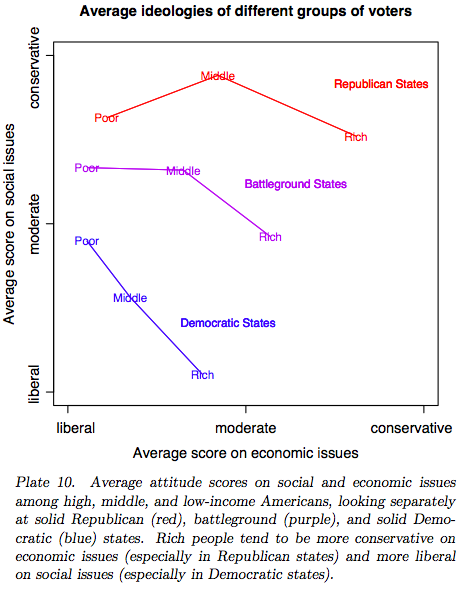
As it happens, however, the GOP relies on the upper class even more than Democrats. Median household income in the United States is $52,250, and if you look at the 2012 election, voters below that mark broke hard for Obama, with those above going for Mitt Romney by lesser margins. This trend of the Democrats getting way more votes below the median income level has roughly held for decades. These days, strong support for Republicans really doesn’t kick in until you get close to $75,000, or roughly the top third of the income ladder.
The difference between the parties is not that one relies on the wealthy and one doesn’t. Both parties lean heavily on those voters and divvy them up in various ways. (Mainly through cultural and social issues.) But the Democrats’ coalition also includes a fair portion that’s lower and working class, that’s still fighting for attention in the party, and that occasionally gets it. Conversely, lower- and working-class voters are mostly just absent from the GOP.
This matters because the upper class also has a pretty distinctive set of economic policy preferences. According to a recent study by Pew, the most financially secure Americans — roughly a fourth to a third of the population, by Pew’s definition — disproportionately say that government can’t afford to do more to help the needy, and that poor people “have it easy” thanks to government benefits. The less financially secure think the opposite. Large majorities of those making below $75,000 say the thing that bothers them the most about taxes is that the wealthy don’t pay their fair share. Large majorities of Americans oppose cuts to everything from Social Security and Medicare to aid for the poor. They support making union organizing easier and more federal spending on education.
Hell, 57 percent of the Republican or Republican-leaning voters who do make less than $30,000 think government doesn’t do enough to support poor people.
The reason the GOP can get away with being on the opposite side on all these matters is the fact that the voting population skews upper class: Even Democrats in the top third of the income distribution are noticeably more economically right-wing than poorer Democrats or Republicans, and Republicans in the top third are really economically right-wing.
There’s a pretty straightforward argument for why the upper class tilts in this direction. As Salam notes, the policy preferences of the upper class that really stick in his craw boil down to protecting their incomes and thus making the goods and services they provide more expensive for everyone else. But the flip side of that is making sure the goods and services everyone else provides — and thus their incomes — come cheap. That’s where the GOP comes in.
The essence of worker bargaining power is the ability to tell an employer “no.” That forces business owners to offer a better deal, driving up wages and benefits. A broad and generous welfare state gives workers leverage in that regard. It also helps boost aggregate demand, getting us closer to the full employment that really gives workers an edge. In short, the income of the working class is inversely proportional to its level of economic desperation. The effect of conservatives’ preferred economic policies — from slashing spending to imposing work requirements for aid — is to keep that desperation as high as possible. And of course, the upper class certainly doesn’t want to shoulder the taxes necessary to make such a system work.
The thing to remember is that, when it comes to what to do with the working class, the interests of the upper class and the super-rich cohere. Whether you’re a corporate CEO, a small-business owner, or just a well-heeled professional who consumes a lot of high-end goods and services, it benefits you to keep the labor of everyday Americans as cheap, compliant, and disposable as possible. It’s true, as Salam notes, that the truly rich aren’t quite as desperate to defend their interests as the upper class is; if you’ve got Mitt Romney’s dough, you can put up with more taxes, regulations, and workers demanding dignified pay and good benefits.
But that just bolsters the point that the fervent bastion of the economic right is the upper class. They’ve got the most to gain by slashing taxes, cutting regulations, scrapping government aid programs, and busting unions.
As Salam acknowledges, he doesn’t want high taxes on the wealthy, or for America to go down the road of the big European welfare states. His fellow reform conservatives and the Republican Party agree with him in this regard. Salam then says of the upper class: “I sensed that their gut political instincts were all about protecting what they had and scratching out the eyeballs of anyone who dared to suggest taking it away from them.”
But aren’t conservative economic policies the perfect expression of that exact impulse?
By: Jeff Spross, The Week, February 3, 2015
“GOP Struggles With Phony Deficit Pretense”: Literally The Same People Who Ignored The Deficit In The Previous Decade
The perception of the Republican Party as the anti-deficit party used to be 100% true. A couple of generations ago, the GOP actually saw the deficit as a legitimate concern, and shaped their policy agenda accordingly. During the Eisenhower era, Republicans kept very high tax rates in place, first approved to pay for WWII, in the name of fiscal conservativism. Many Republicans balked at JFK’s tax breaks out of fear of higher deficits.
Obviously, those eras are long gone. The GOP’s shift began in earnest under Reagan, but became almost ridiculous under George W. Bush – an era in which Republicans put the cost of two wars, a Wall Street bailout, massive tax cuts, and Medicare expansion on the national charge card for some future generation to worry about.
But once the Obama era began, GOP leaders decided they cared about the deficit again. It was impossible to take seriously – we’re talking about literally the same people who ignored the deficit in the previous decade – but Republicans actively pretended they had both credibility and genuine concerns about budget shortfalls.
It’s hard not to notice, however, that much of the new congressional Republican agenda has a common thread. See if you notice what these measures have in common. On health care:
A Republican bill to change how Obamacare defines a full work-week would raise the deficit by $53.2 billion over the next decade.
And abortion:
The official budget scorekeeper of Congress says the Pain-Capable Unborn Child Protection Act, which would ban abortions after 20 weeks, would increase Medicaid costs by as much as $400 million…. CBO officially estimates that the bill increases federal deficits by $75 million between 2014 and 2018, and $225 million between 2014 and 2023.
And immigration:
Senate Democrats threatened Thursday to block action on legislation funding the Homeland Security Department until Republicans jettison House-passed provisions that reverse President Barack Obama’s key immigration policies…. The Congressional Budget Office estimates that the measure would increase the federal deficit by $7.5 billion over a decade.
How would Republicans prevent these proposals from increasing the deficit? With offsetting cuts? Higher taxes? Neither, actually – GOP lawmakers are content to approve their priorities regardless of the impact on the budget shortfall.
It seems about once a week or so, GOP lawmakers unveil some new priority, they learn their idea would make the deficit worse, and they quietly make clear they couldn’t care less.
All of which made it quite amusing to see Republicans complaining about President Obama’s upcoming budget plan, claiming that it – you guessed it – doesn’t go far enough to reduce the deficit that Republicans created in the Bush/Cheney era.
Danny Vinik is absolutely right:
Republicans shouldn’t be allowed to get away with this two-faced policymaking. If they care about the deficit, they have to care about it in all contexts. If not, then they shouldn’t justify their opposition to Obama’s policies on grounds that they increase the deficit. When Republican congressmen react to Obama’s budget and undoubtedly invoke the deficit, the media should ask them why they didn’t care about the deficit last year. Maybe there will be some accountability for a change.
Well, there certainly should be some accountability for a change, but Republicans seem awfully confident that that they’ll face no consequences whatsoever for their incoherent whining about the deficit. Given recent history and misplaced public perceptions, I suspect their expectations are probably correct.
By: Steve Benen, The Maddow Blog, January 29, 2015
Share This Blog


 Unknown Feed
- An error has occurred; the feed is probably down. Try again later.
 mykeystrokes.com