Remember The Uninsured?
In February 2007, Deamonte Driver died of an infected tooth. But he didn’t really die of an infected tooth. He died because he didn’t have consistent insurance. If he’d had an Aetna card, a dentist would’ve removed the tooth earlier, and the bacteria that filled the abscess would never have spread to his brain.
Deamonte Driver was 12. His insurance status wasn’t his fault.
If all you knew about the Affordable Care Act was what you gleaned from watching the Republicans make their case against it, you probably would not know that the legislation means health-care coverage for more than 30 million Americans. Or, if you did know that, you’d be forgiven for not realizing it’s relevant: It almost never gets mentioned (see this congressman’s rundown of the bill’s contents, for instance), and the repeal legislation the Republicans are pushing does nothing to replace the coverage the Affordable Care Act would give to those people.
The lack of concern for how more than 30 million Americans will get their health-care coverage makes for an ugly contrast with the intense concern that Rep. Andy Harris — a proponent of repeal — found when he heard that his congressional health-care coverage wouldn’t begin until a month after he took the oath of office. “He stood up and asked the two ladies who were answering questions why it had to take so long, what he would do without 28 days of health care,” recalled one of the session’s attendees. He knows his taxpayer-subsidized insurance is important. But what about Driver’s?
We have a tendency to let the conversation over health-care reform become a bloodless, abstract discussion over cost curves and CBO models. We do that for two reasons: First, cost is important. Second, it’s important to the people who have political power, which is, by and large, not the same group who doesn’t have health-care insurance. Someone involved in the 2008 campaign once told me he’d seen numbers showing that 95 percent of Obama’s voters were insured. The numbers for McCain were, presumably, similarly high, or even higher. These are the people the political system is responsive too.
But that doesn’t make the plight of the uninsured any less wrenching. The Urban Institute estimated that 22,000 people died in 2006 because they didn’t have health-care insurance. John Ayanian, a professor of medicine and health-care policy at Harvard Medical School, testified before Congress on this issue. “Uninsured adults are 25 percent more likely to die prematurely than insured adults overall,” he said, “and with serious conditions such as heart disease, diabetes or cancer, their risk of premature death can be 40 to 50 percent higher.” And none of that takes into account the unnecessary suffering and physical damage that flourishes in the absence of effective medical care. Nor does it speak to the economic devastation that illness unleashes on uninsured families.
These numbers shouldn’t surprise us: We pay a lot of money for health-care insurance. We’ve directed the government to spend even more money subsidizing that insurance for the elderly, the disabled, some of the poor and everyone who gets health-care coverage through their employer. We value this product so highly for a reason: Most of us would agree that being able to afford to see a doctor isn’t a luxury. It’s a necessity. Rep. Harris certainly feels that way.
The same goes for the uninsured. In fact, it’s often more true for them, as many haven’t received reliable care for some time and have multiple health problems that haven’t been effectively treated. That’s why, when a temporary free clinic set up shop in Los Angeles, 3,000 people lined up for treatment. It’s why the famed RAND health insurance experiment found the people who benefited from insurance most clearly were the poor, as they were often plagued by easy-to-treat conditions like hypertension.
The Affordable Care Act covers the vast majority of the uninsured. It covers everyone who makes less than the poverty line, and almost everyone who makes less than 300 percent of the poverty line. It does all this while spending about 4 percent of what our health-care system currently spends in a year, and it offsets that spending — and more — to make sure the deficit doesn’t bear the burden of society’s compassion. Perhaps there’s a better way to achieve those goals that can pass Congress. If so, I’m open to hearing about it. But to repeal the bill without another solution for the Deamonte Drivers of the world? And to do it while barely mentioning them? We’re a better country than that. Or so I like to think.
By: Ezra Klein, The Washington Post, January 19, 2011
Size Matters: The GOP & Health Care
During the health care debate in 2009 and 2010, a serious issue emerged — the number of pages in congressional bills. I’m not kidding. The Republicans wanted short bills, and the health care reform bill was way, way too long (proving that it did too much and would end civilization as we know it). There was outrage across the country. Angry opponents of reform went to congressional town hall meetings brandishing huge stacks of paper. Then Minority Leader Boehner, foreshadowing his leadership priorities today, used a nationally televised address to condemn the length of the health care bill three times in as many minutes.
The extremists went wild. Rumors swept across the land. Some Tea Party types claimed the bill was 10,000 pages. Slate called the explosive stack-of-paper obsession “peculiar.” Ultimately, the New York Times set the record straight: “In the original version,” the Times said, “H.R. 3590 as passed by the Senate on Dec. 24, 2009, ran to some 2,400 pages, although with a very large font, triple spacing and huge left and right margins.” The newspaper went on to explain that, “With normal margins the document probably would shrink to about 500 pages or so.” Which meant the bill was not really that long when compared to other major bills, such as the financial reform law and past budget deals.
In the November mid-term elections, the Republicans ran on a platform of change, and change is what we got. Not only will the House Republicans vote to repeal the new health care law this week, they’re going to do so with a bill that’s only two pages long.
This is a triumph of conciseness, a 247-word beacon of brevity. The low word-count works especially well for the GOP, given the party’s unfinished “repeal and replace” campaign pledge. The Republicans addressed repeal, but they haven’t quite gotten to the “replace” part. That, we’re told, is a work in progress, and the question is being referred to various House committees to kick around for months.
In Sunday’s Washington Post, reporter Amy Goldstein noted that the Republican repeal vote is “the prelude to a two-pronged strategy that is likely to last throughout the year, or longer.” Great. Just what we need — another interminable debate on health care when the Republicans ought to be focusing on bipartisan solutions to create jobs. Rep. Fred Upton (R-Mich.), the new House Energy and Commerce Committee chairman, said it “may take time” for the GOP to develop a health care plan. Upton, who has been in Congress since 1987, has had only 24 years to come up with some health care ideas of his own. Instead, he hired Julie Goon, the former top lobbyist for the health insurance industry’s biggest trade group, as his special adviser.
I’m not sure what the Republican “replace” plan is (or how many pages it will be), but I know their two-page repeal bill is a bad deal for America’s families, seniors and small businesses.
The Republican repeal bill will take away dozens of benefits and important consumer protections that are making a real difference in peoples’ lives right now. When the Republicans vote for repeal, they’ll be taking away people’s newly won freedom from fear of insurers denying their care, dropping them when their sick and imposing double-digit premium hikes with impunity. They’ll be booting young adults off their parents’ health plans. They’ll be telling seniors they have to pay back the $250 donut hole checks they received to help buy prescription medications and give up their new 50% discount on brand-name drugs. The Republican repeal plan will force nearly 900,000 American families a year into bankruptcy because of huge medical bills. And it will take job-creating tax credits away from small businesses.
Speaker John Boehner and the Republicans don’t want the public to know the truth about the Affordable Care Act and what their repeal plan will take away from America’s consumers. And you can bet the debate about repeal will be filled with misleading information from Boehner and the new Republican majority. To help folks see beyond the rhetoric, Health Care for America Now made a chart that tells the truth. You can read and download a printable, high-resolution version with citations here and below.
The Republican Repeal Bill puts insurance companies back in charge of your health care.
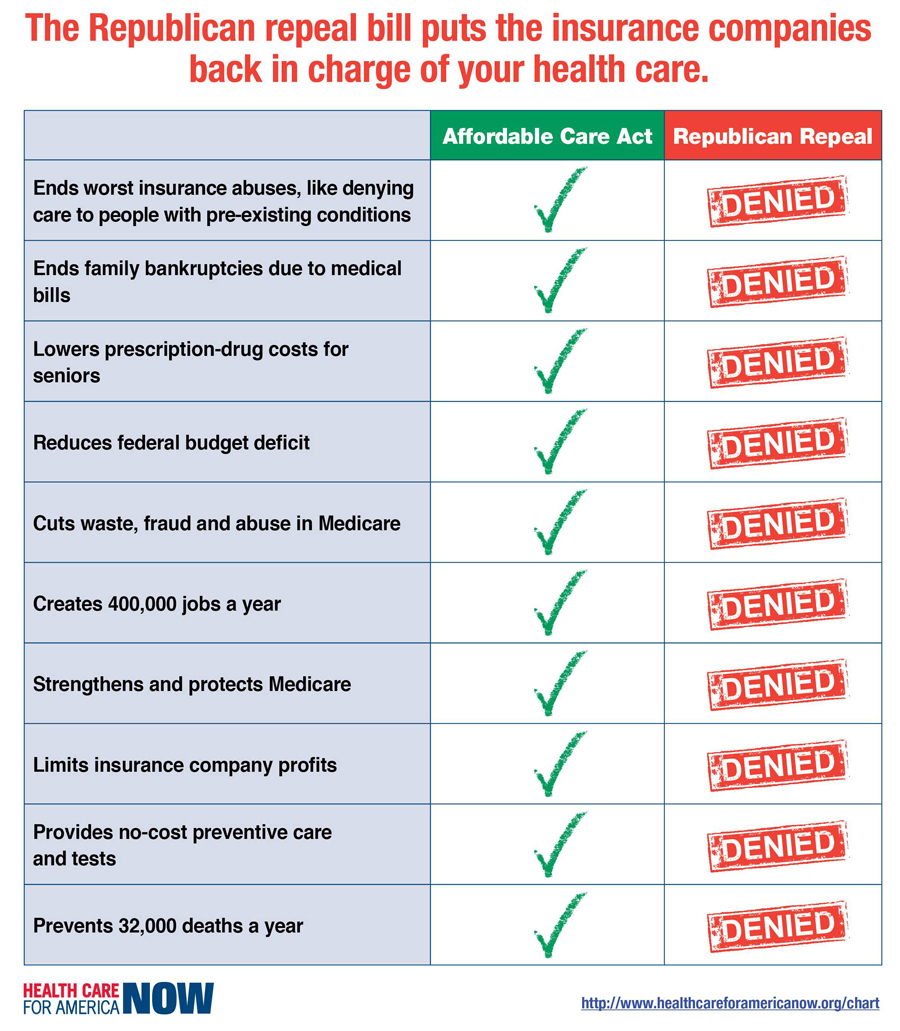
The Republican Repeal Bill
Clearly Constitutional: A Primer on the Constitutionality of the Affordable Care Act
Nearly three dozen judges have now considered challenges to the landmark Affordable Care Act and the overwhelming majority of these cases have been dismissed. Nevertheless, a single outlier judge in Virginia has embraced the meritless arguments against the new health care law and another judge in Florida also appears poised to break with the overwhelming consensus of his colleagues.
With only a few exceptions, these lawsuits principally challenge the Affordable Care Act’s minimum coverage provision—the provision requiring most Americans to either carry health insurance or pay slightly more income taxes—falsely arguing that Congress lacks the constitutional authority to enact such a provision. It is true that Congress’s authority is limited to an itemized list of powers contained in the text of the Constitution itself, but while Congress’s powers are not unlimited, they are still quite sweeping. There is no doubt that the Affordable Care Act fits within these enumerated powers in three ways, as this issue brief will demonstrate.
Congress has broad power to regulate the national economy
A provision of the Constitution known as the “commerce clause” gives Congress power to “regulate commerce … among the several states.” And there is a long line of Supreme Court decisions holding that Congress has broad power to enact laws that substantially affect prices, marketplaces, or other economic transactions. Because health care comprises approximately 17 percent of the national economy, it is impossible to argue that a bill regulating the national health care market does not fit within Congress’s power to regulate commerce.
Nevertheless, opponents of the Affordable Care Act claim that a person who does not buy health insurance is not engaged in any economic “activity” and therefore cannot be compelled to perform an undesired act. Even if these opponents were correct that the uninsured are not active participants in the health care market— and they are active, of course, every time they become ill and seek medical care—nothing in the Constitution supports this novel theory. Indeed, this theory appears to have been invented solely for the purpose of this litigation. Congress has enacted countless laws which would be forbidden under this extra-constitutional theory:
- Guns: President George Washington signed a law that required much of the country to purchase a firearm, ammunition, and other equipment in case they needed to be called up for militia service. Many of the members of Congress who voted for this mandate were members of the Philadelphia Convention that wrote the Constitution.
- Civil rights: The Civil Rights Act of 1964 compelled business owners to engage in transactions they considered undesirable—hiring and otherwise doing business with African Americans.
- Insurance mandates: The Affordable Care Act is not even the only federal law requiring someone to carry insurance. The Price-Anderson Act of 1957 requires nuclear power plants to purchase liability insurance and the Flood Disaster Protection Act requires many homeowners to carry flood insurance.
- Other mandates: Other laws require individuals to perform jury service, file tax returns, and register for selective service.
The minimum coverage provision is the keystone that holds the Affordable Care Act together
The Constitution also gives Congress the power “[t]o make all laws which shall be necessary and proper for carrying into execution” its power to regulate interstate commerce. As Supreme Court Justice Antonin Scalia explains, this means that “where Congress has the authority to enact a regulation of interstate commerce, it possesses every power needed to make that regulation effective.”
The act eliminates one of the insurance industry’s most abusive practices—denying coverage to patients with pre-existing conditions. This ban cannot function if patients are free to enter and exit the insurance market at will. If patients can wait until they get sick to buy insurance, they will drain all the money out of an insurance plan that they have not previously paid into, leaving nothing left for the rest of the plan’s consumers.
Seven states enacted a pre-existing conditions law without also passing an insurance coverage requirement, and all seven states saw health insurance premiums spiral out of control. In some of these states, the individual insurance market collapsed.There is a way out of this trap, however. Massachusetts enacted a minimum coverage provision in 2006 to go along with its pre-existing conditions provision and the results were both striking and immediate. Massachusetts’ premiums rapidly dropped by 40 percent.
In other words, because the only way to make the pre-existing conditions law effective is to also require individuals to carry insurance, that requirement easily passes Scalia’s test.
The link between the minimum coverage provision and the Affordable Care Act’s insurance regulations also sets this law aside from other hypothetical laws requiring individuals to purchase other goods or services. The national market for vegetables will not collapse if Congress does not require people to purchase broccoli, nor will Americans cease to be able to obtain automobiles absent a law requiring the purchase of cars from General Motors. Accordingly, a court decision upholding the Affordable Care Act would not provide a precedent enabling Congress to compel all Americans to purchase broccoli or cars, despite the law’s opponents’ claims to the contrary.
Congress has broad leeway in how it raises money
Congress also has the authority to “lay and collect taxes” under the Constitution. This power to tax also supports the minimum coverage provision, which works by requiring individuals who do not carry health insurance to pay slightly more income taxes. Taxpayers who refuse insurance must pay more in taxes while those who do carry insurance are exempt from this new tax. For this reason, the law is no different than dozens of longstanding tax exemptions, including the mortgage interest tax deduction, which allows people who take out home mortgages to pay lower taxes than people who do not.
Opponents of the Affordable Care Act respond that the minimum coverage provision somehow ceases to be a tax because the new law does not use the word “tax” to describe it, but this distinction is utterly meaningless. Nothing in the Constitution requires Congress to use certain magic words to invoke its enumerated powers. And no precedent exists suggesting that a fully valid law somehow ceases to be constitutional because Congress gave it the wrong name.
By Ian Millhiser, Policy Analyst and Blogger for the Center for American Progress where his work focuses on the Constitution and the Judiciary-January 18, 2011
The Importance of the Individual Mandate — Evidence from Massachusetts
The most contentious aspect of the Patient Protection and Affordable Care Act (ACA) is the individual mandate requiring that most documented U.S. residents obtain health insurance or pay a tax penalty. Many experts have long advocated a mandate as a central pillar of private-sector–based health care reform. Others, however, have argued that a mandate is not necessary for successful reform.
Proponents of the mandate argue that it is necessary to reduce adverse selection in a reformed nongroup insurance market. Adverse selection occurs when a larger fraction of relatively unhealthy people than healthy people purchase health insurance. It is analogous to the purchase of car insurance only by high-risk drivers (or worse, only by drivers who have just had an accident). However, one of the most popular aspects of the ACA may encourage such adverse selection, since the law prohibits health insurers from discriminating against applicants on the basis of health, either by charging higher premiums for sick people or by excluding preexisting conditions from coverage. Absent other reforms, such regulations would theoretically increase premiums for healthy people and lead them to exit the nongroup insurance market, which would cause premiums to rise even more. Informal support for this hypothesis comes from the fact that the five U.S. states with such regulations (known as “community rating”) are among the states with the highest nongroup insurance premiums.1
Opponents of the mandate counter that community rating may work as long as there are large subsidies that attract healthier enrollees to the insurance pool. Such subsidies include the tax credits that the ACA authorizes for people with incomes between 133 and 400% of the federal poverty level. (The federal poverty level for a family of four is about $22,000 per year.) States with community rating do not generally offer such large subsidies, so we can’t use their experience to predict the effects of national reform minus the mandate. But understanding whether the mandate matters, even with large subsidies in place, is critical for assessing its role in reform.
The early experience with health care reform efforts in Massachusetts may offer some lessons. Massachusetts made heavily subsidized insurance available to residents with incomes below 300% of the federal poverty level for nearly a year before mandating insurance coverage. By examining the characteristics of the subsidized insurance pool before and after the mandate went into effect, we assessed how much of an additive effect the mandate had over that of simply offering subsidized, community-rated insurance.
As part of the Massachusetts reform, the Commonwealth Care program provided free insurance to people with incomes below the federal poverty level from October 2006 onward and for those with incomes below 150% of the federal poverty level from July 2007 onward. In both cases, the state automatically enrolled people who were eligible for free coverage; people in higher income groups could enroll but had to pay premiums. We therefore examined the behavior of Massachusetts residents with incomes between 150 and 300% of the poverty level, who were eligible for subsidies and had to pay insurance premiums that were meaningful but much smaller than those mandated by the ACA.
Using claims data from the Massachusetts Commonwealth Connector, we measured the health mix of the population enrolling in Commonwealth Care according to average age, average monthly health care expenditures, and the proportion of enrollees with a chronic illness. We identified enrollees as having a chronic illness if within the first 12 months after enrollment they had an office visit at which a diagnosis of hypertension, high cholesterol level, diabetes, asthma, arthritis, an affective disorder, or gastritis was recorded.2 Relying on only the first 12 months of claims ensured that our estimates of rates of chronic illness for earlier enrollees, whose claims data covered a longer period, were similar to estimates for later enrollees.
We examined these data for the period from March 2007 (the date of the first available reliable information on people with incomes in the relevant range) through June 2008 (the last month for which we could calculate our 12-month measure of chronic illness). In each month, we measured the health of the enrollees who joined the program.
We assessed the characteristics of these enrollees before, during, and after the phasing in of the mandate. Technically, the mandate went into effect on July 1, 2007. The Connector began a massive public outreach campaign in May 2007, and the number of hits on its Web site peaked around July 1. The penalty, however, was assessed on the basis of insurance coverage as of December 31, 2007. That is, people who purchased insurance in November that began in December did not have to pay the penalty, even if they had been uninsured beyond July 1. The penalty for 2007 was the loss of the individual state income tax exemption, a relatively modest $219. It increased to about $900 in 2008 and was prorated on the basis of the number of months of coverage during the year.

Characteristics of New Enrollees in Commonwealth Care, According to Enrollment Period

Number of Enrollees in Commonwealth Care, According to Chronic-Illness Status
It seems possible that even without the mandate, people with the highest health care costs would enroll first and healthier people would enroll over time. But data on the health status of new enrollees suggest that that was not the case (see graph). At the beginning of the mandate’s phase-in in mid-2007, there was a greater increase in the number of healthy enrollees than in the number of enrollees with chronic illness. When the mandate became fully effective at the end of 2007, there was an enormous increase in the number of healthy enrollees and a far smaller bump in the enrollment of people with chronic illness. The gap then shrank to premandate levels as the remaining uninsured residents complied with the mandate, but clearly the mandate brought many more healthy people than nonhealthy ones into the risk pool. The large jump in healthy enrollees that occurred when the program became fully effective suggests that enrollment by the healthy was not simply slower than enrollment by the unhealthy, but rather that the mandate had a causal role in improving risk selection.
Whether the Massachusetts experience can be generalized to the rest of the country depends in part on the relative sizes of the subsidies provided: the higher the subsidies, the smaller the role for an individual mandate. Under Commonwealth Care, adults with incomes between 150 and 200% of the poverty level were asked to contribute $35 per month. Under the ACA, their monthly contribution would be $51 to $107. At 200 to 250% of the poverty level, the monthly contributions are $70 in Massachusetts and $107 to $171 under the ACA; at 250 to 300% of the poverty level, the contributions are $105 in Massachusetts and $171 to $242 under the ACA. The larger subsidies in Massachusetts would be expected to have a greater effect in inducing healthy people to obtain insurance than the ACA’s smaller subsidies — which suggests that mandating coverage might well play an even larger role in encouraging the healthy to participate in health insurance markets nationally than it has in Massachusetts.
By: Amitabh Chandra, Ph.D., Jonathan Gruber, Ph.D., and Robin McKnight, Ph.D.-New England Journal of Medicine | This article (10.1056/NEJMp1013067) was published on January 12, 2011, at NEJM.org.
Source Information
From the John F. Kennedy School of Government, Harvard University (A.C.), and the Massachusetts Institute of Technology (J.G.) — both in Cambridge, MA; and Wellesley College, Wellesley, MA (R.M.).
References
- Rosenbaum S, Gruber J. Buying health care, the individual mandate, and the Constitution. N Engl J Med 2010;363:401-403Full Text | Web of Science | Medline
- Goldman DP, Joyce GF, Escarce JJ, et al. Pharmacy benefits and the use of drugs by the chronically ill. JAMA 2004;291:2344-2350CrossRef | Web of Science | Medline
Health Reform at Work Today and Tomorrow: Improvements That Began Last Year Will Continue
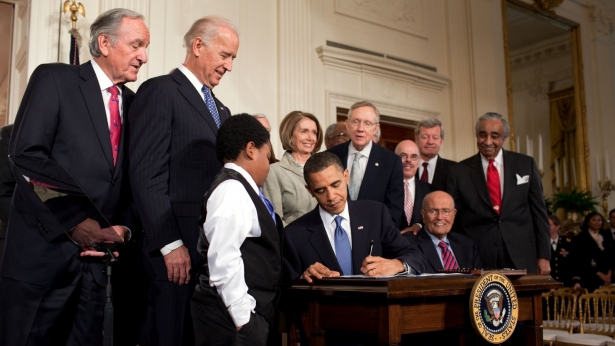
President Barack Obama is applauded as he signs the health care reform bill, on March 23, 2010, in the East Room of the White House in Washington. The bill includes many benefits for Americans who have health insurance today and those who have struggled to find and maintain health coverage.
2010 was a momentous year for the American health care system. In March, Congress passed—and President Barack Obama signed—landmark legislation that reforms the health insurance market, provides all Americans with affordable access to health coverage, and reduces the growth of health care costs.
The Department of Health and Human Services and other parts of the executive branch have begun to implement the new law in the subsequent 10 months. The Affordable Care Act, or ACA, includes many benefits for Americans who have health insurance today and those who have struggled to find and maintain health coverage. Many of these benefits came on-line in 2010.
Signature achievements include:
- Establishing pre-existing condition insurance plans in every state so that individuals with health problems who cannot find coverage in the regular market have a reliable source of coverage
- Requiring employer-sponsored health plans to offer coverage to the young-adult children of policyholders
- Helping employers with unpredictable health care spending for retired workers
- Providing more than 1 million rebate checks to Medicare enrollees who incurred high out-of-pocket prescription drug spending in 2010
- Prohibiting health insurance plans from denying coverage to children with pre-existing conditions
- Protecting individuals with high health care costs from the financial risk of absurdly low annual and lifetime limits on their benefits
- Prohibiting health insurance plans from rescinding coverage when a policyholder gets sick
These changes bring a new degree of stability and security to millions of Americans’ health coverage. And even more improvements are around the corner. Beginning this month, seniors will enjoy meaningful new benefits and significant improvements in their prescription drug coverage, while individuals and businesses will receive premium rebates from their insurance company when the insurers incur excessive administrative costs.
Specific improvements in 2011 include:
- Closing the Medicare prescription drug coverage gap. Seniors and people with disabilities who obtain prescription drug coverage through Medicare Part D will enjoy a new discount on brand-name and generic prescription drugs when they hit the so-called “doughnut hole” in their Part D benefits. Since the beginning of the program, enrollees have hit a gap in coverage when their total drug spending—including out-of-pocket costs and expenses covered by their Medicare Part D plan—exceeds a preset limit (currently $2,830). Patients then pay the total cost of their prescription drugs, without help from their drug plan, until their total drug expenses hit an upper limit and coverage kicks in again. With the new discount, people with drug spending high enough to hit the coverage gap will save almost $500 on average this year, while people with very high drug costs will save more than $1,500.
- Launching new prevention benefits for Medicare enrollees. Good coverage of preventive services helps seniors and other Medicare enrollees better manage their health. New benefits include coverage without cost-sharing for recommended preventive services (those that receive an “A” or “B” rating from the U.S. Preventive Services Task Force) and new coverage for a personal prevention plan.
- Increasing access to primary care. Medicare will pay primary care providers a 10 percent bonus payment, which offers a new incentive for physicians, nurses, and others to provide primary care services.
- Requiring insurers to provide high value for premium dollars. Beginning in 2011, insurers will pay rebates to policyholders—individuals and employers—when plan spending on clinical services falls below 80 percent of premium revenue in the individual and small group market, and 85 percent of premium revenue in the large group market.
Looking ahead, ACA provisions that will touch real people every day will continue coming on-line through 2011. These include providing more consumer information on healthy food choices by requiring chain restaurants and vending machines to provide nutritional data no later than March, and improving long-term care by sending enhanced federal Medicaid payments to support new state investments in community-based long-term care services starting in October. Tangible improvements will continue beyond this year, such as fully closing the coverage gap in Medicare Part D and improving Medicaid coverage for preventive care.
The Affordable Care Act’s most striking impact will come in 2014 when new health insurance exchanges launch, premium subsidies become available, and Medicaid coverage expands to include all low-income individuals regardless of family composition, age, or disability status.
These headline-grabbing changes in our health care system may be a few years down the road. But millions of Americans are already benefiting from the Affordable Care Act—and millions more will receive better care in the near future thanks to the changes in the new law.
By Karen Davenport | January 13, 2011-Center For American Progress. Photo: AP/Charles Dharapak
Share This Blog


 Unknown Feed
- An error has occurred; the feed is probably down. Try again later.
 mykeystrokes.com
You must be logged in to post a comment.