Debunking The Right’s Health Waiver Conspiracy
Is House Minority Leader Nancy Pelosi helping companies in her district get around new health care rules? Conservatives seem to think so, but their evidence is spotty at best.
Last month, the Obama administration granted a reprieve to 204 businesses and policyholders from new health coverage rules under the Affordable Care Act, bringing the total number of waivers to more than 1370. Many of the waivers are for limited benefit or so called “mini-med” plans—controversial rock-bottom plans that provide a very limited amount of coverage (sometimes as little as $2,000 a year) to beneficiaries that are used heavily in low-wage industries like the restaurant business. New federal rules require such plans to offer a minimum of $750,000 of coverage annually, and the waivers exempt the mini-med plans from such rules on a case-by-case basis.
The Daily Caller reported on Tuesday that businesses in Pelosi’s district received nearly 20 percent of the waivers in April, pointing out that many of them went to high-end restaurants and hotels. Sarah Palin piled on in a subsequent interview with the Caller, calling the discovery “unflippingbelievable!” and “corrupt.”
Pelosi’s communications director, Nadeam Elshami, pushed back against the criticisms in an email to Mother Jones, denying that Pelosi’s district received any special treatment. Her office also denied that it was at all involved in the process of granting waivers for these businesses. “It is pathetic that there are those who would be cheering for Americans to lose their minimum health coverage or see their premiums increase for political purposes,” Elshami wrote Tuesday afternoon, emphasizing that health-care waivers “are reviewed and granted solely by the Administration in an open and transparent process.”
In fact, the recent waiver applications from businesses in Pelosi’s district were not even received by the minority leader’s office. Rather, they were submitted directly to the Obama administration through a third-party company, Flex Plan Services, which provides benefit administration to companies in the Bay Area, Washington state, and elsewhere in the country, according to a statement issued by Richard Solarian, an assistant HHS secretary. On March 23, Flex Plan Services submitted applications for annual limit waivers for their clients’ health plan, including 69 businesses in California, 20 in Washington state, two in Georgia, and one in Alaska, including restaurants, home health care providers, and other service-based companies. On April 4, the U.S. Department of Health and Human Services approved the waiver request for all of Flex Plan Services’ clients—not just the ones in Pelosi’s district.
Flex Plan Services never contacted Pelosi’s office about their waiver request, and her office did neither provided any information to the company about the waivers nor helped facilitate the request, according to her spokesperson.
In other words, the reason the waivers were clumped together was because Flex Plan Services—which is in charge of administrating all of these businesses’ health care benefits—had issued a waiver request for the entire group of businesses. Altogether, the Obama administration has granted 1372 waivers and has denied about 100 requests. The mini-med waivers are essentially a stop-gap measure designed to keep employers from dropping health care benefits all together. The White House explains that waivers are granted if conforming to the rules “would disrupt access to existing insurance arrangements or adversely affect premiums, causing people to lose coverage,” acknowledging that the low-benefits plans are sometimes the only option that some employers can offer. The Democrats’ rationale is that the other changes under federal health reform will eventually allow employers to receive better, more affordable coverage under the health insurance exchange, when it begins operating in 2014.
To be sure, it’s worth closely examining which businesses and policyholders have received waivers, as well as which ones have denied them, along with the Obama administration’s rationale for making such decisions. But, as the April waivers reveal, the very fact that reprieves have been granted to businesses residing in democratic districts doesn’t mean the process is unjust. And to assume that the rationale must be political or “corrupt” is to turn a real policy issue into a partisan bludgeon.
By: Suzy Khimm, Mother Jones, May 17, 2011
GOP Medicare Proposal Doesn’t Work Like Members of Congress’ Health Care As Republicans Claim
The Center for American Progress has previously pointed out that the House Republican budget for fiscal year 2012 forces future beneficiaries out of Medicare into more expensive private plans. One of the ways Republicans are trying to sell their Medicare proposal is by claiming that beneficiaries would “be enrolled in the same kind of health-care program that members of Congress enjoy.” That claim is false. In fact, if the rate of growth under this Medicare proposal were applied to federal employees’ most popular health option, the Blue Cross Blue Shield Standard Option, federal workers, including members of Congress, with family coverage would have to pay another $3,330 for the care they enjoy today. Those with individual coverage would have to pay another $1,555.
Most federal workers receive their health coverage through the Federal Employees Health Benefits Plan, or FEHBP. The government contributes a portion of their health premium. That portion is set by law and applied to the weighted average of actual premiums charged in any given year. Beneficiaries make up the rest of the cost.
The Republican budget replaces the traditional fee-for-service Medicare for future beneficiaries with a voucher to private insurance companies that is established on very different terms. Unlike FEHBP, which has a consistent government contribution based on actual premiums charged in any given year, the amount of the voucher is determined independent of actual premiums. Its growth is instead tied to the rate of the consumer price index for all urban consumers, or CPI-U. Because health costs have typically increased faster than inflation, the level of government support from the voucher would become a lower share of actual premium costs over time. In other words, Medicare beneficiaries would be left holding the bag.
What would happen if FEHBP operated like the GOP Medicare proposal?
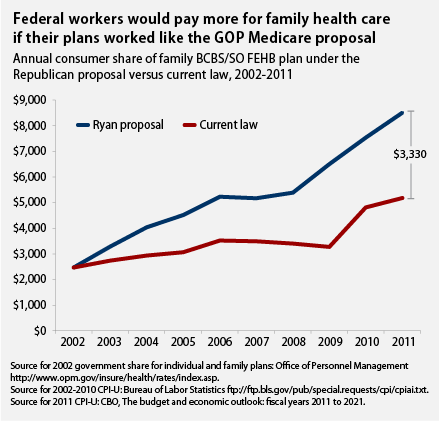
We examined what would happen if FEHBP had operated like the Republican Medicare proposal over the last decade. We used data from the Office of Personnel and Management to look at the annual premiums for federal workers enrolled in the Blue Cross Blue Shield Service Benefit Plan (Standard Family and Standard Individual). We chose this plan because nearly 60 percent of those enrolled in FEHBP have Blue Cross Blue Shield, and the Standard Option is the most popular FEHBP plan. We increased government support for the individual and family plans by the rate of growth in the CPI-U index from 2002 to 2011. We then compared the difference between the government’s share and the actual total premium in each year—which is the amount the beneficiary would pay—under the Republican proposal and the real FEHBP.

The result: A typical federal worker, or member of Congress, enrolled in family coverage in the Blue Cross Blue Shield Standard Option, would have had to pay an additional $3,330.36 for the same level of coverage they have today. Those with individual coverage would have had to pay $1,555 more.
By: Nicole Cafarella, Payment Reform Manager and Policy Analyst and Tony Clark, Policy Analyst, Center for American Progress, April 27, 2011
Remember The Health-Care Reform Debate?: How The Landscape Has Changed
As a participant in the great health-care wars of 2010, it’s been — I don’t know: Amusing? Depressing? Annoying? Vindicating? — to watch Rep. Paul Ryan’s budget run over every principle or concern that Republicans considered so life-or-death a mere 400 days ago. A partial list:
Big changes need to be bipartisan changes. “The only bipartisanship we’ve seen on [the health-care] bill is in opposition to it,” said Eric Cantor, now the House majority leader. “When the stakes are this high – reforming 20 percent of the U.S. economy – there must be constructive conversations and negotiations from Republicans and Democrats in both houses of Congress,” wroteformer representative Tom Davis. The Ryan budget, which is unquestionably a more ambitious document than the Affordable Care Act, passed the House with no Democratic votes and four Republicans voting no. The only thing bipartisan was the opposition, etc. This appears to have given no Republicans anywhere any pause.
Polls matter. In March 2010, John Boehner was very, very upset that Democrats were working to pass a health-care law that a slight plurality opposed in polls. “President Obama made clear he is willing to say and do anything to defy the will of the people and force his job-killing health care plan through Congress,” he thundered. Last week, Speaker Boehner and the Republicans passed Ryan’s budget. How do its elements poll? Much, much worsethan the Affordable Care Act.
The Affordable Care Act’s Medicare cuts will devastate hospitals! Last fall, Ryan’s health-policy guru was saying,“The official Medicare actuaries have determined that approximately 15 percent of hospitals will be driven out of business in less than ten years if these cuts go through and called the cuts ‘clearly unworkable and almost certain to be overridden by Congress.’” Now those same cuts are in Ryan’s budget. C’est la vie, I guess (that’s French for “only Democratic cuts hurt hospitals”).
The Affordable Care Act’s savings don’t begin quickly enough! When the tax on expensive employer-provided insurance plans was pushed back to 2018, conservatives were outraged. “The odds are high that the excise tax will never actually happen,” wrote David Brooks. “There is no reason to think that the Congress of 2018 will be any braver than the Congress of today.” It was a fair argument: Cost savings that begin in the future are less certain than cost savings that begin now. So when does, say, Ryan’s voucherization of Medicare begin? Not 2012. And no, it’s not 2018. It’s 2022.
There’s no reform in the Affordable Care Act. “It would take Sherlock Holmes armed with the latest GPS technology and a pack of bloodhounds to find ‘reform’ in the $2.5 trillion version of the health-care bill we are supposed to vote on in the next few days,” then-Sen. Judd Gregg wrote. But apparently Holmes got his iPhone out, because now the Affordable Care Act is chock-full of reforms. In fact, it’s the model Republicans are following. “It’s exactly like Obamacare,” Sen. John Cornyn saidof the Ryan plan. “It is. It’s exactly like it.” And he meant that as a compliment!
The Congressional Budget Office will score anything you tell it to. “Garbage in, garbage out,” Sen. John McCain said. “Can you really rely on the numbers that the Congressional Budget Office comes out with?” asked Fox’s Steve Doocy. Now, of course, Republicans are touting CBO’s estimates of Ryan’s savings.
First, “do no harm.” That was former Republican National Committee Chairman Michael Steele’s big applause line. “Republicans want reform that should, first, do no harm, especially to our seniors,” he wrote in The Washington Post. Cantor said the Affordable Care Act would “cut Medicare for our seniors and increase premiums for many Virginians.” Say what you will about Ryan’s budget, but going from paying 25-30 percent of your Medicare costs to 70 percent cuts your Medicare while increasing your premiums. Steele also said that “we need to protect Medicare and not cut it in the name of ‘health-insurance reform.’ ” Instead, it’s getting cut in the name of tax cuts. To be fair, Ramesh Ponnuru saw this one coming, so I can’t say conservatives were denying it at the time.
I’m sure I’ve forgotten a couple, but that’s what the comment section is for. The natural next question is whether Democrats have been similarly hypocritical in their opposition to Ryan’s plan. So far as I can tell, we’ve not seen it: Democrats think the plan puts too much of a burden on the backs of seniors and the poor — two things they worried about constantly during the Affordable Care Act — and cuts too many taxes for the rich. They also note that the Congressional Budget Office says privatizing Medicare will make it more expensive — the same finding that led to liberal advocacy for a public option. But if I’m missing something here, I imagine it, too, will come up in comments.
By: Ezra Klein, The Washington Post, April 21, 2011
Congressional Budget Office Looks At “RyanCare” Rationing And It Ain’t Pretty
The Congressional Budget Office has released its preliminary analysis (PDF) of House Budget Committee Chairman Paul Ryan’s budget, and I wouldn’t say it’s pretty. According to the CBO, Medicare beneficiaries will be left paying more for less. The CBO goes about this in a bit of a confusing way, setting a “benchmark” that corresponds to the cost of purchasing a private plan equivalent to Medicare, and then seeing how much more that plan would cost than Medicare under two different scenarios. Compared with either scenario, RyanCare costs a lot more than Medicare:
Under the proposal, most elderly people would pay more for their health care than they would pay under the current Medicare system. For a typical 65-year-old with average health spending enrolled in a plan with benefits similar to those currently provided by Medicare, the CBO estimated the beneficiary’s spending on premiums and out-of-pocket expenditures as a share of a benchmark: what total health-care spending would be if a private insurer covered the beneficiary. By 2030, the beneficiary’s spending would be 68 percent of that benchmark under the proposal, 25 percent under the extended-baseline scenario, and 30 percent under the alternative fiscal scenario.
If Medicare’s beneficiaries are getting less for more, Medicaid’s are simply getting less, period:
Federal payments for Medicaid under the proposal would be substantially smaller than currently projected amounts. States would have additional flexibility to design and manage their Medicaid programs, and they might achieve greater efficiencies in the delivery of care than under current law. Even with additional flexibility, however, the large projected reduction in payments would probably require states to decrease payments to Medicaid providers, reduce eligibility for Medicaid, provide less extensive coverage to beneficiaries, or pay more themselves than would be the case under current law.
As the CBO recognizes, a lot of what Ryan is doing isn’t saving money so much as shifting costs. Poor people and seniors don’t need less health care because Medicare and Medicaid are providing less health care. They just have to pay for more of it on their own. And as the CBO says, it’s hard to imagine Congress simply ignoring their pleas for help:
Under the proposal analyzed here, debt would eventually shrink relative to the size of the economy — but the gradually increasing number of Medicare beneficiaries participating in the new premium support program would bear a much larger share of their health care costs than they would under the current program; payments to physicians and other providers for services provided under the traditional Medicare program would be restrained (as under the two scenarios); states would have to pay substantially more for their Medicaid programs or tightly constrain spending for those programs; and spending for federal programs other than Social Security and the major health care programs would be reduced far below historical levels relative to GDP. It is unclear whether and how future lawmakers would address the pressures resulting from the long-term scenarios or the proposal analyzed here.
By: Ezra Klein, The Washington Post, April 5, 2011

Share This Blog


 Unknown Feed
- An error has occurred; the feed is probably down. Try again later.
 mykeystrokes.com
You must be logged in to post a comment.