RyanCare vs. The Public Option
If you want to understand why the budget debate so infuriates people who actually care about deficits — and, in particular, people who actually care about health-care spending — consider this: The central health-care reform in Paul Ryan’s budget, the one that’s got him so many plaudits for courage, would actually increase costs. The health-care reform that progressives have been pursuing for more than two years would cut them. And yet calling for Medicare to be privatized and voucherized is considered serious, while calling for a public option is considered tiresome. But let’s go to the tape.
Back during the health-care reform fight, the Congressional Budget Office looked at the likely effect of adding a public option that paid Medicare rates. “In total, a public plan based on Medicare rates would save $110 billion over 10 years,” the agency concluded. Importantly, the savings would come because premiums would be lower. The basic mechanism here is not complicated: Just as you get better deals by shopping at a mega-retailer like Wal-Mart, you get better deals by working with a mega-insurer like Medicare. Size matters.
As for Ryan’s plan, CBO’s take was just the opposite. “Under the proposal,” they said, “most elderly people would pay more for their health care than they would pay under the current Medicare system.” That is to say, health-care costs go up. Now, federal health-care spending goes down, as seniors are paying 70 percent of their costs out-of-pocket rather than 30 percent. Or, in CBO-ese, Medicare beneficiaries “would bear a much larger share of their health care costs than they would under the current program.” Of course, back in the real world, seniors are going to react poorly to being unable to afford health-care insurance, and those savings won’t manifest.
But even putting that aside, it makes for a very stark contrast. The progressive reform that won’t happen would cut health-care costs. The conservative reform that won’t happen would increase health-care costs. One idea makes insurance cheaper and one makes it more expensive. And yet the idea that makes insurance cheaper is pretty much off the table, while the idea that makes it more expensive — and that almost certainly wouldn’t work — is considered a very serious proposal worthy of brow-furrowing debate.
By: Ezra Klein, The Washington Post, April 25, 2011
No Glory For Governors Trying To Do The Right Fiscal Thing
If you want to get national attention as a governor these days, don’t try to be innovative about solving the problems you were elected to deal with – in education, transportation and health care. No, if you want ink and television time, just cut and cut and cut some more.
Almost no one in the national media is noticing governors who say the reasonable thing: that state budget deficits, caused largely by drops in revenue in the economic downturn, can’t be solved by cuts or tax increases alone.
There is nothing courageous about an ideological governor hacking away at programs that partisans of his philosophy, including campaign contributors, want eliminated. That’s staying in your comfort zone.
The brave ones are governors such as Jerry Brown in California, Dan Malloy in Connecticut, Pat Quinn in Illinois, Mark Dayton in Minnesota and Neil Abercrombie in Hawaii. They are declaring that you have to cut programs, even when your own side likes them, and raise taxes, which nobody likes much at all. Rhode Island’s Lincoln Chafee has warned of possible tax increases too.
Indeed, to the extent that Quinn received any national press coverage, he got pilloried in conservative outlets in January when he signed tax hikes that included a temporary increase in Illinois’ individual income tax rate from 3 percent to 5 percent.
Despite all the commotion around whether the federal government will shut down, the clamor in the states may be even more important than what’s happening in Washington, which is missing in action on the moment’s most vital fiscal question.
What states are doing to ease their fiscal agonies will only slow down our fragile economic recovery, and may stop it altogether. The last thing we need right now are state and local governments draining jobs and money from the economy, yet that is what they are being forced to do.
As the last three monthly reports from the Bureau of Labor Statistics showed, an economy that created a net 317,000 private-sector jobs lost 70,000 state and local government jobs. Cutbacks are dead weight on the recovery.
In a more rational political climate, President Obama would have resurrected the lovely old Republican idea of federal revenue sharing. Washington should have continued replenishing state budgets for two more years, until we were certain the economic storms had passed. Instead, anything that might be called “stimulus” – “S” is now a scarlet letter in politics – was rejected out of hand.
The federal government could also help the states by picking up more of their Medicaid costs. In the long run, health-care spending should be a responsibility of the national government – as it is in almost every other wealthy democracy. A national commitment would end the specter of states forcing already financially beleaguered citizens off the health insurance rolls.
Such ideas are off the table because the current rage is not for figuring out how to make government work better – a cause that once united governors of both parties – but for cutting back even its most basic and popular functions.
Consider the new budget Gov. Scott Walker announced in Wisconsin on Tuesday. Among other things, he proposed cutting state aid to schools by $834 million over the next two years, a 7.9 percent reduction.
On top of that, Walker would make it harder for localities and school districts to make up for the shortfall by limiting their ability to raise property taxes. This isn’t about education reform. It’s about forcing larger class sizes, layoffs, reductions in extracurricular activities or cuts in teacher pay and benefits. But, hey, if it’s labeled “government,” let’s slash it.
What’s truly amazing, as Stateline.org reported recently, is the number of governors who are cutting taxes at the same time they are eviscerating programs. A particularly dramatic case is Florida’s Republican Gov. Rick Scott. He faces a $3.5 billion budget gap – and is pushing for $2 billion in corporate and property tax cuts.
Historically, times of fiscal stress forced states to make useful economies in programs that didn’t work or were not essential. But what’s happening in so many places now is a reckless rush to gut the parts of government that all but the most extreme libertarians support – and that truly deserve to be seen (one thinks of education and programs for poor children) as investments in the future.
And those governors doing the hard work trying to balance cutbacks and tax increases get ignored, because there’s nothing sexy about being responsible.
By: E. J Dionne, Op-Ed Columnist, The Washington Post, March 3, 2011
Voters Are About to be Disillusioned With the GOP

The Puppet Master and his Minions
But going forward, now that they control the House and aspire to gain control of the Senate and the executive branch in the next election, Republicans will be forced to work for an actual agenda. And as Paul Waldman nicely explains in The American Prospect, this can produce a great pivot in the political climate of the country, very fast:
As a long history of public-opinion research has made clear — and as events continue to remind us — Americans are “symbolic conservatives” but “operational liberals.” In other words, they like the idea of limited government, but they also like just about everything government does. Good things happen to the party that can successfully pander to both impulses, which is why we saw so many ads from Republicans…condemning Democrats for passing a big-government health-care plan because it would … curtail the growth of Medicare.Perhaps they’re just being cautious as they get used to their new majority, but in the last week, Republicans have steadfastly refused to say what their professed desire to limit government would actually entail. Press them hard on what they want to cut, and they’ll answer “earmarks,” which would be fine were it not for the fact that a) earmarks do not appropriate new money; they merely direct money that has already been appropriated, and b) the value of all earmarks amounts to less than 1 percent of the federal budget….
If there’s one thing Republicans have been clear about, it’s their desire to repeal the Affordable Care Act. Even here, though, they don’t want to get too specific. As you’ve no doubt heard many times, a bare majority of the public opposes “health-care reform” (or “Obamacare”), while substantial majorities favor almost all the major provisions of the law. Once again, Republicans can win the vague, general argument but not the specific one. Faced with the impossibility of repealing the entire act (which Obama would veto), Republicans have said they’ll try to dismantle it piece by piece. Try that, however, and they’re suddenly attacking not “health-care reform” but those particular things people like.
That isn’t to say Republicans will inevitably be punished for attempting to repeal the ACA. Pushing repeal will only be dangerous for them if Democrats make it so. Republicans will suffer if they’re attacked aggressively for wanting to reopen the Medicare prescription-drug “doughnut hole,” for wanting to kick young people off their parents’ insurance, or for wanting to give the insurance companies the ability to deny coverage to children with pre-existing conditions. Those are all provisions of the ACA that have already gone into effect. The Democrats are hardly guaranteed to win the battle of ACA, but they have a shot if they make the right arguments.
Waldman goes on to note that House Republicans will have to write a budget resolution, and moreover, are virtually promising a budget showdown with the president, probably forcing a shutdown of the federal government. There’s no particular reason to assume that tactic will fare any better than it did when Newt Gingrich tried it back in the ’90s. But that scenario, too, will force Republicans–and attentive voters generally–to make some sheep-and-goat distinctions between government programs and services that are essential and those that are not. It’s when those two judgments begin to diverge, as they undoubtedly will, that the GOP will begin to pay a high price for consciously promising an austerity budget that somehow won’t upset their own voters. Campaigning on a Big Lie–Big Government is a terrible threat to your liberties and your pocketbook, but Big Government doesn’t involve anything that you care about, dear voter–can cause a real boomerang when the lies have to be turned into an agenda.
BY: Ed Kilgore, The New Republic, November 11, 2010
Historic Achievement For A More Perfect Union
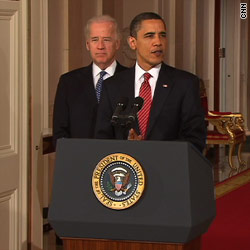
President Obama speaking on passage of Historic Health Reform Bill
“Mr. Speaker, I ask unanimous consent to revise and extend my remarks in opposition to this flawed health care bill”….We heard this canned statement over and over and over again tonight. We heard about the “Cornhusker kickback, the Louisiana Purchase, the Gator aid. We heard that this bill, if it passes, will make Americans less free. We heard that members of the military would loose their health coverage, that abortions would be paid for, that Medicare would be slashed. We heard from John Boehner that this was not the time to create bureaucracies, that there was no transparency, that there was not time to read the bill, that the people do not want this bill. His remarks continued to accent his distress over the process. If I had not been watching and only listening to his remarks over the radio, one would certainly have gotten the distinct impression that he was a very, very angry man. The tone and inflections in his voice gave one to believe that John Boehner just might be a little bit concerned that history was about to pass him by.
Health reform has been talked about and debated dating back to Theodore Roosevelt’s Bull Moose party which called for health insurance for industry. In his first term, President Roosevelt appointed a committee which was to report a program that addressed old-age and unemployment issues, medical care and health insurance. President Truman proposed a single insurance system that would cover all Americans with public subsidies to pay for the poor.
During nearly every Presidential election cycle since those days, every candidate has campaigned on the slogan of “health care for all”. At the end of that cycle, nothing gets done and the cycle continues. We immediately resort back to the status quo. The numbers of uninsured rise, the cost of insurance premiums skyrocket, rescissions continue, out of pocket expenses increase, denials for pre-existing conditions fall off the scales and even children are dropped from coverage.
Well, the time for change is long overdue. Republicans, for too long, have played politics with the lives of all Americans. At every turn, they have denied, delayed, obstructed, lied outright and instilled fear in the hearts and minds of the populace. As Speaker Pelosi said tonight, “all politics are personal”. After tonight, there will be no more politics of fear, no more politics of intimidation, no more threats of personal destruction. All of the talk about process, and all of the whining from republicans with bruised egos, don’t mean a heck of a lot now. What matters to those with no insurance, to those who are uninsured and those who have been bankrupted or lost their homes because of medical bills, simply stated, are results.
Many had given up on health reform with the Senate election results in Massachusetts earlier this year. Many have talked wildly about the upcoming November elections. The insurance companies became emboldened and Sen. Mitch McConnell and Rep. John Boehner actually began to believe their own words. Their repeated echo’s of “No” with the brazen 30-60% premium increases by Anthem and other insurers, re-awakened a cautious Democratic party. I want to personally thank Sen McConnell, Rep. Boehner and the insurance companies for their inadvertent contributions to the cause of health care reform.
In November 2008, America elected a President who said that he would get health reform done. For this President, it was not just a “slogan”. He took flack from all sides…Republicans and Democrats alike. With a determined Speaker of the House in Nancy Pelosi, President Obama and the U.S. House of Representatives delivered for the good of the American people.
When the sun rises in the east tomorrow, the earth will still be turning on it‘s axis, the American economy will not have collapsed, America will still be free, and there will be no Waterloo….the only thing that will be different tomorrow is that historic health reform for all Americans was passed tonight. History is now on the side of the American people.
Closing Arguments-The Day of Reckoning

President Obama making the final arguments for Health Reform
My Saturday began on the West lawn of Capitol Hill, where conservative activists were mounting one final, desperate effort to block health care reform. They came by the thousands, carrying flags and pushing strollers, in a demonstration of genuine grassroots fervor. They chanted “Kill the Bill,” over and over again, in a vaguely menacing tone that, perhaps, foretold a bit of ugliness to come.
But the most remarkable thing about the demonstration was how little it had to do with health care. The signs said “Stop socialism,” “A government of laws, not men,” “Respect our constitution–preserve our republic.” Nobody talked about death panels. Instead, one speaker–a Chicago radio host, I believe–attacked the First Lady’s obesity initiative. “Michelle, keep your hands off my kids’ lunchbox!” Yet another protest sign seemed to capture the mood perfectly: “This isn’t about health care. This is about control.”
A few hours later, inside the Capitol complex, President Obama urged House Democrats to do precisely what the protesters feared: Pass health care reform. It was not the first time he’d given such a speech. Just before the House voted on its initial reform bill in November, he’d come to Capitol Hill. And, broadly speaking, his intent had been the same: To embolden the Democrats by making them enthusiastic about the cause, demonstrating his own commitment to it, and making clear the political virtues of success.
But, like the protesters, this time Obama seemed to dwell less on health care and more on the significance of the moment. He invoked Lincoln, and the importance of fighting for principle. And then he invoked the legacy of the New Deal and Great Society, reminding members that their purpose in office was not to win elections–it was to make life better for their constituents. His closing argument was not about policy or politics. It was about posterity. And it was good.
For the last week or so, ever since it’s become apparent a climactic vote on health care was approaching, I’ve also been thinking about closing arguments. For most of the past year–and, really, it’s been far more than a year–the argument has been most practical. What would the bill do? What wouldn’t it do? And it’s easy enough to make the case for reform on those grounds.
As readers of this space know, I like to think of reform as achieving three broad goals: Making sure anybody can get an affordable insurance policy, shoring up everybody’s coverage so that it provides real economic security, and transforming medical care in order to make it both more effective and less expensive. Those arguments got a lot stronger this week, when the Congressional Budget Office determined that the final reform package–including both the Senate’s health care bill and the proposed amendments to it–would provide coverage to 32 million additional people, strengthen the baseline for coverage, and reduce the federal deficit over time.
But there’s another argument for health care reform, one that is at once more subtle and more sweeping. The disturbing part of our health care system is the financial and physical suffering it causes. But the unjust part of our health care system is the way it distributes that suffering. There are things all of us can do to stay healthy–we can eat right, we can exercise, we can avoid excessive risks. But even when we do the right things, we remain vulnerable.
You can have the perfect diet, jog three miles every day, and wake up one morning to discover you have cancer. So now you face mortal peril. And if, on top of everything else, you can’t pay your medical bills, you face financial ruin, as well.
Chance, of course, is part of life. Americans, in particular, seem to accept that. But every now and then, we have decided that need for such expansion–that there was, even now, the kind of common vulnerability to chance that required the sorts of initiatives we had enacted in the past. It happened with the New Deal, when we created the modern welfare state, and then again with the Great Society, when we expanded it.
The signature programs of these eras, Social Security and Medicare, work because they address a vulnerability we all share. Everybody is at risk of getting old; and everybody is at risk of misfortune, physical and financial, when that happens. To protect against that misfortune–to insure against that misfortune–all of us contribute. We all give, in the form of financial contributions; and we all get, in the form of financial security. Together, quite literally, we are stronger than when we are apart.
The conservatives protesting on the Capitol lawn Saturday see things differently. Health care reform isn’t about contributing money for the sake of their own security; it’s about having their money taken for the sake of somebody else’s security. When they hear stories of people left bankrupt or sick because of uninsurance, they are more likely to see a lack of personal responsibility and virtue than a lack of good fortune. As my colleague Jonathan Chait has observed, theirs is an extreme version of a view common (although surely not universal) on the right: That individuals can fend for themselves, as long as they are responsible and as long as the government gets out of the way.
There’s obviously a balance to be struck between these two world views. But, broadly speaking, conservative ideas about responsibility and vulnerability have dominated political discussion for most of the last four decades. That will change on Sunday, if health care reform passes. The bill before Congress may be flawed. And the process that produced it may be severely flawed. But it is, nevertheless, an expression of the idea that we–as as society–are not prepared to let people continue to suffer such dire consequences just because they’re unlucky.
A few hours after Obama was speaking, the Capitol had nearly cleared out. Leadership staff were meeting in House Speaker Pelosi’s office while a few stray congressmen were giving floor speeches to a nearly empty chamber. By and large, though, members had scattered–a tell-tale sign that Pelosi was confident. If she’d still needed to do serious arm-twisting, she’d have held a series of votes to keep members on the Hill.
I walked the length of the building and then out to the east lawn where the conservative protesters, who spent the day visiting (and, on a few occasions, haranguing) House Democrats, had reconvened. The crowd was more subdued now. It was smaller, too–hundreds instead of thousands. The setting sun behind the capitol dome cast a long shadow over them, as night approached. But a new dawn would come soon enough. And with it, perhaps, a new era.
By: Jonathan Cohn-Senior Editor-The New Republic-March 21, 2010
Share This Blog


 Unknown Feed
- An error has occurred; the feed is probably down. Try again later.
 mykeystrokes.com

You must be logged in to post a comment.