mykeystrokes.com

"Do or Do not. There is no try."

A Year After BP’s Oil Spill, Congress Sits Idly By: “It’s Not In The Headlines Anymore”

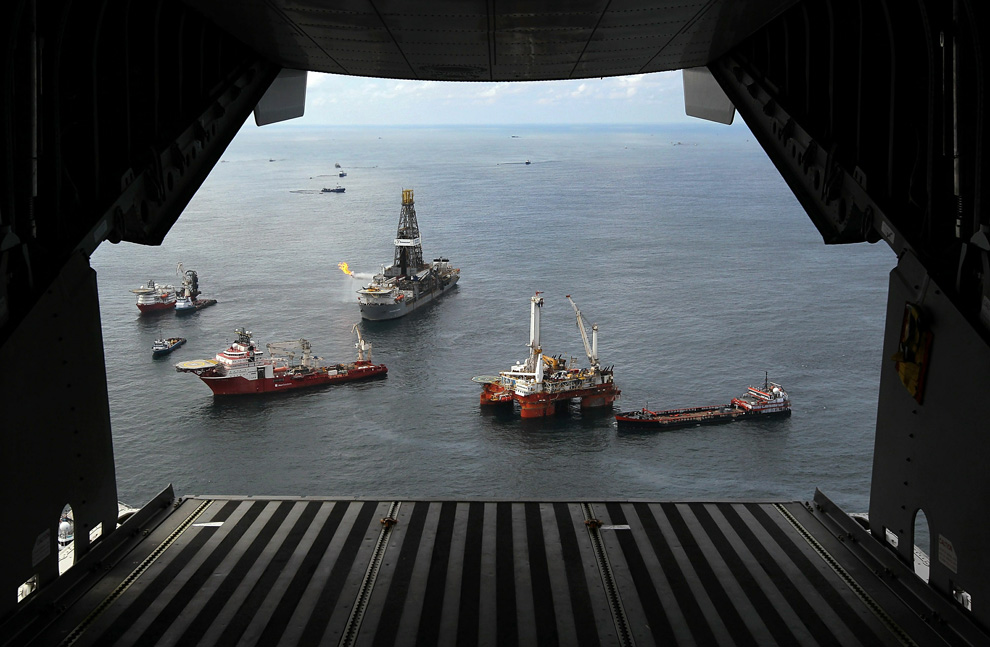
A year has passed since BP PLC’s Macondo well exploded in the Gulf of Mexico, killing 11 rig workers and launching the nation’s worst oil spill — and an all-encompassing environmental drama that played out for months as the oil industry and federal government struggled to contain the gusher.

But the heart-wrenching images of oil-slicked pelicans and the otherworldly videos of oil spewing from the seafloor largely seem to have faded from the minds of lawmakers on Capitol Hill. A year after the blowout, members of Congress have made little progress toward addressing the issues raised by the disaster.

The reasons for their lassitude are numerous.

Chief among them is the highly partisan environment on Capitol Hill, where a narrow Democratic majority in the Senate struggles to find common ground with the overwhelmingly Republican House.

“We haven’t responded because of the general polarization that has affected us in the last few months,” said Senate Energy and Natural Resources Chairman Jeff Bingaman (D-N.M.).

Also key is a shift in concern over offshore drilling safety, regulatory reform and coastal restoration to a closer-to-the-belt fear about the economic ramifications of escalating gasoline prices.

“It’s not in the headlines anymore,” said Rep. Joe Barton(R-Texas), the former ranking member of the House Energy and Commerce Committee who infamously apologized to BP’s then-CEO Tony Hayward last summer for having to endure what Barton characterized as a White House “shakedown.”

Indeed, in the months since BP contained the gusher, a nuclear crisis in Japan and political unrest in the Middle East have sparked a rapid rise in crude oil prices, shifting the energy conversation from one disaster to another. And a resumption of deepwater drilling in the Gulf of Mexico — albeit slowly — has dampened the urgency to pass a spill-response bill that would end the Obama administration’s ban on offshore exploration, a GOP priority.

Still, the lack of progress on a congressional spill response is not sitting well with many in the environmental community.

“I don’t think anybody in Congress has a legitimate excuse for the fact that they’ve done nothing to respond to the worst environmental disaster this nation has ever seen,” said Regan Nelson, senior oceans advocate for the Natural Resources Defense Council.

Nor has it quelled the concerns of some of the staunchest environmental Democrats on Capitol Hill.

“We should have moved last year. We need a response,” said Rep. Henry Waxman (D-Calif.), ranking member on the House Energy and Commerce Committee.

History repeating itself?

But there is historical context for the delay. Congress waited a year and a half after the Exxon Valdez oil tanker ran aground in Alaska’s Prince William Sound in March 1989 before taking legislative action.

That spill happened at the beginning of the 101st Congress, when Democrats held the majority in both chambers.

The Gulf of Mexico oil spill is different. The disaster occurred in an election year, and although the House was able to pass a Democrat-authored spill-response measure last summer, the Senate ran out of political steam to push a bill through in the weeks before the election or in the “lame duck” session last fall.

The House-passed measure (H.R. 3534 (pdf)), which incorporated Democratic language from three House committees, would have beefed up offshore worker and environmental safety standards, imposed new ethics standards on federal drilling regulators, created a restoration program to coordinate efforts to rehabilitate the Gulf of Mexico and created a new industry-funded endowment to protect oceans, among other provisions.

It also would have eliminated liability limits on companies drilling offshore, something most Republicans and oil-state Democrats are staunchly against because of the impact it could have on smaller and independent drillers. Despite GOP resistance to the liability language and other provisions — 193 Republicans and oil-state Democrats voted against the measure — the legislation was ultimately reported favorably. But talks quickly stalled in the Senate, where Democratic margins were smaller and resistance to the liability language from two moderate oil-state Democrats was too great to allow time for passage in the waning months of 2010.

The liability issue is complex and hearkens back to the legislation passed in response to the Exxon Valdez spill. Under that law, Congress capped oil companies’ liability for economic damages related to a spill at $75 million. Oil companies are still responsible for paying the full cost of containing and cleaning up a spill.

At the Obama administration’s prodding last summer — the “shakedown” Barton referred to — BP set up an independent $20 billion claims fund to pay for spill-related damages.

And even though BP agreed to pay for all the financial costs related to its spill — such as fishermen put out of work or empty hotels at the beach at high season — many Democrats in Congress watched in horror as the price tag of those damages escalated and called for a significant hike or complete elimination of the $75 million liability limit to protect coastal residents from a future spill where the companies involved might not have such deep coffers.

Republicans and the oil-state Democrats are not necessarily opposed to raising the cap. They just do not want to eliminate it outright. Doing so would shut out smaller producers and devastate an already battered coastal economy, they say.

“I think there’s widespread consensus among Democrats and Republicans that the liability limit is too low, that it needs to be raised,” said Sen. Mary Landrieu (D-La.), one of the chief opponents of the unlimited liability language. “We want to do that in a way … that keeps the industry as robust as possible between the large multinational companies and the smaller independent companies” (E&E Daily, Feb. 2).

Landrieu is working with Sen. Mark Begich (D-Alaska) on liability compromise language that would raise the initial cap to $250 million after which an industry-funded insurance pool would kick in. But the lawmakers have been negotiating on language since last September, with new promises each week that a bill is forthcoming. They have not introduced a compromise measure yet.

Other Democrats — and a lone Republican — have introduced new measures in both the House and Senate that would eliminate the liability cap entirely.

House focus on drilling

But none shows promise of moving any time soon. Republicans in the House appear poised to take up measures that would instead accelerate domestic oil and gas production, and Senate Democratic leaders have struggled to pass even slightly controversial bills.

Indeed, the House Natural Resources Committee this week marked up three measures from Chairman Doc Hastings (R-Wash.) that would force lease sales in new areas and compel the Interior Department to speed up drilling permit processing, among other provisions.

Such a stance is garnering criticism from Democrats on and off the Hill, like Interior Secretary Ken Salazar, whose agency is responsible for overseeing offshore drilling.

“Much of the legislation I’ve seen bandied around, especially with the House Republicans, it’s almost as if the Deepwater Horizon Macondo well incident never happened,” Salazar told reporters earlier this week. “Some people seem to have gotten amnesia of Deepwater Horizon and the horrific BP spill. I don’t have amnesia” (E&ENews PM, April 12).

Interior has taken great strides to boost its regulatory structure and offshore drilling safety in the months since the spill. The agency has imposed new, stricter permitting safety standards. And it has completely reorganized the beleaguered office that oversees offshore development.

But Hastings bristled at Salazar’s remarks, saying one of his measures would strengthen drilling safety.

“The Gulf bill does two things that’s not current in law: It puts in law the permitting process and it requires the secretary to do a safety review, cleanup review,” Hastings told reporters in the Capitol this week. “Now those two are significant reforms in my vision.”

Democrats have other reforms in mind.

“Here we are, one week removed from the first anniversary of the BP spill, and the Republican majority is marking up a trio of bills that will take us back to the days of rubber stamps and systemic failures,” said Rep. Ed Markey of Massachusetts, the leading Democrat on the resources panel, in a statement earlier this week. “This legislative package reflects a pre-spill mentality of speed over safety.”

Markey earlier this year introduced a new spill-response bill (H.R. 501 (pdf)) that largely mirrors the House-passed bill from last summer while incorporating some of the recommendations from the presidential commission tasked with investigating the causes of the disaster.

The seven-member commission issued its final report to the president in January, making a number of recommendations about how to improve offshore drilling safety and citing the BP incident as evidence of “systemic” problems within the industry.

But Republicans have bristled at that language and will likely ignore the commission’s findings — and Markey’s prodding.

Specifically, Markey’s bill includes the unlimited liability language and calls for a dedicated funding stream for the federal agencies overseeing the offshore drilling industry from user fees on the oil and gas industry.

Republicans and the oil industry have raised concerns about language in the bill that would impose new fees on the oil industry.

Legislation that imposes new fees “would not achieve the results that some of these members are trying to achieve. It would actually reduce investment, reduce revenues, harm jobs,” said Eric Wohlschlegel, a spokesman for the American Petroleum Institute, the industry’s main trade group.

Instead, he said the industry tends to sway toward Hastings’ approach. “Policies that allow for more access will actually accomplish a lot of goals currently on Capitol Hill, which is create jobs, increase revenues and increase energy security.”

Senate movement

On the Senate side, the Energy and Natural Resources Committee is prepping spill-response legislation that will likely look similar to the measure reported out of that committee last summer, with some inclusion of the presidential commission’s recommendations. But the measure won’t likely be as severe as Markey’s measure. For one, the energy panel does not have jurisdiction over liability; the Environment and Public Works Committee does. And Bingaman is known for crafting legislation that can get bipartisan support from many of his panel’s members, including Landrieu and Alaska Republican and oil-industry advocate Lisa Murkowski.

“One of the early bills will be a bill to ensure the Interior Department has the authority and resources they need to maintain proper regulation of oil and gas drilling on the outer continental shelf,” Bingaman said. “I think the American people support that, and I think we’ll have strong support again this year.”

Bingaman said he generally supports moving production and safety legislation separately.

“I don’t know why anyone in the Congress would not want to see us improve safety of drilling in the outer continental shelf,” he said. “I think that there ought to be bipartisan agreement to do whatever legislation needs to be done to improve safety and offshore drilling, and separate from that, we should have a full debate about the extent of increased production we want, things we want to do to encourage more production.”

Bingaman’s approach could gain modest support from environmentalists, who would likely still want to see further action on drilling reform.

NRDC’s Nelson called it “a great first step” and said she was looking forward to seeing the legislation.

Other measures she would like to see taken up include beefing up funding for the Interior agency that oversees offshore drilling, significantly raising the liability cap and sending a portion of the penalty money collected from BP for the spill to the Gulf region for coastal restoration work.

A rare area of consensus

The idea to use BP fines to pay for restoration of the coast has broad support among Republicans and Democrats both on and off Capitol Hill. The presidential panel called on the federal government to use 80 percent of the fines collected from BP for Clean Water Act violations to pay for coastal restoration in the Gulf. And Gulf Coast lawmakers are essentially unanimous in their support of such an idea.

Landrieu and Sen. David Vitter (R-La.) yesterday introduced legislation that would dedicate 80 percent of BP’s penalty fees to coastal restoration in the states affected by the disaster.

Specifically, the measure would send 35 percent of the penalty money to the five Gulf Coast states — Louisiana, Mississippi, Alabama, Florida and Texas — affected by the spill to be used specifically for ecosystem restoration and to support the travel, tourism and seafood industries. The measure would use 60 percent of the penalty money to establish a federal-state council to direct coastal restoration. And 5 percent of the funds would be used to create a science and technology program focused on coastal restoration, protection and research to improve offshore energy development safety.

The Clean Water Act allows U.S. EPA to collect $1,100 to $4,300 per barrel of oil spilled. Based on current federal estimates of 4.9 million barrels spilled, BP could face fines of $5.4 billion to $21.1 billion. Under current law, that money would be paid to the federal government.

“This is a great opportunity for the nation to do right by the Gulf Coast,” Landrieu said in a statement. “It’s a great opportunity for the polluters to step up and do the right thing.”

Rep. Steve Scalise, a Louisiana Republican, has also authored a measure in the House that would direct some of the funds to Gulf states. And according to Rep. Cedric Richmond, a Democrat from Louisiana, “everybody on the delegation is on board with the 80 percent.”

“It’s important to get it through now while you’re talking about deficit and the debt. You don’t want people to say ‘Oh, here’s this new pool of money, we should pay down the debt,'” Richmond said. “No, we should fix what was broken.”

But despite strong support for such a measure from Gulf state lawmakers, House leaders with jurisdiction do not appear anxious to move such legislation.

“I don’t want to act until all the information is in, and not all the information is in,” Hastings told reporters earlier this week. He wants to wait until all the investigations of the disaster — like the presidential commission’s study — are complete before moving any spill-response measures.

The joint Coast Guard and Interior Department board investigating the disaster recently pushed back the deadline for completing its inquiry until July.

But Hastings did not rule out all chances of movement on oil spill-response legislation this Congress.

“I want to get all the information,” he said, “and we’ll respond accordingly.”

By: Katie Howell, Greenwire; Contribution by John McArdel, The New York Times, Published in The New York Times, April 15, 2011

April 17, 2011 Posted by | Congress, Conservatives, Deep Water Horizon Oil Spill, Democrats, Economy, Energy, Environment, Environmental Protection Agency, GOP, Government, Politics, Regulations, Republicans, Senate, States | , , , , , , , , , , , , , | Leave a comment

Let’s Repeal 2010

Gail Collins-Photo:Tony Cenicola/The New York Times

This has been a bad summer for almost everybody — celebrities, shrimpers, Washington insiders, Tea Party outsiders, people who prefer pleasant weather. So far, my list of who did well only includes the Spanish soccer team and Paul the prophetic octopus. Plus, according to Senator Jim Bunning, George Steinbrenner. The Kentucky Republican praised the Yankee owner in the Senate Finance Committee for being “smart enough to die in 2010,” when the estate tax is temporarily suspended.

Oh, that Jim Bunning — always looking on the bright side. Why aren’t there more people like that in government?

This week, Congress passed the huge reform of the financial industry that it had been working on for nearly two years. You’d think there would have been cheering from coast to coast, but the left was disheartened to discover that contrary to all previous precedent, Congress had passed a bill that was imperfect.

“Ending debate on the bill is finishing before the job is done,” said Senator Russ Feingold of Wisconsin, the only Democrat to vote no.

Great idea. I think I speak for us all when I say that there is absolutely nothing I would like better than additional talking in the Senate. It always seems to make things better. Meanwhile, down in the House, John Boehner, the Republican leader, raised the ante, calling for repeal.

Who says that Boehner just hangs out at bars and tanning parlors and doesn’t work hard? The man is tireless! Everybody else was exhausted, but he wanted to start over.

“There are common sense things we should do to plug the holes in the regulatory system … and to bring more transparency to financial transactions. Because transparency is like sunlight and sunlight is the best disinfectant,” he said.

This is an exciting new analogy for Boehner. Just a couple of weeks ago he was leading the opposition to a bill that would require groups that pay for political attack ads to reveal their true identities. Boehner called it a “back-room deal to shred our Constitution.” In this case, transparency was a dangerous concept that would strip away all protective covering and allow vicious ultraviolet rays to stream through the window and burn away our precious freedoms.

Most Republicans are not joining Boehner in his call to repeal the financial reform bill because they are too busy calling for the repeal of health care reform. “The bill should be scrapped and replaced with much better ideas,” said Mario Rubio, the Republican Senate candidate in Florida.

Rubio’s own idea is to eliminate the requirement that healthy people have insurance, but keep the part that says insurance companies have to cover people with pre-existing conditions. This sounds like the ideal solution — no one would have to buy insurance until they got sick, and then they could make the companies sell them a whole bunch of coverage. I don’t know why nobody thought of this before.

With all these great ideas around — debate more, start over, don’t clean the windows — it’s a wonder that Washington hasn’t become the image of Athens in the age of Pericles. But instead, all Barack Obama’s critics have been able to do is make the country feel gloomy about Barack Obama. He’s passed more major legislation than anybody since Franklin Roosevelt and he’s got popularity ratings that look more like Martin Van Buren’s.

This week, there was an enormous outcry at the news that the president was going to take his wife and children to Maine for the weekend. This is the third time he and his family went away for a weekend since the gulf oil crisis. Three weekends in three months!

“Presidents are certainly entitled to vacation, just like everybody else, but there is a fine line as to when presidents should do it, what they should and where they should do it,” a former member of George W. Bush’s staff told CNN. The staff member in question, Brad Blakeman, was in charge of appointments and scheduling. Surely there is nobody better qualified to discuss this important subject than the man who helped the previous president get out of town for a third of his entire time in office.

The Republicans have now set up a site called “Golf or Gulf” that lists all the things Obama has been doing for the last three months when he could have been sitting around worrying about the oil spill. He had Paul McCartney over to the White House. And he played golf 10 times!

Let’s repeal the oil spill and start all over. The right way to handle the disaster, it appears from the many, many critiques, would have been to:

— Call all the oil company executives together to come up with a plan.

— Denounce all the oil companies.

— Apologize to the oil companies.

— Tell Paul McCartney he cannot sing in the White House until all the pelicans are clean.

By GAIL COLLINS-Op-Ed Columnist/NYT
Published: July 16, 2010

July 17, 2010 Posted by | Politics | , , , , , , , , , , , , | Leave a comment

First “Obama’s Katrina,” Now “Obama’s Watergate”


On May 8, 1973, the Senate Watergate Committee began its nationally televised hearings. Archibald Cox served as the Justice Department's special prosecutor for the case.

It appears that the Republican Party and the conservative chattering classes are determined to identify Barack Obama with every famous conservative disaster of recent history. BP’s Gulf Oil spill, we are told incessantly, is “Obama’s Katrina,” presumably because of the common geographic location, and now we hear that the silly, contrived “scandal” over alleged job offers to Democratic primary candidates will be “Obama’s Watergate.” What’s next: Obama’s Iraq? Obama’s U.S. Attorney Scandal? Obama’s Plamegate? Obama’s Illegitimate Election? (Oh, sorry, I forgot, Republicans have already used that one!).In any event, the “Watergate” analogy is insane, unless maybe you are too young or too poorly read to remember what Watergate entailed. As Joe Conason explains at Salon

        “Watergate” was the place where the president’s henchmen staged a “third-rate  burglary” of the Democratic National Committee headquarters on a June night in 1972, but its historical definition is the vast gangsterism of the Nixon regime. Watergate involved no political job offers, but a series of burglaries, warrantless domestic wiretaps, illegal spying, campaign dirty tricks, and assorted acts of thuggery by a group of goons whose leaders included G. Gordon Liddy and the late E. Howard Hunt. Watergate meant a coverup of those felonies with more felonies, set up by lawyers and bureaucrats who collected cash payoffs from major corporations and then handed out hush money and secret campaign slush funds. Watergate implicated dozens of perps, from Hunt and Liddy all the way up to the president, his palace guard, and his crooked minions at the highest levels of the Justice Department, the FBI and the CIA. 

     The allegations against the White House today involve alleged discussions of administration jobs for Democrats running in two Democratic primaries, who turned them down without consequences. Does that sound like Watergate in any way, shape or form?

     But that even assumes there was anything wrong with the discussions, other than their political clumsiness. Yes, one defense is that the same thing has been done by federal, state and local executives from time immemorial, but even that concedes too much to the critics. The federal statute being invoked by conservatives in this situation makes it a crime to offer a job in exchange for “a political act.” But in this case, “the political act” is simply taking the job. If that’s illegal, then it’s illegal to offer appointments to anyone who is or might be running for office. 

It’s not surprising that Republicans are seizing on this silliness, enabled by a bored press corps; not only does it contribute to the constant drumbeat of charges that Obama’s imploding politically and doomed to disaster in 2010 and/or 2012, but it’s also a handy weapon to use against Joe Sestak, who is well-positioned to beat one of the Right’s true heartthrobs, Pat Toomey, in November.

That’s all politics-as-usual, of course. But let’s not get hallucinogenic by comparing this to the wide-ranging use of federal power to raise money illegally and intimidate “enemies” characterized by Watergate.
 

Posted by Ed Kilgore on June 4, 2010-Photo: Marion Trikosko for USN and WR. 

June 4, 2010 Posted by | Politics | , , , , , | Leave a comment

“We the People” are Bald-Faced Hypocrites

President Obama receiving briefing on Gulf Oil Spill shortly after initial explosion


Let me get this straight…. First, we want to reduce the size, scope and power of government at all levels, and on all issues, AND  oppose increasing the size, scope and power of government at any level  AND  for any purpose.  When asked,   “What is the role of government”, we respond “No role”.  We say that government that governs least,  governs  best.   We want the government to keep its hands off our Medicare and Medicaid.   We want the federal government to keep its boot heels off the throats of Big Banks and Wall Street. We say “Drill Baby Drill”. We say that our freedom and liberty are seriously threatened or has even been abolished in some cases.  We want everything under the sun but we don’t want to pay for anything.  What raise my taxes? Forget it. We feel that if only I can portray myself as being more angry or can just shout louder than the other guy, either through distortion or just outright lying, no matter the circumstance, I win.  For those in the media, you  circle the wagons whenever one of your colleagues is questioned or chastised when they are called out for endorsing or propagating half truths or capitalizing on individual’s personal pains, sufferings and tragedies.

Now there is a massive oil leak corrupting the waters of the Gulf of Mexico.  This leak is a catastrophic event that will cause devastating results for generations to come.  And now, you say that the government’s response to this Deep Water Horizon Oil Spill has been too slow. Others say that the response has been completely non-existent.   The federal government has not solved this problem.  All I hear now is “I want the government to end my nightmare”.  All of a sudden, we want “Big Government”, that same government that many of you have been hell-bent on abolishing.   I have heard criticism from Ed Schultz, Chris Matthews, Keith Olbermann, James Carville and Donna Brazille on the Left, and Billy Nungesser, Bobby Jindal, Haley Barbour to wackoo’s Glen Beck, Bill O’Reilly, Sarah Palin and Rush Limbaugh on the Right. Many of these criticisms have been outright lies and distortions. I say “We the People” are bald-faced hypocrites.

For anyone who has an interest, fact based information is readily available and can easily be obtained. Any media outlet worth its weight,  could have and should have set the record straight on the time-line of the government’s response to this disaster.  No.  Instead, none of these people really want to recognize the fact that a major disaster has occurred and all forces must be brought to bear to resolve the problem. Some have suggested that the government kick BP aside and take over all aspects of the operation.  So much for “freedom” from the government…. and exactly what do you think that would accomplish?  Someone even suggested that we just send divers down and plug the hole.  This one has to be my favorite. Unless you are a Sperm of Bluenose whale, good luck with that stupid idea.   For anyone to suggest that the federal government, our federal government, is not taking this catastrophe seriously or is not bringing all forces to bear to completely resolve and recover from this event is terribly misguided and obviously has their own agenda.

Until the leak is stopped, we are all in this oil-slicked boat together.  Posturing and playing politics is not helping nor is it going to help….not one iota.  So for all of you, who still believe that you can stake out a long term position for furthering your political agenda, padding your wallet or trying to increase your ratings, strap on your life-vest and jump out of the boat.  Once you start gulping oil and gasping for breath, it’s going to be very difficult and quite slippery trying to get back in, if you survive that long.  I’m betting that you won’t make it.   When it comes to having “freedom” without government or even “freedom” from government, small or large, be careful what you wish for….you can’t have your cake and eat it too. 

In our efforts to develop solutions, we should strive not to become part of the problem.  If nothing else, we should realize that we are not in a position today or in the foreseeable future to continue to pursue off-shore oil drilling.

May 25, 2010 Posted by | Deep Water Horizon Oil Spill | , , , , , , , , , , , , , , , , , , , , | Leave a comment