GOP Medicare Proposal Doesn’t Work Like Members of Congress’ Health Care As Republicans Claim
The Center for American Progress has previously pointed out that the House Republican budget for fiscal year 2012 forces future beneficiaries out of Medicare into more expensive private plans. One of the ways Republicans are trying to sell their Medicare proposal is by claiming that beneficiaries would “be enrolled in the same kind of health-care program that members of Congress enjoy.” That claim is false. In fact, if the rate of growth under this Medicare proposal were applied to federal employees’ most popular health option, the Blue Cross Blue Shield Standard Option, federal workers, including members of Congress, with family coverage would have to pay another $3,330 for the care they enjoy today. Those with individual coverage would have to pay another $1,555.
Most federal workers receive their health coverage through the Federal Employees Health Benefits Plan, or FEHBP. The government contributes a portion of their health premium. That portion is set by law and applied to the weighted average of actual premiums charged in any given year. Beneficiaries make up the rest of the cost.
The Republican budget replaces the traditional fee-for-service Medicare for future beneficiaries with a voucher to private insurance companies that is established on very different terms. Unlike FEHBP, which has a consistent government contribution based on actual premiums charged in any given year, the amount of the voucher is determined independent of actual premiums. Its growth is instead tied to the rate of the consumer price index for all urban consumers, or CPI-U. Because health costs have typically increased faster than inflation, the level of government support from the voucher would become a lower share of actual premium costs over time. In other words, Medicare beneficiaries would be left holding the bag.
What would happen if FEHBP operated like the GOP Medicare proposal?
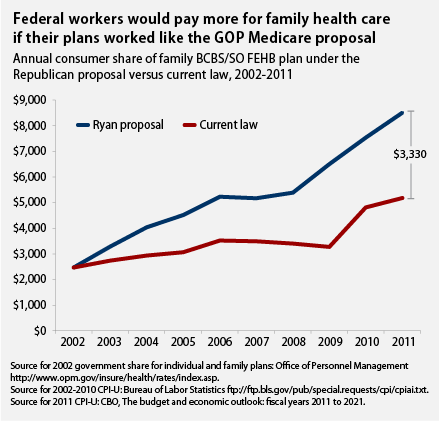
We examined what would happen if FEHBP had operated like the Republican Medicare proposal over the last decade. We used data from the Office of Personnel and Management to look at the annual premiums for federal workers enrolled in the Blue Cross Blue Shield Service Benefit Plan (Standard Family and Standard Individual). We chose this plan because nearly 60 percent of those enrolled in FEHBP have Blue Cross Blue Shield, and the Standard Option is the most popular FEHBP plan. We increased government support for the individual and family plans by the rate of growth in the CPI-U index from 2002 to 2011. We then compared the difference between the government’s share and the actual total premium in each year—which is the amount the beneficiary would pay—under the Republican proposal and the real FEHBP.

The result: A typical federal worker, or member of Congress, enrolled in family coverage in the Blue Cross Blue Shield Standard Option, would have had to pay an additional $3,330.36 for the same level of coverage they have today. Those with individual coverage would have had to pay $1,555 more.
By: Nicole Cafarella, Payment Reform Manager and Policy Analyst and Tony Clark, Policy Analyst, Center for American Progress, April 27, 2011
GOP DeathWish?: Republicans Pushing To Revamp Medicare Could Find Themselves Voted Out Of Office In The Next Election
One of the biggest and most frequent mistakes in politics is for a party to misread its mandate. When it happens, independent and swing voters get angry and punish a candidate or a party on Election Day. Because American politics is a zero-sum game, punishing one party means rewarding the other party—even when the latter is not necessarily deserving of support. Frequently, the party that benefits from the spanking mistakenly interprets it to mean that the public is embracing every aspect of its agenda. Republicans shouldn’t forget that their party had dismal favorable/unfavorable poll ratings last fall. They won because they weren’t Democrats.
There is no question that the Republican base, conservatives, and supporters of the tea party want to take a meat ax to government spending. When Republican congressional members return home and meet with their constituents, they are encouraged to vote against continuing resolutions and for deep spending cuts. These supporters have intensity, and they adamantly oppose any compromise with Democrats.
It would be a blunder, however, to think that such views drove the election. Republicans, conservatives, and tea partiers did not throw Republicans out of their House and Senate majorities in 2006, and they did not vote to increase the size of the Democratic majorities and elect Barack Obama president in 2008.
Independent voters were the ones who cast their ballots for Democrats by an 18-point margin in 2006 because they were mad at President Bush and upset about the war in Iraq, not to mention Republican scandals and the general performance of the GOP Congress. Two years later, these same voters were still angry at the president, were afraid of the financial crisis, and didn’t care for GOP presidential nominee John McCain.
In 2010, these independent voters were unimpressed by the economic-stimulus package, didn’t like cap-and-trade environmental regulation, and really didn’t like the Democratic health care package. Those over or approaching 65 years of age also feared that health care reform would erode Medicare benefits. Even those unaffected by the reforms rallied to defend Medicare.
Polling is very clear. Most voters want to see the federal budget balanced and spending cut. However, they don’t want Social Security, Medicare, or Medicaid touched, and, oh yes, they don’t want taxes increased. Now, anyone with an IQ over room temperature knows that all of this is impossible. Spending on Social Security, Medicare, and Medicaid, along with interest on the national debt, amounts to approximately half the federal budget.
There is no doubt that significant budget cutting is necessary and that Medicare and Medicaid must be reformed. No one can doubt the courage or sincerity of House Budget Committee Chairman Paul Ryan, R-Wis. But it’s little short of suicidal to drop a Medicare reform package—even a voucher plan that would be optional for those currently older than 55—into tough budget negotiations stymied over Republican demands for deep spending cuts. Democrats have some experience with older voters going ballistic, even with changes that wouldn’t affect them.
For many seniors, doing anything to Medicare that can’t be portrayed as an increase is essentially a cut, and they will fight it to their last breath. From a political standpoint, Medicare reform is very dangerous territory. House Republicans are not just pushing the envelope—they are soaking it with lighter fluid and waving a match at it.
One can understand why Republicans are pushing so hard. Their base is demanding that they do so. And if congressional Republicans resist, many of them can look forward to primary opposition next year. But it seems that GOP members of Congress have become so consumed with pleasing their base that they are ignoring general-election voters and the independents who drive the wild gyrations in American politics.
Congressional Republicans would be well advised to pay attention to the results of the latest Pew Research Center poll (conducted March 30 to April 3 among 1,057 adults) that asked Americans whether they would prefer that their lawmakers stand by their principles even if it meant that the government would shut down, or whether they would rather have their lawmakers compromise on a budget even if they didn’t agree with it. Among Republicans and Republican-leaning independents who agree with the tea party movement, 68 percent said they would rather have a lawmaker who stands by his or her principles. But among all Republicans, only 50 percent said stand by their principles, while 43 percent said compromise. Among all adults, 55 percent said compromise; among independents, 53 percent said compromise, with 36 percent siding with the principles option.
The bottom line: GOP primary voters are very different from general-election voters. It would be a very shortsighted strategy for Republican members—especially those in swing districts—to focus too much on primary voters. A lot of Democrats did the same thing in 2009 and 2010. Many are now former members of Congress.
By: Charlie Cook, National Journal, April 7, 2011
The Republican War On Elizabeth Warren
Last week, at a House hearing on financial institutions and consumer credit, Republicans lined up to grill and attack Elizabeth Warren, the law professor and bankruptcy expert who is in charge of setting up the new Consumer Financial Protection Bureau. Ostensibly, they believed that Ms. Warren had overstepped her legal authority by helping state attorneys general put together a proposed settlement with mortgage servicers, which are charged with a number of abuses.
But the accusations made no sense. Since when is it illegal for a federal official to talk with state officials, giving them the benefit of her expertise? Anyway, everyone knew that the real purpose of the attack on Ms. Warren was to ensure that neither she nor anyone with similar views ends up actually protecting consumers.
And Republicans were clearly also hoping that if they threw enough mud, some of it would stick. For people like Ms. Warren — people who warned that we were heading for a debt crisis before it happened — threaten, by their very existence, attempts by conservatives to sustain their antiregulation dogma. Such people must therefore be demonized, using whatever tools are at hand.
Let me expand on that for a moment. When the 2008 financial crisis struck, many observers — myself included — thought that it would force opponents of financial regulation to rethink their position. After all, conservatives hailed the debt boom of the Bush years as a triumph of free-market finance right up to the moment it turned into a disastrous bust.
But we underestimated the speed and determination with which opponents of regulation would rewrite history. Almost instantly, that free-market boom was retroactively reinterpreted; it became a disaster brought on by, you guessed it, excessive government intervention.
There remained, however, the inconvenient fact that some of those calling for stronger regulation have a track record that gives them a lot of credibility. And few have as much credibility as Ms. Warren.
Household debt doubled as a share of personal income over the 30 years preceding the crisis, and these days high levels of debt are widely seen as a major barrier to recovery. But only a handful of people appreciated the dangers posed by rising debt as the rise was happening. And Ms. Warren was among the foresighted few. More than a decade ago, when politicians of both parties were celebrating the wonders of modern banking and widening access to consumer credit, she was already warning that high debt levels could bring widespread financial disaster in the face of an economic downturn.
Later, she took the lead in pushing for consumer protection as an integral part of financial reform, arguing that many debt problems were created when lenders pushed borrowers into taking on obligations they didn’t understand. And she was right. As the late Edward Gramlich of the Federal Reserve — another unheeded expert, who tried in vain to get Alan Greenspan to rein in predatory lending — asked in 2007, “Why are the most risky loan products sold to the least sophisticated borrowers?” And he continued, “The question answers itself — the least sophisticated borrowers are probably duped into taking these products.”
Given Ms. Warren’s prescience and her role in shaping financial reform legislation — not to mention her effective performance running the Congressional panel exercising oversight over federal financial bailouts — it was only natural that she be appointed to get the new consumer protection agency up and running. And it’s hard to think of anyone better qualified to head the agency once it goes into action.
The fact that she’s so well qualified is, of course, the reason she’s being attacked so fiercely. Nothing could be worse, from the point of view of bankers and the politicians who serve them, than to have consumers protected by someone who knows what she’s doing and has the personal credibility to stand up to pressure.
The interesting question now is whether the Obama administration will see the war on Elizabeth Warren for what it is: a second chance to change public perceptions.
In retrospect, the financial crisis of 2008 was a missed opportunity. Yes, the White House succeeded in passing significant new financial regulation. But for whatever reason, it failed to change the terms of debate: bankers and the disaster they wrought have faded from view, and Republicans are back to denouncing the evils of regulation as if the crisis never happened.
By the sheer craziness of their attacks on Ms. Warren, however, Republicans are offering the administration a perfect opportunity to revive the debate over financial reform, not to mention highlighting exactly who’s really in Wall Street’s pocket these days. And that’s an opportunity the White House should welcome.
By: Paul Krugman, Op-Ed Columnist, The New York Times, March 20, 2011
Make-Believe Billionaire Candidate Donald Trump Is A Birther Now
Donald Trump, a reality show host and savage parody of post-industrial Great Stagnation-era capitalism, is pretending to run for president, as a sort of performance art piece mocking the contemporary fad among elites of celebrating plutocrat billionaires as our wise superiors and pretending their vanity campaigns for elected office are some sort of charitable selfless “public service.”
And he’s really going all-out. What began as a sort of through-a-glass-darkly reimagining of the Bloomberg-for-president chatter added a dose of Gingrichian “false run to promote unrelated money-making endeavors” as he ramped up his “campaign” at precisely the moment the new season of his television show premiered.
Today Trump even became a pseudo-birther, in an interview with ABC News, which was for some reason taking part in an extensive marketing campaign for a television show that airs on a rival network:
“Everybody that even gives a hint of being a birther … even a little bit of a hint, like, gee, you know, maybe, just maybe this much of a chance, they label them as an idiot. Let me tell you, I’m a really smart guy,” he said.
[…]
He explained the source of his doubt: “He grew up and nobody knew him. You know? When you interview people, if ever I got the nomination, if I ever decide to run, you may go back and interview people from my kindergarten. They’ll remember me. Nobody ever comes forward. Nobody knows who he his until later in his life. It’s very strange. The whole thing is very strange,” he added.Yes, very strange, very strange.
Funny story! In 1990, Spy Magazine actually took a trip to Trump’s boyhood home in Queens. And while Trump wrote of being “something of a leader” in his old neighborhood, the owner of the local candy store said: “I’ve been running this store for 28 years, and I don’t remember him.” Strange, very strange.
Trump went on to say that you should take him seriously as a candidate because he’s very rich and would be able to give himself $600 million if for some reason his fake campaign needed $600 million.
That actually gets at the heart of why Trump would never run for anything: He’s spent his entire career in the public eye scrupulously hiding how much money he actually has, in real life. He’s sued people for saying his net worth is less than he says it is. But lots of people have their doubts about whether or not he’d actually be able to give himself $600 million at the drop of a hat. And if he ran for real, as Ben Smith and Maggie Haberman say, “at some point he’d actually be required to disclose his assets.”
Which is obviously not going to happen, because it would ruin the whole joke.
By: Alex Pareene, Salon, March 17, 2011
Gunning Down Immigrants — And Other Democratic Experiments
Here in Washington, the immigration debate is in stalemate. But in Kansas, there has been a breakthrough.
This striking achievement came about this week during a meeting of the state House Appropriations Committee on efforts in Kansas to shoot feral swine from helicopters. Republican state Rep. Virgil Peck suddenly had an idea. “Looks like shooting these immigrating feral hogs works,” he commented, according to a recording posted by the Lawrence Journal-World. “Maybe we have found a [solution] to our illegal immigration problem.”
Brilliant! Shooting immigrants from helicopter gunships! Why didn’t they think of that in Congress?
There are a few logistical problems with Peck’s idea, including the fact that Kansas isn’t a border state. But maybe Oklahoma and Texas will grant overflight rights for immigrant-hunting sorties.
Peck, the Republican caucus chairman for the state House, later suggested his brainstorm was a joke, although he also defended himself: “I was just speaking like a southeast Kansas person.”
Kansans may be surprised to learn that the immigrant-shooting idea was offered in their names, but they wouldn’t be the only Americans getting unwelcome news from their state legislators now that many Tea Party types have come to power.
When Louis Brandeis called state legislatures “laboratories of democracy,” he couldn’t have imagined the curious formulas the Tea Party chemists would be mixing in 2011, including: a bill just passed by the Utah legislature requiring the state to recognize gold and silver as legal tender; a Montana bill declaring global warming “beneficial to the welfare and business climate of Montana”; a plan in Georgia to abolish driver’s licenses because licensing violates the “inalienable right” to drive; legislation in South Dakota that would require every adult to buy a gun; and the Kentucky legislature’s effort to create a “sanctuary state” for coal, safe from environmental laws.
In Washington, the whims of the Tea Party lawmakers have been tempered, by President Obama and Senate Democrats, but also by House Republican leaders who don’t want the party to look crazy. Yet these checks often do not exist in state capitols. Though many of the proposals will never become law, the proliferation of exotic policies gives Americans a sense of what Tea Party rule might look like.
Wisconsin Gov. Scott Walker’s attempt to strip public-sector unions of their power has gained national attention, as have various states’ efforts to imitate Arizona’s immigration crackdown. Arizona, meanwhile, moved on to an attempt to assert its authority to nullify federal law; the last time that was tried, we had the Civil War.
Less well known is what’s going on in Montana. Legislators there have introduced several bills that would nullify federal law, including health-care reform, the Endangered Species Act, gun laws and food-safety laws. Under one legislative proposal, FBI agents couldn’t operate in the state without the permission of county sheriffs. Legislators are also looking into a proposed resolution calling on Congress to end membership in the United Nations.
A “birther” bill, similar to proposals in various other states, would require presidential candidates — they’re talking about you, Obama — to furnish proof of citizenship that is satisfactory to state authorities. Montana has also joined the push in many states to restore the gold standard, and a Montana House committee approved legislation invalidating municipal laws against anti-gay discrimination.
Then there’s House Bill 278, authorizing armed citizens’ militias known as “home guards.” With the home guards mobilized, Montana would no longer have to fear a Canadian invasion. And while Montana repels the barbarians from Alberta, New Hampshire is contemplating a state “defense force” to protect it from the marauding Quebecois.
Some of the proposals are ominous: South Dakota would call it justifiable homicide if a killer is trying to stop harm to an unborn child.
Some are petty: Wyoming, following Oklahoma, wants to ban sharia law, even though that state’s 200-odd Muslims couldn’t pose much of a sharia threat.
Some are mean-spirited: Iowa would allow business owners to refuse goods and services to those in gay marriages.
Some are fairly harmless: Arizona took actions to make the Colt Single Action Army Revolver the official state firearm and to create a Tea Party license plate.
And some are just silly: A Georgia bill would require only “pre-1965” silver and gold coins for payment of state debts.
Even if the Tea Party gets its way in the legislature, it won’t be easy to stop residents of Georgia from using their greenbacks — at first. But compliance will undoubtedly increase once the state calls in those helicopter gunships from Kansas.
By: Dana Milbank, The Washington Post, March 15, 2011
Share This Blog


 Unknown Feed
- An error has occurred; the feed is probably down. Try again later.


You must be logged in to post a comment.