GOP Nightmare: Obama Fixes The Economy
President Obama’s bold decision to ignore GOP obstructionism and make recess appointments at the Consumer Financial Protection Bureau and the National Labor Relations Board started off 2012 with a bang, inspiring long-deferred jubilation among liberals and paroxysms of outrage from conservatives. There’s an enormous irony here: After three ridiculous years in which conservatives unfairly and absurdly attacked Obama for impersonating a socialist tyrant, the president is suddenly acting like an actual leader — and now the right is really freaking out.
Here’s the nightmare scenario: What if Obama runs totally wild and uses his executive powers to fix the economy? He might, gasp, win reelection!
Sounds crazy, I know. But that’s exactly the sense of panic that emerges from American Enterprise Institute blogger James Pethokoukis’ excited-to-the-point-of-stark-terror post “January Surprise: Is Obama preparing a trillion-dollar, mass refinancing of mortgages?”
Citing speculation from Jaret Seiberg, an analyst at Guggenheim Securities, Pethokoukis paints a picture in which Obama recess appoints a replacement for the current acting director of the Federal Housing Finance Agency (FHFA), Bush appointee Edward DeMarco. DeMarco’s job is to oversee the giant mortgage finance agencies Fannie Mae and Freddie Mac. DeMarco has long made it clear that he believes his primary job is to improve the financial bottom line of Freddie and Fannie, rather than employ the huge power the two government-sponsored enterprises (GSEs) exert over the residential mortgage market to make it easier for homeowners to refinance their mortgages and escape the threat of foreclosure. With DeMarco out of the way, so the theory goes, the Obama administration would have a free hand to push through a much more aggressive plan to help struggling homeowners.
Seiberg:
That could lead to a mass refinancing program for agency-backed mortgages that would go well beyond the existing HARP program. That could hurt agency [mortgage-backed security] pricing and result in higher financing costs going forward. Yet it also could be a big boost for the economy and housing going into the election.
Pethokoukis:
…[S]ome $3.7 trillion of mortgages would be refinanced. That’s right, this would be the Mother of All Mortgage Refinancing Plans. It would help roughly 30 million borrowers save $75 billion to $80 billion a year. As Mayer puts it: “This plan would function like a long-lasting tax cut for these 25 or 30 million American families.” … Talk about a political and economic game changer in this presidential election year. Obama could offer a trillion-dollar stimulus — as measured over a decade — that would directly and immediately impact tens of millions of Americans suffering from the housing depression. Cash in their pockets. Imagine the electoral impact on key states, such as Florida, suffering from both high unemployment and devastated housing markets.
If only. As a Federal Reserve white paper analyzing problems in the housing sector and reviewing potential solutions noted on Wednesday, 12 million U.S. homeowners are currently underwater on their mortgages. The steady flood of newly foreclosed properties hitting the market — expected to be a million per year in both 2012 and 2013 — exerts a relentless downward pressure on home prices. There are few things the Obama administration could do that would have a bigger positive effect on the overall economy than a really large-scale program of homeowner relief.
So how realistic is the January surprise scenario? As with all good conspiracy theories, there are some grains of truth. DeMarco has definitely been obstructing the Obama administration’s efforts at housing reform. Even the usually mild-mannered Federal Reserve hints at this reality in its white paper. Sure, there would be a cost to a large-scale refinancing program, but the benefits might well outweigh the downside:
“Nonetheless, some actions that cause greater losses to be sustained by the GSEs in the near term might be in the interest of taxpayers to pursue if those actions result in a quicker and more vigorous economic recovery.
Protecting Fannie and Freddie’s balance sheet at the expense of the nation’s is penny-wise and pound-foolish, in other words. Why go to all the trouble and expense of bailing out the GSEs if not to use them to good effect?
However, that still doesn’t quite connect the dots between the appointment of Richard Cordray to run the CFPB and a possible recess appointment that would replace Edward DeMarco. First of all, the Obama administration’s efforts to reboot housing have been, at best, halfhearted, and their failure more properly should be blamed on the White House than a single agency administrator. (And late Thursday afternoon, Bloomberg News reported that the White House was denying it had any new refinancing plan in the works.) Secondly, the legal basis for shoving out DeMarco and replacing him with a recess appointment seems especially iffy. Cordray is considered an independent regulator — so, theoretically, he can’t simply be fired at will by the White House, (although his “acting” status does inject some fuzziness into the equation). According to reporting by Ezra Klein and Brad Plumer, Treasury Secretary Timothy Geithner explored the possibility of firing DeMarco, but ultimately found it unfeasible. Republicans are already threatening to sue the administration for the current batch of recess appointments; axing the existing director for the FHFA in pursuit of an election-year housing reform agenda could easily precipitate a constitutional crisis.
But then again, Republicans would only have themselves to blame for the chaos that would ensue if Obama did take the unlikely step of all-out war. In 2010, the Obama administration proposed North Carolina banking commissioner Joseph Smith as its nominee for FHFA director. But as with so many of Obama’s economic-policy-related nominations, Smith’s appointment by the Senate Finance Committee’s ranking Republican, Richard Shelby, was scuttled on the grounds that Smith was unlikely to resist Obama’s housing reform agenda.
So there is after all a direct connection between the Cordray recess appointment and the FHFA. Senate Republicans have routinely blocked Obama’s executive branch appointments, not because they have any particular problem with the quality of the people being proposed for the jobs, but because they want to block Obama’s reform agenda. It’s a travesty of government — and a made-to-order campaign platform. Want to know why the economy sucks? Because Republicans won’t let Obama appoint the people necessary to take direct action — whether that be at the Federal Reserve, or the FHFA, or anywhere else.
By: Andrew Leonard, Salon, January 5, 2012
A Misguided Appeal For A “Closeted Moderate” Mitt
Nicholas Kristof presents an argument today that I’ve heard before, but which I struggle to understand. As the NYT columnist sees it, Mitt Romney was a “moderate and pragmatic governor,” who, his metamorphoses notwithstanding, may flip “back to his old self” in 2013.
The reassuring thing about Mitt Romney is that for most of his life he probably wouldn’t have voted for today’s Mitt Romney. […]
If we do see, as I expect we will, a reversion in the direction of the Massachusetts Romney, that’s a flip we should celebrate. Until the Republican primaries sucked him into its vortex, he was a pragmatist and policy wonk rather similar to Bill Clinton and President Obama but more conservative. (Clinton described Romney to me as having done “a very good job” in Massachusetts.) Romney was much closer to George H.W. Bush than to George W. Bush.
Kristof says we should “expect” this current version of Romney to revert back to a previous version. I think this is wildly misguided.
The premise here is that the Romney we see running for president is a ridiculous phony. Sure, he’s saying reckless right-wing things, he’s making irresponsible right-wing promises, and he’s completely rejected any sensible positions he once held, but it’s just an act to get elected. Voters should simply pay no attention to what Romney is saying, doing, proposing, and promising, since none this is sincere anyway.
This isn’t a criticism levied by Romney’s detractors; this is a defense offered by Romney’s tacit supporters.
It’s also incoherent.
To accept the premise of the argument, a voter would have to believe that every word out of Romney’s mouth for the last five years — about his policy agenda, worldview, and priorities — has been a deliberate scam. As part of an elaborate scheme to mislead the American public, Romney has chosen to become a closeted moderate. The lie will end and the centrist will reemerge just as soon as the electorate has put the presidency in his hands.
What those making this argument are actually proposing is an incredible gamble with the nation’s future. Sure, Romney says he’ll take a far-right approach to everything from the economy to entitlements, foreign policy to the judiciary, but perhaps we’re witnessing a half-decade-long ruse and everything will turn out fine.
That’s quite a risk with so much on the line.
Let me give Jonathan Bernstein’s piece in the new print issue another plug. The point of the article is important: what candidates say they’ll do is generally what they will do if elected.
Someone might want to send a copy to Nicholas Kristof.
By: Steve Benen, Contributing Writer, Washington Monthly Political Animal, January 5, 2012
The Missing “Leveling Experience”: Dull Mitt Romney Needs A “Groping” Scandal
Republican front-runner Mitt Romney is so dull that he could benefit from an eye-popping scandal because it would help tear down his plastic image and make him look more normal, according to national pollster John Zogby.
“This is the one instance where a groping incident could help a candidate,” said Zogby, in a reference to the scandal that torpedoed former GOP candidate Herman Cain’s campaign.
He said it could be the missing “leveling experience” for Romney that would make him look more human. Zogby explained that many stiff, rich men have run for office and won, but they typically had a humbling moment that made them more likeable. He gave former President George W. Bush’s alcoholism as an example of that leveling experience.
“His problem is an authenticity problem,” said Zogby of Romney, who today released his New Hampshire tracking poll that has Romney far in front. “He’s the kid who never colored outside the lines,” said the pollster.
Zogby said Romney needs to find a way to connect with an unethusiastic party that wants to vote with its brain and heart. But, he warned, he shouldn’t try to do that with a policy speech or new position. “Likability,” he said, “is a lot more than an issue.”
He echoed charges from competing campaigns and President Obama’s advisor David Axelrod that Romney’s 25 percent finish in the Iowa caucuses was an example of how he’s failed to expand his personal base of voters from the amount he received in the 2008 caucuses.
Romney, Zogby said, spent “a lot of time, money and energy to get where he was already.”
By: Paul Bedard, Washington Whispers, U. S. News and World Report, January 5, 2012
Did Santorum Win Iowa?: Caucus Vote Counter Says Typo Gave Mitt Romney 20 Extra Votes
An Iowa GOP caucus voter who helped count the votes at his small caucus meeting in Moulton, Iowa claims that former Gov. Mitt Romney (R-MA) accidentally received 20 extra votes than he earned — a claim which, if true, would change the winner of the unusually close caucus to former Sen. Rick Santorum (R-PA):
Edward True, 28, of Moulton, said he helped count the votes and jotted the results down on a piece of paper to post to his Facebook page. He said when he checked to make sure the Republican Party of Iowa got the count right, he said he was shocked to find they hadn’t.
“When Mitt Romney won Iowa by eight votes and I’ve got a 20-vote discrepancy here, that right there says Rick Santorum won Iowa,” True said. “Not Mitt Romney.”
True said at his 53-person caucus at the Garrett Memorial Library, Romney received two votes. According to the Iowa Republican Party’s website, True’s precinct cast 22 votes for Romney.
Des Moines TV station KCCI 8 captured an image of Moulton’s handwritten vote count:
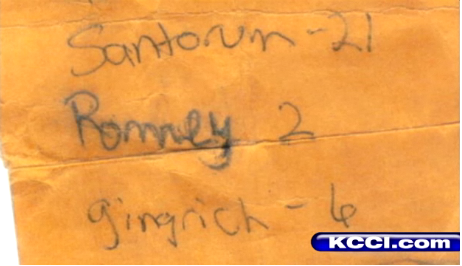
Minor counting errors such as this one are extremely common on election day, so it is perfectly plausible that Moulton is correct and Romney did receive 20 unearned votes. It is equally plausible, however, that these lost votes could be canceled out by a similar error at another caucus site. The tentative results, which showed Romney with the barest 8 vote lead, have not yet been certified.
Nevertheless, the Iowa GOP does not seem happy that True is questioning the early result. According to KCCI, a spokesperson for the Iowa GOP said that “True is not a precinct captain and he’s not a county chairperson so he has no business talking about election results.”
By: Ian Millhiser, Think Progress, January 5, 2011
Share This Blog


 Unknown Feed
- An error has occurred; the feed is probably down. Try again later.


You must be logged in to post a comment.