Mitt Romney Straining to Get to the Right of Genghis Khan
The unpredictable Republican presidential race has taken another surprising turn as recent numbers show Mongol warlord Genghis Khan seizing the lead in national polls of likely GOP primary voters. Benefiting from widespread doubts about Mitt Romney’s authenticity and ideological commitment, Genghis has changed the shape of the race by sounding sharp populist themes that resonate with supporters of the tea party. “Mitt Romney wants to manage Washington, D.C.,” he told an enthusiastic crowd in Scottsdale, Arizona. “I want to burn it to the ground, slay its inhabitants, and stack their skulls in pyramids reaching to the sky.”
Romney’s advisers privately fret that such sharp rhetoric may play badly with upscale suburban swing voters in a general election. Their dilemma is that they cannot attack Genghis’s often harsh positions without reinforcing doubts about Romney’s own right-wing bona fides. Romney has dispatched previous conservative rivals by sowing doubts about their conservatism, assailing Texas Governor Rick Perry as soft on illegal immigration, Newt Gingrich as a Washington insider, and Rick Santorum as a supporter of earmarks and raising the debt ceiling.
Genghis Khan, who boasts of never having previously set foot in Washington or even the entire Western hemisphere, is the most challenging target thus far.
One vulnerability is his colorful personal life, which includes six wives, countless concubines, and habit of eating raw horseflesh. Romney has subtly exploited these weaknesses, recently appearing with his wife, Ann, at a Burger King in Grand Rapids, Michigan. “Here I am, accompanied by my one wife, consuming a sandwich consisting of cooked animal meat,” he told campaign reporters. (Romney paid for the meal by handing the cashier a $1000 bill, telling him to keep the change.)
Genghis’s surge to the top of the polls began after a recent debate in Williamsburg, Mississippi. After moderator Brian Williams questioned if his popular campaign promise to not only defeat President Obama but to enslave his family was racially insensitive, Genghis angrily replied that he enslaves the families of all his defeated rivals, regardless of race. Then, in a dramatic touch that reminded many Republicans of Ronald Reagan’s famous I-paid-for-this-microphone moment, he charged down from the stage on horseback, decapitated Williams, and displayed his head before the roaring crowd. At a post-debate focus group led by pollster Frank Luntz, numerous attendees praised Genghis for standing up to, as one attendee put it, “the politically correct media.”
His continued strong showings have the Romney campaign contemplating more forceful tactics. Pro-Romney super PAC Restore Our Future today released a new ad assailing Genghis for having established a vast mail delivery network based on riding stations, like the post office, and having failed to completely conquer China. The ad includes the tagline, “More government bureaucracy, soft on defense,” while the screen morphs Genghis’s face into that of Jimmy Carter.
The latest ARG poll has Genghis leading Romney by eight points in Ohio.
By: Jonathan Chait, Daily Intel, February 16, 2012
“Gospel Of Inequality”: Santorum Praises Income Inequality
“Santorum Praises Income Inequality.”
That was Fox News’s headlineabout Rick Santorum’s speech at the Detroit Economic Club on Thursday. Santorum said, “I’m not about equality of result when it comes to income inequality. There is income inequality in America. There always has been and, hopefully, and I do say that, there always will be.”
Unbelievable. Maybe not, but stunning all the same.
Then again, Santorum is becoming increasingly unhinged in his public comments. Last week, he said that the president was arguing that Catholics would have to “hire women priests to comply with employment discrimination issues.”
Also last week, he suggested that liberals and the president were leading religious people into oppression and even beheadings. I kid you not. Santorum said: “They are taking faith and crushing it. Why? When you marginalize faith in America, when you remove the pillar of God-given rights, then what’s left is the French Revolution. What’s left is a government that gives you rights. What’s left are no unalienable rights. What’s left is a government that will tell you who you are, what you’ll do and when you’ll do it. What’s left in France became the guillotine.”
Yet for Santorum to champion income inequality in Detroit, of all places, is still incredibly tone-deaf.
Detroit has the highest poverty rate of any big city in America, according to data provided by Andrew A. Beveridge, a demographer at Queens College. Among the more than 70 cities with populations over 250,000, Detroit’s poverty rate topped the list at a whopping 37.6 percent, more than twice the national poverty rate. And according to the Census Bureau, median household income in Detroit from 2006-10 was just $28,357, which was only 55 percent of the overall U.S. median household income over that time.
This is a city that last year announced plans to close half its public schools and send layoff notices to every teacher in the system.
This is a city where the mayor’s pledge to demolish 10,000 abandoned structures was seen as only shaving the tip of the iceberg because, as The Wall Street Journal reported in 2010, “the city has roughly 90,000 abandoned or vacant homes and residential lots, according to Data Driven Detroit, a nonprofit that tracks demographic data for the city.”
This is not the place to praise income inequality. Last week, at a hearing before the Senate Budget Committee, Kent Conrad, the chairman of that committee, laid out the issue as many Americans see it:
“The growing gap between the very wealthy and everyone else has serious ramifications for the country. It hinders economic growth, it undermines confidence in our institutions, and it goes against one of the core ideals of this country — that if you work hard and play by the rules, you can succeed and leave a better future for your kids and your grandkids.”
This is arguably even more true of people in Michigan than for the rest of us. Even though income inequality in the Detroit area isn’t particularly high, looking at the issue as an urban one in the case of cities like Detroit is problematic. The whole region took a hit. The comparison for cities like Detroit may be more intra-city than inter-city.
As Willy Staley argued in 2010 in an online column for Next American City magazine: “In richer cities, the inequality is put side-by-side, in an uncomfortable, loathsome way; for cities left in the dust of deindustrialization, the inequality is presents (sic) as existing between cities, not within them. Gone is the city/suburb divide between rich and poor, income inequality manifests itself within wealthy cities and between cities.”
And it is this feeling of being left behind by the American economy and abandoned by Republicans that is pushing Michigan into the blue. Public Policy Polling, a Democratic polling company, found this week that Obama would handily defeat all the Republican candidates in head-to-head matchups in the state. The company’s president, Dean Debnam, said in a statement: “Michigan is looking less and less like it will be in the swing state column this fall.” He continued, “Barack Obama’s numbers in the state are improving, while the Republican field is heading in the other direction.”
Santorum went on to say about income inequality during his speech on Thursday: “We should celebrate like we do in the small towns all across America — as you do here in Detroit. You celebrate success. You build statues and monuments. Buildings, you name after them. Why? Because in their greatness and innovation, yes, they created wealth, but they created wealth for everybody else. And that’s a good thing, not something to be condemned in America.”
Santorum might want to take a walk around Detroit to see who’s celebrating and to see how many statues he can find to honor people who simply invented something and got rich.
Furthermore, as a newspaperman and a former Detroiter, I’d like to direct him to the James J. Brady Memorial. Detroit1701.org, maintained by a University of Michigan emeritus professor, calls it “one of the more attractive memorials in Detroit.” It pays tribute to Brady, a federal tax collector, who set out to address the issue of child poverty in the city by founding the Old Newsboys’ Goodfellows of Detroit Fund in 1914 — what is essentially a local welfare fund.
The group provides “warm clothing, toys, books, games and candy” to local children every Christmas in addition to sending poor children to summer camps, the dentist and to college.
Then again, charitable giving doesn’t appear to be high on Motor Mouth Santorum’s list of priorities. As The Washington Post pointed out, based on Santorum’s tax return disclosure this week, he has given the least amount to charity of the four presidential candidates who have disclosed their tax returns. (Ron Paul has not.) His charitable giving was just 1.8 percent of his adjusted gross income.
The Obamas were the highest, giving 14.2 percent, even though their income was second lowest.
Maybe that’s the imbalance we should praise.
By: Charles M. Blow, Op-Ed Columnist, The New York Times, February 17, 2012
“Rmoney”: Mitt Is The Lobbyists’ Candidate
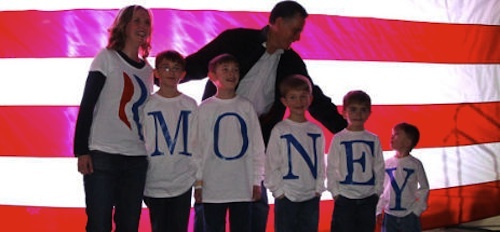
When you think of Mitt Romney, you probably think of a tall, robotic fellow with no discernible strong beliefs or stances (at least, none that can survive longer than a week at a time). That’s terribly unfair, and you should be ashamed for thinking it. He may have started out as an empty husk devoid of strong personal beliefs, but thanks to a crack team of industry insiders, he now is quite filled with opinions. Coincidentally, they happen to be the opinions of an army of top lobbyists in Washington, and the companies they lobby for. Funny how that works.
[Mitt Romney’s] kitchen cabinet includes some of the most prominent Republican lobbyists in Washington, including Charles R. Black Jr., the chairman of Prime Policy Group and a lobbyist for Walmart and AT&T; Wayne L. Berman, who is chairman of Ogilvy Government Relations and represents Pfizer, the drug manufacturer; and Vin Weber, the managing partner for Clark & Weinstock. […]Other lobbyists serve on one of Mr. Romney’s policy advisory teams, have hosted fund-raisers for his campaign or have joined the many influential Republicans whose endorsements Mr. Romney’s campaign has hailed.
Want to know what Mitt Romney’s true policies are? Well, you should have attended Mitt Romney’s $10,000-and-up policy round table, where industry lobbyists led “discussions” on what his policies towards those industries should be:
Mr. Romney’s campaign held an elaborate “policy round table” fund-raiser at a Washington hotel, featuring panel discussions run by lobbyists and former cabinet officials or members of Congress.James Talent, a former senator who runs the lobbying and public affairs firm Mercury Public Affairs, led a panel on infrastructure, according to an invitation. William Hansen, a former deputy secretary of education who is president of the lobbying firm Chartwell Education Group, led the education panel.
Wow. I can’t imagine why anyone would be cynical about American politics these days, can you?
The entertaining thing about this story is just how many large companies are represented. Among those specifically mentioned (and kudos to the three reporters for linking the lobbyists with actual clients, which is rather important information for readers) are Walmart, AT&T, Pfizer (drugs), Microsoft, Altria (tobacco), General Dynamics, Dominion (power), Barclays (finance), Allegheny (steel) and Peabody Energy (coal). Lobbyists are cutting the checks; lobbyists are bundling other people’s checks; lobbyists are holding the panel discussions about how the candidate can best serve the specific industries they represent; lobbyists make up the inner circle of “policy makers,” advising the candidate as to what his own core positions should be.
As for the candidate himself, he’s almost irrelevant at this point. You might as well nominate a bunny named Mr. Buttons: If you surround it with the exact same lobbyist-advisors, you’ll end up with the exact same policies. Sigh, if only we could teach that bunny to hold a pen—but for now we’ll have to settle for our current crop of Republican candidates, all of whom have near-identical policy prescriptions, all of which favor the exact same subset of people and the exact same handful of industries. Go figure.
I’ve given up on the notion that we can keep lobbyists from capturing our politics. I’ve also given up on the notion that we can prevent interests like the oil sector or our current handful of top financial companies from tailoring the American government specifically to serve their needs. Want more profits? Want less environmental protections? Want to crush some emerging industry that threatens to make yours less profitable? Just buy a few congressman, or a senator, or a president. At a few million here and there, it’s cheaper than advertising, and the results are far more secure.
So I’m in the Bill Maher camp on this one. Lobbyists and industries want to buy our politicians? Fine, I give up, let them. Just pass a law saying the candidate has to wear those corporate logos on their jackets whenever they appear on the campaign trail or when they are in office. The more money is contributed, the bigger the logo has to be. Top presidential candidates will look like military dictators-in-training, with badges and medals and ribbons sticking out from them in every direction, and just from looking at them we’ll be able to tell who they serve, and in what proportions. That would certainly be more educational than any rhetoric coming from the candidates themselves.
By: Hunter, Daily Kos, February 15, 2012
“The Great Pretenders”: GOP Deficit Hypocrisy
Republicans love to harp on deficit reduction when a Democratic president releases a budget. But when they’re in power themselves, they couldn’t care less.
Now we are treated to the semiannual spectacle of watching Republicans pretend they care about the deficit. They will hammer at this repeatedly as discussion progresses on the president’s budget budget, which projects a deficit of more than $1 trillion for this year and $901 billion for next. Obama and the Democrats generally have a history of quaking when this deficit talk starts up. But the best thing they can do now is stick to their guns and quote Dick Cheney: “Deficits don’t matter.” Growth matters. And for growth, we need investment.
First, the Republican hypocrisy. I hope you are aware by now that they don’t actually care about deficits. They just care about money being spent on things they don’t like, which outside of overpriced ships the Navy probably doesn’t need and more reinforced steel for the border fence includes pretty much everything. If, say, instead of seeking to spend more money for transportation, Barack Obama had proposed cutting the top marginal tax rate down to 8 percent, well, that would have had a completely disastrous impact on future deficits. But you wouldn’t have seen Republicans complaining about that, because the rich deserve more of their money back.
You also didn’t see Republicans complaining about deficits when George W. Bush was running them up. Oh, a few did. But the protests were infrequent and mousy. By and large, Republicans shuffled along. It is astonishing, isn’t it, to think back on the prescription-drug benefit from 2003. An unfunded, roughly $500 billion expansion of socialized medicine (Medicare), and Tom DeLay kept the floor open for three extra hours so that the small number of Republicans who tried to take the Republican position on this could be browbeaten into voting with the White House. That episode, engineered by DeLay, was as close as we’ve come to legislative fascism in this country in a long, long time, both in the sense of the strong-arm tactics used and in the way it posited that day is night and black is white.
Of course, in 2003 the deficit was “just” $374 billion. This, remember, was only two years after Bush took office, met by a surplus of $237 billion. So he added $611 billion to the deficit in two short years, by diddling around with indefensible tax cuts for the wealthy (remember how they goosed the economy? Didn’t think so) and passing the aforementioned Medicare expansion to shore up the senior vote. Admittedly, Obama outpaced Bush. He added $1 trillion in a year. But we all know why. Well, some of us know why. The economy was going to die, and it needed money. Wall Street and the banks didn’t have it, so the government had to supply it.
The only problem with this was that it didn’t supply enough. I’ve started reading Noam Scheiber’s The Escape Arti$ts, his new book about the Obama economic team’s successes and failures. Scheiber writes that Christina Romer, the administration’s first chief economist, got all the numbers on the economy from the Fed and other reputable sources and set out to determine how much federal intervention, free of political considerations, would be appropriate to prop up the collapsing economy. The number she and her staff settled on—$1.8 trillion—was so high that she didn’t even dare mention it at meetings. Obama, of course, did less than half that, which was the maximum that was politically possible.
After the heavy artillery fire he took for that, Obama decided he had to placate the deficit hawks, at least rhetorically, and so he did that for a while. But that collapsed, partly because the Republicans wouldn’t consider tax increases as part of the mix, and partly because he and the White House eventually figured out that trying to be moderate on these issues was both bad substance and lousy politics. It’s bad substance because, as much as it infuriates some people, government spending helps keep us afloat in hard times. And cutting that spending causes harm. For example, we are down about 610,000 government employees from the day Obama took office. Most of those are at the state and local level, and while it’s hard to say how many are a result of the drastic cuts in federal aid to states, certainly many layoffs stem from budget cuts. Those cuts reduce the deficit, but they add directly to the jobless rolls. Is that what we’ve needed for these past two years? Obviously not.
And it’s bad politics because, as the White House now seems to grasp, it’s time to draw contrasts, and the public is largely on Obama’s side. People kinda-sorta say they care about the deficit, but they don’t, really, in large numbers. And to the extent that they do care, they’d rather raise taxes on the wealthy than cut programs.
When the economy gets better, the deficit will start to heal itself. If the economy is truly picking up in the way the January jobs numbers suggest—and if unemployment goes down to around 8 percent by the end of the year—we’ll be poised for a recovery that will add jobs and tax revenue. At least, that is, until the next Republican president comes along and slashes taxes on multimillionaires, blowing another huge hole in the deficit (Mitt Romney’s hole, for example, would be $600 billion in 2015 alone). If Romney is actually elected, the same Republicans who are going to spend the next few months nattering about Obama’s irresponsibility will be marveling at President Romney’s courage.
But Obama standing firm against the deficit hypocrites will render a Romney presidency even more unlikely than it already is. Republicans use deficit politics to scare Democrats, and Democrats often respond exactly as Republicans hope. It’s time they stopped being afraid.
By: Michael Tomasky, The Daily Beast, February 14, 2012
“Outlawing Contraception”: Virginia House Passes Personhood Bill
Republican delegate Bob Marshall says critics are overstating things when it comes to the personhood bill he is sponsoring in Virginia. Opponents of his bill have argued that not only does the measure grant legal protections to all fetuses beginning at conception, but it could also be construed to outlaw birth control.
The bill is ostensibly less stringent than similar measures that came up in Colorado and Mississippi. As Marshall points out, it does not directly outlaw abortion, but would force the courts to include embryos in definitions of person. “I think I struck a middle ground,” says Marshall.
Try telling that to the bill’s opponents, who fear the bill’s consequences for women’s health. The House rejected an amendment by Democratic delegate Virginia Watts that would have specifically protected birth-control access.
Marshall called the amendment “a vehicle to entrap me,” arguing it would have hurt the bill in court. By specifically allowing birth control, Marshall says, the courts could interpret the bill as prohibiting anything not specifically allowed. “If I were to accept any one of these,” he said, the courts could say “here’s Mr. Marshall, acknowledging unintended consequences.”
But Watts argues the bill already has that problem because it specifically allows in-vitro fertilization. The last section of Marshall’s bill notes that “nothing in this section shall be interpreted as affecting lawfully assisted conception.” In other words, in-vitro is okay. Watts contends that because the bill specifically allows in vitro, it therefore disallows any other acts that would interfere with conception—like birth control. “You said it doesn’t pertain to one thing, therefore it does to everything else,” says Watts. “That’s why my amendment was so crucial … anything that keeps that from being implanted in the womb, kills a person under this bill.”
The bill is headed to the state Senate, where no one seems to know what will happen. While the House committee that dealt with Marshall’s bill was stacked in favor of the Republicans, the Senate’s committee is almost split: seven Republicans who vote pretty consistently with the pro-life advocates, seven Democrats who usually vote pro-choice. Then there’s Senator Harry Blevins, a Republican who’s record is less absolute. Without Blevins’ vote, the bill would probably not make it out of committee. Neither Marshall nor Watts had a clear idea which way Blevins was leaning and the senator was unavailable for comment this afternoon.
Watts is hopeful the debate over her amendment specifically allowing birth control will highlight what’s at stake. “I think that my amendment being so clearly before the body really underscores what’s there,” she said. “Up until then, you could just obfuscate all this with a lot of verbiage.”
Meanwhile Marshall’s busy painting an almost inverse portrait of his bill. “People who are otherwise intelligent keep bringing up these red herrings,” he said, noting that “when it comes to sex a lot of people can’t think straight.” At least that’s something both sides can likely agree on.
By: Abby Rapoport, The American Prospect, February 14, 2012
Share This Blog


 Unknown Feed
- An error has occurred; the feed is probably down. Try again later.


You must be logged in to post a comment.