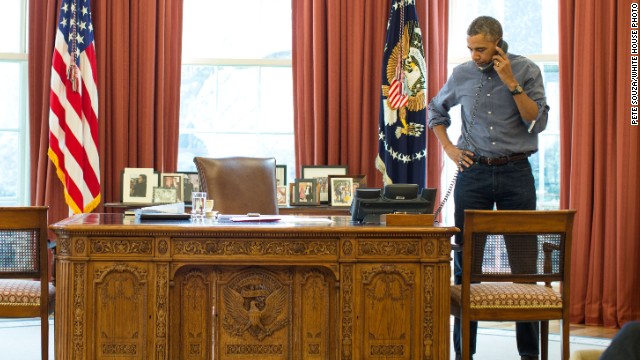
“This From A Trained, Known Failure”: Rumsfeld Thinks “A Trained Ape” Could Do What Obama Can’t
Donald Rumsfeld, whose mastery of foreign policy was amply displayed in Iraq, thinks that “a trained ape” could have done a better job handling Afghanistan’s President, Hamid Karzai, than President Obama and his team have. The problem, Rumsfeld told Greta Van Susteren, of Fox, on Monday night, is that Obama has not been deferential enough to Karzai: “The President has been unpleasant to him.” His entire Administration has dealt with Karzai “repeatedly and publicly in an abusive, unpleasant manner.” Is that perhaps what Rumsfeld considers untrained?
What is it about Obama that bothers people like Rumsfeld? He might ask himself, for a moment, why the idea of Obama—the President of the United States—speaking out of turn bothers him so much, and why the word “ape” sprung to mind. Rumsfeld worked for George W. Bush, who made something of a fetish out of talking like a cowboy; he spent a lot of time in office trying to out-preen Dick Cheney; and yet he just doesn’t like Obama’s tone. What’s particularly odd is that Van Susteren was asking Rumsfeld about, of all things, Karzai’s statement of support for Russia’s annexation of Crimea. (Rumsfeld called it “understandable.”) Haven’t we been hearing from Republicans that Obama is too passive when it comes to Ukraine—that he’s too pleasant with Putin, and doesn’t talk tough in the way that they imagine they would? Just a few weeks ago, Rumsfeld told Van Susteren that “it is U.S. weakness that has shaken the world.” He has also railed against the President’s supposed “apologies” for America.
Van Susteren asked Rumsfeld why it was so hard to get Karzai to sign a status-of-forces agreement—a memorandum that would clarify the legal position of American troops in Afghanistan. Karzai has withheld his agreement for months, despite warnings that it won’t be possible to keep even a residual American force in Afghanistan without one, and despite the approval of Afghanistan’s loya jirga. (He may want to insure he has a card to play after the upcoming Presidential elections.) Rumsfeld scoffed at the idea that Karzai had been difficult—this is where he talked about how “a trained ape can get a status-of-forces agreement. It does not take a genius.”
By that, perhaps, Rumsfeld meant that it does not take a genius to put American troops in another country. Indeed, it does not—Rumsfeld proved that himself, by getting our forces over to Iraq. The hard part can be getting them out.
“I realize these are tough jobs, being President or Secretary of State. But, by golly, they have trashed Karzai publicly over and over and over,” Rumsfeld said. This when Karzai had been so “friendly” during the Bush Administration; under Obama, it had all “gone downhill like a toboggan.” And so, as far as Rumsfeld is concerned, Karzai, a man whose country was invaded by the Soviet Union, was left “feeling he has to defend himself” against a United States government now in the process of withdrawing from his territory by supporting Russia’s invasion of a third country. And, Rumsfeld said, “I personally sympathize with him.” The Obama Administration has certainly made mistakes in Afghanistan, but the most questionable moves, like doubling down on troop levels early on, have tended to be hawkish—and, Rumsfeld style, they didn’t really work. A bitterness toward Obama that would be rich enough to evoke Rumsfeldian warmth toward aspiring Russian proxies is quite a thing. (It seems likely that Karzai is hoping that Putin can be a source of replacement cash, a process that has already begun.)
Rumsfeld may be right that it’s easier than it looks to make Karzai happy, as long as one doesn’t mind losing a good deal of taxpayer money to Afghan graft, and American lives in opaque standoffs in villages where we have no idea who is paying whom for a drug route or a piece of a construction project two provinces over. When Van Susteren suggested that Karzai’s support for Putin on Crimea was “a poke in the eye” to the Americans who had fought and died in Afghanistan to keep his government safe, Rumsfeld brushed her off. Karzai, he said, might have conveyed “his extreme anger” to the American government, but “he also said to the American people give them my best wishes and my gratitude.” How very pleasant of him.
By: Amy Davidson, The New Yorker, March 25, 2014
“A Challenge To Conservative Principles”: Humankind Is Better Off Than It Has Ever Been, And It’s Thanks To Government
There has never been a better time to be a human being than in March 2014. People live longer, wealthier, happier lives than they ever have. Each of the Four Horsemen — disease, famine, war, and death — are being beaten back.
This isn’t just my opinion. The data is incontrovertible. Life expectancy is the highest it’s ever been, and getting higher. Global GDP has never reached our present heights. The number of humans in poverty has never been lower. Wars between nations are almost extinct, and wars in general are getting less deadly.
The notion of human progress isn’t a grand theory anymore; it’s a fact. So why do so many people insist on telling you it’s impossible?
Almost everywhere you turn, some pundit or “literary intellectual” is aching to tell you the “hard, eternal truths” about the way the world works. Progress is a false idol, they’ll say — and worse, an American one. The harsh reality is that nothing ever changes; the sad truth of the human condition is pain and misery.
These people position themselves as besieged truth tellers, braving the wrath of the masses to challenge our dominant, rose-tinted national narrative. In reality, they’re just saying what most people think. A reasonably large majority of Americans think the country’s “best years” are behind it. Post-Great Recession, doom-and-gloom is in.
But while pessimism may be the conventional wisdom nowadays, its intellectual avatars have never been more anemic. Take British philosopher John Gray. Gray has made debunking the notion of “progress” his life’s work, having written two whole books on the matter in addition to innumerable columns and magazine articles. His review of Steven Pinker’s The Better Angels of Our Nature, a book that carefully assembles immense amounts of statistical evidence showing that war and violence claim fewer lives than ever, does not dispute a single bit of Pinker’s data. Incredibly, Gray thinks pointing out that some Enlightenment thinkers disagreed with each other constitutes a devastating rebuttal to Pinker’s detailed empirical argument. The review’s shallowness is emblematic of the general tenor of Gray’s sad crusade.
It’s not just John Gray. Given the enormous amounts of data on the optimists’ side, pessimists have little more than handwaving left to them. The pessimists babble on about “permanent human nature” and “timeless verities.” The optimists cite U.N. life expectancy statistics and U.S. government crime data. Having no answer to books like Pinker’s, Charles Kenny’s Getting Better, or Angus Deaton’s The Great Escape, the pessimists resort to empty pieties.
The irony here is obvious. The pessimists accuse optimists of falling prey to a seductive ideological thinking; “the worship of Progress,” as Christian conservative Rod Dreher puts it. Yet the only people being seduced are the pessimists, clutching the pillars of their ideological house while its foundation shatters.
Today’s optimists notice clear evidence that humanity’s lot is getting better — a point that does not require assuming that it must get better as a consequence of some inevitable historical law. Opponents respond by asserting the world simply cannot be getting better, as their own pessimistic theory of history says it’s impossible. The critics of blind faith have put out their own eyes.
The reason that purportedly hard-boiled realists adhere to the absurd pessimistic ideology is plain. Their own political views depend crucially on the idea that nothing about the world can be improved. The clear evidence that human inventions — government, the market, medicine, international institutions, etc. — have improved the world point to devastating truths adherents to pessimistic ideologies are loath to admit.
The two ideologies I have in mind have been at odds of late: American conservatism and foreign policy “realism.” Yet popular versions of both rely on the notion of an unchanging, conflict-filled political landscape.
For many conservatives, the idea of “progress” constitutes liberalism’s fatal conceit. Russell Kirk put it most eloquently: “Man being imperfect, no perfect social order ever can be created.” Bill Kristol, living proof that movement conservatism has been immune from the happy trends improving the world, is more blunt. “Progressivism is a touchingly simple-minded faith,” he says. “The higher the number of the century, the better things should be. But progressivism happens not to be true.”
Kristol’s understanding of progressivism is wanting, to say the least. But the reason he needs to stamp his feet and deny the evidence of progress is that hard evidence of human improvement challenges his conservative first principles. Improvements in human welfare have come from government — most notably through public health programs, like the campaign against leaded gasoline, but also through institutions like the welfare state and mixed-market economies. It’s no surprise that the wealthiest, healthiest, and happiest countries are all welfare state democracies.
But more fundamentally, human progress runs against the conservative assumption that human nature does not permit fundamental victories over evils like war. Government will always fail, as Kirk suggests, because human nature will frustrate any attempt to eradicate suffering.
But as it turns out, human nature itself is shaped crucially by the institutions we find ourselves surrounded by — including government. The newest research on humanity’s basic psychology, lucidly explained in recent books by neuroscientist Jonathan Greene and primatologist Frans de Waal, find that human “nature” is malleable. We’re naturally inclined toward both conflict and cooperation, and thus have the potential for both great good and great evil. The crucial deciding factor is the circumstances we find ourselves in. The reality of human progress, then, suggests that the political and social arrangements we’ve created are bringing out our better angels. This is a truth the conservative view of human nature cannot abide.
Foreign policy realists are also concerned by human nature, but nowadays tend to rely more on arguments about “the international system.” For them, global harmony is impossible because nations can never trust each other. Without a world government, no one can really ensure that another country’s army won’t come calling on your doorstep. States are driven to conflict by the need to secure themselves from an always-there risk to their security.
The decline in violence constitutes an existential threat to this worldview. There is strong evidence that international institutions, trade interdependences, and the spread of democracy have all contributed to war’s decline. If that’s true, then it really does seem like the globe isn’t destined for conflict forever. Neither human nature nor the international system make war inevitable.
Now, there are real grounds to worry about the future of human progress. Most notably, climate change has the potential to wipe out much of what we’ve accomplished. The reality of human progress isn’t an argument against heading off ecological disaster.
But that crisis hasn’t happened yet. You can simultaneously celebrate the fact that humanity is better off than it has ever been and argue that we need to take drastic action if we want to make sure that progress doesn’t stop with our generation.
So there’s no reason not to sing progress’ praises. Today’s world is much more Lego Movie than True Detective: everything really is kind of awesome, and time is not a damn flat circle.
By: Zack Beauchamp, The Week, March, 13, 2014
“One American Voice”: GOP Should Listen To Gates On Ukraine
The words of the late Sen. Arthur Vandenberg (R-Mich.) have been ringing my ears these past few days. The then-chairman of the Senate Foreign Relations Committee said in 1947 that “partisan politics [must stop] at the water’s edge.” Translation: No matter the domestic battles with the president, international crises demand we speak with one voice. Those days are long gone judging by the cacophony of ridicule of President Obama because of the actions taken in Ukraine by Russian President Vladimir Putin.
Sen. Lindsey Graham (R-S.C.) said on CNN, “We have a weak and indecisive president that invites aggression.” Sen. John McCain (R-Ariz.) slammed Obama on Monday for having “a feckless foreign policy where nobody believes in America’s strength anymore.” And Sarah Palin, the person McCain saw fit to make his 2008 vice presidential running mate said later that night, “People are looking at Putin as one who wrestles bears and drills for oil. They look at our president as one who wears mom jeans and equivocates and bloviates.”
My Post colleague David Ignatius’s column today was a needed tonic. He got former Defense Secretary Robert Gates on the phone to talk about Republican bashing of the president over Ukraine.
Gates, a Republican himself, urged the GOP senators to “tone down” their criticism and “try to be supportive of the president rather than natter at the president.”
Not only that, Gates told Ignatius that Putin “holds most of the high cards” and that “considerable care needs to be taken in terms of what is said, so that the rhetoric doesn’t threaten what policy can’t deliver.” Ah, such reasonableness from the GOP. Pity Gates, now the chancellor of the College of William and Mary, isn’t in the Senate.
In the end, even he shared my lament. “It seems to me that trying to speak with one voice — one American voice — seems to have become a quaint thing of the past,” Gates told Ignatius. “I regret that enormously.” At least I’m in good company.
By: Jonathan Capehart, Opinion Writer, The Washington Post, March 5, 2014
“Playing The Wrong Blame Game”: Blame Vladimir Putin For The Ukraine Crisis, Not President Obama
All I have heard with regard to Ukraine & Russia is the blame game. Rachel Maddow of MSNBC said it was Bush’s fault. The right wingers in America say it’s President Barack Obama’s fault. And I, Leslie Marshall, who do I blame?
Putin.
Putin is acting like a school yard bully, only it isn’t kids he’s targeting, it’s an entire nation. Putin loves what most nation’s leaders historically have: power and money. Just look at the emperors of Rome or the kings of England; the more land they acquired, the more powerful and richer they were. And so is the case with Putin and Ukraine – if he gets his way. And that’s a big if. The people have spoken. The Ukranian parliament has booted its former elected leader. Ukraine wants to be westernized and a part of the European Union. And the western world wants to help them; the United States has already promised, pending Congressional approval, $1 billion dollars in loan guarantees.
Now there are those that believe this is personal between Putin and Obama, as if Putin deliberately took action in Ukraine when the president warned him not to. And to those I say: Don’t be ridiculous. Again, remember who this man is and what he wants. Putin has the ego of Ramses and would have responded in this matter to the resistance of the pro-European Ukranians no matter who was president … Obama, either Bush, Clinton, Carter, Reagan, FDR, Truman or Eisenhower in the same exact way.
And speaking of past presidents; many on the right have invoked the name ‘Reagan” with regard to this issue, saying their political messiah would have shown Putin who is boss. Really? Doubtful. This is a very different time. Putin isn’t Gorbachev, Ukraine isn’t East Germany.
The right also want to blame President Obama for resetting the U.S. relationship with Russia in ’09 and not being more forceful; accusing him of having a weak foreign policy. Really? Was taking Osama bin Laden out weak!? Oh I’m sorry, our Navy SEALs took him out, I forget. But when Saddam Hussein was captured, wasn’t the line being used that Bush got Saddam? I didn’t hear ‘our troops caught Saddam.”
So let’s talk about Saddam. Saddam Hussein. A man who wrongly imprisoned his people and made many of them disappear. Sounds a bit like Putin doesn’t it? There are those that also say we have no right to call out Russia for breaking the law by invading the sovereign nation of Ukraine; but let’s look at who is making that statement: President Obama. Although the United States invaded the sovereign nation of Iraq, it was done during the Bush presidency – and voted against by a young Senator from Illinois named Barack Obama. Iraq was not Obama’s war. He did not start it, he ended it. Must we refuse to help any nation being invaded in the present because of our past sins?
And there are those on the right who roll their eyes at the president when he speaks (hello Lindsey Graham) and many on the right who say the world doesn’t respect Obama or take him seriously and they’re wrong. Of course when the president wanted to fly over Libya’s air space they said he was overreaching. And now with Ukraine’s he’s too cautious. Perhaps the right should make up its mind.
Let’s be honest, the United States is not going to get involved militarily in Ukraine. Obama knows it, the right knows it, Putin knows it and furthermore, both parties in the U.S. don’t want it nor do our allies. Ukraine is just not that important politically or resource wise to either the United States or the EU. So the President has limited options with what he can do. And I believe he is going about this the right way.
Due to Putin’s nature (power and greed), we must strike him where it hurts most. We need to reduce Russia’s International stature and isolate Russia, not just the country, but it’s people; especially the richest of the rich of Russia.
Now Russia’s stature has already been diminished. President Obama contacted (and got on board) Germany, the U.K., Poland and every other G8 nation to hold off preparations for the Sochi meetings. Further, to isolate Russia, Secretary Kerry has discussed travel bans and there is a possibility of freezing Russian business assets. And learning from history, the U.S. won’t do this alone. We won’t fly solo or take just a few of our team with us; we need everyone worldwide to be on board, otherwise we will fail.
And for those that think Obama is weak, an intellect who is trying diplomacy while Putin comes to the fight with a weapon; think again. Putin backed a failed government in Kiev. Putin watched as the world was disgusted by his actions in Ukraine; so much so, he made up a nice fairy tale to justify it. And after President Obama accused Putin of breaking the law, we have not seen any movement from the Russian military in Crimea.
So who is to blame? Putin.
Who does the world look down upon? Putin.
Who is losing this fight? Putin
So for those of you that want to champion Putin over our president, like actor Steven Seagal did on Russian television, perhaps you had better wear red rather than red, white and blue. Obama’s our commander in chief. Russia’s not our ally. The right thing to do – the patriotic thing to do – is to back our president and trust he has our best interest at hand.
In Kiev this week, voices echoed as they chanted “Thank You America!” as Putin covered his ears.
BY: Leslie Marshall, U. S. News and World Report, March 6, 2014
“He’s So Vain”: McCain Has It All Figured Out
Sen. John McCain (R-Ariz.), you’re so vain, you probably think this invasion’s about you.
Sen. John McCain sharply condemned President Obama on Monday, blasting the administration’s foreign policy as “feckless” and partially responsible for the mounting crisis over the advance of Russian forces into Ukraine. […]
“Why do we care? Because this is the ultimate result of a feckless foreign policy in which nobody believes in America’s strength anymore,” McCain said to the annual gathering of Jewish leaders in Washington.
McCain was apparently quite animated on the subject, going on (and on) about how President Obama is personally responsible for shaping world events in a way McCain disapproves of.
Reality, meanwhile, points in a very different direction. As David Ignatius explained this morning, “There are many valid criticisms to be made of Obama’s foreign policy … but the notion that Putin’s attack is somehow the United States’ fault is perverse.”
First, I’m struck by the curious application of McCain’s outrage. When Russia went to war with Georgia in 2008, ignoring the concerns of the Bush/Cheney administration and the international community, the senior senator from Arizona had precious little to say about blaming the United States for Putin’s ambitions. Now that there’s a president McCain doesn’t like in office, apparently he has fewer qualms about blasting the man in the Oval Office – even as the crisis is still unfolding, even when it appears Putin’s flailing desperately in search of a coherent strategy.
And second, whether McCain appreciates this or not, Russia’s interest in Ukraine predates Barack Obama’s presidency. Come to think of it, given the fact that the president was born in 1961, Russia’s interest in Ukraine predates Barack Obama, too.
It’s unsatisfying for many, especially the most aggressive foreign policy hawks in the U.S., to think world events unfold for reasons that have nothing to do with us. But foreign countries really don’t much care whether it’s unsatisfying or not – their geopolitical agendas exist without any real regard for what Americans are going to think about their decisions.
By: Steve Benen, The Maddow Blog, March 3, 2014
Share This Blog


 Unknown Feed
- An error has occurred; the feed is probably down. Try again later.
 mykeystrokes.com