How To Fight The Tax Cut Wars
The next big fight in Congress revolves around extending the Bush tax cuts. Unlike issues like climate change or stimulus, where the public does not accept the Democrats’ basic analysis of the problem, on the tax cuts the Democrats hold the whip hand. The question is whether they emerge with a political win, a public policy win, or both.
Let’s review a few basic facts about the Bush tax cuts. When Republicans took control of government in 2001, their top priority was reducing tax rates on high income earners. Since tax cuts for the rich were unpopular, they had to pair those cuts with middle-class tax cuts in order to make them politically salable. That’s how they pressured Democrats into supporting them. By packaging the whole thing together, they could accuse Democrats of opposing tax cuts for the middle class if they voted no.
Now, ten years later — and what a decade of bountiful economic growth we’ve enjoyed with the energies of investors and entrepreneurs finally unleashed from restrictive Clinton-era tax rates! — the Bush tax cuts are scheduled to expire. Republicans want to extend the whole thing. Democrats just want to extend the parts that benefit people who earn less than $250,000 a year.
Now, here’s the underlying dynamic. Raising taxes on the middle class is unpopular. But raising taxes on the rich is wildly popular. The truth is that neither party cares very much about the portion of the Bush tax cuts that benefit the middle class. Republicans just threw that in to sell the upper-bracket tax cuts, which is what they care about. Democrats might prefer a more progressive tax code with lower middle-class taxes, but most of them would rather have the revenue instead. But Democrats promised not to raise taxes on people earning less than $250,000 a year — a promise they felt they had to make in order to win. And they can’t break that promise without suffering political consequences.
Republicans, on the other hand, don’t want to pass an extension of the middle-class Bush tax cuts without the upper-bracket tax cuts. That would leave the federal tax code more progressive than it was under Bill Clinton — you’d have a combination of Clinton-era tax rates on the rich and Bush-era tax rates on the middle class. Conservatives have been fretting about such a result for more than a year, warning ominously about a country in which half the population pays no income tax. (They’d still pay other taxes, but the central Republican goal is to minimize the progressivity of the tax code.)
So we’re down to a game of chicken. Here’s why the Democrats hold the whip hand. They can pass an extension of the middle-class Bush tax cuts through the House. If Republicans let the bill pass, then they’ve lost their leverage to extend the unpopular Bush upper-income tax cuts. If they filibuster it, then Democrats can blame them for raising taxes on middle-class Americans. It would let Democrats out of their pledge. (Hey, they tried to keep the middle-class tax cuts.) Then nothing would pass, and we’d instantly revert to Clinton-era rates across the board.
What kind of effect would that have on the deficit? A huge one:
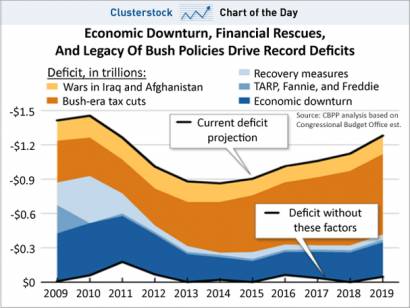
That dark orange stripe is the portion of the deficit attributable to the Bush tax cuts. That would be wiped out. Ending the tax cuts would basically solve the medium-term deficit problem.
The key factor here is that, just as Republicans got to frame the debate in 2001 by combining the tax cuts into an up or down vote, Democrats can frame the debate now by separating the policies Republicans pretend to care about from the ones they actually care about. Republicans want to have a vote on the whole collection of Bush-era tax cuts. Democrats shouldn’t give it to them. You hold a separate vote on the middle class portion and dare them to oppose it.
This seems to be the plan:
“The Senate will move first, and it will be a test to see whether Republicans filibuster” to block the bill in a bid to also win tax cuts for higher earners, said Rep. Chris Van Hollen of Maryland, head of the House Democrats’ re-election effort.
“If you can’t get it out of the Senate, then you take it to the election,” Mr. Van Hollen said in a recent interview. “You say to the American people that Republicans want to continue to hold middle-class tax relief hostage for an extension of tax breaks for [the well-to-do]. That will be the debate.”
Republicans have followed a strategy of opposing nearly everything the Democrats do. It’s worked very well. But the peculiar dynamic of this debate puts the Republicans in a position where they can’t win, and obstructing the Democrats is probably their worst move.
By: Jonathan Chait, Senior Editor, The New Republic-July 26, 2010
GOP Desperate to Sink Finance Reform — Sound Familiar?
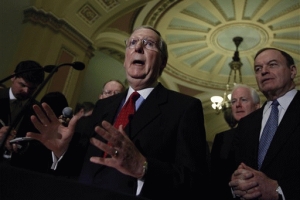
Sen Mitch "Let's scrap this one too" McConnell
Senate Minority Leader Mitch McConnell (R-Ky.) flew to New York two weeks ago for a private, behind-closed-doors meeting with hedge fund managers, bankers, and other Wall Street elites. It was after this meeting — where McConnell reportedly sought campaign contributions — that the Republican Senate leader returned to D.C. determined to kill the legislation that would bring some accountability to the same industry whose recklessness nearly destroyed the global financial system.
McConnell was asked on CNN this morning what, specifically, was said at the gathering about the Wall Street reform bill. The conservative Kentuckian was evasive — imagine that — and instead of answering the questions, he talked about scrapping the legislation altogether.
“We ought to go back to the drawing board and fix it.”
It’s like deja vu all over again — Democrats tackle a pressing national issue, negotiate with Republicans in good faith, craft a reasonable, middle-of-the-road legislative package that deserves bipartisan support, lobbyists tell Republicans to kill it, and McConnell voices his support for killing the legislation and going “back to the drawing board.”
Is it me or does this sound familiar?
McConnell’s principal (but not principled) concern is over the legislation’s liquidation fund, which would impose a fee on large financial institutions, collecting money that would be used to cover the costs of closing firms that fail. McConnell, who doesn’t know what he’s talking about, has characterized this provision as “institutionalizing bailouts.”
Fine, the Obama administration said. If it will help create bipartisan support for the bill, and end talk of a Republican filibuster, the provision on the liquidation fund can be scuttled. So, problem solved? Hardly.
[W]hen asked if he would support the bill if Democrats removed that fund, McConnell told CNN’s “State of the Union” he would still have other issues with the legislation, though he did not say what those qualms were.
Again, we’ve seen these genuinely stupid tactics before.
“Republicans can’t support the reasonable legislation Democrats want because it has a provision we’re pretending not to like.”
“Fine, we’ll get rid of the provision.”
“Republicans still can’t support the legislation, and we don’t want to tell you why.”
I know Republicans want to be taken seriously on public policy, but I can’t figure out why anyone would.
By: Steve Benen-Washington Monthly-April 18, 2010
Procedurally Correct: The House Can Decide How to Enact Health Reform

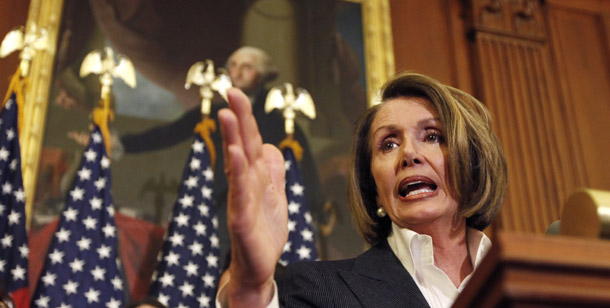
House Speaker Nancy Pelosi (D-CA) is considering asking the full House to vote on a package of amendments to the Senate-passed health care bill that would also contain language adopting the Senate bill
People who are opposed to health care reform are raising a real ruckus over a possible parliamentary maneuver being considered by Speaker of the House Nancy Pelosi (D-CA). She is thinking of asking the full House to vote on a package of amendments to the Senate-passed health care bill that would also contain language adopting the Senate bill. That may sound like a fairly exotic method of enacting important legislation, but is it inappropriate? My answer is no.
What this so-called “deeming” provision does is essentially join the two pieces of legislation into one. If the Senate had a different rule on debate this would happen in a conference committee. The House conferees would insist on amendments very similar to those now in the package that Pelosi is bringing to the floor, but the amendments and underlying legislation would all be wrapped together as a single conference report and voted up or down by both the House and Senate.
Because the 59 senators who support health care cannot shut off debate on such a conference report that option is not open, so the House has created this procedure as a substitute.
But, as some might ask, isn’t the 60-vote majority required to end a Senate filibuster part of the legislative process? Is it fair for the House to attempt to circumvent that process by joining two pieces of legislation—one that has already passed the Senate and the other that is being sent to the Senate for consideration?
The answer is yes. Although the filibuster is part of current Senate rules it has not always been. Further, while some continue to think that the 60-vote supermajority required to terminate debate in the Senate has constitutional origins, the Constitution in fact implies that such matters should be resolved by a simple majority—leaving the House free to take whatever view it chooses on the question of the 60-vote supermajority required by current Senate rules.
The possibly apocryphal story of George Washington and Thomas Jefferson arguing over the role of the Senate is often cited by defenders of the filibuster. Washington supposedly asked Jefferson, “Why did you pour that coffee into your saucer?” Jefferson responded, “To cool it.” Then Washington is said to have replied, “Even so, we pour legislation into the senatorial saucer to cool it.”
But the Senate rules did not permit a filibuster at the time this conversation allegedly took place. Filibusters were not allowed under Senate rules until 1806 and they were not practiced until the 1840s—when they were used largely against legislation to limit the practice of slavery.
The Constitution did structure the Senate in a way that it would counterbalance the possibility for erratic tendencies in the House, which elects all of its members every two years. Senators are elected for six-year terms so that only a third of the body is subjected to the scrutiny of the electorate in any one election.
The Constitution does specify that supermajorities are necessary for certain actions by the Senate. For instance, the Constitution requires that two-thirds of the Senate must vote to approve the overturn of a presidential veto or to ratify a treaty. In five other instances the Constitution requires the Senate to act by a supermajority, but for matters such as the passage of ordinary legislation like the health care bill the Constitution provides it to be determined by majority vote.
The House can’t completely circumvent the current Senate rules, but it can respond to the Senate passage of legislation that is unpopular with House members by packaging it as though it were a conference agreement and sending it forward saying that the body agrees to this legislation only if it is amended as specified by the amendments contained in the rest of the package. That is not simply permissible but it provides the House with the only means of voting on the issue that reflects the true sentiment of the body.
Further, it should be noted that use of self-executing or deeming resolutions is in fact not all that exotic and that the record of those feigning great dismay over its use have repeatedly used exactly the same procedure themselves—often with far less justification than can be provided in the current instance. House Minority Leader John Boehner (R-OH) calls the proposed procedure “the twisted scheme by which Democratic leaders plan to bend the rules.” Yet during the 109th Congress alone (a portion of which Rep. Boehner served as his party’s floor leader when his party was in the majority) deeming resolutions were used 36 times and Boehner supported all of them.
What the speaker is now considering as a means of resolving the long-protracted debate on health care is putting the two pieces of legislation that deal with health care together so the House can vote on them up or down as one package. That is the way our new policy on health care should be considered and it is highly regrettable that the archaic and undemocratic rules of the Senate don’t allow that as the order of business in both houses of Congress.
By:Scott Lilly-Senior Fellow at the Center for American Progress-March 17, 2010
The Coming Conservative Health Care Freakout | The New Republic
The Coming Conservative Health Care Freakout | The New Republic.
“NO” IS NOT A PROCESS
“NO” IS NOT A PROCESS
The dust has yet to settle from last weeks debacle in the Massachusetts Senate election. I have been listening to the pundits who have incessantly harped on and dissected what they thought the election of Scott Brown actually meant for the rest of the country, and for Democrats in particular. The clamoring and jaw-jerking by these same pundits was relentless. They were way too eager, often tripping over themselves to get air time to declare an apocalypse for the Obama administration. Their summations declared Brown’s win as a complete repudiation of the administrations policies and thus, the direction in which these policies were leading the country. Others thought that Brown’s verbal opposition to the current national health reform legislation was the most important factor that led to his upset victory. To be fair, this last interpretation does carry with it a partial truth.
Just for the record, an exit poll conducted by a GOP pollster, Tony Fabrizio, showed that only 38% of the eight hundred participants said they were motivated by opposition to the President’s policies. On the other hand, 32% indicated that they were motivated by support for his policies and 27% indicated that Obama’s policies were not a factor in their voting at all. This means that 59% of the voters polled were either for or indifferent to the President’s policies when they cast their ballot. Furthermore, 53% of independents either supported or were indifferent to the President’s policies.
My take on the results of this Massachusetts election is that a message was indeed sent on that Tuesday night. All of the pundits seem to think that this message is targeted only towards Democrats That message is that people are frustrated, infuriated and exasperated. Why? Because Congress is Not doing its job, plain and simple. A recent CBS poll shows that the approval rating for Congress currently stands at 23% while that for the President remains at 55%. Neither of these numbers however should make anyone comfortable. As such, I believe that Republicans should be just as concerned about November as the Democrats. There is a whole lot of frustration out there and it is highly probable that it will be an equal opportunity un-employer come November.
Reforming health care goes hand in hand with getting the economy back on track. I would like to think of Congress as an institution that is honorable and works for the good of all the people. There is absolutely no reason why health reform should not have been passed to date. There have been all kinds of excuses, lies, obstructions and mis-representations at every turn of the process during this last year.
On the one hand, every Democrat wants to have everything under the sun incorporated into the final bill that the President will eventually sign. This includes the progressive members of the party who often do not or will not see from side to side because of blinders that only allow them to see the tip of their noses. Pay attention progressives….you cannot and will not get everything incorporated into a single package by days end! There will be no “all encompassing” health reform product…this is a project that will have to be massaged for many years to come. This project requires negotiation and cooperation. If you let this opportunity slip away, there will be no second chances. Reasonable people do not use an axe to remove a fly from their forehead. Do not become an instrument for those who say “NO”.
On the other hand, there are my Republican friends who want to say “NO” to anything and everything. First we have those who are livid about the “costs” of any reform package, never mind that this was never a consideration during the previous administration. If it had been, we wouldn’t be in the current mess we are in today. Remember the prescription drug program? If for some reason health reform is not passed this time around and you are worried about what it costs now, what do you think the costs will be when it finally gets back on the radar screen down the road…. and I’m talking somewhere around 2059.
Then there are those who are baffled and dismayed by how the Democrats handled the “process”. They rise to their pontifical perches to berate the Democrats for excluding them from the discussions and debates. They tell anyone who will listen that they have been shut out of the process and that there has been no transparency in any of the multiple committees, no bipartisanship, no good faith, none whatsoever. They were not allowed to offer any amendments to any of the bills at any stage of the “process” and that they were placed under unreasonable “time lines” for completion of a final bill.
As far as I have been able to ascertain, Republicans should be the last to complain about process, bipartisanship, transparency, and good faith. I did a little checking on Republican participation in the various committees leading up to the final passage of the Senate and House health reform bills. On the Senate side, the HELP committee adopted 159 amendments offered by Republicans. On the House side, 16 Republican amendments were adopted during procedures of the Energy and Commerce Committee. In the Education and Labor Committee, 6 of the 17 Republican amendments were adopted by the committee. Finally in the Ways and Means Committee markup, 38 of the Republican sponsored amendments were rejected by the committee.
I think that it is worth noting that during the 111th Congress, Republicans have attempted to filibuster a minimum of 30 times. This has been a part of the “strategy”, a strategy straight from the “obstructionist playbook” offered to Republican colleagues by Sen Judd Gregg in a memo on parliamentary strategy that republicans could use to offer amendments and extend debate on particular resolutions. In efforts to thwart the process, Republicans often offered “technical amendments”, knowing firsthand that they were not significant or relevant to the issues at hand. They were offered only for “strategic” purposes. As expected, these nuisance and frivolous amendments were rejected. Yet these same senators want us to think that they were victimized and that the “process” wasn’t fair or bipartisan….that these amendments were being offered in good faith. Give me a fricking break! By design, you corrupted the process and got what you wanted…an opportunity to cry foul and afford yourselves with another easy distraction to take the focus away from the issues.
It seems to me that the Republican idea of bipartisanship is absolute concession to their ideology, no more, no less. Everything outside the reaches of this ideology falls into the category of “no”. There is no real intention to participate, only to be in a position to say no after no after no. If you continue to chose this route, I remind you that “NO” is not a process. There are consequences for “no”.
With the prevailing winds now blowing within the Washington beltway, it is no wonder that there is so much frustration outside the beltway. Congress, do your job! If you continue your childish games, come November, there will be many “Scott Brown’s” on both sides of the aisle.
Share This Blog


 Unknown Feed
- An error has occurred; the feed is probably down. Try again later.
 mykeystrokes.com

You must be logged in to post a comment.