“Does Jeb Bush Know Anything?”: There’s Something A Little Odd About Running A “Who’s To Say?” Campaign
Jeb Bush has worked in politics for 35 years, and has been a potential presidential candidate for at least 10, but there’s still so much he doesn’t know. He doesn’t know what’s causing climate change. He doesn’t know whether the Iraq war was a good idea. He doesn’t know if a racist shot up a church because black people were in there. There’s something a little odd about running a “Who’s to say?” campaign for a job that by definition answers that question with “me.”
On Friday, Bush said of the Charleston church shooting, “I don’t know what was on the mind or the heart of the man who committed these atrocious crimes. But I do know what was in the heart of the victims.” We don’t have all the facts about this terrible crime. But the alleged shooter, Dylann Roof, appears to be an open book. He wore the flags of the racist governments of Rhodesia and apartheid South Africa. He used racial slurs. He said he wanted to start a “civil war.” So while Jeb is technically right that you can never know exactly what’s in another person’s head at any moment, there’s enough evidence of Roof’s motivations to hazard a guess. But not Jeb, not even when a Huffington Post reporter caught him in a hallway and pressed him on the question:
Huffington Post: Mr Bush do you believe the shooting was racially motivated?
Bush: It was a horrific act and I don’t know what the background of it is, but it was an act of hatred.
Huffington Post: No racially motivated?
Bush: I don’t know! Looks like to me it was, but we’ll find out all the information. It’s clear it was an act of raw hatred, for sure. Nine people lost their lives, and they were African-American. You can judge what it is.
You can judge, just please don’t make Jeb Bush do it!
In many cases, admitting your own ignorance is an act of bravery. For Jeb Bush, it’s probably the opposite. Today’s Republican presidential candidate has to take conservative positions to win the nomination and then, just a few months later, moderate them to appeal to swing voters. So you could imagine he might see an advantage in a different tactic: claiming you just don’t know what to think in the primary and then come to an understanding in the general.
Whatever the reason, “I don’t know” is one of Bush’s favorite phrases. Here are some of the many things he should probably know about but doesn’t.
On whether the federal government should enforce laws against marijuana in states that have legalized it:
“In medical marijuana states? I don’t know. I’d have to sort that out.” – August 15, 2014.
On whether man is causing climate change:
“I’m a skeptic. I’m not a scientist. I think the science has been politicized.” – July 8, 2009.
“I don’t think anybody truly knows what percentage of this is man-made and which percentage is just the natural evolution of what happens over time on this planet.” – May 21, 2015.
On whether he would have invaded Iraq, knowing what we know now:
“Yeah, I don’t know what that decision would have been, that’s a hypothetical.” – May 12, 2015
On whether “religious freedom laws” that allow discrimination against gays are a good thing:
“I don’t know about the law, but religious freedom is a serious issue, and it’s increasingly so, and I think people that act on their conscience shouldn’t be discriminated against, for sure.” – March 19, 2015.
On whether the Florida legislature should compromise and accept the Medicaid expansion:
“I don’t know. That’s their job, frankly. Expanding Medicaid without reforming it is not going to solve our problems over the long run.” – April 16, 2015.
On whether Hillary Clinton should turn over the private server that stored her State Department emails:
“I don’t know. I don’t know what the laws are. I think being clear and transparent in a world of deep disaffection where people don’t trust folks is the right thing to do.” – March 26, 2015.
On a potential Sarah Palin presidential candidacy:
“I don’t know what her deal is.” – February 24, 2010.
On the quality of his own potential candidacy:
“I have no clue if I’d be a good candidate, I hope I would be.” – December 14, 2014.
On the quality of his own potential presidency:
“I think I could serve well as president, to be honest with you. But I don’t know that either.” – December 14, 2014.
By: Elspeth Reeve, Senior Editor, The New Republic, June 19, 2015
“A History Lesson We Adamantly Refuse To Learn”: Our Racist History Isn’t Back To Haunt Us. It Never Left Us
When, on Wednesday night, a 21-year-old white man named Dylann Roof entered the Charleston church founded by former slave Denmark Vesey on the anniversary of Vesey’s planned 1822 slave rebellion and shot and killed nine people, he provided the United States with the latest installment of a history lesson we adamantly refuse to learn: that our racist past is not past. It is present. It is unending. It is, in many ways that we seem congenitally unable to acknowledge, fundamentally unchanged.
In recent years, especially the years during which Barack Obama has occupied the White House, there have been many valuable meditations on the ways in which American policy structures that were shaped in and informed by the slave-holding and Jim Crow chapters of our nation’s story, continue to define today’s racial power imbalances. There’s been history, analysis, and contemporary commentary: Michelle Alexander’s indispensible The New Jim Crow, about our prison and legal systems; Isabel Wilkerson’s Warmth of Other Suns, about the Great Migration; Tom Sugrue’s books on integration and racism in northern cities and on housing policy in Detroit. At the Atlantic, Ta-Nehisi Coates has produced a body of work—culminating (for now) with his Case for Reparations—showing how we have gotten from “there” to “here,” contemporary America, with its persistently unequal scales of opportunity. Throughout our history, racism has indeed found fresh manifestations: from real estate restrictions and usurious interest rates to physical segregation to job discrimination to stop and frisk and police brutality.
There is usually the sense, however, that at least we’re changing, at least we’re moving in some direction, away from the where we started. Except on days like today, when the reminder is that we have not moved one bit.
In addition to new forms of subjugation and prejudice, we live in a country in which racist violence exists in precisely the same forms it always has—unabated, unreconstructed. We are not distant from the crimes and inhumanities and hatred of the past. We are still acting them out and still refusing to accept them for what they are: this country’s original and defining sin.
What happened on Wednesday night is violence enacted on different individuals than the violence enacted on four little girls who were killed in the bombing of the 16th Street Baptist Church in Birmingham in 1963, but it is a crime with the same shape and contours, a crime that leaves innocent people dead in their place of worship because of their race.
Too often, we look at iconic images of our racist past with a kind of antiqued horror. We recall with horror, if we’re old enough, how police turned dogs on innocent people. If we are younger, we suck in our breath and shake our heads with disbelief as we try to fathom a world inhabited by our parents, our grandparents, in which a city official, Bull Connor, ordered the use of fire hoses on peaceful protesters. But we also know that Bull Connor is long dead, a comfortable relic. We can just barely imagine that this happened to John Lewis. Lewis is now a long-serving congressman; his past is crucial, moving, but remote. That was then, look at him now.
But this—a white policeman shoving a 14-year-old girl’s face to the ground, stepping on her, kneeling on her at a pool party in McKinney, Texas—is also now. It’s this month. This, in Fairfield, Ohio, is not simply an altercation “between police and teens” as the caption says, but between a white police and black teens who scream in terror and anger. It is also this month, also at a community pool. Community pools, a locus for racial conflict. Does that sound distant? Or does it sound contemporary?
It is contemporary.
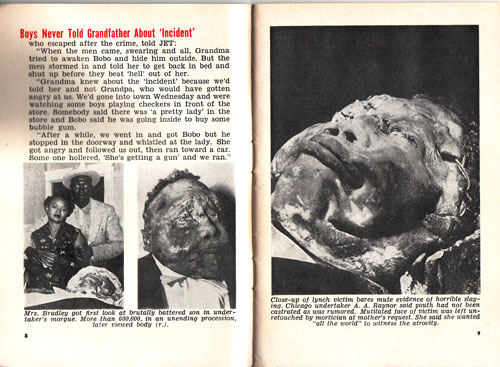
When we think of Emmett Till, the 14-year-old black boy murdered in Mississippi in 1963 after reportedly speaking to a white woman, we recall his open casket. His mother insisted on it, because she wanted the world to see the brutality that had been visited on her son because of the color of his skin. Look at this picture, printed on pages yellowed by all the years that have come between his death and today. Those years have made him famous; we take some cold comfort in the fact that though Till was robbed of the opportunity to love and thrive and work and change the world in life; his death profoundly altered it, kicking off the cycle of social progress that has brought us here, a world away from Money, Mississippi, 1955.
Now look at this image, of Frederick Jermaine Carter, a 26-year-old black man found hanging from a tree in a white suburb in Greenwood, Mississippi. It was taken ten miles south and 55 years after Emmett Till was killed. Carter died in 2010.
Yes, southern (and northern) trees still bear strange fruit. In March of this year, Otis Byrd, a man who had served time for killing a white woman, was found hanging from a tree in Claiborne County, Mississippi. (A special investigation ruled that there was no evidence proving his death a homicide.) Less than a year ago, the body of 17-year-old Lennon Lacey—a young man in a relationship with a white woman—was found hanging from a swing-set in Bladenboro, North Carolina. His death was immediately ruled a suicide, despite a series of inconsistencies and a report from an independent examiner suggesting that given his height and weight, a self-hanging would have been impossible. This death recalled the 2000 hanging of Raynard Johnson from a pecan tree in Kokomo, Mississippi. Johnson, like Lacey, had been dating, and been harassed for dating, a white woman, and his death—on June 16, in advance of a local Juneteenth celebration—was promptly ruled a suicide.
There’s no way to know for sure whether these deaths were lynchings or suicides, but what they are not are echoes of some distant past. They are original sounds. They are simply later chapters in the story of Emmett Till and countless, less well known others. They are a story of violent white resistance to the perceived incursion of blackness on bodies—on women’s bodies and on the nation. These bodies are not just presumed to be white, but presumed to belong to white men, a dynamic made crystal clear by Dylann Roof’s reported locution, during his Wednesday murder spree: “You rape our women and you’re taking over our country. And you have to go.”
We can try to comfort ourselves, as a local news anchor tried earlier this year, by assuring viewers that the cross found burning on the front lawn of a black woman in Elizabethville, Pennsylvania, was “not like those huge crosses from the old days.”
But these are the old days. In February, a Tennessee man and member of a church affiliated with the Ku Klux Klan was fined and sentenced to jail for burning a cross in the yard of a black man in Minor Hill, Tennessee. In 2014 in White River Township, Indiana, a black man was awakened in the middle of the night to find a three-foot cross burning on his front lawn. This is today.
This is Eric Garner, being killed by cops. This is Walter Scott, being shot in the back and killed by a police man. This is Freddie Gray, howling with pain after having had his body broken by police, a week before his death. This is Tamir Rice. He was 12 when he was shot to death, in November of last year, by police.
As Jelani Cobb wrote on Wednesday, recent incidents can “seem like gruesome boomerangs of history until we consider the more terrible idea that they are simple reflections of the present.”
It’s not just a terrible idea, it is a terrible reality. The cold reality of our country right now. We are not post-civil rights. We are not post race. We are not better than we were. We do not inhabit a world in which stray instances of violence might recall a distant and shameful history. This shame is a flood that has never abated.
By: Rebecca Traister, The New Republic, June 18, 2015
Share This Blog


 Unknown Feed
- An error has occurred; the feed is probably down. Try again later.
 mykeystrokes.com