Punishing the Jobless
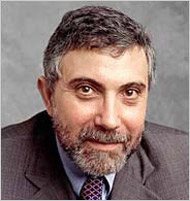
Paul Krugman-Nobel Prize Winner in Economics
There was a time when everyone took it for granted that unemployment insurance, which normally terminates after 26 weeks, would be extended in times of persistent joblessness. It was, most people agreed, the decent thing to do.
But that was then. Today, American workers face the worst job market since the Great Depression, with five job seekers for every job opening, with the average spell of unemployment now at 35 weeks. Yet the Senate went home for the holiday weekend without extending benefits. How was that possible?
The answer is that we’re facing a coalition of the heartless, the clueless and the confused. Nothing can be done about the first group, and probably not much about the second. But maybe it’s possible to clear up some of the confusion.
By the heartless, I mean Republicans who have made the cynical calculation that blocking anything President Obama tries to do — including, or perhaps especially, anything that might alleviate the nation’s economic pain — improves their chances in the midterm elections. Don’t pretend to be shocked: you know they’re out there, and make up a large share of the G.O.P. caucus.
By the clueless I mean people like Sharron Angle, the Republican candidate for senator from Nevada, who has repeatedly insisted that the unemployed are deliberately choosing to stay jobless, so that they can keep collecting benefits. A sample remark: “You can make more money on unemployment than you can going down and getting one of those jobs that is an honest job but it doesn’t pay as much. We’ve put in so much entitlement into our government that we really have spoiled our citizenry.”
Now, I don’t have the impression that unemployed Americans are spoiled; desperate seems more like it. One doubts, however, that any amount of evidence could change Ms. Angle’s view of the world — and there are, unfortunately, a lot of people in our political class just like her.
But there are also, one hopes, at least a few political players who are honestly misinformed about what unemployment benefits do — who believe, for example, that Senator Jon Kyl, Republican of Arizona, was making sense when he declared that extending benefits would make unemployment worse, because “continuing to pay people unemployment compensation is a disincentive for them to seek new work.” So let’s talk about why that belief is dead wrong.
Do unemployment benefits reduce the incentive to seek work? Yes: workers receiving unemployment benefits aren’t quite as desperate as workers without benefits, and are likely to be slightly more choosy about accepting new jobs. The operative word here is “slightly”: recent economic research suggests that the effect of unemployment benefits on worker behavior is much weaker than was previously believed. Still, it’s a real effect when the economy is doing well.
But it’s an effect that is completely irrelevant to our current situation. When the economy is booming, and lack of sufficient willing workers is limiting growth, generous unemployment benefits may keep employment lower than it would have been otherwise. But as you may have noticed, right now the economy isn’t booming — again, there are five unemployed workers for every job opening. Cutting off benefits to the unemployed will make them even more desperate for work — but they can’t take jobs that aren’t there.
Wait: there’s more. One main reason there aren’t enough jobs right now is weak consumer demand. Helping the unemployed, by putting money in the pockets of people who badly need it, helps support consumer spending. That’s why the Congressional Budget Office rates aid to the unemployed as a highly cost-effective form of economic stimulus. And unlike, say, large infrastructure projects, aid to the unemployed creates jobs quickly — while allowing that aid to lapse, which is what is happening right now, is a recipe for even weaker job growth, not in the distant future but over the next few months.
But won’t extending unemployment benefits worsen the budget deficit? Yes, slightly — but as I and others have been arguing at length, penny-pinching in the midst of a severely depressed economy is no way to deal with our long-run budget problems. And penny-pinching at the expense of the unemployed is cruel as well as misguided.
So, is there any chance that these arguments will get through? Not, I fear, to Republicans: “It is difficult to get a man to understand something,” said Upton Sinclair, “when his salary” — or, in this case, his hope of retaking Congress — “depends upon his not understanding it.” But there are also centrist Democrats who have bought into the arguments against helping the unemployed. It’s up to them to step back, realize that they have been misled — and do the right thing by passing extended benefits.
By PAUL KRUGMAN-Published: July 4, 2010 NYT Op-ED
Photo:Fred R. Conrad/The New York Times
“Hypocrisy,” Say Morons

Elephants and facts just don't seem to go together
Republicans plan to hammer the debt and deficit hypocrisy theme in the days and weeks ahead. White House economic adviser Larry Summers has lectured Congressional Democrats that now is a good time for the federal government to borrow to “stimulate demand” because interest rates are low. Yet the President keeps insisting that fiscal responsibility is an important priority of the White House. Republicans are having a field day. A recent email blast reminded supporters of a statement made by President Obama on November 18th: “It is important though to recognize if we keep on adding to the debt, even in the midst of this recession, that at some point, people could lose confidence in the U.S. economy in a way that could actually cause a double dip recession.”
Fiscal schizophrenia reigns in the White House.
Okay, let’s go back and read what Obama said last November 18th:
There may be some tax provisions that can encourage businesses to hire sooner rather than sitting on the sidelines; so, we’re taking a look at those. I think it is important though to recognize that if we keep on adding to the debt, even in the midst of this recovery, that at some point, people could lose confidence in the US economy in a way that could actually lead to a double-dip recession.
And so one of the trickiest things we’re doing right now, is to on the one hand make sure the recovery is supported and not withdraw a lot of money either with tax increases or big spending cuts – and states, for example, need a lot of support to keep hiring teachers and so forth – at the same time, making sure that we’re setting up a pathway longterm for deficit reduction.
Got that? Obama was saying the same thing he’s saying now. In the short run, we have an economic crisis that requires deficits. In the long-run, we’ll need to reduce the deficit. (And the long-term costs of temporary stimulus are pretty low.) Indeed, taking steps that increase long-term deficits could actually hurt in the short run. These are not contradictory ideas. Indeed, in his November interview, Obama endorsed the very notion (helping states mitigate budget cuts for teachers and other things) that he’s pushing for right now.
Moore and the Republicans think it’s “hypocrisy” to be for high deficits during a liquidity crisis but against them during a recovery. Really. The whole Republican message is based on not understanding this distinction.
By: Jonathan Chait-The New Republic-June 18, 2010
Share This Blog


 Unknown Feed
- An error has occurred; the feed is probably down. Try again later.
 mykeystrokes.com
You must be logged in to post a comment.