“Suburbanization Of Poverty”: Tensions In Ferguson Have Been Simmering Below Surface For Decades
The police shooting of Michael Brown was the spark.
But the tinder fueling the anger and resentment that has exploded in Ferguson, Mo., has been building for decades.
The town has seen many middle-class homeowners who eagerly moved to St. Louis’ northern suburbs after World War II to buy brick ranch homes with nice yards leave, replaced by poorer newcomers. Good blue-collar jobs have grown scarce; the factories that once sprouted here have closed shop. Schools have struggled.
And local governments — slow to evolve – often now look little like the people they represent. For the black community, it creates a sense of lost opportunity in a place much like other aging suburbs in the Rust Belt and across the country.
“For a young black man, there’s not much employment, not a lot of opportunity,” said Todd Swanstrom, a professor of public policy at the University of Missouri, St. Louis. “It’s kind of a tinder box.”
The seething tensions prompted Missouri Gov. Jay Nixon to declare a curfew in Ferguson on Saturday, one week after a white police officer shot and killed Brown, an 18-year-old black man. The declaration followed another night of looting.
Critics say an initial heavy-handed response by police using tear gas and rubber bullets touched off the unrest, with mainly white officers facing off against mainly black crowds.
Since Brown’s death, race and police tactics have dominated the headlines blaring from this town 12 miles northwest of St. Louis’ Gateway Arch. But that’s only part of the story.
From jobs to schools to racial transition, Ferguson and its neighboring towns — where many protesters came from — have undergone sweeping changes in recent years. Some places have become pockets of poverty, comparable to the poorest spots in St. Louis.
Others, like Ferguson, remain more mixed, with middle-class subdivisions alongside run-down streets and big apartment complexes like the one where Brown lived. Either way, Swanstrom said, the area highlights the growing challenge of the “suburbanization” of poverty.
“This was a catalyst for something much deeper, the lack of economic opportunities and representation people have,” said Etefia Umana, an educator and board member of a community group called Better Family Life. “A lot of the issues are boiling up.”
It’s been boiling for decades.
St. Louis’ jumble of suburbs — there are 91 municipalities in a county of about 1 million people ringing the city — has long been sharply segregated. Until the late 1940s, restrictive covenants blocked blacks from buying homes in many of them.
Well into the 1970s, tight zoning restrictions and other rules, especially in places near the city’s mostly black north side, kept many largely white, said Colin Gordon, a University of Iowa professor who’s studied housing in St. Louis.
That began to change by the 1980s, when middle- and working-class white families began leaving north county — as the area around Ferguson is known — for newer, roomier housing further out in the exurbs. In their place came a flood of black families from St. Louis in search of better housing and schools.
“When black flight out of the city began, this was the logical frontier,” Gordon said. “It became what the city had been, a zone of racial transition.”
In Ferguson, the change happened fast. In a generation — from 1990 to today — the population changed from three-fourths white to two-thirds black. Even as the area’s demographics shifted, good blue-collar jobs sustained many of these towns, said Lara Granich, a community organizer.
“Everyone in our parish was a brick layer or a letter carrier or something. I didn’t know anyone who had gone to college, but they all made a decent living,” said Granich, who grew up in nearby Glasgow Village, another neighborhood on the decline. “The people who live there now tend to work at McDonald’s.”
The recession hurt, too. This part of the St. Louis region took the brunt of the foreclosure crisis, with subprime loans turning bad, and investors scooping up cheap houses to rent. Auto plants that had sustained a black middle-class shut down.
Since 2000, the median household income in Ferguson has fallen by 30 percent when adjusted for inflation, to about $36,000. In the Census tract where Brown lived, median income is less than $27,000. Just half of the adults work.
Fr. Steven Lawler, rector of St. Stephen’s Episcopal Church in Ferguson, really saw the change in 2008, when visits to his food pantry spiked. They haven’t gone down since.
“I know there are places where an economic recovery’s happening,” he said. “But in the places where people are most stressed, there hasn’t been a recovery.”
Still, as Lawler and others note, Ferguson has some things going for it. Its pleasant, old downtown has seen a revival in recent years, with a busy Saturday farmers market and a new craft brewery. It still has middle-class neighborhoods of historic homes. The headquarters of a Fortune 500 company — Emerson Electric Co. — sits on a serene campus just up the hill from the gas station looters burned a week ago Sunday night.
Gail Babcock, program director at Ferguson Youth Initiative, was quick to note her town still has a strong sense of community — and every morning last week volunteers have poured in to clean up from protests and looting. The challenge is in connecting its poorer residents – especially younger ones – to it.
“It’s very hard for them to find jobs,” said Babcock, who runs a community service program for youth convicted of minor criminal offenses. “That sets up a situation where they tend to get in trouble, and they probably wouldn’t under other circumstances.”
Then there are the schools, one reason why many families moved to these suburbs in the first place. Two north county districts – including the one where Brown graduated from high school in May — have lost their state accreditation in recent years. The district Ferguson shares with a neighboring town remain accredited but scores low on state tests.
That was a big reason why John Weaver took the morning off work Friday, drove his plumbing truck to Florissant, and asked the visiting Gov. Nixon what he planned to do about the problems that have plagued these neighborhoods for years.
Nixon acknowledged there’s “a lot of work to do.” Weaver was not impressed.
“All these politicians say they’ll fight for our education. I feel cheated,” he said in an interview later. “And if I feel cheated, how should these kids feel?”
These issues are all tied together for Shermale Humphrey, a 21-year-old who joined the protests last week. She plans to enlist in the Air Force, but right now works at a McDonald’s near where Brown was shot. She’s something of a veteran activist – helping to organize strikes by fast-food workers in St. Louis — and sees race and local politics and economics here as closely intertwined.
“It’s a shortage of everything,” she said. “It’s a shortage of jobs. Of African Americans on the police force and in government. Of people not being able to get a good education.”
Adding to the frustration, many protesters say, is that the people still running many of these downs don’t much look like the people who live there now. Just three of Ferguson’s 53 police officers are black. Six of seven City Council members are white. So are six of the seven school board members, who run a district with a student body that’s 78 percent black.
Many of these towns are still run “like little fiefdoms,” said Umana, who moved to Ferguson eight years ago, by remnants of their old white middle class that may not share the concerns of newcomers.
“The numbers flip-flopped, but the power structure remained the same,” he said.
It has been hard to build black political leadership in these fast-changing suburbs, said Mike Jones, a black veteran of St. Louis’ political scene. Indeed, it’s been harder than in St. Louis, which has long been racially mixed.
But a more diverse set of voices at Ferguson City Hall, Jones said, might have avoided the heavy-handed police response that only inflamed protests.
“The question is how — in a city that’s 67 percent African-American — do you have absolutely no African American political representation?” Jones asked. “That’s what leads you to a police force that could become involved in this sort of incident.”
It’s an issue more communities will have to face, Jones predicts, as traditionally “urban” issues of poverty and racial change migrate to suburbs often less-equipped to deal with them. And not just in St. Louis.
A study last month by the Brookings Institution found the number of poor people living in high-poverty suburban neighborhoods nationwide more than doubled in the last decade, growing much faster than in big cities.
Chris Krehmeyer, who runs St. Louis-based community development nonprofit Beyond Housing, says he knows colleagues around the country dealing with a lot of the same issues as he is in north St. Louis County, tackling housing and jobs and schools all at once. The key, he said, is to build trust with residents before the community blows up.
Ferguson is a bellwether, he said. “This story could happen in lots of different places, all over this country.”
By: Tim Logan and Molly Hennessy-Fiske, The Los Angeles Times; The National Memo, August 18, 2014
“Bizarre Looking-Glass Ideology”: Deficit Scolds Are The Most Crazed Ideologues In America
A new Congressional Budget Office report shows that the projected increase in the national debt has slowed dramatically. Good news for deficit scolds, right? Not for Ron Fournier, who still thinks the nation is on its last legs:
Only in Washington, the place where you land when you fall through the looking glass, could this be hailed as good news… Our deficit levels (annual totals of red ink) are stalled at breathtakingly high levels — and are projected to soar again in a few years… Scary news, right? Not according to many media outlets and a cynical leadership class in Washington. Some news organizations focused on the sugar-high of good news — the (temporary) dip in deficits.
Think of a reporter covering a shooting. The police tell him the victim is dying of blood loss. Is the headline “Shooting Victim Expected to Die” or “Blood Flow Slows for Shooting Victim”? [National Journal]
Fournier’s economic analysis, if it may be so dignified with the phrase, is comprehensively wretched. As I’ve argued, the real problem with the deficit is that it’s coming down way too fast. Premature austerity has crippled the economic recovery and kept millions out of work. The biggest economic problem facing the nation is unemployment, which outweighs the stupid deficit by Graham’s Number levels of importance.
But the main problem is that his scold case is weak even on its own terms. Fournier understands neither what is driving the increase in the national debt nor why that might be a problem — all of which betrays a bizarre ideology that holds that pain must be inflicted before any gains can be made.
The huge increase in the annual deficit in 2008-09 was driven by two things: first, the economic collapse, which caused revenues to fall and spending to increase as people drew on safety net programs like unemployment insurance. Second, the Recovery Act, aka the stimulus, which provided a one-time surge of spending to restore aggregate demand and get people back to work. Though the stimulus was not nearly large enough to fill the hole in demand, this is what macroeconomic policy is supposed to do in a recession (a fact that Republicans were happy to accept when they were in power).
The long-term debt and deficit projections, on the other hand, are entirely about health-care spending. As Peter Fisher once said, the government is basically an insurance company with an army, and for many years the price of health care increased much faster than the rate of economic growth. This made government spending on health care (mostly Medicare and Medicaid) consume an ever-greater portion of the federal budget. Past CBO projections just assumed this trend would continue, which accounts for past reports predicting that the national debt would eventually eat the whole budget.
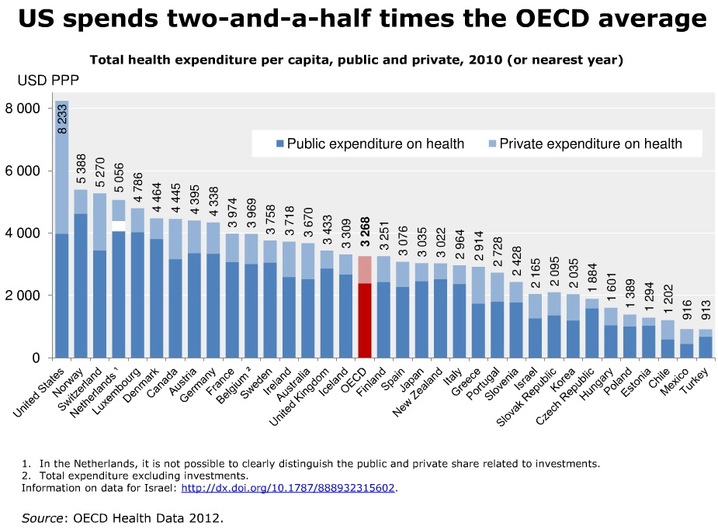
What this means is that Fournier’s preferred solution for dealing with this trend — higher taxes, fewer entitlements — is completely pointless. We have to fix the problem of rising prices, otherwise eventually a single tablet of aspirin will consume the entire federal budget. And the price problem is driven by awful policy design, not excessive generosity. America manages the rare trick of having very patchy and stingy social insurance that is simultaneously incredibly expensive. We spend more government money per person than Canada does — and the Canadians have universal single-payer coverage.
Fewer entitlements or higher taxes will get you a few years of breathing room before price increases eat up all the savings — and the whole point of Fournier’s column is that a couple decades of breathing room is still grounds for hair-on-fire panic.
Luckily, since the passage of ObamaCare, price increases have indeed slowed dramatically. That, plus a new projection that interest rates will stay low for a long time, accounts for the new CBO analysis showing slower debt growth. Just why this is happening is a matter of some dispute; I suspect it is partly the result of several programs in ObamaCare designed to bring prices down, and partly that health-care prices are already so high they’re running into resource constraints.
I think the fact that Fournier is patently uninterested in any of these things, and favors a policy that would accomplish nothing whatsoever on the deficit by his own standards, reveals that the pro-austerity school of punditry isn’t about the deficit at all. Instead, he says that his entitlement-cutting agenda is “going to happen sooner or later, painfully or more painfully.” As with David Gregory, the pain is the operative concept. The centrist definition of responsible politics holds that the American people must suffer a little more to keep the nation healthy. It’s only the “hateful partisans” who are keeping the wise, reasonable moderates from making those tough bipartisan compromises to slash social insurance and inflict pain.
But make no mistake: This has nothing to do with economics, and everything to do with the bizarre looking-glass ideology of “serious people” in Washington, D.C.
By: Ryan Cooper, The Week, July 24, 2014
“The Fiscal Fizzle”: An Imaginary Budget And Debt Crisis
For much of the past five years readers of the political and economic news were left in little doubt that budget deficits and rising debt were the most important issue facing America. Serious people constantly issued dire warnings that the United States risked turning into another Greece any day now. President Obama appointed a special, bipartisan commission to propose solutions to the alleged fiscal crisis, and spent much of his first term trying to negotiate a Grand Bargain on the budget with Republicans.
That bargain never happened, because Republicans refused to consider any deal that raised taxes. Nonetheless, debt and deficits have faded from the news. And there’s a good reason for that disappearing act: The whole thing turns out to have been a false alarm.
I’m not sure whether most readers realize just how thoroughly the great fiscal panic has fizzled — and the deficit scolds are, of course, still scolding. They’re even trying to spin the latest long-term projections from the Congressional Budget Office — which are distinctly non-alarming — as somehow a confirmation of their earlier scare tactics. So this seems like a good time to offer an update on the debt disaster that wasn’t.
About those projections: The budget office predicts that this year’s federal deficit will be just 2.8 percent of G.D.P., down from 9.8 percent in 2009. It’s true that the fact that we’re still running a deficit means federal debt in dollar terms continues to grow — but the economy is growing too, so the budget office expects the crucial ratio of debt to G.D.P. to remain more or less flat for the next decade.
Things are expected to deteriorate after that, mainly because of the impact of an aging population on Medicare and Social Security. But there has been a dramatic slowdown in the growth of health care costs, which used to play a big role in frightening budget scenarios. As a result, despite aging, debt in 2039 — a quarter-century from now! — is projected to be no higher, as a percentage of G.D.P., than the debt America had at the end of World War II, or that Britain had for much of the 20th century. Oh, and the budget office now expects interest rates to remain fairly low, not much higher than the economy’s rate of growth. This in turn weakens, indeed almost eliminates, the risk of a debt spiral, in which the cost of servicing debt drives debt even higher.
Still, rising debt isn’t good. So what would it take to avoid any rise in the debt ratio? Surprisingly little. The budget office estimates that stabilizing the ratio of debt to G.D.P. at its current level would require spending cuts and/or tax hikes of 1.2 percent of G.D.P. if we started now, or 1.5 percent of G.D.P. if we waited until 2020. Politically, that would be hard given total Republican opposition to anything a Democratic president might propose, but in economic terms it would be no big deal, and wouldn’t require any fundamental change in our major social programs.
In short, the debt apocalypse has been called off.
Wait — what about the risk of a crisis of confidence? There have been many warnings that such a crisis was imminent, some of them coupled with surprisingly frank admissions of disappointment that it hadn’t happened yet. For example, Alan Greenspan warned of the “Greece analogy,” and declared that it was “regrettable” that U.S. interest rates and inflation hadn’t yet soared.
But that was more than four years ago, and both inflation and interest rates remain low. Maybe the United States, which among other things borrows in its own currency and therefore can’t run out of cash, isn’t much like Greece after all.
In fact, even within Europe the severity of the debt crisis diminished rapidly once the European Central Bank began doing its job, making it clear that it would do “whatever it takes” to avoid cash crises in nations that have given up their own currencies and adopted the euro. Did you know that Italy, which remains deep in debt and suffers much more from the burden of an aging population than we do, can now borrow long term at an interest rate of only 2.78 percent? Did you know that France, which is the subject of constant negative reporting, pays only 1.57 percent?
So we don’t have a debt crisis, and never did. Why did everyone important seem to think otherwise?
To be fair, there has been some real good news about the long-run fiscal prospect, mainly from health care. But it’s hard to escape the sense that debt panic was promoted because it served a political purpose — that many people were pushing the notion of a debt crisis as a way to attack Social Security and Medicare. And they did immense damage along the way, diverting the nation’s attention from its real problems — crippling unemployment, deteriorating infrastructure and more — for years on end.
By: Paul Krugman, Op-Ed Columnist, The New York Times, Julo 20, 2014
“Build We Won’t”: Weakening The Economy In The Short Run While Undermining Its Prospects For The Long Run
You often find people talking about our economic difficulties as if they were complicated and mysterious, with no obvious solution. As the economist Dean Baker recently pointed out, nothing could be further from the truth. The basic story of what went wrong is, in fact, almost absurdly simple: We had an immense housing bubble, and, when the bubble burst, it left a huge hole in spending. Everything else is footnotes.
And the appropriate policy response was simple, too: Fill that hole in demand. In particular, the aftermath of the bursting bubble was (and still is) a very good time to invest in infrastructure. In prosperous times, public spending on roads, bridges and so on competes with the private sector for resources. Since 2008, however, our economy has been awash in unemployed workers (especially construction workers) and capital with no place to go (which is why government borrowing costs are at historic lows). Putting those idle resources to work building useful stuff should have been a no-brainer.
But what actually happened was exactly the opposite: an unprecedented plunge in infrastructure spending. Adjusted for inflation and population growth, public expenditures on construction have fallen more than 20 percent since early 2008. In policy terms, this represents an almost surreally awful wrong turn; we’ve managed to weaken the economy in the short run even as we undermine its prospects for the long run. Well played!
And it’s about to get even worse. The federal highway trust fund, which pays for a large part of American road construction and maintenance, is almost exhausted. Unless Congress agrees to top up the fund somehow, road work all across the country will have to be scaled back just a few weeks from now. If this were to happen, it would quickly cost us hundreds of thousands of jobs, which might derail the employment recovery that finally seems to be gaining steam. And it would also reduce long-run economic potential.
How did things go so wrong? As with so many of our problems, the answer is the combined effect of rigid ideology and scorched-earth political tactics. The highway fund crisis is just one example of a much broader problem.
So, about the highway fund: Road spending is traditionally paid for via dedicated taxes on fuel. The federal trust fund, in particular, gets its money from the federal gasoline tax. In recent years, however, revenue from the gas tax has consistently fallen short of needs. That’s mainly because the tax rate, at 18.4 cents per gallon, hasn’t changed since 1993, even as the overall level of prices has risen more than 60 percent.
It’s hard to think of any good reason why taxes on gasoline should be so low, and it’s easy to think of reasons, ranging from climate concerns to reducing dependence on the Middle East, why gas should cost more. So there’s a very strong case for raising the gas tax, even aside from the need to pay for road work. But even if we aren’t ready to do that right now — if, say, we want to avoid raising taxes until the economy is stronger — we don’t have to stop building and repairing roads. Congress can and has topped up the highway trust fund from general revenue. In fact, it has thrown $54 billion into the hat since 2008. Why not do it again?
But no. We can’t simply write a check to the highway fund, we’re told, because that would increase the deficit. And deficits are evil, at least when there’s a Democrat in the White House, even if the government can borrow at incredibly low interest rates. And we can’t raise gas taxes because that would be a tax increase, and tax increases are even more evil than deficits. So our roads must be allowed to fall into disrepair.
If this sounds crazy, that’s because it is. But similar logic lies behind the overall plunge in public investment. Most such investment is carried out by state and local governments, which generally must run balanced budgets and saw revenue decline after the housing bust. But the federal government could have supported public investment through deficit-financed grants, and states themselves could have raised more revenue (which some but not all did). The collapse of public investment was, therefore, a political choice.
What’s useful about the looming highway crisis is that it illustrates just how self-destructive that political choice has become. It’s one thing to block green investment, or high-speed rail, or even school construction. I’m for such things, but many on the right aren’t. But everyone from progressive think tanks to the United States Chamber of Commerce thinks we need good roads. Yet the combination of anti-tax ideology and deficit hysteria (itself mostly whipped up in an attempt to bully President Obama into spending cuts) means that we’re letting our highways, and our future, erode away.
By: Paul Krugman, Op-Ed Columnist, The New York Times, July 3, 2014
“The Fear Economy”: The Economy May Be Lousy For Workers, But Corporate America Is Doing Just Fine
More than a million unemployed Americans are about to get the cruelest of Christmas “gifts.” They’re about to have their unemployment benefits cut off. You see, Republicans in Congress insist that if you haven’t found a job after months of searching, it must be because you aren’t trying hard enough. So you need an extra incentive in the form of sheer desperation.
As a result, the plight of the unemployed, already terrible, is about to get even worse. Obviously those who have jobs are much better off. Yet the continuing weakness of the labor market takes a toll on them, too. So let’s talk a bit about the plight of the employed.
Some people would have you believe that employment relations are just like any other market transaction; workers have something to sell, employers want to buy what they offer, and they simply make a deal. But anyone who has ever held a job in the real world — or, for that matter, seen a Dilbert cartoon — knows that it’s not like that.
The fact is that employment generally involves a power relationship: you have a boss, who tells you what to do, and if you refuse, you may be fired. This doesn’t have to be a bad thing. If employers value their workers, they won’t make unreasonable demands. But it’s not a simple transaction. There’s a country music classic titled “Take This Job and Shove It.” There isn’t and won’t be a song titled “Take This Consumer Durable and Shove It.”
So employment is a power relationship, and high unemployment has greatly weakened workers’ already weak position in that relationship.
We can actually quantify that weakness by looking at the quits rate — the percentage of workers voluntarily leaving their jobs (as opposed to being fired) each month. Obviously, there are many reasons a worker might want to leave his or her job. Quitting is, however, a risk; unless a worker already has a new job lined up, he or she doesn’t know how long will it take to find a new job, and how that job will compare with the old one.
And the risk of quitting is much greater when unemployment is high, and there are many more people seeking jobs than there are job openings. As a result, you would expect to see the quits rate rise during booms, fall during slumps — and, indeed, it does. Quits plunged during the 2007-9 recession, and they have only partially rebounded, reflecting the weakness and inadequacy of our economic recovery.
Now think about what this means for workers’ bargaining power. When the economy is strong, workers are empowered. They can leave if they’re unhappy with the way they’re being treated and know that they can quickly find a new job if they are let go. When the economy is weak, however, workers have a very weak hand, and employers are in a position to work them harder, pay them less, or both.
Is there any evidence that this is happening? And how. The economic recovery has, as I said, been weak and inadequate, but all the burden of that weakness is being borne by workers. Corporate profits plunged during the financial crisis, but quickly bounced back, and they continued to soar. Indeed, at this point, after-tax profits are more than 60 percent higher than they were in 2007, before the recession began. We don’t know how much of this profit surge can be explained by the fear factor — the ability to squeeze workers who know that they have no place to go. But it must be at least part of the explanation. In fact, it’s possible (although by no means certain) that corporate interests are actually doing better in a somewhat depressed economy than they would if we had full employment.
What’s more, I don’t think it’s too much of a stretch to suggest that this reality helps explain why our political system has turned its backs on the unemployed. No, I don’t believe that there’s a secret cabal of C.E.O.’s plotting to keep the economy weak. But I do think that a major reason why reducing unemployment isn’t a political priority is that the economy may be lousy for workers, but corporate America is doing just fine.
And once you understand this, you also understand why it’s so important to change those priorities.
There’s been a somewhat strange debate among progressives lately, with some arguing that populism and condemnations of inequality are a diversion, that full employment should instead be the top priority. As some leading progressive economists have pointed out, however, full employment is itself a populist issue: weak labor markets are a main reason workers are losing ground, and the excessive power of corporations and the wealthy is a main reason we aren’t doing anything about jobs.
Too many Americans currently live in a climate of economic fear. There are many steps that we can take to end that state of affairs, but the most important is to put jobs back on the agenda.
By: Paul Krugman, Op-Ed Columnist, The New York Times, December 26, 2013
Share This Blog


 Unknown Feed
- An error has occurred; the feed is probably down. Try again later.
 mykeystrokes.com