“No Longer May It Wave!”: If It Were Up To Me, This Emblem Of Treason And Racism Would Be Pulled Down, Permanently
So there’s a reason for the grotesque fact that even as the US and South Carolina flags were lowered to half-mast in recognition of the murderous terrorist attack on Emanuel AME Church, the Confederate Battle Flag in front of the Statehouse continued to fly at its full height (per Schuyler Kropf of the Charleston Post and Courier):
Officials said the reason why the flag has not been touched is that its status is outlined, by law, as being under the protected purview of the full S.C. Legislature, which controls if and when it comes down.
State law reads, in part, the state “shall ensure that the flags authorized above shall be placed at all times as directed in this section and shall replace the flags at appropriate intervals as may be necessary due to wear.”
The protection was added by supporters of the flag to keep it on display as an officially recognized memorial to South Carolinians who fought in the Civil War.
So it would take a full act of the legislature to bring the Confederate flag down.
I tell you what: If I were in charge of the Statehouse grounds, I’d be real tempted to bring down that flag to half-mast and defy anyone to do anything about it. But then if it were really up to me this emblem of treason and racism would be pulled all the way down, permanently, and consigned to a museum. We’ve just witnessed another deadly data point for burying the Lost Cause beneath a mountain of opprobrium so high and so heavy that it will be no more acceptable an emblem for gun-toting “loners” and “drifters” than a swastika.
Ta-Nehisi Coates is demanding that step as a small token of historical honesty in the service of long-delayed justice for African-Americans. I’m demanding it even more basically as a gesture of southern self-respect. No, we cannot ensure that people like Dylann Roof won’t find inspiration in the Confederacy for the evil in his heart. But we can deny him respectable company. That’s particularly important in South Carolina, where the disastrous moral and material failure of the Confederacy began.
UPDATE: WaPo’s Justin Moyer adds two details to the flag story: (1) the law protecting the Confederate Battle Flag stipulates that it can only be repealed by a two-thirds vote (!); and (2) the flag on the Statehouse grounds is not raised and lowered daily on pulleys, but is permanently affixed to the flag pole.
This doesn’t move me much. Just as the flag was attached to the pole at some point, it can be unattached, and if the whole rig doesn’t allow for half-mast displays, the people of South Carolina can do without a Confederate Battle Flag for a few days or weeks.
As for the law: again, who’s going to enforce it if Nikki Haley orders the flag down? There’s also something inherently screwy about legal protections for a symbol of rebellion and lawlessness.
By: Ed Kilgore, Contributing Writer, Political Animal Blog, The Washington Monthly, June 20, 2015
“A Brutal And Cowardly Attack”: Charleston Church Massacre Inspired By White Supremacy
“I have to do it. You’re raping our women and taking over the country. You have to go,” declared the young white gunman as he emptied clip after clip of a .45 caliber handgun into the small group of African-American churchgoers at a Wednesday evening Bible study.
After sitting amid the congregation for nearly an hour, he stood up and started firing the handgun he’d recently received as a birthday present. He kept firing, reloading his gun five times in a rampage that left eight people dead on the floor of the historic Emanuel African Methodist Episcopal Church. Another, the ninth, died on the way to the hospital. The church had been founded by worshipers fleeing racism; white slaveholders had previously burned it to the ground for its connection with a thwarted slave revolt; and in the civil rights era it became a symbol and headquarters of the movement. Now it was once again in the crosshairs.
The church sits less than a dozen miles from the park where Walter Scott, an unarmed black man, was gunned down by a white police officer. The calls of “Black Lives Matter” were still ringing throughout Charleston, when gunshots again cut down black lives.
The victims of this brutal and cowardly attack inside the sanctuary of a house of worship included a South Carolina state senator, a librarian, and a recent college graduate.
The alleged killer, later identified as Dylann Storm Roof of nearby Lexington, fled the scene in his black four-door sedan adorned with an ornamental license plate that read “Confederate States of America” with the image of the Confederate flag. After a 15-hour manhunt, Roof was arrested without incident nearly 250 miles away, during a traffic stop in Shelby, North Carolina.
Though new details continue to be unearthed, a portrait of 21-year-old Roof as a withdrawn, troubled man with an interest in white supremacy is starting to emerge.
The Daily Beast quoted a classmate from White Knoll High School about his reputation for spouting racism. “Just he had that kind of Southern pride, I guess some would say. Strong conservative beliefs,” said John Mullins. “He made a lot of racist jokes, but you don’t really take them seriously like that. You don’t really think of it like that.”
“Southern pride” still runs deep in parts of South Carolina. The wounds of slavery and the Civil War are still unhealed, in many ways. Despite many protests, the Confederate flag continues to fly over the state capitol building. In January 2000, at the dawn of the new millennium, 6,000 Confederate flag supporters marched through Columbia, the state capital, according to Leonard Zeskind’s Blood and Politics.
This spring, just 90 miles from the shooting, a statewide Tea Party convention invited a white nationalist leader to speak. The organizers canceled his appearance after the Institute for Research and Education on Human Rights exposed his ideology. At that same convention, however, Tea Party officials and potential presidential candidates shared the stage with a Tea Partier who promotes a book that refers to blacks as “pickaninnies,” claims that slaves were treated humanely, and insists that slavery was just as inhumane for the slavemasters.
Beyond the racist jokes and Confederate flags on his car, Roof displayed more of the warning signs of involvement with white nationalism on his Facebook page. His profile photo shows him in the winter woods staring into the camera, clad in a black jacket with two flags affixed above over his chest: an apartheid-era South African flag, and a flag used to represent the unrecognized state of Rhodesia, after the former British colony of South Rhodesia fractured and a white minority attempted to take control of the country. Both patches are worn by white nationalists in the United States to express support for white minority rule.
Roof’s recent arrests also indicate that he may have had additional targets in mind for his killing spree. Last February he attracted attention at the Columbiana Centre, a shopping mall, when he asked store employees “out-of-the-ordinary questions” such as how many people were working and what time they would be leaving, according to a police report. A police officer questioning Roof at the scene discovered that he was illegally in possession of a controlled substance; he was arrested and charged with felony drug possession. In April, Roof was charged with trespassing on the roof of the same mall.
In a sad commentary about the dominance of local gun culture, the same morning that The Charleston Post and Courier ran a front-page story about the shooting with the headline “Church attack kills 9,” some readers found the headline obscured by a sticker advertising “Ladies’ Night” at the ATP Gun Shop & Range in Summerville, South Carolina.
By: Devin Burghart, Vice President of the Institute for Research and Education on Human Rights; the National Memo, June 18, 2015
“Take Down The Confederate Flag—Now”: The Heritage Of White Supremacy Endorsing Violence
Last night, Dylann Roof walked into a Charleston church, sat for an hour, and then killed nine people. Roof’s crime cannot be divorced from the ideology of white supremacy which long animated his state nor from its potent symbol—the Confederate flag. Visitors to Charleston have long been treated to South Carolina’s attempt to clean its history and depict its secession as something other than a war to guarantee the enslavement of the majority of its residents. This notion is belied by any serious interrogation of the Civil War and the primary documents of its instigators. Yet the Confederate battle flag—the flag of Dylann Roof—still flies on the Capitol grounds in Columbia.
The Confederate flag’s defenders often claim it represents “heritage not hate.” I agree—the heritage of White Supremacy was not so much birthed by hate as by the impulse toward plunder. Dylann Roof plundered nine different bodies last night, plundered nine different families of an original member, plundered nine different communities of a singular member. An entire people are poorer for his action. The flag that Roof embraced, which many South Carolinians embrace, does not stand in opposition to this act—it endorses it. That the Confederate flag is the symbol of of white supremacists is evidenced by the very words of those who birthed it:
Our new government is founded upon exactly the opposite idea; its foundations are laid, its corner-stone rests, upon the great truth that the negro is not equal to the white man; that slavery subordination to the superior race is his natural and normal condition. This, our new government, is the first, in the history of the world, based upon this great physical, philosophical, and moral truth…
This moral truth—“that the negro is not equal to the white man”—is exactly what animated Dylann Roof. More than any individual actor, in recent history, Roof honored his flag in exactly the manner it always demanded—with human sacrifice.
Surely the flag’s defenders will proffer other, muddier, interpretations which allow them the luxury of looking away. In this way they honor their ancestors. Cowardice, too, is heritage. When white supremacist John Wilkes Booth assassinated Abraham Lincoln 150 years ago, Booth’s fellow travelers did all they could to disassociate themselves. “Our disgust for the dastardly wretch can scarcely be uttered,” fumed a former governor of South Carolina, the state where secession began. Robert E. Lee’s armies took special care to enslave free blacks during their Northern campaign. But Lee claimed the assassination of the Great Emancipator was “deplorable.” Jefferson Davis believed that “it could not be regarded otherwise than as a great misfortune to the South,” and angrily denied rumors that he had greeted the news with exultation.
Villain though he was, Booth was a man who understood the logical conclusion of Confederate rhetoric:
“TO WHOM IT MAY CONCERN”:
Right or wrong. God judge me, not man. For be my motive good or bad, of one thing I am sure, the lasting condemnation of the North.
I love peace more than life. Have loved the Union beyond expression. For four years have I waited, hoped and prayed for the dark clouds to break, and for a restoration of our former sunshine. To wait longer would be a crime. All hope for peace is dead. My prayers have proved as idle as my hopes. God’s will be done. I go to see and share the bitter end….
I have ever held the South were right. The very nomination of ABRAHAM LINCOLN, four years ago, spoke plainly, war—war upon Southern rights and institutions….
This country was formed for the white, not for the black man. And looking upon African Slavery from the same stand-point held by the noble framers of our constitution. I for one, have ever considered if one of the greatest blessings (both for themselves and us,) that God has ever bestowed upon a favored nation. Witness heretofore our wealth and power; witness their elevation and enlightenment above their race elsewhere. I have lived among it most of my life, and have seen less harsh treatment from master to man than I have beheld in the North from father to son. Yet, Heaven knows, no one would be willing to do more for the negro race than I, could I but see a way to still better their condition.
By 1865, the Civil War had morphed into a war against slavery—the “cornerstone” of Confederate society. Booth absorbed his lesson too well. He did not violate some implicit rule of Confederate chivalry or politesse. He accurately interpreted the cause of Jefferson Davis and Robert E. Lee, men who were too weak to truthfully address that cause’s natural end.
Moral cowardice requires choice and action. It demands that its adherents repeatedly look away, that they favor the fanciful over the plain, myth over history, the dream over the real. Here is another choice.
Take down the flag. Take it down now.
Put it in a museum. Inscribe beneath it the years 1861-2015. Move forward. Abandon this charlatanism. Drive out this cult of death and chains. Save your lovely souls. Move forward. Do it now.
By: Ta-Nehist Coates, The Atlantic, June 18, 2015
“A History Lesson We Adamantly Refuse To Learn”: Our Racist History Isn’t Back To Haunt Us. It Never Left Us
When, on Wednesday night, a 21-year-old white man named Dylann Roof entered the Charleston church founded by former slave Denmark Vesey on the anniversary of Vesey’s planned 1822 slave rebellion and shot and killed nine people, he provided the United States with the latest installment of a history lesson we adamantly refuse to learn: that our racist past is not past. It is present. It is unending. It is, in many ways that we seem congenitally unable to acknowledge, fundamentally unchanged.
In recent years, especially the years during which Barack Obama has occupied the White House, there have been many valuable meditations on the ways in which American policy structures that were shaped in and informed by the slave-holding and Jim Crow chapters of our nation’s story, continue to define today’s racial power imbalances. There’s been history, analysis, and contemporary commentary: Michelle Alexander’s indispensible The New Jim Crow, about our prison and legal systems; Isabel Wilkerson’s Warmth of Other Suns, about the Great Migration; Tom Sugrue’s books on integration and racism in northern cities and on housing policy in Detroit. At the Atlantic, Ta-Nehisi Coates has produced a body of work—culminating (for now) with his Case for Reparations—showing how we have gotten from “there” to “here,” contemporary America, with its persistently unequal scales of opportunity. Throughout our history, racism has indeed found fresh manifestations: from real estate restrictions and usurious interest rates to physical segregation to job discrimination to stop and frisk and police brutality.
There is usually the sense, however, that at least we’re changing, at least we’re moving in some direction, away from the where we started. Except on days like today, when the reminder is that we have not moved one bit.
In addition to new forms of subjugation and prejudice, we live in a country in which racist violence exists in precisely the same forms it always has—unabated, unreconstructed. We are not distant from the crimes and inhumanities and hatred of the past. We are still acting them out and still refusing to accept them for what they are: this country’s original and defining sin.
What happened on Wednesday night is violence enacted on different individuals than the violence enacted on four little girls who were killed in the bombing of the 16th Street Baptist Church in Birmingham in 1963, but it is a crime with the same shape and contours, a crime that leaves innocent people dead in their place of worship because of their race.
Too often, we look at iconic images of our racist past with a kind of antiqued horror. We recall with horror, if we’re old enough, how police turned dogs on innocent people. If we are younger, we suck in our breath and shake our heads with disbelief as we try to fathom a world inhabited by our parents, our grandparents, in which a city official, Bull Connor, ordered the use of fire hoses on peaceful protesters. But we also know that Bull Connor is long dead, a comfortable relic. We can just barely imagine that this happened to John Lewis. Lewis is now a long-serving congressman; his past is crucial, moving, but remote. That was then, look at him now.
But this—a white policeman shoving a 14-year-old girl’s face to the ground, stepping on her, kneeling on her at a pool party in McKinney, Texas—is also now. It’s this month. This, in Fairfield, Ohio, is not simply an altercation “between police and teens” as the caption says, but between a white police and black teens who scream in terror and anger. It is also this month, also at a community pool. Community pools, a locus for racial conflict. Does that sound distant? Or does it sound contemporary?
It is contemporary.
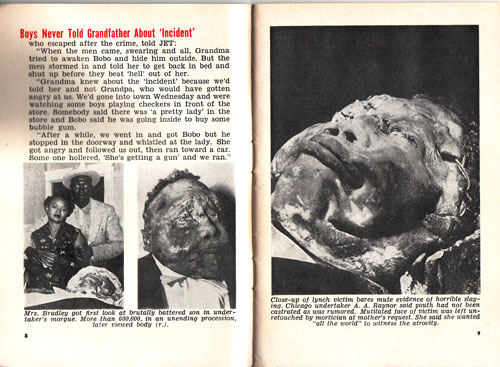
When we think of Emmett Till, the 14-year-old black boy murdered in Mississippi in 1963 after reportedly speaking to a white woman, we recall his open casket. His mother insisted on it, because she wanted the world to see the brutality that had been visited on her son because of the color of his skin. Look at this picture, printed on pages yellowed by all the years that have come between his death and today. Those years have made him famous; we take some cold comfort in the fact that though Till was robbed of the opportunity to love and thrive and work and change the world in life; his death profoundly altered it, kicking off the cycle of social progress that has brought us here, a world away from Money, Mississippi, 1955.
Now look at this image, of Frederick Jermaine Carter, a 26-year-old black man found hanging from a tree in a white suburb in Greenwood, Mississippi. It was taken ten miles south and 55 years after Emmett Till was killed. Carter died in 2010.
Yes, southern (and northern) trees still bear strange fruit. In March of this year, Otis Byrd, a man who had served time for killing a white woman, was found hanging from a tree in Claiborne County, Mississippi. (A special investigation ruled that there was no evidence proving his death a homicide.) Less than a year ago, the body of 17-year-old Lennon Lacey—a young man in a relationship with a white woman—was found hanging from a swing-set in Bladenboro, North Carolina. His death was immediately ruled a suicide, despite a series of inconsistencies and a report from an independent examiner suggesting that given his height and weight, a self-hanging would have been impossible. This death recalled the 2000 hanging of Raynard Johnson from a pecan tree in Kokomo, Mississippi. Johnson, like Lacey, had been dating, and been harassed for dating, a white woman, and his death—on June 16, in advance of a local Juneteenth celebration—was promptly ruled a suicide.
There’s no way to know for sure whether these deaths were lynchings or suicides, but what they are not are echoes of some distant past. They are original sounds. They are simply later chapters in the story of Emmett Till and countless, less well known others. They are a story of violent white resistance to the perceived incursion of blackness on bodies—on women’s bodies and on the nation. These bodies are not just presumed to be white, but presumed to belong to white men, a dynamic made crystal clear by Dylann Roof’s reported locution, during his Wednesday murder spree: “You rape our women and you’re taking over our country. And you have to go.”
We can try to comfort ourselves, as a local news anchor tried earlier this year, by assuring viewers that the cross found burning on the front lawn of a black woman in Elizabethville, Pennsylvania, was “not like those huge crosses from the old days.”
But these are the old days. In February, a Tennessee man and member of a church affiliated with the Ku Klux Klan was fined and sentenced to jail for burning a cross in the yard of a black man in Minor Hill, Tennessee. In 2014 in White River Township, Indiana, a black man was awakened in the middle of the night to find a three-foot cross burning on his front lawn. This is today.
This is Eric Garner, being killed by cops. This is Walter Scott, being shot in the back and killed by a police man. This is Freddie Gray, howling with pain after having had his body broken by police, a week before his death. This is Tamir Rice. He was 12 when he was shot to death, in November of last year, by police.
As Jelani Cobb wrote on Wednesday, recent incidents can “seem like gruesome boomerangs of history until we consider the more terrible idea that they are simple reflections of the present.”
It’s not just a terrible idea, it is a terrible reality. The cold reality of our country right now. We are not post-civil rights. We are not post race. We are not better than we were. We do not inhabit a world in which stray instances of violence might recall a distant and shameful history. This shame is a flood that has never abated.
By: Rebecca Traister, The New Republic, June 18, 2015
Share This Blog


 Unknown Feed
- An error has occurred; the feed is probably down. Try again later.
 mykeystrokes.com