Tax-Cut Deal: If It’s Good for Regular Americans, Isn’t That Good Enough for Now?
“Absolute disaster.” “Legislative blackmail.” “Almost moral corruptness.” We get it. Democrats in Congress really, really don’t like President Obama’s tax deal with the Republicans. But is it truly as apocalyptically bad as all that?
— Oh yeah, the rich. They’re getting a 35 percent inheritance tax and an exemption for individual estates under $5 million (Obama and Democrats say both are too generous), and — the part that makes Democrats question their reason for being — the lower Bush-era rates on income above $250,000.
When Democrats finally brought their tax cut package to the floor a few days ago, the Senate couldn’t overcome a filibuster threat. Time was running out. Obama said his top priority is to make sure 2 million long-term unemployed don’t lose their lifelines and “tens of millions of hardworking Americans are not seeing their paychecks shrink on January 1st just because the folks here in Washington are busy trying to score political points.” The agreement gives Washington time to have the political argument over taxes, he said, without doing harm to individuals or the economy as a whole.
Some liberal interest groups have pounced on Obama and branded the deal a complete sellout. “If Obama’s theory is that Independent voters will flock to presidential weakness, mission accomplished,” wrote Adam Green, head of the Progressive Change Campaign Committee. His evidence: An Associated Press dispatch Monday headlined “Republicans achieve top goal in Obama tax-cut plan.” Republicans “largely dictated the terms” of the compromise though they don’t control the House, Senate or White House, the AP said.
Never mind that Republicans would have preferred a permanent extension of the high-end tax cuts instead of the two years they got. Or that they agreed to extend unemployment benefits for an unprecedented 13 months, a $56-billion expense, and did not secure spending cuts to offset the cost. Their insistence on such an offset — even as they said there was no need to offset the 10-year, $700 billion cost of the high-end tax cuts — has repeatedly held up attempts to extend the benefits, including twice since Nov. 30.
By Tuesday, the AP had its economic team on the case. New headline: “Tax deal should help economy, analysts say.” Bill Scher of the very liberal Campaign for America’s Future implored Democrats to “do the deal. For the Jobless. For the Economy.” The liberal Center for American Progress (CAP) said the plan could save or create 2.2 million jobs. The group’s ThinkProgress blog says Obama’s priorities get far more money in the deal and help 32 times as many people as the GOP’s priorities.
Voters Are About to be Disillusioned With the GOP

The Puppet Master and his Minions
But going forward, now that they control the House and aspire to gain control of the Senate and the executive branch in the next election, Republicans will be forced to work for an actual agenda. And as Paul Waldman nicely explains in The American Prospect, this can produce a great pivot in the political climate of the country, very fast:
As a long history of public-opinion research has made clear — and as events continue to remind us — Americans are “symbolic conservatives” but “operational liberals.” In other words, they like the idea of limited government, but they also like just about everything government does. Good things happen to the party that can successfully pander to both impulses, which is why we saw so many ads from Republicans…condemning Democrats for passing a big-government health-care plan because it would … curtail the growth of Medicare.Perhaps they’re just being cautious as they get used to their new majority, but in the last week, Republicans have steadfastly refused to say what their professed desire to limit government would actually entail. Press them hard on what they want to cut, and they’ll answer “earmarks,” which would be fine were it not for the fact that a) earmarks do not appropriate new money; they merely direct money that has already been appropriated, and b) the value of all earmarks amounts to less than 1 percent of the federal budget….
If there’s one thing Republicans have been clear about, it’s their desire to repeal the Affordable Care Act. Even here, though, they don’t want to get too specific. As you’ve no doubt heard many times, a bare majority of the public opposes “health-care reform” (or “Obamacare”), while substantial majorities favor almost all the major provisions of the law. Once again, Republicans can win the vague, general argument but not the specific one. Faced with the impossibility of repealing the entire act (which Obama would veto), Republicans have said they’ll try to dismantle it piece by piece. Try that, however, and they’re suddenly attacking not “health-care reform” but those particular things people like.
That isn’t to say Republicans will inevitably be punished for attempting to repeal the ACA. Pushing repeal will only be dangerous for them if Democrats make it so. Republicans will suffer if they’re attacked aggressively for wanting to reopen the Medicare prescription-drug “doughnut hole,” for wanting to kick young people off their parents’ insurance, or for wanting to give the insurance companies the ability to deny coverage to children with pre-existing conditions. Those are all provisions of the ACA that have already gone into effect. The Democrats are hardly guaranteed to win the battle of ACA, but they have a shot if they make the right arguments.
Waldman goes on to note that House Republicans will have to write a budget resolution, and moreover, are virtually promising a budget showdown with the president, probably forcing a shutdown of the federal government. There’s no particular reason to assume that tactic will fare any better than it did when Newt Gingrich tried it back in the ’90s. But that scenario, too, will force Republicans–and attentive voters generally–to make some sheep-and-goat distinctions between government programs and services that are essential and those that are not. It’s when those two judgments begin to diverge, as they undoubtedly will, that the GOP will begin to pay a high price for consciously promising an austerity budget that somehow won’t upset their own voters. Campaigning on a Big Lie–Big Government is a terrible threat to your liberties and your pocketbook, but Big Government doesn’t involve anything that you care about, dear voter–can cause a real boomerang when the lies have to be turned into an agenda.
BY: Ed Kilgore, The New Republic, November 11, 2010
How To Fight The Tax Cut Wars
The next big fight in Congress revolves around extending the Bush tax cuts. Unlike issues like climate change or stimulus, where the public does not accept the Democrats’ basic analysis of the problem, on the tax cuts the Democrats hold the whip hand. The question is whether they emerge with a political win, a public policy win, or both.
Let’s review a few basic facts about the Bush tax cuts. When Republicans took control of government in 2001, their top priority was reducing tax rates on high income earners. Since tax cuts for the rich were unpopular, they had to pair those cuts with middle-class tax cuts in order to make them politically salable. That’s how they pressured Democrats into supporting them. By packaging the whole thing together, they could accuse Democrats of opposing tax cuts for the middle class if they voted no.
Now, ten years later — and what a decade of bountiful economic growth we’ve enjoyed with the energies of investors and entrepreneurs finally unleashed from restrictive Clinton-era tax rates! — the Bush tax cuts are scheduled to expire. Republicans want to extend the whole thing. Democrats just want to extend the parts that benefit people who earn less than $250,000 a year.
Now, here’s the underlying dynamic. Raising taxes on the middle class is unpopular. But raising taxes on the rich is wildly popular. The truth is that neither party cares very much about the portion of the Bush tax cuts that benefit the middle class. Republicans just threw that in to sell the upper-bracket tax cuts, which is what they care about. Democrats might prefer a more progressive tax code with lower middle-class taxes, but most of them would rather have the revenue instead. But Democrats promised not to raise taxes on people earning less than $250,000 a year — a promise they felt they had to make in order to win. And they can’t break that promise without suffering political consequences.
Republicans, on the other hand, don’t want to pass an extension of the middle-class Bush tax cuts without the upper-bracket tax cuts. That would leave the federal tax code more progressive than it was under Bill Clinton — you’d have a combination of Clinton-era tax rates on the rich and Bush-era tax rates on the middle class. Conservatives have been fretting about such a result for more than a year, warning ominously about a country in which half the population pays no income tax. (They’d still pay other taxes, but the central Republican goal is to minimize the progressivity of the tax code.)
So we’re down to a game of chicken. Here’s why the Democrats hold the whip hand. They can pass an extension of the middle-class Bush tax cuts through the House. If Republicans let the bill pass, then they’ve lost their leverage to extend the unpopular Bush upper-income tax cuts. If they filibuster it, then Democrats can blame them for raising taxes on middle-class Americans. It would let Democrats out of their pledge. (Hey, they tried to keep the middle-class tax cuts.) Then nothing would pass, and we’d instantly revert to Clinton-era rates across the board.
What kind of effect would that have on the deficit? A huge one:
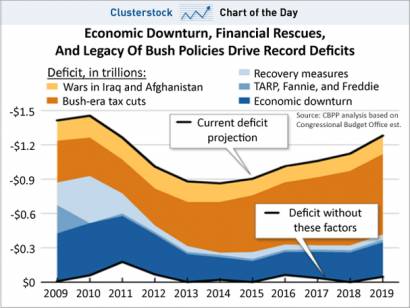
That dark orange stripe is the portion of the deficit attributable to the Bush tax cuts. That would be wiped out. Ending the tax cuts would basically solve the medium-term deficit problem.
The key factor here is that, just as Republicans got to frame the debate in 2001 by combining the tax cuts into an up or down vote, Democrats can frame the debate now by separating the policies Republicans pretend to care about from the ones they actually care about. Republicans want to have a vote on the whole collection of Bush-era tax cuts. Democrats shouldn’t give it to them. You hold a separate vote on the middle class portion and dare them to oppose it.
This seems to be the plan:
“The Senate will move first, and it will be a test to see whether Republicans filibuster” to block the bill in a bid to also win tax cuts for higher earners, said Rep. Chris Van Hollen of Maryland, head of the House Democrats’ re-election effort.
“If you can’t get it out of the Senate, then you take it to the election,” Mr. Van Hollen said in a recent interview. “You say to the American people that Republicans want to continue to hold middle-class tax relief hostage for an extension of tax breaks for [the well-to-do]. That will be the debate.”
Republicans have followed a strategy of opposing nearly everything the Democrats do. It’s worked very well. But the peculiar dynamic of this debate puts the Republicans in a position where they can’t win, and obstructing the Democrats is probably their worst move.
By: Jonathan Chait, Senior Editor, The New Republic-July 26, 2010
Punishing the Jobless
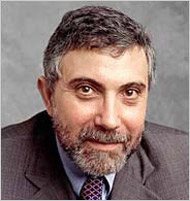
Paul Krugman-Nobel Prize Winner in Economics
There was a time when everyone took it for granted that unemployment insurance, which normally terminates after 26 weeks, would be extended in times of persistent joblessness. It was, most people agreed, the decent thing to do.
But that was then. Today, American workers face the worst job market since the Great Depression, with five job seekers for every job opening, with the average spell of unemployment now at 35 weeks. Yet the Senate went home for the holiday weekend without extending benefits. How was that possible?
The answer is that we’re facing a coalition of the heartless, the clueless and the confused. Nothing can be done about the first group, and probably not much about the second. But maybe it’s possible to clear up some of the confusion.
By the heartless, I mean Republicans who have made the cynical calculation that blocking anything President Obama tries to do — including, or perhaps especially, anything that might alleviate the nation’s economic pain — improves their chances in the midterm elections. Don’t pretend to be shocked: you know they’re out there, and make up a large share of the G.O.P. caucus.
By the clueless I mean people like Sharron Angle, the Republican candidate for senator from Nevada, who has repeatedly insisted that the unemployed are deliberately choosing to stay jobless, so that they can keep collecting benefits. A sample remark: “You can make more money on unemployment than you can going down and getting one of those jobs that is an honest job but it doesn’t pay as much. We’ve put in so much entitlement into our government that we really have spoiled our citizenry.”
Now, I don’t have the impression that unemployed Americans are spoiled; desperate seems more like it. One doubts, however, that any amount of evidence could change Ms. Angle’s view of the world — and there are, unfortunately, a lot of people in our political class just like her.
But there are also, one hopes, at least a few political players who are honestly misinformed about what unemployment benefits do — who believe, for example, that Senator Jon Kyl, Republican of Arizona, was making sense when he declared that extending benefits would make unemployment worse, because “continuing to pay people unemployment compensation is a disincentive for them to seek new work.” So let’s talk about why that belief is dead wrong.
Do unemployment benefits reduce the incentive to seek work? Yes: workers receiving unemployment benefits aren’t quite as desperate as workers without benefits, and are likely to be slightly more choosy about accepting new jobs. The operative word here is “slightly”: recent economic research suggests that the effect of unemployment benefits on worker behavior is much weaker than was previously believed. Still, it’s a real effect when the economy is doing well.
But it’s an effect that is completely irrelevant to our current situation. When the economy is booming, and lack of sufficient willing workers is limiting growth, generous unemployment benefits may keep employment lower than it would have been otherwise. But as you may have noticed, right now the economy isn’t booming — again, there are five unemployed workers for every job opening. Cutting off benefits to the unemployed will make them even more desperate for work — but they can’t take jobs that aren’t there.
Wait: there’s more. One main reason there aren’t enough jobs right now is weak consumer demand. Helping the unemployed, by putting money in the pockets of people who badly need it, helps support consumer spending. That’s why the Congressional Budget Office rates aid to the unemployed as a highly cost-effective form of economic stimulus. And unlike, say, large infrastructure projects, aid to the unemployed creates jobs quickly — while allowing that aid to lapse, which is what is happening right now, is a recipe for even weaker job growth, not in the distant future but over the next few months.
But won’t extending unemployment benefits worsen the budget deficit? Yes, slightly — but as I and others have been arguing at length, penny-pinching in the midst of a severely depressed economy is no way to deal with our long-run budget problems. And penny-pinching at the expense of the unemployed is cruel as well as misguided.
So, is there any chance that these arguments will get through? Not, I fear, to Republicans: “It is difficult to get a man to understand something,” said Upton Sinclair, “when his salary” — or, in this case, his hope of retaking Congress — “depends upon his not understanding it.” But there are also centrist Democrats who have bought into the arguments against helping the unemployed. It’s up to them to step back, realize that they have been misled — and do the right thing by passing extended benefits.
By PAUL KRUGMAN-Published: July 4, 2010 NYT Op-ED
Photo:Fred R. Conrad/The New York Times
First “Obama’s Katrina,” Now “Obama’s Watergate”

On May 8, 1973, the Senate Watergate Committee began its nationally televised hearings. Archibald Cox served as the Justice Department's special prosecutor for the case.
It appears that the Republican Party and the conservative chattering classes are determined to identify Barack Obama with every famous conservative disaster of recent history. BP’s Gulf Oil spill, we are told incessantly, is “Obama’s Katrina,” presumably because of the common geographic location, and now we hear that the silly, contrived “scandal” over alleged job offers to Democratic primary candidates will be “Obama’s Watergate.” What’s next: Obama’s Iraq? Obama’s U.S. Attorney Scandal? Obama’s Plamegate? Obama’s Illegitimate Election? (Oh, sorry, I forgot, Republicans have already used that one!).In any event, the “Watergate” analogy is insane, unless maybe you are too young or too poorly read to remember what Watergate entailed. As Joe Conason explains at Salon:
“Watergate” was the place where the president’s henchmen staged a “third-rate burglary” of the Democratic National Committee headquarters on a June night in 1972, but its historical definition is the vast gangsterism of the Nixon regime. Watergate involved no political job offers, but a series of burglaries, warrantless domestic wiretaps, illegal spying, campaign dirty tricks, and assorted acts of thuggery by a group of goons whose leaders included G. Gordon Liddy and the late E. Howard Hunt. Watergate meant a coverup of those felonies with more felonies, set up by lawyers and bureaucrats who collected cash payoffs from major corporations and then handed out hush money and secret campaign slush funds. Watergate implicated dozens of perps, from Hunt and Liddy all the way up to the president, his palace guard, and his crooked minions at the highest levels of the Justice Department, the FBI and the CIA.
The allegations against the White House today involve alleged discussions of administration jobs for Democrats running in two Democratic primaries, who turned them down without consequences. Does that sound like Watergate in any way, shape or form?
But that even assumes there was anything wrong with the discussions, other than their political clumsiness. Yes, one defense is that the same thing has been done by federal, state and local executives from time immemorial, but even that concedes too much to the critics. The federal statute being invoked by conservatives in this situation makes it a crime to offer a job in exchange for “a political act.” But in this case, “the political act” is simply taking the job. If that’s illegal, then it’s illegal to offer appointments to anyone who is or might be running for office.
It’s not surprising that Republicans are seizing on this silliness, enabled by a bored press corps; not only does it contribute to the constant drumbeat of charges that Obama’s imploding politically and doomed to disaster in 2010 and/or 2012, but it’s also a handy weapon to use against Joe Sestak, who is well-positioned to beat one of the Right’s true heartthrobs, Pat Toomey, in November.
That’s all politics-as-usual, of course. But let’s not get hallucinogenic by comparing this to the wide-ranging use of federal power to raise money illegally and intimidate “enemies” characterized by Watergate.
Posted by Ed Kilgore on June 4, 2010-Photo: Marion Trikosko for USN and WR.
Share This Blog


 Unknown Feed
- An error has occurred; the feed is probably down. Try again later.
 mykeystrokes.com
You must be logged in to post a comment.