Republicans Say Everything the Dems Pass Is Unconstitutional — Even Policies They’ve Championed for Decades
That Republicans are relentlessly attacking the constitutionality of what had long been one of their signature ideas for reforming the health-care system — the individual mandate requiring people to buy insurance or pay a penalty – is a testament to just how far down the rabbit-hole our discourse has gone.
Late last year, when a federal judge ruled against the mandate (two other courts disagreed, and the Supreme Court will end up deciding the question), Senator Orrin Hatch, R-Utah, rejoiced. “Today is a great day for liberty,” he said. “Congress must obey the Constitution rather than make it up as we go along.” It was an odd testament to freedom, given that Hatch himself co-sponsored a health-care reform bill built around an individual mandate in the late 1990s.
Journalist Steve Benen noted that while “the record here may be inconvenient for the right … it’s also unambiguous: the mandate Republicans currently hate was their idea.”
It was championed by the Heritage Foundation… Nixon embraced it in the 1970s, and George H.W. Bush kept it going in the 1980s. For years, it was touted by the likes of John McCain, Mitt Romney, Scott Brown, Chuck Grassley, Bob Bennett, Tommy Thompson, Lamar Alexander, Lindsey Graham, John Thune, Judd Gregg, and many other … notable GOP officials.
According to NPR, the mandate was the Right’s response to progressive proposals to establish a single-payer system. Mark Pauly, the conservative economist widely credited with the idea, explained that “a group of economists and health policy people, market-oriented, sat down and said, ‘Let’s see if we can come up with a health reform proposal that would preserve a role for markets but would also achieve universal coverage.'”
That was then, this is now. Since it was a Democratic Congress that enacted the mandate, this conservative idea for creating a business-friendly model of universal health care has become something profoundly un-American, according to many of those very same Republicans who championed it. (Asked about the GOP’s retreat from the individual mandate it had long promoted, Pauly said, “That’s not something that makes me particularly happy.”)
And as is generally the case in these heady days of Tea Party conservatism, it’s not just that the individual mandate is bad – it’s also “un-Constitutional” (just like child labor laws, federal disaster assistance, food safety standards, etc.). As Gary Epps, a legal scholar at the University of Baltimore, put it, “Conservative lawmakers increasingly claim that the ‘original intent’ of the Constitution’s framers and the views of the right wing of the Republican Party are one and the same.”
A brief filed in support of Virginia’s challenge to the Affordable Care Act by the Landmark Legal Foundation – headed by noted wing-nut radio host Mark Levin, who believes that the Tea Partiers have been “tormented and abused far more than the colonists were by the King of England” – laid out the argument, calling the erstwhile Republican approach to universal health care “evidence of congressional power run amok.”
Congress can tax interstate commerce, it can regulate interstate commerce, it can even prohibit certain types of interstate commerce, but it cannot compel an individual to enter into a legally binding private contract against the individual’s will and interests. There is nothing in the history of this nation, let alone the history of the Constitution … that endorses such a radical departure from precedent, law, and logic.
Like most of the Right’s views of the Constitution – and the Founders’ intent – this is entirely wrong; it’s historical revisionism driven by ideology.
In 1792, none other than George Washington signed the Uniform Militia Act, a law requiring every white male citizen to purchase a whole basket of items – “a good musket or firelock, a sufficient bayonet and belt, two spare flints, and a knapsack, a pouch, with a box therein” – from private companies. Bradley Latino at Seton Hall law school’s Health Reform Watch added that “this was no small thing.”
Although anywhere from 40 to 79% of American households owned a firearm of some kind, the Militia Act specifically required a military-grade musket. That particular kind of gun was useful for traditional, line-up-and-shoot 18th-century warfare, but clumsy and inaccurate compared to the single-barrel shotguns and rifles Americans were using to hunt game. A new musket, alone, could cost anywhere from $250 to $500 in today’s money. Some congressmen estimated it would cost £20 to completely outfit a man for militia service — about $2,000 today.
Some on the Right have argued that this history is irrelevant as the law was passed under the auspices of the Constitution’s militia clauses, not the Commerce Clause. That’s true, but doesn’t change the fact that it disproves the claim that Congress has never compelled citizens to purchase goods or services from private firms – that’s patently false, regardless of how the measures differed in their details.
And despite the fact that there were a number of legislators serving in that Congress who had signed the Constitution five years earlier, “not one of militia reform’s many opponents thought to argue the mandate was a government taking of property for public use. Nor did anyone argue it to be contrary to States’ rights under the Tenth Amendment.” Those who opposed the bill simply argued that it would put too great a burden on the poor.
Of course, mandating that citizens buy a gun is different than requiring them to purchase health insurance. But as Rick Ungar, an attorney and writer, pointed out, Congress did in fact pass a mandate requiring health insurance…back in 1798.
The Act for Sick and Disabled Seamen created a government-operated hospital system – socialized medicine! – and mandated that all privately employed sailors purchase health insurance in order to sail.
It’s not an exact parallel. Nobody was forced to become a merchant seaman. But as Ungar noted, “this is no different than what we are looking at today. Each of us has the option to turn down employment that would require us to purchase private health insurance under the health care reform law.”
The Act also required sea captains to withhold 1 percent of sailors’ earnings to finance the program rather then mandate that they purchase a policy themselves – it was the first payroll tax. But as Ezra Klein noted in the Washington Post, “if conservatives really do prefer a system of payroll taxes that purchase you public insurance to the private system envisioned in the Affordable Care Act, I’m sure there are a lot of liberals who would vote for a bill that repealed the Affordable Care Act and replaced it with Medicare-for-all.”
It’s an important point – the liberal approach to universal health care is not only simpler and far more cost-effective, but unlike the Right’s individual mandate, it also falls unambiguously within the federal government’s enumerated powers.
Health care is also, in the words of the Congressional Research Service, “a unique market” in that one cannot opt out of it even if one wishes to do so. That’s because, by law, we don’t allow people to simply die in the streets, untreated. The uninsured without the means to pay nonetheless get (very costly) care in emergency rooms, and the rest of us pick up the tab.
And here, again, it’s worth noting that “the 5th Congress did not really need to struggle over the intentions of the drafters of the Constitutions in creating this Act as many of its members were the drafters of the Constitution.” The bill was signed into law by none other than John Adams, considered to be among the most influential of the “Founding Fathers.” Thomas Jefferson was the president of the Senate at the time, and Jonathan Dayton, the youngest man to sign the Constitution, served as Speaker of the House.
As the current legislation stands, even the American Enterprise Institute concedes that “the majority of constitutional experts are betting that the courts will uphold the mandate” – although they’re not happy about it. And that’s because the other Constitutional arguments against the reforms are just as dubious. Conservatives have come to use the Constitution as a crutch, avoiding debates on the merits of various proposals by asserting, with a broad wave of the hand, that whatever the policy in question may be, it’s all illegitimate.
The constitutionality of the health-care mandate will ultimately be decided by an activist majority on the Supreme Court. Nobody can predict how it will rule, but the Constitution gives the Congress power to “to lay and collect Taxes, Duties, Imposts and Excises … and provide for the common Defense and general Welfare of the United States,” a power the Congressional Research Service characterizes as ”one of the broadest powers in the Constitution,” and one that forms “the basis of government health programs in the Social Security Act, including Medicare, Medicaid, and the State Children’s Health Insurance Program.”
The Supreme Court has interpreted the Commerce Clause as giving the government the authority to regulate not only interstate commercial transactions in a limited sense, but also “those activities having a substantial relation to interstate commerce.” (Our health-care system is the costliest in the world, and eats up about 18 percent of our economic output, so it’s hard to see how one can argue that it doesn’t have a “substantial relation” to our national economy.)
Then there’s the common conservative argument that the Commerce Clause only covers economic activity, but not inactivity – a claim that is also factually incorrect, but was nonetheless accepted by Henry Hudson, the federal judge who ruled against the government in the Virginia suit. But even if it were true, it’s hard to see the relevance of the argument given the Constitution’s Necessary and Proper clause, which authorizes the government to “make all Laws which shall be necessary and proper for carrying into Execution the foregoing Powers.”
So, to recap: Congress is expressly authorized to raise taxes and spend public funds to further the “general welfare” of the nation; it can regulate any area that has a “substantial relation” to interstate commerce, and it can pass any law that is “necessary and proper” to further those enumerated powers.
On its face, there’s nothing in the Constitution constraining the government from enacting its health-care scheme. But the heart of conservative rhetoric these days is that any legislation passed by Democrats is illegitimate and defies the will of the Founders, as channeled by the mystics who lead the Tea Party movement.
That’s apparently the case even when those policies are among those they’ve championed for years based on their own ideological preferences.
By: Joshua Holland, Editor and Senior Writer, AlterNet-January 28, 2011
What The Teaparty Wants From The Constitution
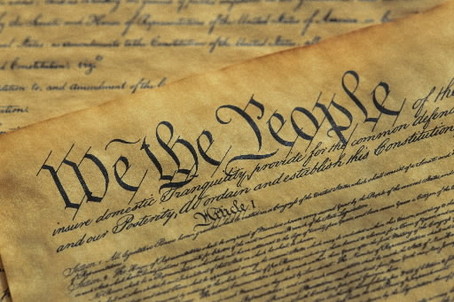
U.S. Constitution: Relevant only when it meets the needs of us "Real Americans"
I’m very curious to know what the GOP — or the tea partyers they’re presumably pandering to — think will happen when every piece of legislation requires “a statement from its sponsor outlining where in the Constitution Congress is empowered to enact such legislation.” What’s the evidence that this will make legislation more, rather than less, constitutional, for whatever your definition of the Constitution is?
Let’s take an example: Most legislation doesn’t currently include a statement of constitutional authority. But there’s one recent measure that did: Section 1501 of the Patient Protection and Affordable Care Act. That is to say, the individual mandate.
“The individual responsibility requirement provided for in this section (in this subsection referred to as the requirement) is commercial and economic in nature, and substantially affects interstate commerce,” reads the opening paragraph. Shortly thereafter, the legislation makes itself more explicit: “In United States v. South-Eastern Underwriters Association (322 U.S. 533 (1944)), the Supreme Court of the United States ruled that insurance is interstate commerce subject to Federal regulation.”
Has that statement convinced the GOP that the individual mandate is constitutional? Of course not. Currently, two judges have ruled in favor of the provision and one judge has ruled against. The split has been clean across partisan lines. The political verdicts have been little different: Sen. Chuck Grassley went from co-sponsoring an individual mandate in June of 2009 when it was still an idea connected to Republicans to condemning it as unconstitutional a few months later when it was clear that President Obama owned it and no Republicans would be joining his health-care bill.
My friends on the right don’t like to hear this, but the Constitution is not a clear document. Written more than 200 years ago, when America had 13 states and very different problems, it rarely speaks directly to the questions we ask it. The Second Amendment, for instance, says nothing about keeping a gun in the home if you’ve not signed up with a “well-regulated militia,” but interpreting the Second Amendment broadly has been important to those who want to bear arms. And so they’ve done it.
That’s their right, of course. Liberals pick and choose their moments of textual fidelity as well. But as the seemingly endless series of 5-4 splits on the Supreme Court shows, even the country’s most experienced and decorated constitutional authorities routinely disagree, and sharply, over what the text means when applied to today’s problems. To presume that people writing what they think the Constitution means — or, in some cases, want to think it means — at the bottom of every bill will change how they legislate doesn’t demonstrate a reverence for the document. It demonstrates a disengagement with it as anything more than a symbol of what you and your ideological allies believe.
In reality, the tea party — like most everyone else — is less interested in living by the Constitution than in deciding what it means to live by the Constitution. When the constitutional disclaimers at the bottom of bills suit them, they’ll respect them. When they don’t — as we’ve seen in the case of the individual mandate — they won’t.
By: Ezra Klein-Washington Post, 12/30/10: Photo credit: Todd Gipstein/National Geographic/Getty Images
PolitiFact’s Lie of the Year: ‘A government takeover of health care’
In the spring of 2009, a Republican strategist settled on a brilliant and powerful attack line for President Barack Obama’s ambitious plan to overhaul America’s health insurance system. Frank Luntz, a consultant famous for his phraseology, urged GOP leaders to call it a “government takeover.”
“Takeovers are like coups,” Luntz wrote in a 28-page memo. “They both lead to dictators and a loss of freedom.”
The line stuck. By the time the health care bill was headed toward passage in early 2010, Obama and congressional Democrats had sanded down their program, dropping the “public option” concept that was derided as too much government intrusion. The law passed in March, with new regulations, but no government-run plan.
But as Republicans smelled serious opportunity in the midterm elections, they didn’t let facts get in the way of a great punchline. And few in the press challenged their frequent assertion that under Obama, the government was going to take over the health care industry.
PolitiFact editors and reporters have chosen “government takeover of health care” as the 2010 Lie of the Year. Uttered by dozens of politicians and pundits, it played an important role in shaping public opinion about the health care plan and was a significant factor in the Democrats’ shellacking in the November elections.
Readers of PolitiFact, the St. Petersburg Times‘ independent fact-checking website, also chose it as the year’s most significant falsehood by an overwhelming margin. (Their second-place choice was Rep. Michele Bachmann’s claim that Obama was going to spend $200 million a day on a trip to India, a falsity that still sprouts.)
By selecting “government takeover’ as Lie of the Year, PolitiFact is not making a judgment on whether the health care law is good policy.
The phrase is simply not true.
Said Jonathan Oberlander, a professor of health policy at the University of North Carolina-Chapel Hill: “The label ‘government takeover” has no basis in reality, but instead reflects a political dynamic where conservatives label any increase in government authority in health care as a ‘takeover.’ ”
An inaccurate claim
“Government takeover” conjures a European approach where the government owns the hospitals and the doctors are public employees. But the law Congress passed, parts of which have already gone into effect, relies largely on the free market:
• Employers will continue to provide health insurance to the majority of Americans through private insurance companies.
• Contrary to the claim, more people will get private health coverage. The law sets up “exchanges” where private insurers will compete to provide coverage to people who don’t have it.
• The government will not seize control of hospitals or nationalize doctors.
• The law does not include the public option, a government-run insurance plan that would have competed with private insurers.
• The law gives tax credits to people who have difficulty affording insurance, so they can buy their coverage from private providers on the exchange. But here too, the approach relies on a free market with regulations, not socialized medicine.
PolitiFact reporters have studied the 906-page bill and interviewed independent health care experts. We have concluded it is inaccurate to call the plan a government takeover because it relies largely on the existing system of health coverage provided by employers.
It’s true that the law does significantly increase government regulation of health insurers. But it is, at its heart, a system that relies on private companies and the free market.
Republicans who maintain the Democratic plan is a government takeover say that characterization is justified because the plan increases federal regulation and will require Americans to buy health insurance.
But while those provisions are real, the majority of Americans will continue to get coverage from private insurers. And it will bring new business for the insurance industry: People who don”t currently have coverage will get it, for the most part, from private insurance companies.
Consider some analogies about strict government regulation. The Federal Aviation Administration imposes detailed rules on airlines. State laws require drivers to have car insurance. Regulators tell electric utilities what they can charge. Yet that heavy regulation is not described as a government takeover.
This year, PolitiFact analyzed five claims of a “government takeover of health care.” Three were rated Pants on Fire, two were rated False.
‘Can’t do it in four words’
Other news organizations have also said the claim is false.
Slate said “the proposed health care reform does not take over the system in any sense.’ In a New York Times economics blog, Princeton University professor Uwe Reinhardt, an expert in health care economics, said, “Yes, there would be a substantial government-mandated reorganization of this relatively small corner of the private health insurance market (that serves people who have been buying individual policies). But that hardly constitutes a government takeover of American health care.”
FactCheck.org, an independent fact-checking group run by the University of Pennsylvania, has debunked it several times, calling it one of the “whoppers” about health care and saying the reform plan is neither “government-run” nor a “government takeover.”
We asked incoming House Speaker John Boehner’s office why Republican leaders repeat the phrase when it has repeatedly been shown to be incorrect. Michael Steel, Boehner’s spokesman, replied, “We believe that the job-killing ObamaCare law will result in a government takeover of health care. That’s why we have pledged to repeal it, and replace it with common-sense reforms that actually lower costs.”
Analysts say health care reform is such a complicated topic that it often cannot be summarized in snappy talking points.
“If you’re going to tell the truth about something as complicated as health care and health care reform, you probably need at least four sentences,” said Maggie Mahar, author of Money-Driven Medicine: The Real Reason Health Care Costs So Much. “You can”t do it in four words.”
Mahar said the GOP simplification distorted the truth about the plan. “Doctors will not be working for the government. Hospitals will not be owned by the government,” she said. “That’s what a government takeover of health care would mean, and that’s not at all what we”re doing.”
How the line was used
If you followed the health care debate or the midterm election – even casually – it’s likely you heard “government takeover” many times.
PolitiFact sought to count how often the phrase was used in 2010 but found an accurate tally was unfeasible because it had been repeated so frequently in so many places. It was used hundreds of times during the debate over the bill and then revived during the fall campaign. A few numbers:
• The phrase appears more than 90 times on Boehner’s website, GOPLeader.gov.
• It was mentioned eight times in the 48-page Republican campaign platform “A Pledge to America” as part of their plan to “repeal and replace the government takeover of health care.”
• The Republican National Committee’s website mentions a government takeover of health care more than 200 times.
Conservative groups and tea party organizations joined the chorus. It was used by FreedomWorks, the Heritage Foundation and the Cato Institute.
The phrase proliferated in the media even after Democrats dropped the public option. In 2010 alone, “government takeover” was mentioned 28 times in the Washington Post, 77 times in Politico and 79 times on CNN. A review of TV transcripts showed “government takeover” was primarily used as a catchy sound bite, not for discussions of policy details.
In most transcripts we examined, Republican leaders used the phrase without being challenged by interviewers. For example, during Boehner’s Jan. 31 appearance on Meet the Press, Boehner said it five times. But not once was he challenged about it.
In rare cases when the point was questioned, the GOP leader would recite various regulations found in the bill and insist that they constituted a takeover. But such followups were rare.
An effective phrase
Politicians and officials in the health care industry have been warning about a “government takeover” for decades.
The phrase became widely used in the early 1990s when President Bill Clinton was trying to pass health care legislation. Then, as today, Democrats tried to debunk the popular Republican refrain.
When Obama proposed his health plan in the spring of 2009, Luntz, a Republican strategist famous for his research on effective phrases, met with focus groups to determine which messages would work best for the Republicans. He did not respond to calls and e-mails from PolitiFact asking him to discuss the phrase.
The 28-page memo he wrote after those sessions, “The Language of Healthcare 2009,” provides a rare glimpse into the art of finding words and phrases that strike a responsive chord with voters.
The memo begins with “The 10 Rules for Stopping the ‘Washington Takeover’ of Healthcare.” Rule No. 4 says people “are deathly afraid that a government takeover will lower their quality of care – so they are extremely receptive to the anti-Washington approach. It’s not an economic issue. It’s a bureaucratic issue.”
The memo is about salesmanship, not substance. It doesn’t address whether the lines are accurate. It just says they are effective and that Republicans should use them. Indeed, facing a Democratic plan that actually relied on the free market to try to bring down costs, Luntz recommended sidestepping that inconvenient fact:
“The arguments against the Democrats’ healthcare plan must center around politicians, bureaucrats and Washington … not the free market, tax incentives or competition.”
Democrats tried to combat the barrage of charges about a government takeover. The White House and House Speaker Nancy Pelosi repeatedly put out statements, but they were drowned out by a disciplined GOP that used the phrase over and over.
Democrats could never agree on their own phrases and were all over the map in their responses, said Howard Dean, former head of the Democratic National Committee.
“It was uncoordinated. Everyone had their own idea,” Dean said in an interview with PolitiFact.
“The Democrats are atrocious at messaging,” he said. “They’ve gotten worse since I left, not better. It’s just appalling. First of all, you don”t play defense when you”re doing messaging, you play offense. The Republicans have learned this well.”
Dean grudgingly admires the Republican wordsmith. “Frank Luntz has it right, he just works for the wrong side. You give very simple catch phrases that encapsulate the philosophy of the bill.”
A responsive chord
By March of this year, when Obama signed the bill into law, 53 percent of respondents in a Bloomberg poll said they agreed that “the current proposal to overhaul health care amounts to a government takeover.”
Exit polls showed the economy was the top issue for voters in the November election, but analysts said the drumbeat about the “government takeover” during the campaign helped cement the advantage for the Republicans.
Rep. Earl Blumenauer, an Oregon Democrat whose provision for Medicare end-of-life care was distorted into the charge of “death panels” (last year’s Lie of the Year), said the Republicans’ success with the phrase was a matter of repetition.
“There was a uniformity of Republican messaging that was disconnected from facts,” Blumenauer said. “The sheer discipline . . . was breathtaking.”
By: Bill Adair, Angie Drobnic Holan, PolitiFact-December 16th, 2010
Charles Krauthammer Is the Fraud
Charles Krauthammer says that Obama has conned Republicans into agreeing to a second stimulus even bigger than the first. Democrats are too stupid to see this (and Republicans are even more stupid, presumably, since they are the victims).
Barack Obama won the great tax-cut showdown of 2010 – and House Democrats don’t have a clue that he did. In the deal struck this week, the president negotiated the biggest stimulus in American history, larger than his $814 billion 2009 stimulus package. It will pump a trillion borrowed Chinese dollars into the U.S. economy over the next two years – which just happen to be the two years of the run-up to the next presidential election. This is a defeat?
He’s right about the Democrats’ stupidity, but this is not Krauthammer at his most lucid.
Yes, Democrats are fools to tear their hair out over this deal, which gives them most of what they wanted: the middle-class tax rates, unemployment benefit extension, payroll-tax cut, and so on. They compound the idiocy by advertising higher taxes on the rich as their core objective. Forget relieving poverty, widening access to health care, improving opportunities for the disadvantaged. What matters more than any of that is sticking it to “millionaires and billionaires” (two-earner households making more than $250,000). You bet, the Democrats are acting like fools.But this stimulus is not bigger than the first, not even close. Two-thirds of its “cost” is keeping tax rates where they currently are. There is no new stimulus in failing to put taxes up–in forgoing a drastic fiscal tightening that nobody wanted and nobody expected. Unlike Krauthammer, I think further short-term stimulus makes sense, so I welcome the $300 billion (over two years) or so of extra stimulus in the deal. Oppose this if you like, but please don’t call it a bigger stimulus than the first.
In any event, the key question is this: does Krauthammer oppose the deal? Having declared Obama guilty of a massive swindle, and recalling that he is opposed to all of Obama’s sinister purposes, Krauthammer is obliged by his own logic to say what a bad thing the agreement must be. So what exactly did he want to happen? Presumably, raise everybody’s taxes next month, with an especially steep rise for $250,000+ households. Has he previously advocated this policy? Maybe he has, and I missed it; if so, I apologize. But if he agrees it makes sense for now to keep taxes where they are, which has been the Republicans’ defensible position, what is so bad about what just happened? Krauthammer is left opposing it because Obama was in favour. It is not every day that Krauthammer is backed into an absurd and dishonest position by his own logic.
What about the long-term deficit? This deal, if temporary, has little effect on that either way, and could easily be deficit-reducing if it avoids a second dip (as Krauthammer seems to concede it might). Obviously, the long-term deficit remains a huge concern. Tackling that requires prolonged Bowles-Simpson-type efforts that were not on the agenda for this deal. They should have been, but they weren’t. Was that a reason for rejecting the deal and letting taxes rise next month? I think not. Again, if that is the outcome Krauthammer wanted, then all right. But if that is not his position, then he is the fraud.
Read David Brooks instead.
BY: Clive Crook, Senior Editor of The Atlantic-December 11, 2010
Obama’s Silent Majority
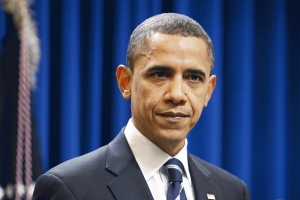
Preident Barack Obama

Preident Barack Obama
You’d never know it from cable news, but the average liberal Democrat actually likes the job the president is doing
Everyone knows that progressives have been growing increasingly disillusioned with Barack Obama since, well … even before he took office. He’s compromised too much, fought too little, sold out on one big issue after another, and fallen horribly, tragically short of the transformational goals that defined his 2008 campaign.
And now that he’s gone and cut a deal with Mitch McConnell (of all people!) to keep the Bush tax cuts in place for the wealthiest Americans for the next two years (at least), the left’s anger is louder than ever. No wonder Time’s Mark Halperin says the president’s base is “shattered.” And no wonder the media is filled with speculation about a potential challenge to the president in the 2012 Democratic primaries. Really, has there ever been a president who’s succeeded so thoroughly in taking the very people who put him in office and turning them against him?
It’s a fun topic for cable news and the blogosphere, where liberal commentators and activists routinely brand the president a Judas and threaten to support a primary challenger in 2012. And it’s a fun topic in the “mainstream media,” which takes all of this racket as confirmation that Obama is rapidly losing — or has already lost — his base.
There’s just one problem: The premise on which all of this is based is totally and completely wrong. Liberal commentators and activists and interest group leaders may be seething over Obama, but their rage has not trickled down to the Democratic voters (and, in particular, the Democratic voters who identify themselves as liberals), even though they’ve been venting their grief for the better part of two years.
As I noted earlier this week, Obama’s approval rating among Democrats has held steady at or near the 80 percent level throughout all of the turmoil of 2010. This puts him in as strong a position with his own party’s voters as any modern president has been at this same point in his presidency (with the exception of George W. Bush, whose numbers remained unusually high for well over a year after 9/11). Look closer and you’ll also find that Obama’s approval rating among Democrats is actually highest among those who call themselves liberals — an 83 percent score in the most recent round of Gallup polling, completed a few days ago. Among moderate Democrats, he clocks in at 75 percent, and among conservative Democrats, 69 percent. Again, these numbers have more or less held steady all year. To the extent Obama has a serious problem with Democrats, then, it’s with those who are on the right, not the left. This is hardly what you’d expect for a president who, according to the dominant narrative, has spent his presidency poking a stick in the left’s eye by cutting deals with conservative Democrats and Republicans.
Obama, in other words, seems to have developed his own silent majority. Rank-and-file liberal Democrats may not agree with everything he has done, but they do not share the sense of abandonment and betrayal that has defined liberal commentary throughout so much of his presidency. The party’s liberal base still very much likes him; it’s the elites who have turned on him.
The biggest reason for this disconnect, I would suggest, is that the liberal Democratic base liked Obama, both personally and ideologically, from the very beginning. Virtually from the moment he electrified the 2004 Democratic convention, liberals latched on to him as one of their own — and they haven’t (and don’t want to) let go.
This is not an unheard of phenomenon in politics, and it’s one of the reasons I’ve been so keen on comparing Obama’s political appeal to that of Ronald Reagan. Rank-and-file conservatives felt as strongly about Reagan in the 1980 campaign (and in 1976, for that matter) as liberals did about Obama in 2008. And they stayed true to him even when conservative elites concluded two years into his term that Reagan was a sellout.
Indeed, in the wake of this week’s drama over the Bush tax cuts, it’s worth recalling a similar moment in Reagan’s presidency, when congressional Democrats forced him into a tax hike in the summer of 1982. Like Obama now, Reagan had no leverage: The economy was spiraling out of control, voters were abandoning him, and Democrats were having great success (or seeming to have great success) hammering him over the exploding deficit. Thus did Reagan agree to a tax hike package that increased revenues by nearly $100 billion over the next three years — the largest tax increase in history, right-wing activists and commentators screamed. To these conservative elites, it was simply the latest act of betrayal by their one-time hero. When the GOP was drubbed in that fall’s midterms, they claimed vindication (see — not conservative enough!) and talked openly of challenging Reagan in the 1984 primaries. But rank-and-file conservative voters didn’t listen. They still liked the Gipper, still thought he was one of them, and still backed him in polling. It’s the same story today for Obama with rank-and-file liberals.
If Obama had been introduced to the Democratic base differently — that is, if they’d been suspicious and resistant to him and he’d landed in the presidency in spite of their skepticism — the objections of liberal elites might be far more damaging.
Here a parallel can be drawn to George H.W. Bush, who was introduced to the GOP’s “New Right” base in 1980 as the moderate, Gerald Ford-ish establishment Republican running against Reagan. Thus, the New Right, which essentially took control of the GOP for good with Reagan’s ’80 triumph, never really trusted Bush. Eight years of loyal service as Reagan’s V.P. was enough to win Bush the right’s benefit of the doubt in 1988, but when he “caved” as president — as he did on the S&L bailout, the 1990 tax hike, and a host of other issues — it merely brought back to the surface all of the right’s old attitudes toward him. So when the triumph of the Gulf War faded in 1991, there was room for Pat Buchanan to run to Bush’s right in the 1992 primaries. Buchanan didn’t win any states, but he did secure enough support — especially in New Hampshire — to severely embarrass the president. Obama’s history with liberals, though, is much different from Bush’s history with conservatives.
This isn’t to say that it’s impossible for Obama to lose the Democratic base; it’s just that there’s a lot more goodwill toward him among that base — and a lot more willingness to rationalize his “betrayals” as sensible pragmatism in the face of the other party’s obstructionism — than most people recognize.
At his press conference Tuesday, Obama noted that many of the “purist” liberals now blasting his tax cut deal also savaged his final healthcare compromise earlier this year, which wiped out the public option. It’s an apt comparison. And it’s worth remembering that the cries of betrayal back then did nothing to lessen rank-and-file’s assessment of Obama’s job performance — probably because the main thing they saw was that Obama, unlike every president before him, had actually gotten healthcare done.
By Steve Kornacki-Salon: Wednesday, Dec 8, 2010
Share This Blog


 Unknown Feed
- An error has occurred; the feed is probably down. Try again later.
 mykeystrokes.com

You must be logged in to post a comment.