“By The People, For The People”: Proof Obamacare Puts Control Of Healthcare In The Hands Of The Consumer
One of the key talking points consistently mouthed by opponents of the Affordable Care Act is their declaration that the law wrests control of healthcare out from the hands of the consumer and places it squarely under the control of the federal government.
And yet, the meme—like so many others employed by dedicated Obamacare bashers— is simply not true.
Now, we can prove it.
You have likely never heard about the section of the ACA that provides federal loans to help launch consumer owned and controlled health insurance plans. The money is available for insurance plans showing a reasonable chance for success, are owned by the membership (people like you and I) and operated by a board of directors where members comprise the majority -not passive investors looking to make a buck.
It is health insurance by the people and for the people.
Tufts Medical Center in Massachusetts—along with their physician group and a company which owns and operates two hospitals in the region—has acted on this provision of the law and received $88.5 million in federal funds to create the state’s first member owned and controlled health insurance plan. While the program is being put together by a panel of experts, once the insurance plan is qualified to do business by the state’s insurance regulators, they will begin signing up individuals and small businesses who will not only become the owners of the plan, they will ultimately end up running the company.
How’s that for putting control of our healthcare back into the hands of the consumer?
The not-for-profit plan entitled the Minuteman Health Initiative—which expects to offer health insurance coverage in Eastern and Central Massachusetts beginning in 2014—is looking to bring down the cost of premiums to its members by streamlining the billing process and allowing providers to work directly with employers.
According to Dr. Jeff Lasker, chief executive of the Tufts physician group, New England Quality Care Alliance, “Imagine working closely with an employer who can help us gather data and, with employees’ permission, to be able to share that data with their primary care providers. “
Imagine, indeed.
Physicians, hospitals and consumers working alongside one another to design coverage options that better meet the needs of all the participants in the healthcare equation in the effort to bring about a better result for everyone—and done in an environment where the consumer is in control of the board of directors rather than profit driven executives whose bonuses are determined by how much money is left in the till at the end of the quarter.
Can there be anyone who does not see the great potential in this concept?
We are a nation where our health care is, for most of our citizens, controlled by private insurance companies—not the United States government. If you don’t believe that, just ask your physician what he or she must go through to get an insurance company to approve a treatment or procedure you need and how you end up paying for all this time your doctor invests in fighting for your care.
Will the Minuteman Health Initiative work? Will it accomplish the goal of lowering costs and providing appropriate benefits to consumers while allowing for a workable compensation structure to health care providers—all under the direction of the very people who depend on the plan for their health care needs?
We’ll see.
But if you don’t try something, you never find better solutions. And should the Minuteman plan work out, we can expect to see similar programs launched in every state in the union—insurance plans designed to work for both provider and beneficiary and all under the control of the people who actually pay the premiums and depend upon the benefits for the security of their families.
I don’t care how much you think you detest Obamacare. If you aren’t rooting for success in the case of the Minuteman Health Initiative—and the law that made it possible—you simply are not paying attention.
By: Rick Ungar, Contributor, Forbes, September 1, 2012
What Steve Jobs’s Legacy Says About Innovation
In the wake of Apple Computer cofounder Steve Jobs’s death, it’s become almost a truism that he provided consumers what they needed before they even knew they needed it.
I think it’s true not only in the case of the revolutionary products that Jobs marshaled into existence, but of many, many consumer goods that seemed exotic or pointless at first, and then became ubiquitous.
It’s the nature of innovation, the “novus.” The New Thing.
There’s an important moral dimension to it, too, I think—this idea of “needing” consumer goods. Pro-innovation people—the vast majority of us—love new things. We love things that make our lives simpler, easier, more enriching, or just more fun.
Take the vacuum cleaner.
I remember well a lefty history professor in college, lecturing in a disdainful deterministic tone about the vacuum cleaner. Did it make housewives’ lives easier—or did it impel them to remove household dust that had previously been a nonissue?
On the one hand, Christine Rosen’s 2006 essay in The New Atlantis, “Are We Worthy Our Kitchens?”, was a definitive takedown of such thinking. There have been real gains in human welfare due to industrial-era electronic technology:
Despite its humble status … the electric washing machine represents one of the more dramatic triumphs of technological ingenuity over physical labor. Before its invention in the twentieth century, women spent a full day or more every week performing the backbreaking task of laundering clothes. Hauling water (and the fuel to heat it), scrubbing, rinsing, wringing—one nineteenth-century American woman called laundry “the Herculean task which women all dread.” No one who had the choice would relinquish her washing machine and do laundry the old-fashioned way.
Then again, even with all of our fancy time-saving gadgets, has family/domestic really improved? She continues:
Judging by how Americans spend their money—on shelter magazines and kitchen gadgets and home furnishings—domesticity appears in robust health. Judging by the way Americans actually live, however, domesticity is in precipitous decline. Families sit together for meals much less often than they once did, and many homes exist in a state of near-chaos as working parents try to balance child-rearing, chores, long commutes, and work responsibilities. As Cheryl Mendelson, author of a recent book on housekeeping, observes, “Comfort and engagement at home have diminished to the point that even simple cleanliness and decent meals—let alone any deeper satisfactions—are no longer taken for granted in many middle-class homes.” Better domestic technologies have surely not produced a new age of domestic bliss.
True, no?
And who can deny the moral, or at least McLuhan-esque, dimension of “gadget love”?
There’s no simple answer to these questions—and I ponder them anew every time I interact with an Apple product. (Like right now, as I type.)
I’m far from a Mac nerd, but I am, in my own way, a heavy user. My iPod battery has been broken for months, and I haven’t gotten around to replacing it. Lately, the idea of driving without ready access to my entire music library—something that would have been unthinkable for most of my lifetime—is a continual annoyance.
And when I first bought that iPod, I found myself mired in a sort of technological obsessive-compulsive disorder:
With 1,000-plus CDs that I’d ideally like to upload—because you can’t let all those free gigabytes starve, not with so many of the world’s poor children starving for gigabytes—the process of ripping, in short order, became an object of dread and crippling self-doubt. Unripped CDs now taunt me in their unripped-ness. I can almost hear them, in their half-broken jewel cases and water-stained leaflets, in their state of 20th-century plastic inertness, laugh at me.
I’ve also found the aesthetic, near-cultic magnetism of Apple products a little creepy, too:
When I read stories about iPod users rhapsodizing about how their iPods are profound reflections of their personalities; how their iPod shuffle mechanism has the seemingly mystical ability to randomly spit out the right song for the right moment; how life screeches to a halt when their iPod suffers a technical glitch [um, yes — S.G.]—when I read these stories I think of Mr. McLuhan’s chapter on “gadget lovers.”
Riffing on the Greek myth of Narcissus, Mr. McLuhan wrote that technology gadgets were like narcotic extensions of the self; we worship them as idols and thus become a self-enclosed system.
Sound familiar?
“Servomechanism” was the term of art that Mr. McLuhan employed: a device that controls something from a distance.
He said of gadget love: “We must, to use them at all, serve these objects, these extensions of ourselves, as gods or minor religions. An Indian is the servomechanism of his canoe, as the cowboy of his horse or the executive of his clock.”
When you think of mere gadgets in such terms, it’s no wonder there’s been such an outpouring of grief over the loss of Steve Jobs.
But who among us is willing to pull a modern-day Thoreau and wall ourselves off from innovation?
It’s part of the human condition, I suppose.
By: Scott Galupo, U. S. News and World Report, October 6, 2011
Toilets, Light Bulbs and Reproductive Rights: Rand Paul Is Pro-Choice For Toilets
The senator gives a stunning rant against energy efficiency — and reproductive choice
Ladies and gentlemen, this is what we are up against. In a diatribe as bizarre and petulant as anything out of Charlie Sheen’s or any recent star of “The Bachelor’s” mouth, Kentucky Sen. Rand Paul went on a tear Thursday about how abortion is somehow interfering with his God-given right to incandescent light bulbs. Clearly, there wasn’t one illuminating over his head when he started down the crazy path.
On Friday, Irin Carmon at Jezebel beautifully drilled down the essence of the rant — that “Rand Paul Thinks His Toilet Is More Important Than Your Abortion Rights.” In a mind-boggling display of foot stamping during an energy hearing, Paul asked deputy assistant energy secretary for efficiency Kathleen Hogan if she was “pro-choice,” leading the visibly puzzled Hogan to reply she’s pro-choice on light bulbs. Rand then launched into full cri de coeur mode, comparing the choice of abortion to being “anti-choice on every other consumer item, including light bulbs, refrigerators, toilets. You can’t go around your house without being told what to buy. You restrict my purchases. You don’t care about my choices.” Boo hoo hoooooo!
Who knew that reproductive choice was a consumer purchase? Who knew you could run out to Best Buy and pick up one of them late-term abortion thingies with an Energy Star rating? Paul then went on to overshare that “My toilets don’t work in my house. And I blame you and people like you.” We get it — Rand Paul has a fiber diet and a low flush toilet. “I can’t find a toilet that works!” he blurted angrily again later. So if you’re a pregnant teenage rape victim, maybe you should start thinking about how Rand Paul is suffering to get a little perspective.
Much of Paul’s speech doesn’t even make sense: If he’s so ticked about some perceived limitation of his “choice,” why does his Web page insist “I believe in a Human Life Amendment and a Life at Conception Act as federal solutions to the abortion issue.” You don’t like government regulation? The government regulates abortion. Where’s your free market now, Paul?
The whole piece is a truly remarkable piece of irony-rich rantitude, sure to be included in the next volume of Now That’s What I Call False Equivalencies and White Male Solipism! Paul said he finds it “troubling, this busybody nature that you want to come into my house — my bedroom, my bathroom …” But a woman’s womb, hey, that’s up for grabs.
Yet when he kvetched to Hogan that “I find it insulting … appalling and hypocritical,” it was clear the parallels to how he feels and the sentiments of many of us on the side of reproductive freedom are stunningly similar. Just because Rand Paul has problems with his plumbing, it’s astonishing that he believes he has the right to meddle in ours. But when he declared, “You busybodies are always trying to tell us how we can live our lives better — keep it to yourselves,” I had to admit, Rand Paul, you dismissive, whiny jerk, that I could not agree more.
By: Mary Elizabeth Williams, Salon, March 11, 2011
Size Matters: The GOP & Health Care
During the health care debate in 2009 and 2010, a serious issue emerged — the number of pages in congressional bills. I’m not kidding. The Republicans wanted short bills, and the health care reform bill was way, way too long (proving that it did too much and would end civilization as we know it). There was outrage across the country. Angry opponents of reform went to congressional town hall meetings brandishing huge stacks of paper. Then Minority Leader Boehner, foreshadowing his leadership priorities today, used a nationally televised address to condemn the length of the health care bill three times in as many minutes.
The extremists went wild. Rumors swept across the land. Some Tea Party types claimed the bill was 10,000 pages. Slate called the explosive stack-of-paper obsession “peculiar.” Ultimately, the New York Times set the record straight: “In the original version,” the Times said, “H.R. 3590 as passed by the Senate on Dec. 24, 2009, ran to some 2,400 pages, although with a very large font, triple spacing and huge left and right margins.” The newspaper went on to explain that, “With normal margins the document probably would shrink to about 500 pages or so.” Which meant the bill was not really that long when compared to other major bills, such as the financial reform law and past budget deals.
In the November mid-term elections, the Republicans ran on a platform of change, and change is what we got. Not only will the House Republicans vote to repeal the new health care law this week, they’re going to do so with a bill that’s only two pages long.
This is a triumph of conciseness, a 247-word beacon of brevity. The low word-count works especially well for the GOP, given the party’s unfinished “repeal and replace” campaign pledge. The Republicans addressed repeal, but they haven’t quite gotten to the “replace” part. That, we’re told, is a work in progress, and the question is being referred to various House committees to kick around for months.
In Sunday’s Washington Post, reporter Amy Goldstein noted that the Republican repeal vote is “the prelude to a two-pronged strategy that is likely to last throughout the year, or longer.” Great. Just what we need — another interminable debate on health care when the Republicans ought to be focusing on bipartisan solutions to create jobs. Rep. Fred Upton (R-Mich.), the new House Energy and Commerce Committee chairman, said it “may take time” for the GOP to develop a health care plan. Upton, who has been in Congress since 1987, has had only 24 years to come up with some health care ideas of his own. Instead, he hired Julie Goon, the former top lobbyist for the health insurance industry’s biggest trade group, as his special adviser.
I’m not sure what the Republican “replace” plan is (or how many pages it will be), but I know their two-page repeal bill is a bad deal for America’s families, seniors and small businesses.
The Republican repeal bill will take away dozens of benefits and important consumer protections that are making a real difference in peoples’ lives right now. When the Republicans vote for repeal, they’ll be taking away people’s newly won freedom from fear of insurers denying their care, dropping them when their sick and imposing double-digit premium hikes with impunity. They’ll be booting young adults off their parents’ health plans. They’ll be telling seniors they have to pay back the $250 donut hole checks they received to help buy prescription medications and give up their new 50% discount on brand-name drugs. The Republican repeal plan will force nearly 900,000 American families a year into bankruptcy because of huge medical bills. And it will take job-creating tax credits away from small businesses.
Speaker John Boehner and the Republicans don’t want the public to know the truth about the Affordable Care Act and what their repeal plan will take away from America’s consumers. And you can bet the debate about repeal will be filled with misleading information from Boehner and the new Republican majority. To help folks see beyond the rhetoric, Health Care for America Now made a chart that tells the truth. You can read and download a printable, high-resolution version with citations here and below.
The Republican Repeal Bill puts insurance companies back in charge of your health care.
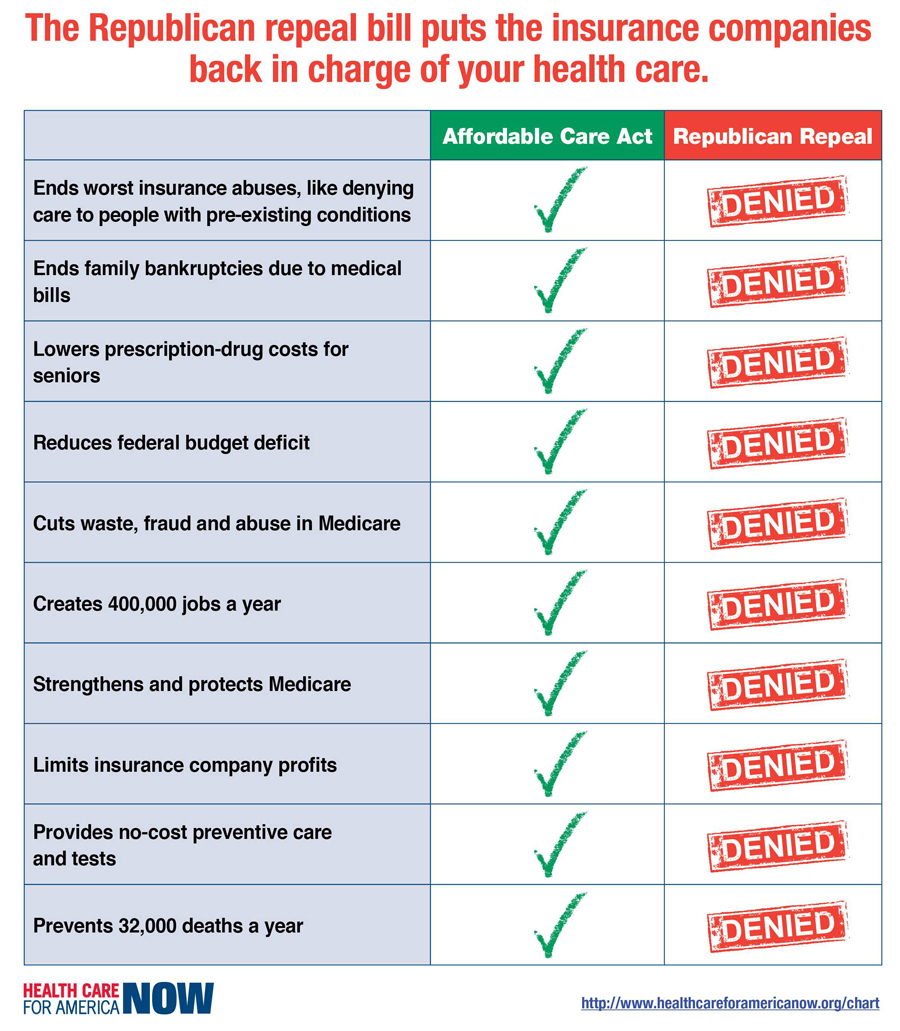
The Republican Repeal Bill
Share This Blog


 Unknown Feed
- An error has occurred; the feed is probably down. Try again later.
 mykeystrokes.com
You must be logged in to post a comment.