“The Big Problem With Paul Ryan’s New Poverty Plan”: Accountability Is Only Required Of Poor People
Today, Rep. Paul Ryan is unveiling his latest idea to change the federal government’s poverty programs. For someone who is constantly saying how concerned he is about poverty, Ryan’s previous budgets have relied an awful lot on slashing benefits to poor people. But this time, he promises that his proposal doesn’t cut benefits, but merely reorganizes them. Some parts of the proposal might be worthwhile. But it’s hard to avoid the conclusion that it’s still driven by the longstanding conservative desire to limit the help we give to the poor.
The centerpiece of the proposal is a consolidation of multiple separate programs into a single block grant that would be given to states; they could decide how to dispense the money, and the federal government’s job would essentially be reduced to oversight. States would choose whether or not to participate.
This sounds reasonable until you start to think about how it would play out. In practice, it’s likely that the states most eager to sign on would be precisely those that aren’t too happy about the ways the federal government provides benefits now. The devil would be in the details; what if a state decided to take its entire block grant and devote it to giving lectures to poor people on why they should get married? There could be a lot of needs going unmet while states implement their ideologically-driven visions of how poverty ought to be addressed.
Ryan’s plan assumes that the same Republican states that rejected the federal government’s offer to insure poor citizens through the expansion of Medicaid — in other words, who would rather see poor people go uninsured than get coverage from the government — are now going to be spectacularly committed and creative in working to help those same poor citizens through their time of need. Color me skeptical.
Ryan insists his plan would hold funding for these programs constant, not cut them. But it’s more complicated than that. Conservatives have long advocated block-granting of poverty programs, always with the justification that states will better deliver assistance to poor Americans if they aren’t hamstrung by requirements from Washington. But there’s little evidence that block granting accomplishes anything other than making it easier for these programs to be cut in future years or simply whittled away by inflation. As Jared Bernstein points out, Temporary Assistance to Needy Families, which we used to call “welfare,” was block-granted in 1996 and has since then seen its value slashed by 30 percent in inflation-adjusted terms.
One of the real dangers of Ryan’s approach is that it would render the programs unable to deal with economic downturns unless Congress stepped in and supplied more money, which would be unlikely as long as Republicans control at least one house. So for instance, right now the food stamp program is an entitlement; if you meet eligibility standards you’re entitled to food stamps. The program can never run out of money in a given year. When the Great Recession hit, millions of Americans found themselves newly out of work and thus eligible for food stamps.
But under Ryan’s program, food stamps would be part of a block grant whose total amount is fixed. If and when another recession hit, states would be flooded with people who needed assistance, but they’d have the same limited sum of money they got at the beginning of the year. So they’d either have to turn people away or find a way to rob Peter to pay Paul, taking money out of other poverty programs to meet the increased need for food.
(There’s a brief discussion of inserting a provision into the plan to account for this kind of eventuality, but it seems neither particularly well thought-out nor nearly adequate to address what could be a major need.)
Ryan’s plan would also require “accountability” from those receiving assistance, in the form of time-limited benefits and work requirements (how you satisfy those requirements when people can’t find work is its own sad story). This too is a hallmark of the Republican approach to poverty programs, in which poor people have to jump through hoops to demonstrate their moral worth to get benefits. “Accountability” is something that is required of poor people, and only poor people. Farmers who get government subsidies don’t have to be “accountable.” Nor do government contractors who waste huge amounts of taxpayer money. Only the poor are forced to pee in a cup or account for their time or endure a hundred other petty humiliations, so we can be sure that if they get any government assistance they have proven themselves to be morally upstanding enough to deserve help.
That isn’t to say there’s nothing worthwhile in Ryan’s proposal. As he writes in a USA Today op-ed, “Right now, you have to go to a bunch of different offices to enroll in a bunch of different programs, often with different paperwork requirements and eligibility standards. Under the Opportunity Grant, you could go to one office and work with one person.” As anyone who has tried to apply for assistance knows, the paperwork requirements seem designed to hold down enrollment by making it as difficult as possible to apply. Streamlining that process would be terrific.
While this plan isn’t going to become law (at least not any time soon), it does serve a political purpose of showing that Republicans are thinking about poverty, and Ryan isn’t the only one in his party trying to revive “compassionate conservatism.” We can give him credit for addressing the issue. If only there was more reason to believe his ideas would do much to help Americans who are struggling.
By: Paul Waldman, Contributing Editor, The American Prospect; Published at The Plum Line, The Washington Post, July 24, 2014
“An Explosive Failure”: Brownback ‘Experiment’ Blows Up Laboratory Of Democracy
When Louis Brandeis wrote in 1932 that a “single courageous state may, if its citizens choose, serve as a laboratory; and try novel social and economic experiments without risk to the rest of the country,” he was suggesting that state innovations might advance reform on the federal level. The progressive Supreme Court justice surely wasn’t imagining anything quite like Brownbackistan.
Under Governor Sam Brownback, however, the old Brandeis metaphor is especially apt for Kansas, where a highly publicized “experiment” in extreme tax cutting has just blown up the entire laboratory. As Kansans peer through the still-smoking ruins, they evidently don’t much like what they see.
What makes the Brownback blowup feel so familiar is that the same experiment was mounted more than three decades ago, on the federal level, under the rubric of Reaganomics – by some of the same people. It crashed miserably then, too. But the Republican right has a special knack for dressing up old mischief as fresh policy. To put this one over, Brownback has enjoyed heavy support from the Koch brothers — chief financial backers of the ultra-right Tea Party — whose industrial empire is headquartered in Kansas.
The statewide tax cut that Brownback pushed through the legislature in 2012 certainly benefited the most wealthy Kansans – people just like the Kochs – while inflicting higher taxes on middle income and working-class families through sales and property tax increases. Proceeding with expert advice of Arthur Laffer, author of the “supply-side” theory underlying the Reagan tax cuts, the gung-ho governor promised that these regressive changes would promote rapid economic growth. He predicted that his plan would produce 23,000 new jobs and over $2 billion in new disposable income for Kansans. Their tax payments were supposed to offset the loss of nearly 8 percent of state revenues.
But the results have yet to justify the hype. Today, the fruits of Brownback’s experiment include a state budget deficit of nearly $340 million this year; a decision by Moody’s to lower the rating on Kansas bonds; a growing gap in education funding at every level, from kindergarten through college; a ruinous reduction in state and local workforces across the state; and a future that promises even larger deficits and service cutbacks to come.
Advocates of the Brownback cuts – who are much more likely to be found in New York and Washington think tanks than in Kansas itself – insist that with patience, the governor’s vindication will come. Noting that the tax cuts took effect less than two years ago, they say that with time will come the jobs and revenues that Kansans expected. But over the past several months, as most states have added jobs, their state has fallen behind.
The Kansas City Star, leading newspaper in the state, recently analyzed federal employment data compiled by the Bureau of Labor Statistics – and published an editorial comparing Kansas with other states in seasonally adjusted, non-farm total job growth. The bottom line was not encouraging. From January 2011 through June 30, 2014, job growth for Kansas at 3.5 percent was lower than its four neighbors, other Midwestern states, and even “extremely high income tax” New York, not to mention the national average of 6.1 percent. “Kansas has had one of the nation’s poorest rates of employment growth during Brownback’s time in office,” noted the Star editorial, “including since the first tax cuts took effect in 2013.” Moreover, the state actually had fewer jobs at the end of June than it did seven months ago.
As a creature of the Koch machine, Brownback naturally blames this embarrassing data on Barack Obama, the devilish socialist in Washington. But polls show that whatever Kansans may think of the president, they aren’t so easily bamboozled by such arguments anymore. Their opinion of the governor is declining almost as quickly as the state’s revenues — and in some polls he is trailing the lesser-known Democrat, Paul Davis, who bravely challenged him this year. Even some prominent Republicans recently declared they would rather elect Davis than continue the destruction that Brownback is inflicting on their state.
Nationally, the Republican Party still promotes Brownback as an innovator with expertise in growing the economy. The Koch brothers will deluge their home state in dark money and Tea Party propaganda before they let him fall. But if the voters boot him in November, this latest experiment in extremism will be ranked as an explosive failure.
By: Joe Conason, Editor-in-Chief, The National Memo, July 25, 2014
“How Did The GOP Turn Into Such A Bunch of Clowns?”: Lurching From One Strategic Screw Up To The Next
For a lot of reasons, the current era will probably be seen as unusually consequential in the history of the two parties, particularly the GOP. For Republicans, it has been a time of ideological hardening and bitter infighting. But one aspect of the Republican dilemma hasn’t gotten as much attention as those: This is a time of unusual, even stunning, Republican political incompetence.
Let me back up for a moment, to put what I’m saying in context. As the 2012 election approached, liberals began to understand just how deluded many conservatives were about empirical reality, and in ways that could do them serious political damage. It’s one thing to deny climate change (a denial that may benefit you and your allies), but if you convince yourself that you’re going to win when you’re actually going to lose, you’re hurting no one but yourself. When they began to rally around a guy claiming to “unskew” the 2012 presidential polls that showed Barack Obama heading for a victory, liberals had a great time ridiculing them. But then it turned out that even within the Romney campaign—including the candidate himself—people who were supposedly hard-nosed political professionals had convinced themselves that it was just impossible they could lose, whatever the polls said. As seen in an unforgettable bit of election-night television, Karl Rove, the party’s most celebrated strategist, refused to believe that Romney had lost even when Fox News called the race for Obama.
Once the race was over, there was some soul-searching within the GOP about their loss, but most of it concerned the party’s image as a bunch of unfeeling, out-of-touch white guys who couldn’t appeal to young voters and Hispanics. (Needless to say, this is a problem they’ve yet to solve,) There was some discussion about the conservative information bubble and the distorting effects it can have, but nothing changed—lots of conservatives still get their news from Fox and Rush Limbaugh, and assume that everything in the New York Times is a lie.
There seems to be little question that the alternative media universe they built, which was once a strength for the right, has become a liability. But their biggest problem now isn’t the things so many conservatives believe about the world that aren’t true, or what they think will happen that won’t. It’s about the strategic decisions they make, and where those decisions come from. Think about it this way: Has there been a single instance in the last few years when you said, “Wow, the Republicans really played that one brilliantly”?
In fact, before you’ll find evidence of the ruthless Republican skillfulness so many of us had come to accept as the norm in a previous era, you’ll need to go back an entire decade to the 2004 election. George W. Bush’s second term was a disaster, Republicans lost both houses of Congress in 2006, they lost the White House in 2008, they decided to oppose health-care reform with everything they had and lost, they lost the 2012 election—and around it all they worked as hard as they could to alienate the fastest growing minority group in the country and make themselves seem utterly unfit to govern.
In fact, in the last ten years they’ve only had one major victory, the 2010 midterm election. But that didn’t happen because of some brilliant GOP strategy, it was a confluence of circumstance; the natural tendency for the president’s party to lose significant numbers of seats two years after he’s elected, and the stagnant economy would have meant a big GOP victory no matter what they did.
Since then they’ve lurched from one strategic screw-up to the next, the root of which is almost always the same: It happens because they’re deluded into thinking that the country shares their particular collection of peeves and biases.
In fairness, this is a challenge for both parties and, indeed, for everyone involved in politics. When politics is your life, it’s hard, if not impossible, to think like an ordinary, inattentive voter thinks. When you’ve spent so much time convincing yourself that you’re right; the idea that anyone else who’s even remotely fair-minded wouldn’t agree can seem nothing short of absurd. It can be hard to persuade people when you can’t put yourself in their shoes.
But again and again, Republicans seem shocked to find out that Americans aren’t on the same page with them. They’re flummoxed when the public doesn’t rise up in outrage to demand more answers on Benghazi. They’re befuddled when shutting down the government turns into a political disaster. They’re gobsmacked when the electorate doesn’t reject Barack Obama for saying “you didn’t build that,” and even more amazed when he gets reelected. And in between, they can’t come up with any strategy to accomplish their goals, whether in policy or elections. Again and again, they think the American public is going to see things their way, and when the public doesn’t, they never seem to learn anything from it.
It isn’t always pure bumbling; there are times when the GOP follows an unwise strategic path not because of miscalculation, but because of unavoidable internal dynamics within the party. For instance, they’ve failed to pass comprehensive immigration reform not because party leaders don’t understand the political necessity of doing so, but because most members of the House come from conservative districts where comprehensive reform is unpopular, and therefore it makes sense for them to oppose it.
It would be too simple to put the GOP’s recent string of missteps and disasters down only to the struggle within the party, which yields a course ultimately determined by its radical wing. It is important that Tea Partiers, while being very good at figuring out how to make life miserable for the rest of their party, are abysmal when it comes to devising strategies for appealing to the country as a whole. But it’s equally relevant that the supposedly more pragmatic and experienced conservatives haven’t found a way to handle the snarling beast on their right flank and turn the whole ghastly mess into something that can fight Democrats with any modicum of success.
This shows no sign of changing. They’re going to win seats this November, but once again it won’t be because they came up with some brilliant strategy. If they win the Senate it will be because Democrats are defending more seats this year, many of which are in conservative states. (Two years from now when that situation is reversed, Democrats will almost certainly take back the Senate if they lose it this year.) Republicans will probably gain a few seats in the House, but don’t forget that in 2012, they retained their sizeable majority despite getting fewer votes nationwide than Democrats: Their advantage there is baked into the distribution of congressional districts.
And look at the people lining up to run for the White House in 2016. Does any one of them seem like the kind of brilliant politician who can navigate the deadly obstacle course of a two-year long presidential campaign and win over a majority of American voters, including millions who aren’t already on board with his party’s agenda? Who might that be? Ted Cruz? Rand Paul? Bobby Jindal? Rick Perry? Facing that collection of political samurai, Hillary Clinton must be positively terrified.
There are still plenty of smart Republicans out there. But the days when Republicans would run circles around Democrats, outdoing them in fundraising, messaging, organizing, and every other aspect of campaigning and politics, are a fading memory. The 2010 election may have blinded us to how long it’s really been since they set out to achieve a political goal and made it happen through their acumen and judgment. I’m sure that one day the GOP will get its strategic mojo back. But it could be a while.
By: Paul Waldman, Contributing Editor, The American Prospect, July 24, 2014
“More Unhinged Than Usual”: Ted Cruz Sees An Imaginary ‘Economic Boycott Of Israel’
Just last week, a civilian airliner was shot down over a war zone, killing all 298 people on board. On Tuesday, just five days after the tragedy in Ukraine, a rocket landed Tuesday within a mile of Ben Gurion International Airport in Tel Aviv, Israel.
In the interest of public safety and fearing a “potentially hazardous security situation,” the Federal Aviation Administration announced a temporary halt to U.S. flights into the Israeli capital. “Safety is the very first priority for DOT, for FAA,” Transportation Secretary Anthony Foxx said yesterday. The announcement coincided with suspended flights from Air France and Lufthansa, along with a warning from the European Aviation Safety Agency, which “strongly” recommended against flights into Tel Aviv.
Here in the U.S., many on the right responded to the news with the kind of maturity and restraint we’ve come to expect: “FAA Trutherism” was born. Sen. Ted Cruz (R-Texas), in a move that was brazen even for him, accused the Obama administration of launching an “economic boycott on Israel.”
“When Secretary Kerry arrived in Cairo this week his first act was to announce $47 million in additional aid to Gaza, which is in effect $47 million for Hamas. In short order, this travel ban was announced by the FAA. Aiding Hamas while simultaneously isolating Israel does two things. One, it helps our enemy. Two, it hurts our ally.
“Until these serious questions are answered, the facts suggest that President Obama has just used a federal regulatory agency to launch an economic boycott on Israel, in order to try to force our ally to comply with his foreign-policy demands. If so, Congress should demand answers.”
By any fair measure, Cruz’s response was more unhinged than his usual condemnations. The FAA’s security concerns, the far-right Texan said, are “punitive” and a possible attempt at “economic blackmail.” The senator raised the prospect of a presidential conspiracy, demanding information on “specific communications … between the FAA and the White House.”
Keep in mind, the Obama administration also asked Congress this week to “fast-track Israel’s request for an additional $225 million for the Iron Dome anti-missile system.” As Steve M. noted, the Obama administration and other Democrats “are seeking additional funding for Israel’s defense shield while Ted Cruz is alleging an economic boycott of Israel on Obama’s part.”
Cruz either hasn’t kept up on current events or he’s choosing not to see details that contradict his wild-eyed nonsense.
And the senator isn’t alone. Last night, Fox News’ Megyn Kelly told viewers the FAA was prohibiting domestic flights to Tel Aviv, but the FAA hadn’t imposed a similar policy over Ukraine. What Kelly claimed was wrong – the FAA has banned commercial travel over Ukraine since April.
This is what happens when the right gets a little too excited about bashing Obama – they lose sight of reality. The instinct to see presidential conspiracies lurking in every corner has passed the tipping point.
Let’s not brush past just how bizarre this whining really is. At its core, the complaint from Cruz and his allies is that the Obama administration is trying too hard to protect Americans traveling near war zones. If there were a deadly incident at the Tel Aviv airport involving a civilian U.S. passenger plane, it’s easy to imagine conservatives demanding to know why the FAA didn’t do more. This week, Republicans are instead complaining the FAA did too much.
This morning, however, Cruz received the news he wanted to hear: the FAA is now satisfied there are security measures in place and the travel ban is now over. The right can now move safely about the political landscape, looking for new “scandals” in need of conspiracy theories.
By: Steve Benen, The Maddow Blog, July 24, 2014
“Bizarre Looking-Glass Ideology”: Deficit Scolds Are The Most Crazed Ideologues In America
A new Congressional Budget Office report shows that the projected increase in the national debt has slowed dramatically. Good news for deficit scolds, right? Not for Ron Fournier, who still thinks the nation is on its last legs:
Only in Washington, the place where you land when you fall through the looking glass, could this be hailed as good news… Our deficit levels (annual totals of red ink) are stalled at breathtakingly high levels — and are projected to soar again in a few years… Scary news, right? Not according to many media outlets and a cynical leadership class in Washington. Some news organizations focused on the sugar-high of good news — the (temporary) dip in deficits.
Think of a reporter covering a shooting. The police tell him the victim is dying of blood loss. Is the headline “Shooting Victim Expected to Die” or “Blood Flow Slows for Shooting Victim”? [National Journal]
Fournier’s economic analysis, if it may be so dignified with the phrase, is comprehensively wretched. As I’ve argued, the real problem with the deficit is that it’s coming down way too fast. Premature austerity has crippled the economic recovery and kept millions out of work. The biggest economic problem facing the nation is unemployment, which outweighs the stupid deficit by Graham’s Number levels of importance.
But the main problem is that his scold case is weak even on its own terms. Fournier understands neither what is driving the increase in the national debt nor why that might be a problem — all of which betrays a bizarre ideology that holds that pain must be inflicted before any gains can be made.
The huge increase in the annual deficit in 2008-09 was driven by two things: first, the economic collapse, which caused revenues to fall and spending to increase as people drew on safety net programs like unemployment insurance. Second, the Recovery Act, aka the stimulus, which provided a one-time surge of spending to restore aggregate demand and get people back to work. Though the stimulus was not nearly large enough to fill the hole in demand, this is what macroeconomic policy is supposed to do in a recession (a fact that Republicans were happy to accept when they were in power).
The long-term debt and deficit projections, on the other hand, are entirely about health-care spending. As Peter Fisher once said, the government is basically an insurance company with an army, and for many years the price of health care increased much faster than the rate of economic growth. This made government spending on health care (mostly Medicare and Medicaid) consume an ever-greater portion of the federal budget. Past CBO projections just assumed this trend would continue, which accounts for past reports predicting that the national debt would eventually eat the whole budget.
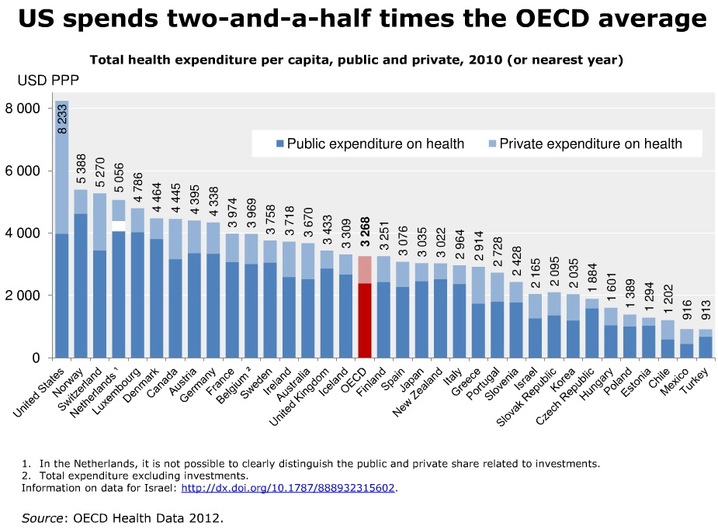
What this means is that Fournier’s preferred solution for dealing with this trend — higher taxes, fewer entitlements — is completely pointless. We have to fix the problem of rising prices, otherwise eventually a single tablet of aspirin will consume the entire federal budget. And the price problem is driven by awful policy design, not excessive generosity. America manages the rare trick of having very patchy and stingy social insurance that is simultaneously incredibly expensive. We spend more government money per person than Canada does — and the Canadians have universal single-payer coverage.
Fewer entitlements or higher taxes will get you a few years of breathing room before price increases eat up all the savings — and the whole point of Fournier’s column is that a couple decades of breathing room is still grounds for hair-on-fire panic.
Luckily, since the passage of ObamaCare, price increases have indeed slowed dramatically. That, plus a new projection that interest rates will stay low for a long time, accounts for the new CBO analysis showing slower debt growth. Just why this is happening is a matter of some dispute; I suspect it is partly the result of several programs in ObamaCare designed to bring prices down, and partly that health-care prices are already so high they’re running into resource constraints.
I think the fact that Fournier is patently uninterested in any of these things, and favors a policy that would accomplish nothing whatsoever on the deficit by his own standards, reveals that the pro-austerity school of punditry isn’t about the deficit at all. Instead, he says that his entitlement-cutting agenda is “going to happen sooner or later, painfully or more painfully.” As with David Gregory, the pain is the operative concept. The centrist definition of responsible politics holds that the American people must suffer a little more to keep the nation healthy. It’s only the “hateful partisans” who are keeping the wise, reasonable moderates from making those tough bipartisan compromises to slash social insurance and inflict pain.
But make no mistake: This has nothing to do with economics, and everything to do with the bizarre looking-glass ideology of “serious people” in Washington, D.C.
By: Ryan Cooper, The Week, July 24, 2014
Share This Blog


 Unknown Feed
- An error has occurred; the feed is probably down. Try again later.