“Republican Ideas Haven’t Changed Since The 1970s”: John Boehner Should Try Listening To His Own Economic Advice For Obama
After President Obama released his 2016 budget on Monday, House Speaker John Boehner published a list of ten things that are “newer than Obama’s ideas.” Instagram, Angry Birds, Frozen, and the selfie stick all made the cut. Boehner’s office even created a clunky hashtag for the list—#NewerThanObamasIdeas. The irony is rich: Republican ideas have hardly changed since the 1970s.
It’s true that many proposals in Obama’s budget, like increased infrastructure spending, comprehensive immigration reform, and universal pre-kindergarten, were in his previous budget too. But there were many new ideas, as well. He proposed a new, 19 percent minimum tax on foreign corporate profits—a big move towards the GOP’s preferred territorial tax system. He also wants to expand a tax credit for child care while increasing the capital gains tax rate from 23.8 percent to 28 percent. He put forward a major overhaul of the unemployment insurance system.
None of these represent radical departures from Obama’s previous agendas. But Obama is a Democrat, not a Republican. He wasn’t suddenly going to abolish the Internal Revenue Service and repeal the Affordable Care Act, just as Republicans won’t suddenly wake up and support a single-payer system and higher taxes on the rich.
And Republican ideas on the economy have aged even worse than the Democrats’ stale agenda. Take monetary policy. Throughout Obama’s presidency, GOP lawmakers have frequently criticized the Federal Reserve for low interest rates and its recently-ended bond-buying program. Those policies, they have argued, would send inflation shooting upwards. That, of course, has not happened. Inflation has remained below the Fed’s 2 percent target for years. The greater risk is actually deflation—falling prices.
Of course, in the 1970s, inflation was a very real concern. Then-Fed chair Paul Volcker raised interest rates, causing a recession, but stamping out inflation. Republicans, fearing pre-Volcker inflation, are trying to apply those lessons during a very different time, when the far greater risk to the economy has been a weak labor market. If the Fed had implemented them, it would have led to a disastrous economic contraction.
Or consider taxes. Most of the Republican Party has a laser-like focus at lowering the top marginal tax rates. But some reform-minded conservatives also want to finance a huge expansion of the Child Tax Credit (CTC)—a tax credit available to parents. They believe that the Reagan tax cuts in the 1980s that lowered the top marginal tax rate from 70 percent to 50 percent was a smart move. But they see far fewer benefits in lowering marginal tax rates now. “Let’s say we cut the 15 percent federal income-tax rate faced by much of the middle class to 10 percent,” Robert Stein writes in the reformicon’s new conservative agenda, titled “Room to Grow.” “Instead of keeping 85 cents for a dollar of extra effort, a worker would get 90 cents—an improvement of only 5.9 percent.… For these workers, cutting the 15 percent rate to 10 percent would make absolutely no difference in work incentives.” A CTC expansion would put money directly into the pockets of parents who need it. While a few prominent members in the Republican Party have adopted Stein’s tax proposal, most notably Senator Marco Rubio, the vast majority of the party would rather lower marginal rates further instead of expanding the CTC. In other words, Republican tax ideas are still stuck in the 1970s as well.
At the end of Boehner’s listicle, his office writes, “The simple truth is this: The federal budget shouldn’t be cobwebbed by the policies of the past. It should be focused on the future—a future where our kids and grandkids can grow up free from the fear of never-ending debt and a bloated Washington bureaucracy.” His party should listen to that advice.
By: Danny Vinik, The New Republic, February 6, 2015
“The Product Of A Fringe Movement”: The Crazy Is A Resume Item For Rand Paul
At the Prospect today, Paul Waldman manages to remind us of two important things to keep in mind in contemplating the Rand Paul presidential campaign: first, some of the crazy things he’s said in the not-too-distant past (example: ruminations on the North American Superhighway Conspiracy in 2008), and second, why that matters more in his case than in others. The crazy stuff will drib and drab into public view for the next few months, and some people will notice and others won’t. So it’s the second issue most interests me, because it explains why we should notice:
[M]ost politicians who get to where Paul is work their way up by climbing the political ladder: they run for city council in their town, then maybe mayor, then they become a state rep, then a state senator or congressman, and finally run for the Senate. That experience makes you a creature of the place where you come from and party that nurtured you. Along the way your views will come to reflect their concerns and their consensus about policy.
But that’s not the path Rand Paul followed. Whatever his talents, he’s a United States senator because he’s Ron Paul’s son. Over his time in Congress, Ron Paul developed a small but fervent national constituency, made up of some ordinary libertarians and a whole lot of outright wackos. That constituency was greatly expanded by his 2008 presidential campaign. Despite the fact that Paul had plenty of interesting and reasonable things to say, it’s also the case that if you were building a bunker to prepare for the coming world financial crash and ensuring societal breakdown (and possible zombie apocalypse), there was only one presidential candidate for you. When Rand Paul decided to run for Senate in 2010, having never run for anything before, the Ron Paul Army mobilized for him, showering him with money and volunteers. He also had the good fortune to be running in a year when Republicans everywhere were looking for outsider, tea party candidates, so he easily beat the choice of the Kentucky GOP establishment in the primary.
In other words, Senator Rand Paul is the product of a fringe movement that has embraced all sorts of nuttiness from the theocratic urges of the Constitution Party to Agenda 21 to the North American Superhighway, in addition to its better-known eccentric obsessions with crank monetary policy. That’s his resume. You have to examine it the same way you examine what other candidates did just before becoming national political celebrities. Otherwise you buy into the idea that he sprang fully developed from the brow of his father before running for president himself.
By: Ed Kilgore, Contributing Writer, Political Animal, The Washington Monthly, February 6, 2015
“Keeping Desperation As High As Possible”: Why The Greedy Upper Class Loves The GOP
Last week, Reihan Salam took a whack at America’s upper class in Slate. His charge? That the upper class uses its considerable political clout to protect itself from competition and keep its own incomes high, thus making life harder on everyone else further down the economic ladder. And he’s not wrong!
But Salam is also a conservative, with a conservative’s standard desire for low taxes, few regulations, and a skimpy social safety net. And what he conveniently leaves out of his screed is the fact that these preferences are themselves the ultimate expression of upper-class greed and self-dealing.
Let’s start with what Salam gets right. He points out that licensing and accreditation laws protect professions like dentists, lawyers, electricians, hairstylists, and the like from competition, which raises the costs of services they provide and prevents other workers from breaking into the market. The local land-use restrictions and zoning regulations that many in the upper class favor drive up housing prices, which makes it harder for the lower class to live in good neighborhoods with good schools, or to benefit from the economic development that comes with gentrification. The upper class seems implicitly content with an immigration status quo that maximizes competition in working-class jobs while minimizing it among high-skill professions. And of course there was the recent collapse of President Obama’s proposal to raise new tax revenue from 529 college savings accounts, a self-interested revolt of the upper class if ever there was one.
However, if you read between the lines, Salam isn’t really talking about the upper class writ large here. He’s talking about the liberal upper class. The issues he cites are mainly a big deal in cities, where liberals cluster. And conservative commentary in general these days has a tendency to talk about the American upper class as if it’s populated entirely by liberal yuppies who love yoga, organic food, Neil deGrasse Tyson, and abortions, and who think that guns are barbaric and that religion is backwards.
As it happens, however, the GOP relies on the upper class even more than Democrats. Median household income in the United States is $52,250, and if you look at the 2012 election, voters below that mark broke hard for Obama, with those above going for Mitt Romney by lesser margins. This trend of the Democrats getting way more votes below the median income level has roughly held for decades. These days, strong support for Republicans really doesn’t kick in until you get close to $75,000, or roughly the top third of the income ladder.
The difference between the parties is not that one relies on the wealthy and one doesn’t. Both parties lean heavily on those voters and divvy them up in various ways. (Mainly through cultural and social issues.) But the Democrats’ coalition also includes a fair portion that’s lower and working class, that’s still fighting for attention in the party, and that occasionally gets it. Conversely, lower- and working-class voters are mostly just absent from the GOP.
This matters because the upper class also has a pretty distinctive set of economic policy preferences. According to a recent study by Pew, the most financially secure Americans — roughly a fourth to a third of the population, by Pew’s definition — disproportionately say that government can’t afford to do more to help the needy, and that poor people “have it easy” thanks to government benefits. The less financially secure think the opposite. Large majorities of those making below $75,000 say the thing that bothers them the most about taxes is that the wealthy don’t pay their fair share. Large majorities of Americans oppose cuts to everything from Social Security and Medicare to aid for the poor. They support making union organizing easier and more federal spending on education.
Hell, 57 percent of the Republican or Republican-leaning voters who do make less than $30,000 think government doesn’t do enough to support poor people.
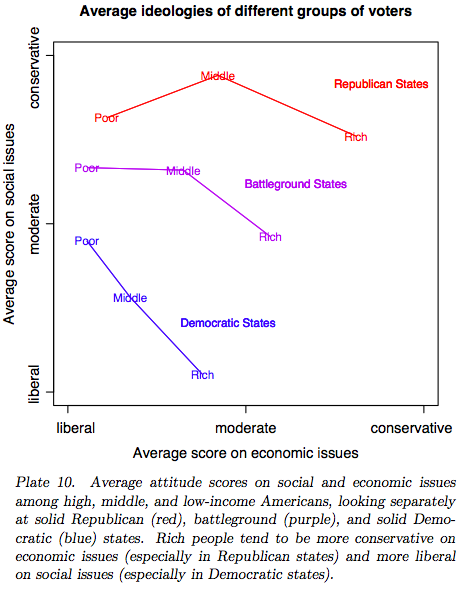
The reason the GOP can get away with being on the opposite side on all these matters is the fact that the voting population skews upper class: Even Democrats in the top third of the income distribution are noticeably more economically right-wing than poorer Democrats or Republicans, and Republicans in the top third are really economically right-wing.
There’s a pretty straightforward argument for why the upper class tilts in this direction. As Salam notes, the policy preferences of the upper class that really stick in his craw boil down to protecting their incomes and thus making the goods and services they provide more expensive for everyone else. But the flip side of that is making sure the goods and services everyone else provides — and thus their incomes — come cheap. That’s where the GOP comes in.
The essence of worker bargaining power is the ability to tell an employer “no.” That forces business owners to offer a better deal, driving up wages and benefits. A broad and generous welfare state gives workers leverage in that regard. It also helps boost aggregate demand, getting us closer to the full employment that really gives workers an edge. In short, the income of the working class is inversely proportional to its level of economic desperation. The effect of conservatives’ preferred economic policies — from slashing spending to imposing work requirements for aid — is to keep that desperation as high as possible. And of course, the upper class certainly doesn’t want to shoulder the taxes necessary to make such a system work.
The thing to remember is that, when it comes to what to do with the working class, the interests of the upper class and the super-rich cohere. Whether you’re a corporate CEO, a small-business owner, or just a well-heeled professional who consumes a lot of high-end goods and services, it benefits you to keep the labor of everyday Americans as cheap, compliant, and disposable as possible. It’s true, as Salam notes, that the truly rich aren’t quite as desperate to defend their interests as the upper class is; if you’ve got Mitt Romney’s dough, you can put up with more taxes, regulations, and workers demanding dignified pay and good benefits.
But that just bolsters the point that the fervent bastion of the economic right is the upper class. They’ve got the most to gain by slashing taxes, cutting regulations, scrapping government aid programs, and busting unions.
As Salam acknowledges, he doesn’t want high taxes on the wealthy, or for America to go down the road of the big European welfare states. His fellow reform conservatives and the Republican Party agree with him in this regard. Salam then says of the upper class: “I sensed that their gut political instincts were all about protecting what they had and scratching out the eyeballs of anyone who dared to suggest taking it away from them.”
But aren’t conservative economic policies the perfect expression of that exact impulse?
By: Jeff Spross, The Week, February 3, 2015
“Mollifying The Extremists”: GOP Back To ‘Impeachment,’ ‘Jail Time’ For Obama
As the 2014 cycle progressed, the number of congressional Republicans talking about impeaching President Obama faded, and there’s no real mystery as to what happened. GOP leaders, fearing a public backlash, told Republican incumbents and candidates to dial it down a notch. Why rile up Democrats, who too often stay home in midterm cycles, when they’re tuning out?
And as a consequence, for months, the “i” word more or less faded. That is, until very recently.
Last week, Rep. Brian Babin (R-Texas), less than a month into his first term in Congress, announced his belief that President Obama, without a doubt, “deserves impeachment.” He’s not the only one talking like this.
Republican Rep. Tom Marino of Pennsylvania says President Obama is “getting close” to impeachment. “People say, ‘should the president be impeached?’ I say, we’re getting close to that,” Marino said in a video posted on YouTube Wednesday by the local newspaper, the Wellsboro Gazette.
Marino said he was talking about impeachment because “it comes up consistently at town hall meetings.”
Well, that’s a good reason. Marino was a little fuzzy on what, exactly, would be the grounds for presidential impeachment, but for many GOP lawmakers, that’s a minor and inconvenient detail that shouldn’t interfere with reckless rhetoric.
Rep. Mo Brooks (R-Ala.), meanwhile, has no use for subtlety and is already talking publicly about “jail time” for the president:
In an appearance on “The Steve Malzberg Show” [Tuesday], Rep. Mo Brooks, R-Ala., continued his crusade against President Obama’s executive actions on immigration reform, calling on the federal courts to find that the president’s actions violated the law.
If Obama defies such a ruling, Brooks said, then Congress should pass a contempt citation against the president for his “reckless conduct” and demand that he comply with the court’s decision.
He said that Obama would then drop his executive actions since he, like Richard Nixon, doesn’t want to “incur the wrath that comes with a contempt citation with potential fines and jail time.”
At this point, I still consider it unlikely that GOP leaders will go along with the far-right’s impeachment crusade, but conservative media appears to be on board, and the number of congressional Republican talking up the idea since the elections keeps growing.
Even if party leaders balk, this only means they’ll have to think of something else to mollify the extremists in their midst, and pointless anti-Obama lawsuits probably won’t cut it.
By: Steve Benen, The Maddow Blog, February 4, 2015
“Jeb’s Past vs Jeb’s Future”: A Forgiving Standard For Himself And A Punitive Standard For Everyone Else
There’s nothing in American public life quite like the scrutiny of a presidential campaign. Credible candidates can expect to see their entire lives dissected in granular ways that are often unflattering, and it’s up to voters to decide whether, and to what extent, a presidential hopeful’s life experiences matter.
With this in mind, the Boston Globe ran a lengthy feature over the weekend on former Florida Gov. Jeb Bush, a leading Republican presidential candidate, who apparently had a troubled youth.
He bore little resemblance to his father, a star on many fronts at Andover, and might have been an even worse student than brother George. Classmates said he smoked a notable amount of pot – as many did – and sometimes bullied smaller students. […]
Meanwhile, his grades were so poor that he was in danger of being expelled, which would have been a huge embarrassment to his father, a member of Congress and of the school’s board of trustees.
At this point, I suspect many Republicans are thinking, “He was a dumb teenager and none of this tells us anything important about his character now.” It’s a perfectly legitimate defense – as brutal as a presidential vetting process is, there has to be a limit on how closely we look at candidates’ backgrounds, especially before they were even adults.
I imagine we can all look back at our high-school years and think of things we should have handled differently. Presidential politics can tolerate some statutes of limitations on teen-aged stupidity.
But in this particular case, the Globe’s look at Jeb Bush’s past may have some relevance to contemporary policy disputes.
Sen. Rand Paul says it’s hypocritical for Jeb Bush to oppose legalizing marijuana given that Bush smoked a fair amount at prep school. “You would think he’d have a little more understanding then,” Paul told The Hill while en route to a political event in Texas.
“He was even opposed to medical marijuana,” Paul said of Bush. “This is a guy who now admits he smoked marijuana but he wants to put people in jail who do.”
The Kentucky Republican, a likely Bush rival for the 2016 nomination, went on to say, “I think that’s the real hypocrisy, is that people on our side, which include a lot of people who made mistakes growing up, admit their mistakes but now still want to put people in jail for that…. Had he been caught at Andover, he’d have never been governor, he’d probably never have a chance to run for the presidency.”
I don’t say this often, but Rand Paul raises a good point.
If Jeb Bush said his drug use in high school was a long time ago, it was a teen-aged mistake, and he’d like voters to overlook his youthful indiscretions, the issue would be a non-factor in the campaign.
But that’s not quite the situation we’re confronted with here. Rather, Bush seems to support one forgiving standard for himself and a punitive standard for everyone else.
As a politician, Bush has not embraced marijuana. He spent much of his time as Florida governor championing jail instead of treatment for nonviolent drug offenders, and pushed for mandatory prison sentences for drug offenders – with the exception of his daughter, Noelle, who has struggled with crack cocaine use.
More recently, while acknowledging that states should “have a right” to decide on the legalization of marijuana, Bush publicly opposed an amendment to legalize medical marijuana in Florida.
Overlooking a presidential candidate’s high-school-era mistakes is easy. Overlooking a presidential candidate who punishes those for making the same mistakes he made is far more difficult.
By: Steve Benen, The Maddow Blog, February 2, 2015
Share This Blog


 Unknown Feed
- An error has occurred; the feed is probably down. Try again later.
 mykeystrokes.com