Republicans Say Everything the Dems Pass Is Unconstitutional — Even Policies They’ve Championed for Decades
That Republicans are relentlessly attacking the constitutionality of what had long been one of their signature ideas for reforming the health-care system — the individual mandate requiring people to buy insurance or pay a penalty – is a testament to just how far down the rabbit-hole our discourse has gone.
Late last year, when a federal judge ruled against the mandate (two other courts disagreed, and the Supreme Court will end up deciding the question), Senator Orrin Hatch, R-Utah, rejoiced. “Today is a great day for liberty,” he said. “Congress must obey the Constitution rather than make it up as we go along.” It was an odd testament to freedom, given that Hatch himself co-sponsored a health-care reform bill built around an individual mandate in the late 1990s.
Journalist Steve Benen noted that while “the record here may be inconvenient for the right … it’s also unambiguous: the mandate Republicans currently hate was their idea.”
It was championed by the Heritage Foundation… Nixon embraced it in the 1970s, and George H.W. Bush kept it going in the 1980s. For years, it was touted by the likes of John McCain, Mitt Romney, Scott Brown, Chuck Grassley, Bob Bennett, Tommy Thompson, Lamar Alexander, Lindsey Graham, John Thune, Judd Gregg, and many other … notable GOP officials.
According to NPR, the mandate was the Right’s response to progressive proposals to establish a single-payer system. Mark Pauly, the conservative economist widely credited with the idea, explained that “a group of economists and health policy people, market-oriented, sat down and said, ‘Let’s see if we can come up with a health reform proposal that would preserve a role for markets but would also achieve universal coverage.'”
That was then, this is now. Since it was a Democratic Congress that enacted the mandate, this conservative idea for creating a business-friendly model of universal health care has become something profoundly un-American, according to many of those very same Republicans who championed it. (Asked about the GOP’s retreat from the individual mandate it had long promoted, Pauly said, “That’s not something that makes me particularly happy.”)
And as is generally the case in these heady days of Tea Party conservatism, it’s not just that the individual mandate is bad – it’s also “un-Constitutional” (just like child labor laws, federal disaster assistance, food safety standards, etc.). As Gary Epps, a legal scholar at the University of Baltimore, put it, “Conservative lawmakers increasingly claim that the ‘original intent’ of the Constitution’s framers and the views of the right wing of the Republican Party are one and the same.”
A brief filed in support of Virginia’s challenge to the Affordable Care Act by the Landmark Legal Foundation – headed by noted wing-nut radio host Mark Levin, who believes that the Tea Partiers have been “tormented and abused far more than the colonists were by the King of England” – laid out the argument, calling the erstwhile Republican approach to universal health care “evidence of congressional power run amok.”
Congress can tax interstate commerce, it can regulate interstate commerce, it can even prohibit certain types of interstate commerce, but it cannot compel an individual to enter into a legally binding private contract against the individual’s will and interests. There is nothing in the history of this nation, let alone the history of the Constitution … that endorses such a radical departure from precedent, law, and logic.
Like most of the Right’s views of the Constitution – and the Founders’ intent – this is entirely wrong; it’s historical revisionism driven by ideology.
In 1792, none other than George Washington signed the Uniform Militia Act, a law requiring every white male citizen to purchase a whole basket of items – “a good musket or firelock, a sufficient bayonet and belt, two spare flints, and a knapsack, a pouch, with a box therein” – from private companies. Bradley Latino at Seton Hall law school’s Health Reform Watch added that “this was no small thing.”
Although anywhere from 40 to 79% of American households owned a firearm of some kind, the Militia Act specifically required a military-grade musket. That particular kind of gun was useful for traditional, line-up-and-shoot 18th-century warfare, but clumsy and inaccurate compared to the single-barrel shotguns and rifles Americans were using to hunt game. A new musket, alone, could cost anywhere from $250 to $500 in today’s money. Some congressmen estimated it would cost £20 to completely outfit a man for militia service — about $2,000 today.
Some on the Right have argued that this history is irrelevant as the law was passed under the auspices of the Constitution’s militia clauses, not the Commerce Clause. That’s true, but doesn’t change the fact that it disproves the claim that Congress has never compelled citizens to purchase goods or services from private firms – that’s patently false, regardless of how the measures differed in their details.
And despite the fact that there were a number of legislators serving in that Congress who had signed the Constitution five years earlier, “not one of militia reform’s many opponents thought to argue the mandate was a government taking of property for public use. Nor did anyone argue it to be contrary to States’ rights under the Tenth Amendment.” Those who opposed the bill simply argued that it would put too great a burden on the poor.
Of course, mandating that citizens buy a gun is different than requiring them to purchase health insurance. But as Rick Ungar, an attorney and writer, pointed out, Congress did in fact pass a mandate requiring health insurance…back in 1798.
The Act for Sick and Disabled Seamen created a government-operated hospital system – socialized medicine! – and mandated that all privately employed sailors purchase health insurance in order to sail.
It’s not an exact parallel. Nobody was forced to become a merchant seaman. But as Ungar noted, “this is no different than what we are looking at today. Each of us has the option to turn down employment that would require us to purchase private health insurance under the health care reform law.”
The Act also required sea captains to withhold 1 percent of sailors’ earnings to finance the program rather then mandate that they purchase a policy themselves – it was the first payroll tax. But as Ezra Klein noted in the Washington Post, “if conservatives really do prefer a system of payroll taxes that purchase you public insurance to the private system envisioned in the Affordable Care Act, I’m sure there are a lot of liberals who would vote for a bill that repealed the Affordable Care Act and replaced it with Medicare-for-all.”
It’s an important point – the liberal approach to universal health care is not only simpler and far more cost-effective, but unlike the Right’s individual mandate, it also falls unambiguously within the federal government’s enumerated powers.
Health care is also, in the words of the Congressional Research Service, “a unique market” in that one cannot opt out of it even if one wishes to do so. That’s because, by law, we don’t allow people to simply die in the streets, untreated. The uninsured without the means to pay nonetheless get (very costly) care in emergency rooms, and the rest of us pick up the tab.
And here, again, it’s worth noting that “the 5th Congress did not really need to struggle over the intentions of the drafters of the Constitutions in creating this Act as many of its members were the drafters of the Constitution.” The bill was signed into law by none other than John Adams, considered to be among the most influential of the “Founding Fathers.” Thomas Jefferson was the president of the Senate at the time, and Jonathan Dayton, the youngest man to sign the Constitution, served as Speaker of the House.
As the current legislation stands, even the American Enterprise Institute concedes that “the majority of constitutional experts are betting that the courts will uphold the mandate” – although they’re not happy about it. And that’s because the other Constitutional arguments against the reforms are just as dubious. Conservatives have come to use the Constitution as a crutch, avoiding debates on the merits of various proposals by asserting, with a broad wave of the hand, that whatever the policy in question may be, it’s all illegitimate.
The constitutionality of the health-care mandate will ultimately be decided by an activist majority on the Supreme Court. Nobody can predict how it will rule, but the Constitution gives the Congress power to “to lay and collect Taxes, Duties, Imposts and Excises … and provide for the common Defense and general Welfare of the United States,” a power the Congressional Research Service characterizes as ”one of the broadest powers in the Constitution,” and one that forms “the basis of government health programs in the Social Security Act, including Medicare, Medicaid, and the State Children’s Health Insurance Program.”
The Supreme Court has interpreted the Commerce Clause as giving the government the authority to regulate not only interstate commercial transactions in a limited sense, but also “those activities having a substantial relation to interstate commerce.” (Our health-care system is the costliest in the world, and eats up about 18 percent of our economic output, so it’s hard to see how one can argue that it doesn’t have a “substantial relation” to our national economy.)
Then there’s the common conservative argument that the Commerce Clause only covers economic activity, but not inactivity – a claim that is also factually incorrect, but was nonetheless accepted by Henry Hudson, the federal judge who ruled against the government in the Virginia suit. But even if it were true, it’s hard to see the relevance of the argument given the Constitution’s Necessary and Proper clause, which authorizes the government to “make all Laws which shall be necessary and proper for carrying into Execution the foregoing Powers.”
So, to recap: Congress is expressly authorized to raise taxes and spend public funds to further the “general welfare” of the nation; it can regulate any area that has a “substantial relation” to interstate commerce, and it can pass any law that is “necessary and proper” to further those enumerated powers.
On its face, there’s nothing in the Constitution constraining the government from enacting its health-care scheme. But the heart of conservative rhetoric these days is that any legislation passed by Democrats is illegitimate and defies the will of the Founders, as channeled by the mystics who lead the Tea Party movement.
That’s apparently the case even when those policies are among those they’ve championed for years based on their own ideological preferences.
By: Joshua Holland, Editor and Senior Writer, AlterNet-January 28, 2011
What The Teaparty Wants From The Constitution
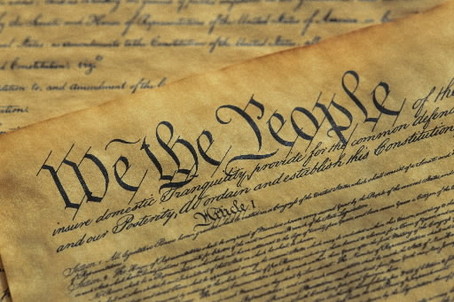
U.S. Constitution: Relevant only when it meets the needs of us "Real Americans"
I’m very curious to know what the GOP — or the tea partyers they’re presumably pandering to — think will happen when every piece of legislation requires “a statement from its sponsor outlining where in the Constitution Congress is empowered to enact such legislation.” What’s the evidence that this will make legislation more, rather than less, constitutional, for whatever your definition of the Constitution is?
Let’s take an example: Most legislation doesn’t currently include a statement of constitutional authority. But there’s one recent measure that did: Section 1501 of the Patient Protection and Affordable Care Act. That is to say, the individual mandate.
“The individual responsibility requirement provided for in this section (in this subsection referred to as the requirement) is commercial and economic in nature, and substantially affects interstate commerce,” reads the opening paragraph. Shortly thereafter, the legislation makes itself more explicit: “In United States v. South-Eastern Underwriters Association (322 U.S. 533 (1944)), the Supreme Court of the United States ruled that insurance is interstate commerce subject to Federal regulation.”
Has that statement convinced the GOP that the individual mandate is constitutional? Of course not. Currently, two judges have ruled in favor of the provision and one judge has ruled against. The split has been clean across partisan lines. The political verdicts have been little different: Sen. Chuck Grassley went from co-sponsoring an individual mandate in June of 2009 when it was still an idea connected to Republicans to condemning it as unconstitutional a few months later when it was clear that President Obama owned it and no Republicans would be joining his health-care bill.
My friends on the right don’t like to hear this, but the Constitution is not a clear document. Written more than 200 years ago, when America had 13 states and very different problems, it rarely speaks directly to the questions we ask it. The Second Amendment, for instance, says nothing about keeping a gun in the home if you’ve not signed up with a “well-regulated militia,” but interpreting the Second Amendment broadly has been important to those who want to bear arms. And so they’ve done it.
That’s their right, of course. Liberals pick and choose their moments of textual fidelity as well. But as the seemingly endless series of 5-4 splits on the Supreme Court shows, even the country’s most experienced and decorated constitutional authorities routinely disagree, and sharply, over what the text means when applied to today’s problems. To presume that people writing what they think the Constitution means — or, in some cases, want to think it means — at the bottom of every bill will change how they legislate doesn’t demonstrate a reverence for the document. It demonstrates a disengagement with it as anything more than a symbol of what you and your ideological allies believe.
In reality, the tea party — like most everyone else — is less interested in living by the Constitution than in deciding what it means to live by the Constitution. When the constitutional disclaimers at the bottom of bills suit them, they’ll respect them. When they don’t — as we’ve seen in the case of the individual mandate — they won’t.
By: Ezra Klein-Washington Post, 12/30/10: Photo credit: Todd Gipstein/National Geographic/Getty Images
Health Care Lawsuits: Separating Law From Spin

"Now if we can just fool the Courts"
If a public figure walks on water at noon, by 3 p.m. a dozen talking heads will be explaining that he can’t swim. That’s politics. But we can hope that federal judges won’t think in sound bites.
The current lawsuits challenging the Affordable Care Act raise this question insistently. I return to this lawsuit in yet another column because I believe this case will dominate both constitutional law and political discourse over at least the next 12 months–and because I believe its stakes far transcend its immediate consequences, important though they will be. I think that if our federal courts are willing to sign on to the challengers’ jejune theory of this case, not only we but our children will spend years dealing the malign consequences of the mistake. Nothing less than the ability of the United States to function as a modern nation may be at stake.
So far, in two of the pending lawsuits, opponents of the law have succeeded in spinning the judges, framing the lawsuits as posing the question whether (as Virginia argued) the federal government can “impose a penalty for what amounts to passive inactivity.”
We know the talk-radio answer to this question: Tyranny! Death panels! Black helicopters! Praise the Lord and pass the ammunition!
But the judicial answer, it seems to me, should be two-fold.
The first, and most important, answer a judge should give is, “I dunno. Find a case where the government does that and get back to me.” Because that description of the Affordable Care Act is simply inaccurate.
The second answer, which a judge shouldn’t give but a Con Law jock like me can, is, “Why ever not?”
I will get to that one later; but first, let’s deal with the canard that the Act somehow “penalizes inactivity.”
Here’s how Judge Henry Hudson put it in his decision in Cuccinelli v. Sebelius: The Act “requires that every United States citizen, other than those falling within specified exceptions, maintain a minimum level of health insurance.”
This snappy apothegm is the logical equivalent of saying that the Defense Appropriations Act “requires that every United States citizen, other than those who leave the country, engage in accepting a minimum level of protection by the United States military.” The provisions of the Health Care Act provide a benefit. The majority of Americans, who already have health coverage (and seem, by and large, to regard this coverage as worth bargaining for) will simply see improvements in their existing health care benefits, such as an end to lifetime benefit limits and the right to include older adult children on their policies. A significant number of others who are currently uninsured will become eligible for government-funded health insurance.
There will remain a small but significant number of Americans who can afford health care insurance but choose not to buy it. But contrary to the sound bite above, even they are not required to “maintain a minimum level of health insurance.” If they wish to keep their uninsured status, they may do so by paying an addition to their income tax bills–ranging from as little as $695 for an individual taxpayer to $2085 for a family of six or more. The claim that the government is “forcing individuals to buy a commercial product” is worse than spin; it is simply false.
In fact, even the choice of procuring insurance or paying a tax is put not to “every United States citizen,” or even “every United States citizen not already covered by insurance,” but only to those who earn enough income to qualify as taxpayers. “A small fraction of fewer than half of United States citizens,” though accurate, is much less thrilling to say, even for a judge, than “every citizen.”
This brings us to the contention that the act somehow regulates “inactivity.” Let’s you and I test this proposition: why don’t you just remain totally inactive in 2014, when the Act first takes effect.
Quit your job and get rid of your investments. The government will not regulate you. (True, it may offer you government-financed health care; but again, that is a benefit, not a regulation or punishment.)
But if you decide actually to work (I recommend that, by the way), you are not being “inactive.” You are taking part in commerce. The Constitution gives Congress plenary authority “to regulate commerce with foreign nations, and among the several States, and with the Indian Tribes.”
A system of regulation might easily include requiring you to pay taxes if you choose to burden commerce; willful refusal to maintain adequate health coverage for yourself and your family is such a burden. To claim otherwise doesn’t pass the straight-face test.
Conservatives like to prate about “individual responsibility” when it is a question of forcing the poor to work; asking the solvent to pay for themselves seems quite in line with these conservative values.
And as to the idea that Congress can only regulate “activity,” here again, verbal formulae are obscuring the practical truth. The Constitution does not say anything about “activity”; that’s a gloss that the Rehnquist Court put on it. Nor does it refer to “interstate commerce,” which to some (apparently including Justice Thomas) means men in knee breeches handing trinkets across state lines. The Constitution says that Congress may “regulate commerce . . . among the several states.”
Chief Justice Marshall (who was a ratifier, though not a Framer, of the Constitution) wrote in 1824 that “among” means “intermingled with,” not “between.” Marshall wrote that Congress’s commerce power reaches everything except that small set of matters “which are completely within a particular state, which do not affect other states, and with which it is not necessary to interfere, for the purpose of executing some of the general powers of the government.” Health care, and the citizen’s economic relationship with it, most assuredly affect all the states, and individual decisions about insurance are an important part of that effect–just as a farmer’s decision to raise private wheat are a part of agriculture’s effect on commerce.
I am somewhat mystified why the state plaintiffs even have standing to appear. In order for them to be injured, the Act would have to infringe some power that is reserved by the Constitution to the states. Judge Hudson placed great emphasis on an obscure 1922 precedent called Bailey v. Drexel Furniture, in which a laissez-faire majority of the Supreme Court invalidated a federal tax on products produced by child labor. The tax, the Court reasoned, was an attempt to prevent exploitation of children in factories and mills; such labor regulations were “a purely state activity.”
The Court has long since given up the idea that “labor laws” are solely state matters. But assume that in the formal sense Drexel is good law. So what? The tax, or penalty, in the Affordable Health Care Act doesn’t regulate any “purely state activity.” If it pretended to regulate commerce but was actually aimed at preventing divorce, or imposing a national zoning code, or requiring homeowners to maintain tasteful wallpaper, there might–might–be a Tenth Amendment issue. But not here: In the guise of regulating commerce, the Act regulates . . . commerce.
Here’s the nub of the objectors’ argument–it is not that this isn’t a regulation of commerce, but that the Commerce Power isn’t strong enough to regulate an entire national market. That kind of limitation on the Commerce Power finds no support in, well, the Constitution.
The doctrine under which the Act is being assailed quite simply constitutes a threat to most of the significant advances in federal law of the past 100 years: federal pension programs, national wildernesses and parks, consumer protection, environmental regulation, and most particularly statutory guarantees of civil rights.
It’s not coincidental that right now Ron Paul laments the Civil Rights Act and that Haley Barbour speaks fondly the segregated South, that anti-immigrant extremists target birthright citizenship, or that right-wingers seek to wreck the Constitution with an old-South style amendment letting states repeal federal laws. A decision to void the Act would furnish a powerful precedent for those who would “restore” a libertarian dreamland that never existed, and that for most of us would quickly become a nightmare.
The great achievement of the Framers–the one they clearly thought most important–was the creation of a national Congress with plenary powers in the spheres assigned to it. Trying to wreck Congress is warring on the Constitution.
That’s not to say that Congress can regulate commerce by unconstitutional means. But the prohibitions on means are in the Constitution, not in the fevered brain of Cuccinelli & McCollum. If a new health care act were to restrict free speech, or impose ex post facto laws, or authorize bills of attainder, or deny due process, the courts should certainly step in.
But that’s not what is at issue here.
Stripped of spin, the state plaintiffs are arguing that Congress can’t use its commerce power to actually regulate commerce. If the courts buy this nonsense, they may fatally damage the power of Congress to manage a modern commercial economy. Repairing that mistake would involve far greater sacrifices than having to pay a tax.
By: Garrett Epps- former reporter for The Washington Post-Original article-The Atlantic, December 30, 2010
Commerce Clause Conundrum–Will The Hudson Ruling Stand?
In declaring unconstitutional the new requirement for Americans to buy health insurance, federal Judge Henry Hudson rests his decision on one of the most widely applied clauses in the Constitution.
Does his interpretation hold up?
Hudson ruled Monday that the Commerce Clause does not give Congress the authority to make people buy something. The Clause itself serves as the basis for a vast swath of federal regulatory statute, and it states, simply, that:
The Congress shall have Power … To regulate Commerce with foreign Nations, and among the several States, and with the Indian Tribes
The Commerce Clause has been interpreted quite broadly over the years, to the point where “interstate” holds little distinctive meaning in the eyes of judges. Courts have so thoroughly established the precedent that one economic action by one person, even if it happens only within one state, can affect the broader economy of any good in question, that the Commerce Clause generally applies to all economic activity.
Hudson’s problem with the federal government’s argument is that this is a novel application of the Commerce Clause, in that it actually forces people to buy something.
Earlier in this opinion, the Court concluded that Congress lacked power under the Commerce Clause, or associated Necessary and Proper Clause, to compel and individual to involuntarily engage in a private commercial transaction, as contemplated by the Minimum Essential Coverage Provision [i.e., the requirement to buy insurance]. The absence of constitutionally viable exercise of this enumerated power is fatal to the accompanying sanction for noncompliance. …
A thorough survey of pertinent constitutional case law has yielded no reported decisions from any federal appellate courts extending the Commerce Clause or General Welfare Clause to encompass regulation of a person’s decision not to purchase a product, notwithstanding its effect on interstate commerce or role in a global regulatory scheme. The unchecked expansion of congressional power to the limits suggested by the Minimum Essential Coverage Provision would invite unbridled exercise of federal police powers. At its core, this dispute is not simply about regulating the business of insurance–or crafting a scheme of universal health insurance coverage–it’s about an individual’s right to choose to participate.
There are more ins and outs, including whether or not the individual mandate is enforced by a “tax” or a “penalty,” but that’s the crux of Hudson’s ruling: a lack of precedent for forcing people into commercial engagement.
There is, however, some precedent.
As Georgetown constitutional law professor Louis Michael Seidman pointed out, the 1964 Civil Rights Act forced businesses into economic engagement when it outlawed racial discrimination in business. Some restaurants didn’t want to engage in commerce with black people, but the federal government forced them to (coincidentally, this was the portion of the law to which Sen.-elect Rand Paul objected).
In another case, Wickard v. Filburn, the federal government tried to penalize a farmer for growing wheat on his own property simply for him and his family to eat. He wasn’t selling it. But the federal government wanted to drive up the price of wheat, and the Supreme Court ruled that the government was within its powers to penalize him for this noncommercial activity and force him, instead, to buy his wheat from the interstate wheat economy, which Congress governs. That decision was handed down in 1942, but the Supreme Court reaffirmed it (cited it to support the logic of a ruling) in 2005, in its ruling on the Raich medical marijuana case.
Judges can decide on their own how directly those ruling apply, and the Supreme Court can always go back on previous decisions if the justices feel it appropriate.
But those are the relevant decisions in which a vaguely similar issue was confronted, in case you were wondering if there’s any historical context for the issue that’s now being forced.
By: Chris Good, Associate Editor –The Atlantic, December 13, 2010
Share This Blog


 Unknown Feed
- An error has occurred; the feed is probably down. Try again later.
 mykeystrokes.com
You must be logged in to post a comment.