For the GOP, Fear is Always the Answer in Thwarting Health Care Reform
With the Congressional Budget Office’s report out, detailing that health care reform will trim the deficit over the next 10 years by $138 billion, Republican resistance to this bill has gone from annoying to downright illogical, and I mean birther-style illogical. It is no longer about cost or policy issues, it is simply an obvious attempt to kill this presidency and damn the citizens in the process.
The Congressional Budget Office’s methods or neutrality on issues have never been questioned until now. It seems that now because reality doesn’t coincide with the Republicans desire to block health care reform, the CBO is playing a shell game.
“Only in Washington, D.C. can people announce they are spending a trillion dollars and reducing the national deficit,” said Mike Pence., R-Indiana, on The Dylan Ratigan show. “The American people know this is growing the government. It’s only going to increase the deficit, increase the debt…This massive government plan, with the CBO report withstanding, is not fooling anyone.”
Then, on the conservative Web site, Redstate.com: “The natural reaction by most Americans to the unofficial and preliminary claim that the $2.5 trillion ObamaCare bill is revenue-neutral is, well, B.S. (There is a card game with the same name.) The second natural reaction is the realization that ObamaCare must cut the guts out of Medicare and raise taxes through the roof.”
What is even more strange and really disappointing is that this “non-logic” appears to be working. Even with the CBO report, Americans are evenly divided on health care reform. Even with the proof that it will reduce, not add to the deficit, recent polling indicates only a slight improvement for passage of the bill. Why? Fear.
These are uncertain times. Jobs are disappearing. The banks are doubling down on fees while demanding more in terms of credit, down payments and collateral. The American Automotive industry is effectively existing only through taxpayer subsidies. Even Toyota—who not so long ago was considered “the standard” in the industry—appears to maybe knowingly have put its customers at risk to save a few bucks.
FOX News has been on a mission for the last year to discredit and derail this administration by misinforming and enraging its viewers. America is at a tipping point. Within the next decade, Caucasians will no longer be the majority. In the next decade, Blacks will no longer be the largest minority in this country. Within the next decade, America loses its prominence as the wealthiest nation to China. In the last 10 years, we have endured terrorism. We are currently engaged in two wars and still in the middle of the most debilitating recession in more than 20 years. These are uncertain times and Americans are fearful.
Past efforts to overhaul the nation’s health care system looked different. The process to reaching the legislation was different. The folks supporting it were different. The folks opposing reform were different. The one common denominator in this effort and every past effort: Fear.
“It’s really a case of deja vu,” Jonathan Oberlander, a political scientist at the University of North Carolina at Chapel Hill said. “You hear in today’s debate echoes of the past that extend all the way to the early part of the 20th century. And I think the reason that people use fear again and again is that it’s effective. It’s worked to stop health reform in the past. And so they’re going to try and use it in the present.”
The very first time in 1915 when America attempted to change its health care system, it was defeated by tying those attempts to our greatest international treat of the time: The German Empire.
Fear was used again in the next effort of the late 1940s. This time the American Medical Association told citizens if the nation adopted national health insurance, the Red army would be marching up and down the streets. Then even later when former President Bill Clinton tried passing health care reform, the health care industry was firmly in place. Their lobbying influence in Congress was apparent and their might in terms of influencing public opinion by flooding the television with misleading advertisements was informidable. Remember Harry and Louise?
This time around it’s the same. They’ve gone back to the well of fear with the death panels claim, fear of big government, fear of socialism, fear of rationing. Then they targeted the politicians themselves, with the fear of losing their next election. Today, the GOP upped the ante of this fear campaign, by telling Democrats that if they vote for reform, and lose their next election, he will personally block them from future governmental appointments. Once again, the obstacle to change is fear.
Fear is something you cannot reason with. You cannot refute. You cannot combat. It’s this primal instinct that, once aroused, simply takes over your brain, rendering you incapable of either reason or logic. A lot of people are pointing to the points where health care reform falls short. Others are pointing to how the president has come up short in terms of selling reform to America and Congress.
Me? I’m just wondering if this will finally be the year that fear no longer works.
By: Devona Walker- TheLoop21.com’s senior financial/political reporter and blogger-March 19, 2010
Discrediting the Legislative Process Itself
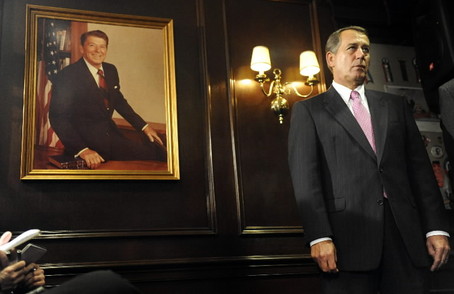
John Boehner-House Minority Leader of "No"
So far in the health-care debate, Republicans have attacked the legitimacy of private negotiations, parochial dealmaking, the budget reconciliation process, self-executing rules, the Congressional Budget Office’s analyses, and even the constitutionality of the legislation. It’s a good theory: Make people hate Washington and mistrust the legislative process and you’ll make people hate and mistrust what emerges from that process.
But it’s also dangerous. As Republicans well know, private negotiations between lawmakers, deals that advantage a state or a district, and a base level of respect for the CBO’s scores have long been central to the lawmaking progress. As the parties have polarized, reconciliation and self-executing rules (like deem and pass) have become more common — and the GOP’s own record, which includes dozens of reconciliation bills and self-executing rules, proves it.
The GOP’s answer to this is that health-care reform is important. Stopping the bill is worth pulling out all the stops. And I’m actually quite sympathetic to this view. Outcomes are, in fact, more important than process. But once you’ve taken the stops out, it’s hard to put them back in. Democrats will launch the very same attacks when they’re consigned to the minority, and maybe think up a few new ones of their own.
The result of this constant assault on how a bill becomes a law — a process that has never before been subject to such 24/7 scrutiny from cable news and blogs and talk radio — will be ever more public cynicism. Evan Bayh put it well in his New York Times op-ed. “Power is constantly sought through the use of means which render its effective use, once acquired, impossible,” he wrote. Republicans, who’re likely to return to power with a majority that’s well below 60 seats in the Senate and a 40-vote margin in the House, will soon find themselves on the wrong end of that calculus.
Photo credit: Melina Mara/Washington Post.
By Ezra Klein | March 19, 2010
Summited Out: The GOP Wants Capitulation, Not Compromise
Who won? It’s the exact same question people asked in 2008, after each of the presidential debates. I didn’t like it then and I don’t like it now. What’s “winning”–scoring more debate points, making fewer gaffes, or simply appealing to more voters? And aren’t all those judgments pretty subjective anyway?
But if Thursday’s event didn’t produce a winner, it was clarifying.
Health care reform, as I’ve said many times now, is really about achieving three basic goals: Making sure everybody has insurance, making sure coverage is good, and making sure that, over time, medical care will cost less. Thursday’s discussion revealed the stark differences between the two parties–not just over how to pursue these goals but also over whether they are even worth pursuing.
Making sure everybody has insurance is primarily a matter of providing access to policies, regardless of medical status, and then guaranteeing that people can pay for them, no matter what their income. The former requires re-engineering the insurance market–in particular, organizing the non-group market into insurance exchanges, through which insurers will sell regular policies at regular prices even to people with pre-existing conditions. The latter requires providing subsidies, based on people’s incomes, which in turn requires raising some money.
The Republicans made clear on Thursday they rejected both ideas. Re-engineering the insurance market requires too much government, they said, and providing subsidies requires too much money. The best they could offer were “high-risk pools,” which would provide thinner coverage–at higher prices–to people who couldn’t get insurance on their own. This means expanding coverage to only 3 million people, rather than 30 million, but the Republicans hardly seem to care. When Obama asked Wyoming Senator John Barrasso to speak to the problems of the uninsured, Barrasso responded by saying he wanted to talk about … the already insured. Not that Democrats mind talking about the already insured.
Reform’s second goal–making sure everybody’s coverage is good–is primarily for the benefit of people who have insurance today. Many of these people have coverage that won’t meet their needs, although they may not know it yet. Only when they get sick will they discover that their plans have loopholes, allow for exorbitant out-of-pocket costs, and leave them with little recourse if there are disputes over what’s covered. The Democrats propose to fix this by establishing a minimum set of benefits that all plans must cover, limiting the amount of out-of-pocket expenses insurers can pass along, and creating appeals mechanisms for consumers upset about denials.
This approach, too, is one the Republicans rejected on Thursday. Over and over again, Republican representatives and senators said the problem wasn’t insufficient regulation. It was too much regulation. They called for allowing people to purchase insurance across state lines–and allowing small businesses to form associations that would be exempt from existing state regulations. The effect of such changes, as the Congressional Budget Office has noted, would be to erode benefits–to weaken, not strengthen, the protection from medical expenses insurance now provides. Senator Tom Coburn praised this transformation, suggesting the great exposure would turn people into smarter consumers. Well, it might do that. Or it might simply mean people with medical problems face even more onerous financial burdens.
And what about making medical care less expensive? The Democrats’ approach is to try a combination of approaches: Eliminating waste, redirecting Medicare payments so that they reward efficiency, altering the tax treatment of insurance, and so on. They admit it will take time and that they are not sure which approaches will work best. But these efforts get at the root causes of rising medical costs–not just profit or administrative inefficiency, but also the tendency towards unnecessary over-treatment.
Republicans in theory should support many of these ideas, but, as usual, they had nothing good to say about them. Instead, they continued to pound the Democrats for cutting Medicare, even though the Democratic reductions are calibrated to make the program more responsive–and even though the Democratic reductions are far smaller than the ones Republicans have championed over the last 15 years (not to mention the ones Representative Paul Ryan still supports).
Instead, the Republicans’ great hope for reducing cost lay in de-regulation–which, again, succeeds only by shifting medical expenses back onto the people with medical problems–and malpractice reform–another idea that Democrats support but that, according to CBO, doesn’t actually account for that much spending.
The Republicans have their justifications–and, to be fair, if they are convinced government spending and regulation will do more harm than good, then they are right to hold these many views. But it is not as if their alternatives even come close to solving the problems Democrats would. Instead, Republicans seem to believe these problems are fundamentally unsolvable, at least in any manner they would find acceptable.
And this explains the message Republicans delivered over and over again on Thursday: Rip up the bill and start over. That’s not a plea for compromise. That’s a demand for capituation. And it frames the choice for Democrats pretty clearly. Either they will act alone, or they will not act at all.
By: Jonathan Cohn, Senior Editor- The New Republic Feb. 26, 2010
Share This Blog


 Unknown Feed
- An error has occurred; the feed is probably down. Try again later.
 mykeystrokes.com
You must be logged in to post a comment.