Does Michele Bachmann Have A ‘Reverend Wright’ Problem?
Joshua Green of The Atlantic is reporting that Rep. Michelle Bachmann has long belonged to a church that, well, has some odd views about the Catholic Church:
Michele Bachmann is practically synonymous with political controversy, and if the 2008 presidential election is any guide, the conservative Lutheran church she belonged to for many years is likely to add another chapter due to the nature of its beliefs–such as its assertion, explained and footnoted on this website, that the Roman Catholic Pope is the Antichrist.
The short, obvious response to the idea that this might hurt Bachmann’s presidential aspirations is, in a few words, “Reverend Jeremiah Wright.”
After all, President Barack Obama’s ties to Reverend Wright and his church didn’t hurt his presidential campaign nearly as much as expected — as he went on to win. Even in 2008, the idea that Obama was a covert black radical hiding behind a moderate liberal façade seemed far fetched. There was little connection between Wright’s views and Obama’s actual policy agenda.
This could, however, create problems for Bachmann. After all, unlike Obama, Bachmann has placed her religious views front and center in the campaign, most recently by signing onto a “pledge” issued by a group of social conservatives in Iowa affirming a number of paternalistic policy positions. In signing the pledge, Bachmann was promising to fight marriage equality, pornography, the repeal of Don’t Ask Don’t Tell and even the presence of women in the Armed Forces. Bachmann’s religious views, unlike Obama’s, are easily connectable to a definable policy agenda. So her religious views will be far more relevant than Obama’s — and many of the policy positions she’s adopted as a result aren’t likely to be popular outside of the GOP base.
George W. Bush frequently credited Karl Rove’s outreach to Catholics as key to his ascension to the White House. Has Bachmann — who left her former church last year and disavowed its views on Catholicism — damaged herself with this key segment of the electorate? That’s anybody’s guess. But generally speaking, some of her religiously informed political views will be a major liability among the broader electorate, should she win the nomination, and may even discourage Republicans who want to win the White House from voting for her. The more stories like this one expose the extent to which some of Bachmann’s religious views smack of bigotry, the worse her chances will get.
By: Adam Serwer, The Washington Post, July 14, 2011
Newt Gingrich And “The Food Stamp President”
Newt Gingrich doubled down on his clever new slur against President Obama as “the food stamp president.” He tried the line in a Friday speech to the Georgia Republican convention, and he used it again on “Meet the Press Sunday.” It’s a short hop from Gingrich’s slur to Ronald Reagan’s attacks on “strapping young bucks” buying “T-bone steaks” with food stamps. Blaming our first black president for the sharp rise in food-stamp reliance (which resulted from the economic crash that happened on the watch of our most recent white president) is just the latest version of Rush Limbaugh suggesting that Obama’s social policy amounts to “reparations” for black people.
But when host David Gregory suggested the term had racial overtones, Gingrich replied “That’s bizarre,” and added, “I have never said anything about President Obama which is racist.” That’s not quite as extreme or silly as Donald Trump declaring “I am the least racist person there is,” but it’s up there. He also told Georgia Republicans Friday that 2012 will be the most momentous election “since 1860,” which happens to be the year we elected the anti-slavery Abraham Lincoln president, and he suggested the U.S. bring back a “voting standard” that requires voters to prove they know American history — which sounds a lot like the “poll tests” outlawed by the Voting Rights Act.
Just last week Gingrich said Obama “knows how to get the whole country to resemble Detroit,” which just happens to be home to many black people. And last year Gingrich accused Obama of “Kenyan anti-colonialist behavior” that made him “outside our comprehension” as Americans, spreading Dinesh D’Souza’s idiocy that Obama inherited angry African anti-colonialism from the Kenyan father he never knew. “This is a person who is fundamentally out of touch with how the world works, who happened to have played a wonderful con, as a result of which he is now president,” Gingrich told the National Review Online last year.
All this from the guy who’s supposed to be the “smart” candidate for the GOP nomination?
Republicans have done well with their quest to stigmatize social welfare programs as handouts to the undeserving, and to pretend that most of the undeserving are black people. But it may not be working as well today. Paul Ryan’s class-war budget is going down in flames, largely because seniors are up in arms over Ryan’s attacks on Medicare. Ryan and his GOP allies tried to be clever, making sure his plans to phase out Medicare wouldn’t apply to today’s seniors, who happen to be disproportionately white and disproportionately Republican. But seniors are seeing through the ruse, telling Ryan and the GOP that they want to protect Medicare for their children, too. Even Gingrich is now backing away from the Ryan budget, telling Gregory it’s too “radical” and “too big a jump.” A jump off a political cliff for Republicans, that is.
Let’s hope Gingrich’s attacks on our “food stamp president” backfire, too. I learned about the ex-GOP speaker’s latest use of the term from the group Catholic Democrats, which Tweeted Sunday morning that the twice-divorced Catholic convert ought to have a look at Catholic social teaching if he’s going to call himself a Catholic. The American bishops have lately been trying to remind Americans (and themselves, perhaps) that Catholic social teaching is about more than abortion. The church has long been a force on behalf of the poor and powerless, going back to Pope Leo XIII’s encyclical Rerum Novarum (On the Condition of Labor) at the height of the Gilded Age in 1891, which put the church on the side of labor organizing, through Pope Benedict’s “Caritas in Veritate” (Charity in Truth) of 2009, which restated the church’s commitment to support for workers and the poor worldwide, in the wake of the greed-driven financial crisis of 2008.
House Speaker John Boehner got a taste of the rising Catholic concern for social justice when 83 Catholic scholars wrote to Boehner protesting his attacks on programs for the poor, after Boehner was chosen as Catholic University’s commencement speaker. They didn’t call on the university to cancel Boehner’s address, unlike Catholic conservatives who protested Obama’s commencement address at Notre Dame in 2009). They wrote:
Your voting record is at variance from one of the church’s most ancient moral teachings. From the apostles to the present, the Magisterium of the Church has insisted that those in power are morally obliged to preference the needs of the poor. Your record in support of legislation to address the desperate needs of the poor is among the worst in Congress. This fundamental concern should have great urgency for Catholic policymakers. Yet, even now, you work in opposition to it.
The scholars also noted that the U.S. Conference of Catholic Bishops called Boehner-promoted Ryan budget as “anti-life” for its cuts to programs for pregnant women and children. Boehner’s commencement address went on Saturday with a quiet protest from students who wore green placards reading “Where’s the compassion, Speaker Boehner?” over their graduation gowns. Of course the Catholic Boehner didn’t address the controversy; instead he shed tears remembering how his high school football coach called him the morning he became speaker to tell him “you can do it,” which he considered an answer to his prayers.
Boehner may have been crying about what his support of the Ryan budget is doing to House GOP re-election chances. Gingrich could find that his racially coded attacks on Obama backfire as well. Both the poverty rate and the unemployment rate for white Americans have doubled since the start of this recession. Maybe Republican policies will succeed in uniting Americans across racial lines for a change, as more people see them as favoring one minority — the super-rich — over the rest of us.
By: Joan Walsh, Editor at Large, Salon, May 15, 2011
GOP Presidential Contenders Compete To Win Over “The Political Army Of The Lord”
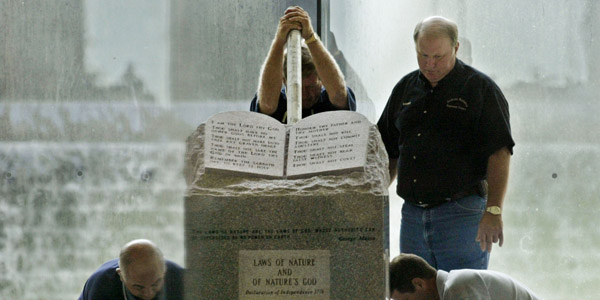
Workers remove a monument of the Ten Commandments from the rotunda of the Alabama Judicial Building after Superior Court Justice Roy Moore refused to take it down in 2003
So you can add another car to the crazy train that is the 2012 Republican presidential nominating contest. No, I’m not talking about last week’s sensation, Donald Trump. He’s a pretty conventional figure compared to the latest would-be president, former Alabama Supreme Court Chief Justice Roy Moore, who is currently barnstorming through Iowa after announcing an exploratory committee.
You may remember Judge Moore as the man who was forced from his judicial post after refusing to remove a gigantic monument to the Ten Commandments from his courthouse. He was also known for abrasive comments from the bench about homosexuality as contrary to God’s will, which in Moore’s opinion was dispositive. A martyr for theocrats everywhere, Moore spent some time hauling his monument around Alabama before launching two notably unsuccessful gubernatorial races — coming in a bad second in 2006’s Republican primary and a bad fourth in 2010 — and becoming a minor fixture at tea party events.
Moore was undoubtedly drawn to Iowa by that state’s furor over same-sex marriage, decreed legal by a 2009 state Supreme Court ruling. Iowa’s powerful Christian Right movement has made overturning that decision Job One, beginning with a successful effort in 2010 to remove three of the seven jurists responsible for it. It’s one of the few places left where Republicans don’t try to ignore the whole issue of gay rights as a divisive loser of an issue (which is why presidential wannabees like Tim Pawlenty have anachronistically come out against the repeal of “don’t ask, don’t tell). For Moore, it must have felt more like “home” than home.
Before writing off Moore as a kook trying to horn in on the spotlight of a presidential race, consider the company he’s keeping on his tour of the first-in-the-nation-caucuses state: former state legislator Danny Carroll. Carroll was co-chairman (with three-time gubernatorial candidate Bob Vander Plaats) of Mike Huckabee’s successful 2008 Caucus campaign, and more recently, signed on as a lobbyist for Vander Plaats’ new Christian Right umbrella group, The Family Leader. He’s a reasonably big deal in Iowa GOP circles, and by no means someone who howls at the moon.
For all I know, Carroll sees something in the crusty Alabama judge that others haven’t seen. Or maybe Judge Moore is a convenient stalking horse for Huckabee, designed to keep The Faithful loose and out of anyone else’s camp, in case Huck ultimately decides to run.
Regardless of Carroll’s (or Moore’s) personal motives, it’s likely the national Republican chattering class will dismiss the Judge’s campaign as a joke even worse than Trump’s. Or, it may be said, there is now such a crowd on the far right that opportunities are opening up for more moderate possibilities like Romney, T-Paw or an establishment-backed candidate-yet-to-be-named.
But I’d like to suggest another theory: the Christian/tea party right in Iowa is big enough, powerful enough, and politically sophisticated enough to hold its own caucus-within-a-caucus (well, caucuses, to be technical about it), an intramural contest to determine which candidate will actually represent the cause when Iowa Republicans make their final commitments before Caucus Night. Proven zealots like Michele Bachmann, Herman Cain, and now Moore, will joust with more suspect supplicants like T-Paw, Newt Gingrich — and maybe even Donald Trump! — over the next few months, with someone emerging as the designated favorite of the political army of the Lord. That is arguably what happened in Iowa in 2008, when Huckabee and Sen. Sam Brownback fought to become the Christian Right alternative to Mitt Romney, with Huckabee becoming The Man only after he out-organized Brownback at the State Party Straw Poll in Ames during the summer.
Moore’s candidacy may not ultimately have any direct influence on what happens next winter in Iowa, when conservative evangelicals and conservative Catholics get together to shape the 2012 Republican nominating process.
But he could indeed intensify the competition for Christian Right voters. And just as importantly, he could definitely serve as a symbol of the ideological and psychological gap between rigorous conservative activists and the mainstream political commentariat. Most of the latter think Moore is a crazy person. But most of the Iowa audiences before which Moore speaks will consider him an authentic if polarizing voice expressing the Word of God. That’s a pretty big gulf in perception, but also a pretty good reflection of the real differences Americans experience in how they view their leaders.
By: Ed Kilgore, Managing Editor of The Democratic Strategist and Senior Editor, Progressive Policy Institute. Article published in The Atlantic, April 20, 2011: Photo by Tami Chappell (Reuters)
Priest’s And Abuse: What Happened to ‘Zero Tolerance’?
A meeting of the nation’s Roman Catholic bishops is scheduled for June. It needs to repair the gaping holes uncovered in their “zero tolerance” mandate for priests suspected of sexually abusing children.
A grand jury report in February found that the Philadelphia archdiocese, for all its announced safeguards, allowed 37 suspect priests to remain in parish work. The indictment of a layman and four church figures — including a monsignor accused of covering up abuse — is proof that the bishops’ system of local and national review boards isn’t strong enough.
Board appointees are supposedly equipped to scrutinize each diocese’s adherence to zero tolerance. But the grand jury in Philadelphia found that the hierarchy there continued to protect accused priests despite repeated scandals and vows for reform.
The leader of the Philadelphia review board pointed to one major weakness: currently, any allegations about rogue priests are first vetted by chancery officials working for the archdiocese. They rightly should go directly to the review boards. This should be a universal no-brainer, along with stronger outside auditing of safeguard programs. Both were initially required, but the bishops subsequently eased that to a policy of “self-reporting” with audits every three years.
The haunting question is how many other Philadelphias may be out there.
A church review panel of laypeople formed in 2002 looked beyond zero tolerance for priests and warned that “there must be consequences” for bishops who engineered cover-ups. More than 700 priests had to be dismissed in a three-year period. But there has been nothing close to an accounting of bishops’ culpability in protecting predatory priests and paying hush money to contain complaints. This is a fact for the bishops to ponder at their June meeting alongside the shocking grand jury report.
By: Editorial, The New York Times, April 1, 2011
Share This Blog


 Unknown Feed
- An error has occurred; the feed is probably down. Try again later.
 mykeystrokes.com
You must be logged in to post a comment.