Nobody Understands Debt
In 2011, as in 2010, America was in a technical recovery but continued to suffer from disastrously high unemployment. And through most of 2011, as in 2010, almost all the conversation in Washington was about something else: the allegedly urgent issue of reducing the budget deficit.
This misplaced focus said a lot about our political culture, in particular about how disconnected Congress is from the suffering of ordinary Americans. But it also revealed something else: when people in D.C. talk about deficits and debt, by and large they have no idea what they’re talking about — and the people who talk the most understand the least.
Perhaps most obviously, the economic “experts” on whom much of Congress relies have been repeatedly, utterly wrong about the short-run effects of budget deficits. People who get their economic analysis from the likes of the Heritage Foundation have been waiting ever since President Obama took office for budget deficits to send interest rates soaring.
Any day now!
And while they’ve been waiting, those rates have dropped to historical lows. You might think that this would make politicians question their choice of experts — that is, you might think that if you didn’t know anything about our postmodern, fact-free politics.
But Washington isn’t just confused about the short run; it’s also confused about the long run. For while debt can be a problem, the way our politicians and pundits think about debt is all wrong, and exaggerates the problem’s size.
Deficit-worriers portray a future in which we’re impoverished by the need to pay back money we’ve been borrowing. They see America as being like a family that took out too large a mortgage, and will have a hard time making the monthly payments.
This is, however, a really bad analogy in at least two ways.
First, families have to pay back their debt. Governments don’t — all they need to do is ensure that debt grows more slowly than their tax base. The debt from World War II was never repaid; it just became increasingly irrelevant as the U.S. economy grew, and with it the income subject to taxation.
Second — and this is the point almost nobody seems to get — an over-borrowed family owes money to someone else; U.S. debt is, to a large extent, money we owe to ourselves.
This was clearly true of the debt incurred to win World War II. Taxpayers were on the hook for a debt that was significantly bigger, as a percentage of G.D.P., than debt today; but that debt was also owned by taxpayers, such as all the people who bought savings bonds. So the debt didn’t make postwar America poorer. In particular, the debt didn’t prevent the postwar generation from experiencing the biggest rise in incomes and living standards in our nation’s history.
But isn’t this time different? Not as much as you think.
It’s true that foreigners now hold large claims on the United States, including a fair amount of government debt. But every dollar’s worth of foreign claims on America is matched by 89 cents’ worth of U.S. claims on foreigners. And because foreigners tend to put their U.S. investments into safe, low-yield assets, America actually earns more from its assets abroad than it pays to foreign investors. If your image is of a nation that’s already deep in hock to the Chinese, you’ve been misinformed. Nor are we heading rapidly in that direction.
Now, the fact that federal debt isn’t at all like a mortgage on America’s future doesn’t mean that the debt is harmless. Taxes must be levied to pay the interest, and you don’t have to be a right-wing ideologue to concede that taxes impose some cost on the economy, if nothing else by causing a diversion of resources away from productive activities into tax avoidance and evasion. But these costs are a lot less dramatic than the analogy with an overindebted family might suggest.
And that’s why nations with stable, responsible governments — that is, governments that are willing to impose modestly higher taxes when the situation warrants it — have historically been able to live with much higher levels of debt than today’s conventional wisdom would lead you to believe. Britain, in particular, has had debt exceeding 100 percent of G.D.P. for 81 of the last 170 years. When Keynes was writing about the need to spend your way out of a depression, Britain was deeper in debt than any advanced nation today, with the exception of Japan.
Of course, America, with its rabidly antitax conservative movement, may not have a government that is responsible in this sense. But in that case the fault lies not in our debt, but in ourselves.
So yes, debt matters. But right now, other things matter more. We need more, not less, government spending to get us out of our unemployment trap. And the wrongheaded, ill-informed obsession with debt is standing in the way.
By: Paul Krugman, Op-Ed Columnist, The New York Times, January 1, 2012
GOP Medicare Proposal Doesn’t Work Like Members of Congress’ Health Care As Republicans Claim
The Center for American Progress has previously pointed out that the House Republican budget for fiscal year 2012 forces future beneficiaries out of Medicare into more expensive private plans. One of the ways Republicans are trying to sell their Medicare proposal is by claiming that beneficiaries would “be enrolled in the same kind of health-care program that members of Congress enjoy.” That claim is false. In fact, if the rate of growth under this Medicare proposal were applied to federal employees’ most popular health option, the Blue Cross Blue Shield Standard Option, federal workers, including members of Congress, with family coverage would have to pay another $3,330 for the care they enjoy today. Those with individual coverage would have to pay another $1,555.
Most federal workers receive their health coverage through the Federal Employees Health Benefits Plan, or FEHBP. The government contributes a portion of their health premium. That portion is set by law and applied to the weighted average of actual premiums charged in any given year. Beneficiaries make up the rest of the cost.
The Republican budget replaces the traditional fee-for-service Medicare for future beneficiaries with a voucher to private insurance companies that is established on very different terms. Unlike FEHBP, which has a consistent government contribution based on actual premiums charged in any given year, the amount of the voucher is determined independent of actual premiums. Its growth is instead tied to the rate of the consumer price index for all urban consumers, or CPI-U. Because health costs have typically increased faster than inflation, the level of government support from the voucher would become a lower share of actual premium costs over time. In other words, Medicare beneficiaries would be left holding the bag.
What would happen if FEHBP operated like the GOP Medicare proposal?
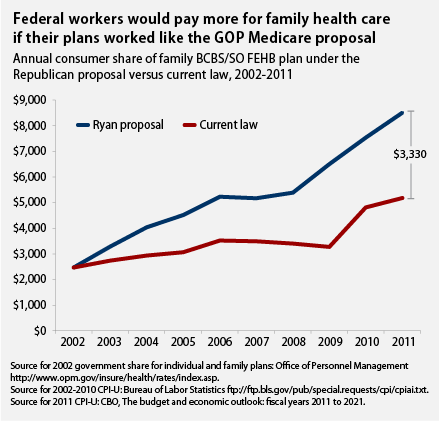
We examined what would happen if FEHBP had operated like the Republican Medicare proposal over the last decade. We used data from the Office of Personnel and Management to look at the annual premiums for federal workers enrolled in the Blue Cross Blue Shield Service Benefit Plan (Standard Family and Standard Individual). We chose this plan because nearly 60 percent of those enrolled in FEHBP have Blue Cross Blue Shield, and the Standard Option is the most popular FEHBP plan. We increased government support for the individual and family plans by the rate of growth in the CPI-U index from 2002 to 2011. We then compared the difference between the government’s share and the actual total premium in each year—which is the amount the beneficiary would pay—under the Republican proposal and the real FEHBP.

The result: A typical federal worker, or member of Congress, enrolled in family coverage in the Blue Cross Blue Shield Standard Option, would have had to pay an additional $3,330.36 for the same level of coverage they have today. Those with individual coverage would have had to pay $1,555 more.
By: Nicole Cafarella, Payment Reform Manager and Policy Analyst and Tony Clark, Policy Analyst, Center for American Progress, April 27, 2011
Governor Walker’s Misleading Claims On Medicaid
Wisconsin Governor Scott Walker painted a misleading picture of Medicaid in his New York Times op-ed on Friday. Medicaid is neither obsolete nor inflexible and changing it to a block grant, as the House Republican budget that Walker supports would do, would significantly harm the millions of seniors, people with disabilities and children who rely on it every day.
Governor Walker says Medicaid is obsolete because it is biased toward covering people in nursing homes rather than their own homes. In fact, Medicaid is moving in precisely the opposite direction. In 1990, just 13 percent of Medicaid spending on long-term care went for care in the community rather than in an institution. By 2009, the figure was 43 percent. That’s a great example of how Medicaid is changing with the times.
Moreover, health reform, (i.e., the Affordable Care Act) provides several new options to speed this trend along and continues funding for the “Money Follows the Person” program, in particular, which moves people from nursing homes back to the community. With health reform’s new options and funding, progress will likely continue. That won’t happen under the House Republican budget plan, which would sharply reduce funding for Medicaid and convert the program to a block grant.
My colleagues, Edwin Park and Matt Broaddus, have shown how risky a block grant is for states. If the House Republican block grant proposal had been in place starting in 2000, their analysis shows, in 2009 Wisconsin would have received 40 percent less in federal funds – nearly $1.6 billion in that year alone. With such a sharp drop in federal funds, the state would have been ill-equipped to deal with a recession or even to meet the ongoing needs of an aging population.
Governor Walker claims the success of the Children’s Health Insurance Program (CHIP) and state Medicaid demonstration projects show that states could do well under a Medicaid block grant, but he’s wrong on both counts:
CHIP, which does operate under a structure similar to a block grant, has a narrower purpose than Medicaid, as noted in a recent brief from the Kaiser Commission on Medicaid and the Uninsured. It covers far fewer children than Medicaid and covers children in families with higher incomes. Moreover, in the past, some state CHIP programs did run short of funds and had to freeze enrollment and set up waiting lists.
As to Medicaid demonstration projects, they allow states to cover people who are ordinarily not eligible for Medicaid (such as low-income, childless adults) or services that aren’t usually covered (such as short-term, or “respite,” care for families with children with complex medical conditions) as long as they don’t spend more federal funds than they otherwise would have received. This is nothing like the Ryan block grant, which would slash the federal funds that states would otherwise get to help them run their programs, not hold federal funds steady.
By: Judy Solomon, Center on Budget and Policy Priorities, April 25, 2011
RyanCare vs. The Public Option
If you want to understand why the budget debate so infuriates people who actually care about deficits — and, in particular, people who actually care about health-care spending — consider this: The central health-care reform in Paul Ryan’s budget, the one that’s got him so many plaudits for courage, would actually increase costs. The health-care reform that progressives have been pursuing for more than two years would cut them. And yet calling for Medicare to be privatized and voucherized is considered serious, while calling for a public option is considered tiresome. But let’s go to the tape.
Back during the health-care reform fight, the Congressional Budget Office looked at the likely effect of adding a public option that paid Medicare rates. “In total, a public plan based on Medicare rates would save $110 billion over 10 years,” the agency concluded. Importantly, the savings would come because premiums would be lower. The basic mechanism here is not complicated: Just as you get better deals by shopping at a mega-retailer like Wal-Mart, you get better deals by working with a mega-insurer like Medicare. Size matters.
As for Ryan’s plan, CBO’s take was just the opposite. “Under the proposal,” they said, “most elderly people would pay more for their health care than they would pay under the current Medicare system.” That is to say, health-care costs go up. Now, federal health-care spending goes down, as seniors are paying 70 percent of their costs out-of-pocket rather than 30 percent. Or, in CBO-ese, Medicare beneficiaries “would bear a much larger share of their health care costs than they would under the current program.” Of course, back in the real world, seniors are going to react poorly to being unable to afford health-care insurance, and those savings won’t manifest.
But even putting that aside, it makes for a very stark contrast. The progressive reform that won’t happen would cut health-care costs. The conservative reform that won’t happen would increase health-care costs. One idea makes insurance cheaper and one makes it more expensive. And yet the idea that makes insurance cheaper is pretty much off the table, while the idea that makes it more expensive — and that almost certainly wouldn’t work — is considered a very serious proposal worthy of brow-furrowing debate.
By: Ezra Klein, The Washington Post, April 25, 2011
The Right’s Criticism of Obama On Japan And The Budget Ring Hollow
President Obama’s not acting as a leader. That’s what the right will tell you. On Saturday, the president talked about women’s history month and the need for women to receive the same on the dollar as a man. (Note to self: we obviously haven’t come a long way baby, Gloria Steinem better keep that bra handy to be burned again). And then, the president had the audacity to go golfing! And select his picks for the NCAA tournament! The shame of it!
Those on the right will argue that the president is not leading this nation, nor his Congress because he didn’t speak on the budget, hasn’t presented himself before Congress on the budget and didn’t address Japan or Libya in his Saturday radio address. And of course, how dare he take a day off during all of this that is going on in the world!
What they won’t tell you is how that radio address is usually prerecorded, often days before. What they won’t tell you is how the president met with Democratic leaders in the Senate regarding the budget last week. What they won’t tell you is that just 24 hours before this radio address, the president spoke of Japan and of Libya. What they won’t tell you is how the United States has sent money, resources, and our Navy, arguably the best in the world, to assist Japan at this time. What they won’t tell you is how the president has a leader in Secretary of State Hillary Clinton, who is discussing along with our allies internationally, the U.N. and NATO our next steps in Libya; which even a Republican Senator, Richard Lugar, stated we must approach very cautiously or we end up in a longterm military problem in Libya, which we clearly can’t afford being involved in two wars already.
What does the right want from this man? If the president had spoken about Japan on Saturday as well as Friday would that have stopped their nuclear power plants from having four explosions, two fires, and leaking radiation at 400 times the level a human should be exposed to it? Would he have stopped the 140,000 people in a 20 mile radius who were told to stay home, work, please don’t go outside? Maybe if he had spoken about Japan a few weeks ago he could have single handedly stopped the earthquake and tsunami, right!?!! And of course, speaking about Libya, he could stop the madman at the helm, their leader, their dictator!?!
Nah, he can’t do that. He’s just the president folks; although with the enormous responsibilities the right lay upon his shoulders you’d think he was God; who I am told, took the seventh day off. The question is, did he go golfing?
By: Leslie Marshall, U.S. News and World Report, March 16, 2011
Share This Blog


 Unknown Feed
- An error has occurred; the feed is probably down. Try again later.
 mykeystrokes.com
You must be logged in to post a comment.