“The Wasted Life Of Fred Phelps”: It’s Hard To Mourn A Monster
And what shall we say now that the monster has died?
His estranged sons Mark and Nate told the world just a few days ago that their 84-year-old father, Fred Phelps, was in the care of a hospice and “on the edge of death.” Thursday morning, he went over the edge.
The senior Phelps, of course, was the founder of Westboro Baptist “Church” in Topeka, KS. He was the “God hates” guy. As in “God Hates China” (its divorce rates are too high), “God Hates Islam” (for being a false religion), “God Hates Qatar” (for being rich) “God Hates The Media” (for saying mean things about Westboro), “God Hates Tuvalu” (for having too many holidays), “God Hates America” (for tolerating homosexuality) and, of course, most notoriously, “God Hates Fags” — Phelps’ odious word for gay men and lesbians.
He was also the man who applauded the deaths of American soldiers and picketed their funerals, under the dubious formulation that their dying represented God’s judgment upon this country.
Westboro is a tiny “church” — hate group, actually — said to draw its membership almost exclusively from Phelps’ extended family. His sons say Phelps was excommunicated from it last year for some reason, which the “church” refused to confirm or deny, saying its “membership issues are private.” For what it’s worth, last week Phelps was conspicuous by his near absence from Westboro’s website, which once displayed his words and image prominently.
Now the monster is gone. What shall we say?
The people hurt and maligned by Phelps didn’t wait for his actual expiration to begin answering that question. They started days ago when his sons announced that his end was near. One woman tweeted about Death needing rubber gloves to touch the body. Another woman set up a “Fred Phelps Death Watch” on Facebook, the tone of which can be inferred from one posting depicting feces in a toilet as a photo of Phelps in hospice care.
After his death, one person tweeted the hope that “his final hours were filled with immense physical pain and horrifying hallucinations.”
You can hardly blame people for not being prostrate with grief. This man cheered the lynching of a young gay man in Wyoming. He turned the funerals of American military personnel into circuses. It is hard to imagine anyone more loathsome, despicable and justifiably reviled than he.
And yet it is also hard not to feel saddened by this reaction, diminished by it.
If one is a Christian as Phelps claimed to be, one may hear the voice of Jesus arising from conscience: “A new command I give you: Love one another.” And you may demand an exemption from that command, because being asked to love the spectacularly unlovable Phelps is just too much. But, if you love only the lovable, what’s the point? What does that say or prove? Indeed, loving the unlovable pretty much constitutes God’s job description.
Even beyond the obligations imposed by faith, though, there is something troubling in the idea that some of us willingly become what we profess to abhor, adopt extremist hatred in protest of extremist hatred. As Martin Luther King famously put it, “Darkness cannot drive out darkness; only light can do that. Hate cannot drive out hate; only love can do that.”
It is hard to imagine that anyone beyond, perhaps, his immediate family, is sorry Fred Phelps is dead. And that is probably the truest barometer of his life and its value. But as most of us are not sorry, some of us are not glad, either. What we feel is probably best described as a certain dull pity.
Phelps was given the gift, the incandescent miracle, of being alive in this world for over 80 years — and he wasted it, utterly.
If God hates anything, surely God hates that.
By: Leonard Pitts, Jr., Opinion Writer, Miami Herald; Published in The National Memo, March 24, 2014
“Religion Is No Excuse for Bigotry Against Women”: Corporations Have No Soul, And They Certainly Don’t Have A Relationship With God
This Tuesday, the U.S. Supreme Court will hear arguments in two consolidated cases, Sebelius v. Hobby Lobby Stores and Conestoga Wood Specialties v. Sebelius, on the government’s authority to require employers to provide health care coverage that includes birth control and other pregnancy-related services under the Affordable Care Act.
The owners of two for-profit corporations, Hobby Lobby Stores and Conestoga Wood Specialties Corp., claim their Christian religious beliefs justify withholding contraception coverage from their employees, never mind what their employees believe.
Hobby Lobby and Conestoga Wood Specialities are not the only employers seeking the legal right to restrict their women employees’ access to birth control. Some 100 companies or nonprofit organizations — NOW calls them the Dirty 100 — have sued the United States Government for that same power.
Two issues raised by these lawsuits are receiving a lot of attention: First, can a corporation claim religious freedom under the First Amendment? Second, can a corporation block its employees from at least some forms of contraception on the grounds they are abortifacients? I’ll comment on those in a moment, but first I want to pause over a third issue: Can a corporation use its supposed Christian religion to justify discriminating against its women employees?
I want to propose that we lay to rest, once and for all, the tired old I’m-a-bigot-because-God-wants-it argument. Think about it. Proponents of discrimination have routinely used religion to justify their hurtful policies: two shameful examples are slavery in the United States and segregation in the Deep South.
More recently, religious claims were the driving force behind California’s Proposition 8, which sought to prohibit same-sex marriages. But these arguments have been thoroughly discredited. We have progressed as a society to the point where the use of religion to justify excluding, demeaning or discriminating against whole groups of people is roundly condemned, and rightly so. The idea of Hobby Lobby Stores, Conestoga Wood, or any of the Dirty 100 using religion as an excuse to block women’s access to birth control should be no less condemned.
As to whether Hobby Lobby Stores or Conestoga Wood can claim religious freedom SCOTUSblog summarized what’s at stake.
At the level of their greatest potential, the two cases raise the profound cultural question of whether a private, profit-making business organized as a corporation can “exercise” religion and, if it can, how far that is protected from government interference. The question can arise — and does, in these cases — under either the First Amendment’s Free Exercise Clause or under a federal law, the Religious Freedom Restoration Act, passed by Congress in 1993.
In a manner of speaking, these issues pose the question — a topic of energetic debate in current American political and social discourse — of whether corporations are “people.” The First Amendment protects the rights “of the people,” and the 1993 law protects the religious rights of “persons.” Do profit-making companies qualify as either?
As an aside, I have to wonder, if the Supreme Court decides that a corporation is a “person” with religious freedom under the First Amendment, where might that leave the status of women as “persons” with the right to equal protection of the law under the Fourteenth Amendment? In any event, Caroline Mala Corbin, a law professor at the University of Miami, succinctly rejected the idea of corporations as having the capacity for religious belief. As she said, “For-profit corporations do not and should not have religious rights. They have no soul, and they certainly don’t have a relationship with God.”
So, what about the claim that Hobby Lobby Stores and others in the Dirty 100 are making, that some forms of contraception are actually abortifacients? Two summaries by the National Partnership for Women & Families (here and here) are worth reading, and I’d be interested to know if you have the same reaction that I did when I read them.
These arguments would be laughable if the men running the Dirty 100 entities weren’t so deadly serious about blocking women’s access to life-saving health care. Because that’s what contraception is: life-saving. Unintended pregnancy is highly associated with infant and maternal mortality. Unintended pregnancy is also a significant risk factor for domestic violence.
So when these guys start saying that they have to, just have to, block women’s access to safe and effective contraception because they’re worried about the “lives” of the zygotes, I want to say: Seriously?
You are going to claim to be pro-life but ignore infant mortality? And maternal mortality? You are going to claim to be confused and worried about the fertilized egg, and the implantation, and the uterine wall, but ignore the intimate partner violence that accompanies unintended pregnancy? What business do you have talking about women’s bodies — as if we are not in the room — in the same way one might talk about, say, whether robots are more like androids or more like appliances? Seriously.
Let’s review some facts. Some 99 percent of sexually active women, including 98 percent of sexually active Catholic women, use contraception at some point. According to the National Partnership, an estimated 17.4 million women need subsidized services and supplies because they are unable to access or purchase contraceptive services and supplies on their own. And more than half of young adult women say cost concerns have led them to not use their birth control method as directed.
The Guttmacher Institute has found that about half (51 percent) of the 6.6 million pregnancies in the United States each year (3.4 million) are unintended. What’s more, the 19 percent of women at risk who use contraception inconsistently or incorrectly account for 43 percent of all unintended pregnancies.
Yet, in the face of these facts, Hobby Lobby and the others in the Dirty 100 want to restrict women’s access to this essential preventive care because of the claim that “zygotes are people too.”
If that’s the best they can do, they should surely lose this appeal. Of course, the case is before Chief Justice John Robert’s Supreme Court, which ushered in the era of corporations as people with the Citizens United case, and is widely considered the most politically active since the earliest days of our republic. So never say never. But whatever the Supreme Court does, I know what I’m not going to do: give my business or my money to Hobby Lobby or any of the other Dirty 100 that practice similar gender bigotry.
You can take action too: Click here to sign our petition telling them their bias is not acceptable.
By: Terry O’Neil, President, National Organization for Women; The Blog, The Huffington Post, March 21, 2014
“From Backyard Barbeque To Food Fight”: CPAC, The Right-Wing Woodstock Or A Bad Family Reunion?
Like at a family reunion, the infighting at this year’s Conservative Political Action Conference (CPAC) started long before anybody arrived.
First, the group American Atheists announced that it would be sponsoring a booth at the conference, with the goal of bringing conservative nonbelievers “out of the closet.” The religious right was not pleased.
“CPAC’s mission is to be an umbrella for conservative organizations that advance liberty, traditional values and our national defense,” said the Family Research Council’s Tony Perkins. But he made clear that atheists would certainly not fit under his umbrella: “Does the American Conservative Union really think the liberties and values they seek to preserve can be maintained when they partner with individuals and organizations that are undermining the understanding that our liberties come from God?” he asked. Good question.
So, the American Conservative Union, which organizes CPAC, gave the atheist group the boot. In response, the atheists showed up anyway to debate attendees in the hallway.
Then there was the perennial problem of the gays. In 2011, religious right groups including the FRC boycotted CPAC after the ACU allowed the conservative LGBT group GOProud to cosponsor the event. Once again, the establishment sided with the religious right and for the next two years banned GOProud from participating. This year, ACU offered a “compromise” in which GOProud was allowed to attend the event but not to so much as sponsor a booth in the exhibition hall. The “compromise” was so insulting that one of GOProud’s founders quit the organization’s board in protest.
But what about the people who were too embarrassingly far-right for CPAC? Not to worry, there’s no such thing.
Although the atheist and LGBT groups were too far off-message for the ACU, it did allow the anti-immigrant group ProEnglish to sponsor a booth at CPAC. Just a quick Google would have told the conference organizers that ProEnglish is run by a zealous white nationalist, Bob Vandervoort. In fact, CPAC’s organizers might have recognized Vandervoort’s name from the uproar his inclusion in the event caused in 2012 and 2013.
Now, just because the ACU was ready to welcome anti-immigrant extremists doesn’t mean that that was enough for immigrant bashers. A group of anti-immigrant and anti-Muslim activists who were worried that CPAC was going too soft on their issues organized an alternative conference across the street. One of their concerns was the perennial conspiracy theory that ACU member Grover Norquist is a secret Muslim Brotherhood agent. Another is that CPAC dared to hold a panel featuring immigration reform proponents.
They shouldn’t have worried. Three days of speeches on the CPAC main stage made clear that many prominent conservative activists have no intention of moderating their stance on immigration reform. Donald Trump told the audience that immigrants are “taking your jobs,” Rep. Michele Bachmann said she wouldn’t even consider immigration reform until they “build the danged fence,” and Ann Coulter, never one to disappoint, suggested that if immigration reform passes “we organize the death squads for the people who wrecked America.” Then, there was One America News anchor Graham Ledger, who used the CPAC podium to claim that because of immigration, schools no longer teach “the American culture.”
To be fair, CPAC did make some efforts at opening the Republican umbrella, hosting a panel on minority outreach off the main stage. But the gesture would have been slightly more meaningful if anybody had bothered to show up.
Any family has its squabbles. But this awkward backyard barbeque has turned into a full-fledged food fight.
By: Michael B. Keegan, President, People For The American Way; The Huffington Post Blog, March 11, 2014
“The Right Defends A New Jim Crow”: 50 Years Since The Civil Rights Act, Wingnuts Still Don’t Get It
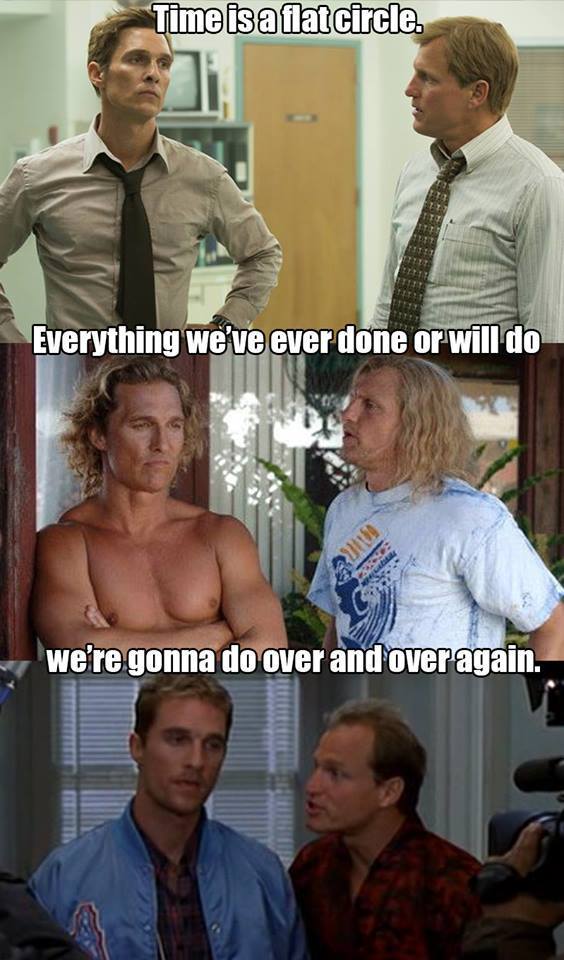
Watching the debate over Arizona’s SB 1062 (better known as the state’s anti-gay Jim Crow law) unfold this past week, I couldn’t help but think of the already iconic line from Matthew McConaughey’s “True Detective” character Rust Cohle: “Time is a flat circle.” As is always the case with the nihilistic and willfully esoteric Cohle, it’s not entirely clear what he’s trying to say with the metaphor, but we get the gist: Like Nietzsche’s “eternal return,” Cohle’s flat circle theory holds that all of us are destined to relive every moment of our conscious lives, forever. It’s as if we all were stuck in the late Harold Ramis’ “Groundhog Day,” but instead of repeating a single day, we repeat our entire lives.
Beyond the fact that, like many others, obsessing over “True Detective” has increasingly become the chief way I spend my free time, Arizona’s brief foray into the politics of segregation reminded me of the flat circle quote because I had recently seen Bryan Cranston’s Broadway debut, “All the Way,” in which the “Breaking Bad” star plays former president Lyndon B. Johnson during the historic period between Kennedy’s assassination and Johnson’s reelection, a time when the 36th president was working feverishly to ensure the passage of the Civil Rights Act of 1964. The play is good and Cranston is great, but what was most striking throughout was how much Johnson’s opponents then sounded like SB 1062’s supporters today. It was, as Cohle would say, some “heavy shit.”
The similarities weren’t merely superficial, either. Sure, the play, written by Pulitzer prize-winning playwright Robert Schenkkan (who obviously did his homework), was littered with hysterical charges of “fascism” and “socialism” and “big government” from no-name Dixiecrats that most of us never knew or were happy to forget. And of course these moments brought to mind much of the anti-Obamacare rhetoric that has emanated from conservatives during the past five years. But the parallels went deeper than that. It wasn’t just the language that sounded so familiar, but the logic behind it, too. Whether conservatives were defending Jim Crow proper or the Southwest’s latest variant, their worldview, all these years later, was disturbingly unchanged.
To explain what I mean, allow me to cite two of conservatism’s leading lights: Kentucky Sen. Rand Paul and all-around media mogul Glenn Beck.
As the opposition to SB 1062 increased in fervency and numbers, the usually loquacious Paul was, unlike his fellow Senate Republican John McCain (who opposed the bill), deafeningly mute. Anyone familiar with Paul’s history knows why: Because the obvious presidential aspirant wanted to avoid reminding people of the unfortunate 2010 interview with Rachel Maddow in which he stated that, even today, he would not support the government-run dismantling of Jim Crow. “I don’t want to be associated with those people,” Paul said, referring to white supremacists who’d bar blacks from their restaurants, “but I also don’t want to limit their speech in any way…” Paul’s orthodox libertarianism told him that the freedom to discriminate was too valuable, too sacred, to let the federal government stand in its way. Like Sen. Barry Goldwater did in 1964, when he voted against the Civil Rights Act, Paul argued that the Constitution had no room for anti-discrimination.
Roughly four years later, Glenn Beck made a similar argument, this time in defense of SB 1062. After doing his best impression of Hamlet, grappling aloud with his competing interest to not be a bigot while on the other hand maintaining allegiance to his understanding of liberty, Beck cut to the chase, telling his coworkers that he could only support Arizona’s bill, because “freedom is ugly.” Like Paul, Beck was sure to make clear that he held no sympathy for anyone who would ban LGBTQ people from their premises. But also like Paul, Beck had no choice but to conclude that the freedom to ostracize and discriminate was, in part, what the American experiment was all about. “I don’t like that world,” Beck said, “but that’s freedom! That’s freedom! Freedom is ugly. It’s ugly.”
High-profile though they may be, Beck and Paul are hardly the only conservatives who still cling to a vision of freedom that many Americans wrongly thought was swept into Reagan’s “ash-heap of history” decades before. Tucker Carlson — who, if Paul is to be Goldwater, we must describe as today’s version of the braying, segregationist Dixiecrats — was adamant in his defense of SB 1062, saying on Fox News that opponents of the bill were advocating for “fascism” and had gone “too far” in their quest to prevent state-sanctioned bigotry. “Everybody in America is terrified to tell the truth,” Carlson warned, “which is, this is insane, this is not tolerance, this is fascism.” Tellingly, when his sparring partner, Fox’s house liberal, Alan Colmes, asked Carlson whether he would have supported the Civil Rights Act, the editor of the Daily Caller could only respond by saying, “Don’t bring [that] into this,” with a sneer.
Even conservatives who are more intellectually inclined than Beck, Paul and Carlson put forward a defense of SB 1062 that could easily and quickly be adopted to oppose the federal government’s dismantling of Jim Crow. Ilya Shapiro of Cato, libertarianism’s premiere think tank and ostensible guardian of liberty for all, wrote, “I have no problem with SB 1062.” Repeating an argument that was offered by Goldwater, Paul, Beck and Carlson, Shapiro maintained that those who would be discriminated against, were SB 1062 to pass, should simply trust that the free market would punish bigots and, eventually, guarantee their liberty. “[P]rivate individuals should be able to make their own decisions on whom to do business with and how – on religious or any other grounds,” Shapiro wrote. “Those who disagree can take their custom elsewhere and encourage others to do the same.”
The fact that this very same logic recently undergirded a century of Jim Crow seemed to escape Shapiro. Either that or he, like W. James Antle III of the American Conservative, was content to dismiss comparisons to Jim Crow on the grounds that Arizona is not the Jim Crow South and 2014 is not the mid-’60s. “People often argue for or against the civil-rights laws of the 1960s on the basis of abstract principles,” Antle wrote, “but they were in fact a reaction to a very specific set of circumstances.” (This is an argument that, more than anything else, raises the question as to whether this is the first time Antle’s come into contact with an analogy.) Perhaps Shapiro, like Antle, was content to support the bill not because it wouldn’t give the government’s imprimatur to homophobia, but because such an outcome is, in their minds, “not very likely.” After all, what’s a little discrimination in the grand scheme of things?
If we put all these and many other conservative defenses of SB 1062 together, it’s hard not to reach a clear and unsettling conclusion: While conservatives themselves have largely given up the racism that coursed through a previous generation’s defense of Jim Crow, conservatism itself has learned no enduring lesson from the Civil Rights Movement and has made no ideological adjustments as a result. Indeed, National Review’s Kevin Williamson recently declared that Goldwater’s brief against the Civil Rights Act “has been proved correct” for worrying that “expanding the federal mandate … would lead to cumbrous and byzantine federal micromanagement of social affairs.” Going further, National Review’s editors, writing on the 50-year anniversary of the March on Washington (which NR at the time opposed) would only concede that the magazine was wrong to oppose the Civil Rights Movement because its principles “weren’t wrong, exactly” but were instead “tragically misapplied.”
For all of her many flaws, Jan Brewer decided on Wednesday to refrain from applying her conservative “principles” in such a “tragic” manner, opting instead to veto the bill and maybe — just maybe — push her party that much closer to joining the rest of us in the 21st century. And while many conservatives received the veto as a crushing disappointment, or even a step toward “slavery,” I’d caution my right-wing fellow citizens against slipping into outright despair. If the events in Arizona have taught us nothing else, they’ve shown that time is indeed a flat circle; future right-wingers will have plenty of chances to keep getting this most basic question of freedom terribly, terribly wrong.
By: Elias Isquith, Salaon, March 1, 2014
“Counting Dollars And Cents”: For Whatever Reason, Jan Brewer Does The Right Thing
The writing was on the wall all week. Arizona Gov. Jan Brewer had no choice but to veto SB 1062, which would have let businesses discriminate against gay patrons (and presumably others) on religious grounds. The veto was demanded by businesses: from the NFL, sponsors of the Arizona-bound 2015 Super Bowl, to Apple to American Airlines to JPMorgan Chase. Even GOP lawmakers who voted for the bill began quailing and taking back their votes shortly after casting them.
Brewer, who has shown independence from her Tea Party base before, particularly on accepting Medicaid expansion, proved to be up to this challenge, too.
The Arizona Tea Party governor vetoed the bill, she said, because of its “unexpected and unintended consequences. The legislation seeks to protect businesses,” she wrote, “yet the business community overwhelmingly opposes the proposed law.” The bill, she said, “could create more problems than it purports to solve.”
Indeed. The proposed Arizona law shows how quickly America’s corporate leaders, and even some Republicans, have counted dollars and counted votes and realized that power lies with gay people and their straight allies who can’t stand anti-gay bigotry – and won’t patronize those who are selling it.
Even as Arizona Republican politicians like Sens. John McCain and Jeff Flake declared their enduring fealty to the sanctity of man-woman marriage, they could oppose SB 1062 because of the business backlash. This is a stunning turnaround from 10 years ago, when Karl Rove encouraged Republicans to put anti-gay-marriage measures on state ballots to turn out the right and buoy George W. Bush’s reelection against John Kerry in 2004. There was no downside for Rove 10 years ago.
That was the same year that San Francisco Mayor Gavin Newsom became persona non grata even to some Democrats for legalizing gay marriage in San Francisco. From Dianne Feinstein to Barney Frank, Newsom got pummeled for promoting too much gay freedom too soon. But just 10 years later, a far-right governor of a changing but still conservative state thinks she has to veto this gay Jim Crow law that businesses are smart enough to oppose.
Let’s celebrate. But let’s also look plainly at how Democrats have won the culture war but are still fighting a grim conflict over economic populism – including, sometimes, against other Democrats. I look forward to the day when businesses lobby for a hike in the minimum wage and universal preschool and higher tax rates for those at the very top, and Republicans like Jan Brewer face the fact that they have to relent. It may be a long time coming. But let this victory remind us what a difference even 10 years can make, on an issue that was once a loser for Democrats. May we catch up on issues of poverty, income inequality and economic opportunity just as quickly.
By: Joan Walsh, Editor at Large, Salon, February 27, 2014
Share This Blog


 Unknown Feed
- An error has occurred; the feed is probably down. Try again later.
 mykeystrokes.com