“The Case For Barack Obama”: A Record Of Accomplishment That Bests Any President Since Roosevelt
I decided to support Barack Obama pretty early in the Democratic primary, around spring of 2007. But unlike so many of his supporters, I never experienced a kind of emotional response to his candidacy. I never felt his election would change everything about American politics or government, that it would lead us out of the darkness. Nothing Obama did or said ever made me well up with tears.
Possibly for that same reason, I have never felt even a bit of the crushing sense of disappointment that at various times has enveloped so many Obama voters. I supported Obama because I judged him to have a keen analytical mind, grasping both the possibilities and the limits of activist government, and possessed of excellent communicative talents. I thought he would nudge government policy in an incrementally better direction. I consider his presidency an overwhelming success.
I can understand why somebody who never shared Obama’s goals would vote against his reelection. If you think the tax code already punishes the rich too heavily, that it’s not government’s role to subsidize health insurance for those who can’t obtain it, that the military shouldn’t have to let gays serve openly, and so on, then Obama’s presidency has been a disaster, but you probably didn’t vote for him last time. For anybody who voted for Obama in 2008 and had even the vaguest sense of his platform, the notion that he has fallen short of some plausible performance threshold seems to me unfathomable.
Obama’s résumé of accomplishments is broad and deep, running the gamut from economic to social to foreign policy. The general thrust of his reforms, especially in economic policy, has been a combination of politically radical and ideologically moderate. The combination has confused liberals into thinking of Obamaism as a series of sad half-measures, and conservatives to deem it socialism, but the truth is neither. Obama’s agenda has generally hewed to the consensus of mainstream economists and policy experts. What makes the agenda radical is that, historically, vast realms of policy had been shaped by special interests for their own benefit. Plans to rationalize those things, to write laws that make sense, molder on think-tank shelves for years, even generations. They are often boring. But then Obama, in a frenetic burst of activity, made many of them happen all at once.
Bipartisan panels of economists had long urged Medicare to reform its payment methods to curb perverse incentives by hospitals and doctors to run up costs as high as possible; Obama overcame fierce resistance in Congress in order to craft, as part of Obamacare, a revolution in paying for quality rather than quantity. He eliminated billions of dollars in useless subsidies to banks funneling (at no risk) government loans to college students. By dangling federal public-education grants, Obama unleashed a wave of public-school reform, over the objections of the most recalcitrant elements of the teachers union movement. And he forced Wall Street to accept financial regulations that, while weaker than ideal, were far tougher than anybody considered possible to get through Congress.
It is noteworthy that four of the best decisions that Obama made during his presidency ran against the advice of much of his own administration. Numerous Democrats in Congress and the White House urged him to throw in the towel on health-care reform, but he was one of very few voices in his administration determined to see it through. Many of his own advisers, both economists steeped in free-market models and advisers anxious about a bailout-weary public, argued against his decision to extend credit to, and restructure, the auto industry. On Libya, Obama’s staff presented him with options either to posture ineffectually or do nothing; he alone forced them to draw up an option that would prevent a massacre. And Obama overruled some cautious advisers and decided to kill Osama bin Laden.
The latter three decisions are all highly popular now, but all of them carried the risk of inflicting a mortal political wound, like Bill Clinton’s health-care failure and Jimmy Carter’s attempted raid into Iran. (George W. Bush, presented with a similar option, did not strike bin Laden.) In making these calls, Obama displayed judgment and nerve.
A year ago, I wrote about the pervasive disillusionment felt by Obama’s supporters. It is a sentiment that has shadowed every Democratic president since Franklin Roosevelt, and even Roosevelt provoked long bouts of agony and disillusionment among his supporters. All were seen by many Democrats at the time as failures, weaklings, or unprincipled deal-makers. It’s true that all of them, including Obama, have made terrible errors. What this tells us, though, is that we need some realistic baseline against which to measure them.
Obama can boast a record of accomplishment that bests any president since Roosevelt, and has fewer demerits on his record than any of them, including Roosevelt. The only president that comes close in gross positive accomplishment is Lyndon Johnson, whose successes were overwhelmed by his failures to such a degree that he abandoned his reelection campaign. The immediacy of the political moment can — and usually does — blind us. (In the aftermath of September 11, 2001, the wide and even bipartisan sentiment prevailed that George W. Bush was exactly the right sort of person we would want to have as president at that moment.)
The sense among Obama’s wavering supporters that he has failed rests upon a two-part indictment. The first and most potent is that he has presided over a weak economy. This line of attack on Obama became inevitable starting on approximately September 14, 2008, when the U.S. financial system imploded. The economists Carmen Reinhart and Kenneth Rogoff have established that financial crises wreak vastly deeper harm than regular recessions. Financial crises freak out consumers, and they freak out political elites in a way that creates a panicked stampede toward exactly the wrong sorts of policies (like reducing short-term deficits) that in turn makes the crisis even worse.
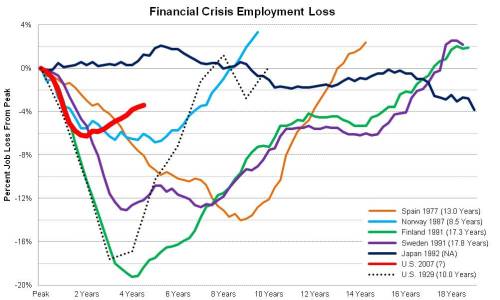
This panic has impeded Obama’s recovery measures. But the fact remains that, by the standards of a financial crisis, the United States suffered through a relatively shallow trough and has enjoyed a fairly rapid recovery. (Here is a chart laying out the comparison between the United States and other comparably afflicted economies.) Obama managed to stabilize the financial system and, through the stimulus, avert a total collapse in consumer demand.
But while America has suffered less since 2008 than other victims of a financial crisis, it has suffered. Obama’s notable success in containing the damage has not redounded to his benefit for another, even more historically durable reason: Voters tend to blame or credit incumbent politicians for the state of their lives utterly regardless of responsibility. This is not even limited to things like the economy, where politicians can affect the outcome. Voters reward or punish incumbents based on the weather or the success of local sports teams. Mitt Romney’s campaign theme attempting to assign all blame to Obama for the state of the economy is a clever manipulation of this long-standing form of irrationality. In 2004, Romney dismissed any attempt to blame George W. Bush for the decline of jobs under his watch as “poppycock.” In his most condescending tone, Romney explained that of course outside forces were to blame — those outside forces being the vastly milder 2001 recession — and that attempting to hold Bush responsible for the economic record of his term was sheer stupidity. Now Romney has made that very theme the central basis of his presidential campaign.
The second indictment of Obama is that he failed to redeem the broader vision of trans-partisan governance he campaigned on. The reason this happened is that the Republicans’ leadership in Congress grasped early on that its path to returning to power required Obama to fail, and that they could help bring this about by denying his initiatives any support. In a meeting before Obama’s inauguration reported by Time’s Michael Grunwald, the House Republican leadership instructed their members on exactly this strategy. GOP Senate Minority Leader Mitch McConnell has followed the same strategy. GOP House members and senators have admitted, some of them publicly, that their leadership prevailed upon them not to negotiate with Obama.
Partisan strife between Congress and the president has gone on for decades. In the past, members of Congress often opposed the president’s agenda, but they also believed that the voters would punish them if they failed to show accomplishments, and so they carefully balanced their substantive opposition with a sense of political self-preservation. What makes the Republican opposition different is that it rests upon a novel, and probably true, insight. Most Americans pay little attention to the details of policy. They rely upon a broad heuristic — if something has touched off an ugly and protracted battle, it is probably bad, but if both sides agree on it, it is probably good. Even many Sunday political talk-show chatterers and other blowhards use the same basic thought process. And so, as McConnell actually said out loud, “if the proponents of the bill were able to say it was bipartisan, it tended to convey to the public that this is O.K., they must have figured it out.” McConnell, in keeping with his Bond-villain habit of boasting openly about his nefarious intentions, actually announced in a prepared speech that his top political priority was to make Obama a one-term president.
The Republican strategy is perfectly clear and not even very well hidden. Yet many of us don’t accept it as a reality because it does not feel true. We instinctively hold the president, not Congress, responsible, another finding political scientists have measured. The hunger to attribute all outcomes to the president is so deep that the political elite take it on faith. Bob Woodward, who is justly famed as a reporter but whose opinions are interesting only as a barometer of Washington establishmentarianism, blamed Obama because Republicans turned down an extraordinarily favorable budget deal. “Presidents work their will — or should work their will,” Woodward declared, “on the important matters of national business.”
How can a president “work his will” in such a way as to force autonomous members of the opposite party controlling a co-equal branch of government to sacrifice their own calculated self-interest? It is a form of magical thinking, but a pervasive one. Which is exactly why the Republican strategy — making Obama’s promise to transcend partisanship fail by withholding cooperation — has worked.
Whether this strategy succeeds in its ultimate goal — returning the GOP to power in 2013 — depends on the election. In an unusual way, the success of Obama’s first term hangs in large part on his reelection bid, as a President Romney would probably kill his grandest achievement of providing health insurance to those Americans too sick or poor to acquire it in the marketplace. So any evaluation of Obama’s term before the election must be provisional.
What can be said without equivocation is that Obama has proven himself morally, intellectually, temperamentally, and strategically. In my lifetime, or my parents’, he is easily the best president. On his own terms, and not merely as a contrast to an unacceptable alternative, he overwhelmingly deserves reelection.
By: Jonathan Chait, Daily Intel, October 31, 2012
Share this:
- Share on Facebook (Opens in new window) Facebook
- Share on X (Opens in new window) X
- Share on Newsvine (Opens in new window) Newsvine
- Share on Tumblr (Opens in new window) Tumblr
- Share on Reddit (Opens in new window) Reddit
- Share on Pinterest (Opens in new window) Pinterest
- Share on LinkedIn (Opens in new window) LinkedIn
- Print (Opens in new window) Print
- Email a link to a friend (Opens in new window) Email
November 1, 2012 Posted by raemd95 | Election 2012 | Barack Obama, Congress, Economic Policy, Foreign Policy, Health Reform, Mitch McConnell, Politics, Republicans, Wall Street | 5 Comments
“Who Is This Guy Anyway?”: President Obama Calls Out Mitt Romney For His “Romnesia”
Sunday the Salt Lake City Tribune endorsed President Barack Obama and asked the $64 million question about former Gov. Mitt Romney, which is, “Who is this guy anyway?” The editorial answered its own question when it called Romney, the former liberal and former conservative and current moderate candidate, the “shapeshifting nominee”. In the first debate, a passive President Obama let Romney get away with statements the former governor made that night that contradicted assertions he made during the GOP nomination campaign. Last night and in the previous debate, the president challenged Romney’s flip flops, and the commander in chief scored big points.
To put it in the president’s terms, you have Rommesia if you previously opposed setting a date for U.S. withdrawal from Afghanistan and flip flopped last night by calling for the withdrawal of American troops from that war torn land by the end of 2014. Romney was the passive voice Monday night when he endorsed much of the president’s foreign policy agenda night, which makes you wonder why Romney is running and why anybody should vote to replace the current commander in chief. I half expected the challenger to end the debate Monday by announcing his withdrawal from the race because he agreed with so many of the president’s decisions.
The first candidate to bring up Russia last night was the president, which is odd because Romney believes that the former Soviet Union was our “No. 1 geopolitical foe.” I’m sure Romney’s foreign policy priority prompted a lot of chuckles from the party boys in the Forbidden City and from the amused mullahs in Tehran. If they were still alive, Osama bin Laden and the rest of the al Qaeda leaders would have laughed when they heard Romney’s claim that the terrorist organization was still a potent force.
Today is the first anniversary of the day when the new provisional government in Libya officially declared that they had ended Muammar Qadhafi’s tyranny. Last night, the president was effective in linking Romney’s policies with the failed presidency of George W. Bush. The difference between the president’s tactics in Libya and Bush’s approach to Iraq is the perfect illustration of President Obama’s superior performance. Bush’s defeat of Saddam Hussein resulted in the deaths of more than 4,000 brave young Americans. Working with the Libyan rebels, the current president got rid of Qadhafi without the loss of a single American life.
Point, set, and match to the president.
By: Brad Bannon, U. S. News and World Report, October 23, 2012
Share this:
- Share on Facebook (Opens in new window) Facebook
- Share on X (Opens in new window) X
- Share on Newsvine (Opens in new window) Newsvine
- Share on Tumblr (Opens in new window) Tumblr
- Share on Reddit (Opens in new window) Reddit
- Share on Pinterest (Opens in new window) Pinterest
- Share on LinkedIn (Opens in new window) LinkedIn
- Print (Opens in new window) Print
- Email a link to a friend (Opens in new window) Email
October 24, 2012 Posted by raemd95 | Election 2012 | Al Qaeda, Barack Obama, Foreign Policy, George W. Bush, Libya, Mitt Romney, Osama bin Laden, Politics, Russia | Leave a comment
“The Testosterone Effect”: How An Obama Victory Hurts Republican Men
In response to habitual conservative claims that polling firms are cooking the books in Obama’s favor, Jon Chait recently made the case that poll denialism was understandable, even if its reasoning was wrong.
A good deal of what undecided voters who are just now tuning in will learn about Romney is that he’s a loser disdained by fellow Republicans. Conservative rage over this fact may be utterly misplaced, but the sentiment itself is perfectly understandable.
The desire to vote with the winning team–regardless of party affiliation–is even stronger than Chait suggested. An essay in this weekend’s Sunday Review argues that all those discouraged Republican men are going to be even more depressed if Romney loses for psychological, rather than strictly political reasons.
Men who had voted for the losing presidential candidate, John McCain, suffered a big drop in their testosterone after hearing of his defeat. The scientists reported that the male McCain voters “felt significantly more controlled, submissive, unhappy and unpleasant.” The testosterone effect was “as if they directly engaged head-to-head in a contest for dominance” and lost, one researcher told a reporter when the study was published in 2009. The men who voted for Obama fared better. The researchers speculated that there might be an Obama baby boom.
No change, meanwhile, was observed in women’s testosterone levels. This evidence, as the author notes, suggests higher female voting rates may reflect the fact that women don’t let elections affect their self-worth. Pardoxically, it seems, hypercompetitive male behavior has made men less likely to fight for their own teams.
By: Simon van Zuylen-Wood, Washington Monthly Political Animal, October 7, 2012
Share this:
- Share on Facebook (Opens in new window) Facebook
- Share on X (Opens in new window) X
- Share on Newsvine (Opens in new window) Newsvine
- Share on Tumblr (Opens in new window) Tumblr
- Share on Reddit (Opens in new window) Reddit
- Share on Pinterest (Opens in new window) Pinterest
- Share on LinkedIn (Opens in new window) LinkedIn
- Print (Opens in new window) Print
- Email a link to a friend (Opens in new window) Email
October 8, 2012 Posted by raemd95 | Election 2012 | Barack Obama, Hormones, John McCain, Mitt Romney, Politics, Republican Male Voters, Republicans, Undecided Voters | 1 Comment
“Shut The Front Door”: Barack Obama Has Disappointed Bob Woodward
Here’s First Read’s account of the interview with Diane Sawyer granted by Bob Woodward about his latest book, which has set the Beltway aflame:
What’s particularly striking about the new Bob Woodward book is that, unlike his past works, he’s making an argument rather than trying to recreate and report on a past event and letting others draw the conclusions. Woodward’s argument here: Obama didn’t lead in the debt-ceiling debate. Woodward told ABC, per Political Wire: “President Clinton, President Reagan. And if you look at them, you can criticize them for lots of things. They by and large worked their will,” Woodward said.” On this, President Obama did not.” He added, “Now, some people are going to say he was fighting a brick wall, the Republicans in the House and the Republicans in Congress. Others will say it’s the president’s job to figure out how to tear down that brick wall. In this case, he did not.”
Now I obviously haven’t read Woodward’s book (though I have read David Corn’s authoritative account of the debt-limit battle, Showdown), and you have to figure that whatever it says Woodward wants to sell a lot of copies by providing one of those “even-handed” assessments that spread the blame for dangerous events widely. But as quoted, Woodward’s take on Obama’s “leadership” as compared to past presidents is just ridiculous.
Reagan “worked his will” sometimes by building a coalition of Republicans and “Boll Weevil” Democrats who would by and large be Republicans today, and sometimes by making the kind of compromises Republicans today would never consider. Clinton “worked his will” by getting enough Democrats in a Democratic-controlled Congress to vote for his crucial first budget (no Republicans voted for it); then outmaneuvered Newt Gingrich and company on subsequent budgets; then won re-election by a big margin. Yes, he compromised with Republicans on welfare reform and the 1997 Balanced Budget Agreement, but only after fighting them on both for a good while. And compared to today’s congressional Republican leaders, Newt Gingrich was a malleable pussycat.
It’s telling that Woodward seems to ascribe Obama’s “leadership gap” to tiny personal gestures and other psychological factors, which were somehow as responsible as what he accurately calls a “brick wall” of GOP obstructionism for the debt limit crisis. He should have “figured out” how to overcome a hard-core ideological commitment, reinforced by litmus tests and threatened purges, to oppose tax increases no matter what, even if the economy was collapsing or even if the stars fell and the sun exploded.
Sure, Obama could have averted or shortened the crisis by just surrendering. I don’t know if that’s what Woodward faults him for not “figuring out,” but it’s the logical implication.
I do just love this last sentence from the First Read piece:
Does the Woodward book on such an ugly inside the Beltway fight have legs in the swing states in these final days? We’ll see.
I have a mental image of a swing voter in Iowa or Virginia staring at the tube or pouring over Politico, and then ruefully concluding: “Barack Obama has disappointed Bob Woodward. That does it for me.”
By: Ed Kilgore, Contributing Writer, Washington Monthly Political Animal, September 10, 2012
Share this:
- Share on Facebook (Opens in new window) Facebook
- Share on X (Opens in new window) X
- Share on Newsvine (Opens in new window) Newsvine
- Share on Tumblr (Opens in new window) Tumblr
- Share on Reddit (Opens in new window) Reddit
- Share on Pinterest (Opens in new window) Pinterest
- Share on LinkedIn (Opens in new window) LinkedIn
- Print (Opens in new window) Print
- Email a link to a friend (Opens in new window) Email
September 11, 2012 Posted by raemd95 | Election 2012 | Barack Obama, Bill Clinton, Bob Woodward, Debt Ceiling, GOP, Politics, Republicans, Ronald Reagan, Swing Voters | Leave a comment
“The Right Policies, The Right Politics”: Seven Things President Obama Did Very Well In His Acceptance Speech
Game on, now. President Obama fired ’em up tonight and now all sides are ready to go officially on to the fall campaign which will be the visible manifestation of the “avalanche of money and advertising” which President Obama warned about. That onslaught will be punctuated three times in October by the presidential debates (oh I know, Joe Biden and Paul Ryan will spar once as well, but I’m talking about the main event). The president’s speech marked the last national moment before those debates and his best single chance to make his case to the country.
That case is getting mixed initial reviews from the punditverse, especially for lacking in programmatic specifics. Here are seven things he did right:
Working the values. For 20 years, winning Democrats have focused on the values of hard work and playing by the rules. They appeal to swing voters and they help inoculate the party of activist government from charges that they want to give hand outs to the undeserving poor at the cost of the suffering middle class. Obama repeatedly emphasized the formulation of hard work and equal opportunity, defining the American dream as “the promise that hard work will pay off; that responsibility will be rewarded; that everyone gets a fair shot, and everyone does their fair share, and everyone plays by the same rules.” And later: “We insist on personal responsibility and we celebrate individual initiative. We’re not entitled to success. We have to earn it.”
A balancing act. Democrats (not unreasonably) paint the GOP as a party that has been lost to rigid ideologues unwilling to compromise. In his speech tonight Obama worked to present a nuanced view of governance, not only explicitly saying that “no party has a monopoly on wisdom,” but on a couple of other instances acknowledging the limitations of his party’s animating philosophy of active government. He cautioned the party of FDR, for example, that “not every problem can be remedied with another government program or dictate from Washington.”
Choose or lose. Since the start of the campaign, Team Obama has been determined to not let this election simply devolve into a referendum on the president’s record. In their view, the president’s clearest path to victory was to turn it into a choice between two competing visions—and while the Romney campaign initially seemed intent on a referendum campaign, their selection of Rep. Paul Ryan as vice presidential nominee solidified the choice narrative. Obama drove that frame, mentioning the notion of a choice or voters choosing at least 10 times in the first half of the speech, which was the more policy-oriented part of it.
Commanding-in-chief. Obama saluted the military, not simply those currently serving but those who have come home and are still owed a debt of thanks from the nation they served. This section had the dual value of being the right policy but also the right politics, exploiting Romney’s silence regarding the troops last week. It’s true that voters won’t cast their ballots based on foreign policy issues, but this respect for the military becomes one factor shaping Americans’ overall view of Obama as president and commander in chief. And in the longer term, Obama has an opportunity to close the gap Democrats have had on national security issues for more than 30 years.
Map to the future. According to Democratic pollster Celinda Lake, focus group participants’ number one question for Obama had been where he wants to take the country in a second term. And while he may not have laid out a State of the Union-style policy blueprint, he set out signposts for what he wants to accomplish.
Sober poetry. The president has a well deserved reputation as an accomplished orator, but the nation’s mood and his own incumbency present a challenge to his instinct for a singing speech. He tempered it by emphasizing—in a manner reminiscent of John F. Kennedy and his campaign for a “New Frontier” of challenges—that he doesn’t promise an easy road. “The path we offer may be harder,” he told voters, “but it leads to a better place.”
No change on hope. Even in times that require a somber note, however, voters want aspiration and optimism. It’s a truism in politics that the most optimistic candidate wins the election and so Obama was wise to end on a note that acknowledged the tough times but expressed unalloyed optimism (though it might have been hard to hear over the roar of the crowd): “We draw strength from our victories, and we learn from our mistakes, but we keep our eyes fixed on that distant horizon, knowing that Providence is with us, and that we are surely blessed to be citizens of the greatest nation on Earth.” Amen.
By: Robert Schlesinger, U. S. News and World Report, September 7, 2012
Share this:
- Share on Facebook (Opens in new window) Facebook
- Share on X (Opens in new window) X
- Share on Newsvine (Opens in new window) Newsvine
- Share on Tumblr (Opens in new window) Tumblr
- Share on Reddit (Opens in new window) Reddit
- Share on Pinterest (Opens in new window) Pinterest
- Share on LinkedIn (Opens in new window) LinkedIn
- Print (Opens in new window) Print
- Email a link to a friend (Opens in new window) Email
September 7, 2012 Posted by raemd95 | Election 2012 | Barack Obama, Democratic National Convention, GOP, media, Middle Class, Military, Mitt Romney, Pundits, Veterans | Leave a comment
Pages
-
Join 943 other subscribers
Share This Blog


 Unknown Feed
- An error has occurred; the feed is probably down. Try again later.
Top Posts
- "A Democrat That Can Win Is What We Need": Translating Values Into Governance And Delivering The Goods
- "Democrats, Don’t Blow It": Ask Yourselves, Whom Would You Prefer To Name Future Supreme Court Judges?
- "Is He Is, Or Is He Ain't": Will A Birther Lawsuit Derail Ted Cruz?
- "Scott Walker Would Be A Very Dangerous President": Vicious And Vindictive, With An Attack Dog’s Contempt
- "Sorry, Teabaggers": America Really Loves These Liberal Policies
- "Never As Consistently Anti-Intervention As Advertised": Vetting Bernie: He Never Voted For Intervention In Iraq — Except Twice
- Affordable Care Act African Americans Bain Capital Citizens United Congress Conservatives Contraception Corporations Debt Ceiling Democracy Democrats Donald Trump Economic inequality Economy Foreign Policy Fox News George W. Bush GOP GOP Presidential Candidates Government Shutdown Gun Control Gun Violence Health Exchanges Health Insurance Hillary Clinton House Republicans Immigration Immigration Reform Iraq War ISIS Jeb Bush Jobs John Boehner John McCain Koch Brothers Lindsey Graham Marco Rubio media Medicaid Medicare Middle Class Middle East Minorities Mitch McConnell Mitt Romney National Security Newt Gingrich NRA ObamaCare Paul Ryan Politics Poor and Low Income Poverty Progressives Racism Rand Paul Republicans Rick Santorum Right Wing Ronald Reagan Rush Limbaugh Scott Walker SCOTUS Senate Spending Cuts Tax cuts Taxes Tea-party Teaparty Ted Cruz Terrorism uninsured Voter Suppression Wall Street Wealthy
Categories
Archives
April 2026 M T W T F S S 1 2 3 4 5 6 7 8 9 10 11 12 13 14 15 16 17 18 19 20 21 22 23 24 25 26 27 28 29 30 Twitter Timeline
Tweets by raemd95Blog Stats
- 339,025 hits
 mykeystrokes.com