Health Reform at Work Today and Tomorrow: Improvements That Began Last Year Will Continue
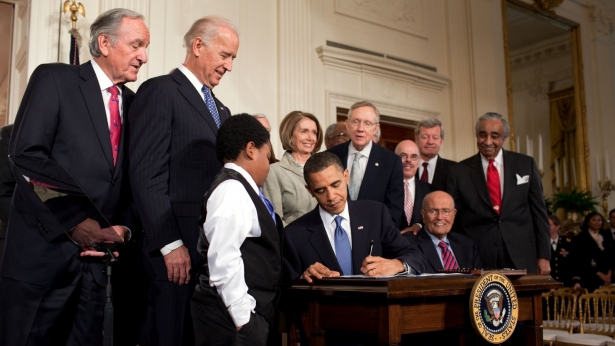
President Barack Obama is applauded as he signs the health care reform bill, on March 23, 2010, in the East Room of the White House in Washington. The bill includes many benefits for Americans who have health insurance today and those who have struggled to find and maintain health coverage.
2010 was a momentous year for the American health care system. In March, Congress passed—and President Barack Obama signed—landmark legislation that reforms the health insurance market, provides all Americans with affordable access to health coverage, and reduces the growth of health care costs.
The Department of Health and Human Services and other parts of the executive branch have begun to implement the new law in the subsequent 10 months. The Affordable Care Act, or ACA, includes many benefits for Americans who have health insurance today and those who have struggled to find and maintain health coverage. Many of these benefits came on-line in 2010.
Signature achievements include:
- Establishing pre-existing condition insurance plans in every state so that individuals with health problems who cannot find coverage in the regular market have a reliable source of coverage
- Requiring employer-sponsored health plans to offer coverage to the young-adult children of policyholders
- Helping employers with unpredictable health care spending for retired workers
- Providing more than 1 million rebate checks to Medicare enrollees who incurred high out-of-pocket prescription drug spending in 2010
- Prohibiting health insurance plans from denying coverage to children with pre-existing conditions
- Protecting individuals with high health care costs from the financial risk of absurdly low annual and lifetime limits on their benefits
- Prohibiting health insurance plans from rescinding coverage when a policyholder gets sick
These changes bring a new degree of stability and security to millions of Americans’ health coverage. And even more improvements are around the corner. Beginning this month, seniors will enjoy meaningful new benefits and significant improvements in their prescription drug coverage, while individuals and businesses will receive premium rebates from their insurance company when the insurers incur excessive administrative costs.
Specific improvements in 2011 include:
- Closing the Medicare prescription drug coverage gap. Seniors and people with disabilities who obtain prescription drug coverage through Medicare Part D will enjoy a new discount on brand-name and generic prescription drugs when they hit the so-called “doughnut hole” in their Part D benefits. Since the beginning of the program, enrollees have hit a gap in coverage when their total drug spending—including out-of-pocket costs and expenses covered by their Medicare Part D plan—exceeds a preset limit (currently $2,830). Patients then pay the total cost of their prescription drugs, without help from their drug plan, until their total drug expenses hit an upper limit and coverage kicks in again. With the new discount, people with drug spending high enough to hit the coverage gap will save almost $500 on average this year, while people with very high drug costs will save more than $1,500.
- Launching new prevention benefits for Medicare enrollees. Good coverage of preventive services helps seniors and other Medicare enrollees better manage their health. New benefits include coverage without cost-sharing for recommended preventive services (those that receive an “A” or “B” rating from the U.S. Preventive Services Task Force) and new coverage for a personal prevention plan.
- Increasing access to primary care. Medicare will pay primary care providers a 10 percent bonus payment, which offers a new incentive for physicians, nurses, and others to provide primary care services.
- Requiring insurers to provide high value for premium dollars. Beginning in 2011, insurers will pay rebates to policyholders—individuals and employers—when plan spending on clinical services falls below 80 percent of premium revenue in the individual and small group market, and 85 percent of premium revenue in the large group market.
Looking ahead, ACA provisions that will touch real people every day will continue coming on-line through 2011. These include providing more consumer information on healthy food choices by requiring chain restaurants and vending machines to provide nutritional data no later than March, and improving long-term care by sending enhanced federal Medicaid payments to support new state investments in community-based long-term care services starting in October. Tangible improvements will continue beyond this year, such as fully closing the coverage gap in Medicare Part D and improving Medicaid coverage for preventive care.
The Affordable Care Act’s most striking impact will come in 2014 when new health insurance exchanges launch, premium subsidies become available, and Medicaid coverage expands to include all low-income individuals regardless of family composition, age, or disability status.
These headline-grabbing changes in our health care system may be a few years down the road. But millions of Americans are already benefiting from the Affordable Care Act—and millions more will receive better care in the near future thanks to the changes in the new law.
By Karen Davenport | January 13, 2011-Center For American Progress. Photo: AP/Charles Dharapak
More Small Businesses Offering Health Care To Employees Thanks To Obamacare
The first statistics are coming in and, to the surprise of a great many, Obamacare might just be working to bring health care to working Americans precisely as promised.
The major health insurance companies around the country are reporting a significant increase in small businesses offering health care benefits to their employees.
Why?
Because the tax cut created in the new health care reform law providing small businesses with an incentive to give health benefits to employees is working.
We certainly did not expect to see this in this economy,” said Gary Claxton, who oversees an annual survey of employer health plans for the nonprofit Kaiser Family Foundation. “It’s surprising.”
How significant is the impact? While we won’t have full national numbers until small businesses file their 2010 tax returns this April, the anecdotal evidence is as meaningful as it is unexpected.
United Health Group, Inc., the nation’s largest health insurer, added 75,000 new customers working in businesses with fewer than 50 employees.
Coventry Health Care, Inc., a large provider of health insurance to small businesses, added 115,000 new workers in 2010 representing an 8% jump.
Blue Cross Blue Shield of Kansas City, the largest health insurer in the Kansas City, Mo. area, reports an astounding 58% increase in the number of small businesses purchasing coverage in their area since April, 2010-one month after the health care reform legislation became law.
“One of the biggest problems in the small-group market is affordability,” said Ron Rowe, who oversees small-group sales for the Kansas City operation for Blue Cross Blue Shied. “We looked at the tax credit and said, ‘this is perfect.”
Rowe went on to say that 38% of the businesses it is signing up had not offered health benefits before.
Whatever your particular ideology, there is simply no denying that these statistics are incredibly heartening. However, for those of you who cannot get past your opposition, even for a moment of universal good news, let’s break it down.
The primary, most enduring complaint of the opponents of the ACA has been that the law is deathly bad for small business.
Apparently, small businesses, and their employees, do not agree.
The next argument has been that the PPACA is a job killer.
If these small businesses found the new law to be so onerous, why have so many of them voluntarily taken advantage of the benefits provided in the law to give their employees these benefits? They were not mandated to do so. And to the extent that the coming mandate obligations might figure into their thinking, would you not imagine they would wait until 2014 to make a move as the rules do not go into effect until that time?
Of course, there is the nagging banter as to how Obamacare is leading us down the road to socialism.
Let it go, folks.
Private market insurance companies are experiencing significant growth because of a tax break provided by the PPACA. I may have missed the day this was discussed in economics class, but I’m pretty sure this is not a socialistic result of federal legislation.
When data like this appears, we have the opportunity to really find out who is talking smack for political benefit and who actually cares about getting affordable and available health care to America’s workers. Certainly, there will be elements of the new law that will not work out exactly as planned. That’s simply reality when it comes to any new piece of landmark legislation. But if you cannot celebrate what appears to be an important early success, you really should give some thought as to where your true interests and intents lie.
If you’re all about beating up on President Obama, you can conveniently forget this bit of data as if it never really happened. However, if your interest is to make health care available to more Americans, this should be a happy day for you – no matter what your ideological beliefs.
By: Rick Ungar, The Policy Page-Forbes, January 6, 2011
When Opposition to Health-Care Reform Stops Being Polite and Starts Getting Scary
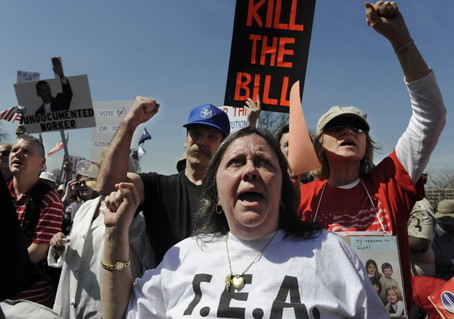
When do you cross the line?
In the Wyoming state legislature, 10 congressmen and three senators have co-sponsored “The Health Care Choice and Protection Act.” The intent? To make it a felony to implement the health-care reform law — which is, you’ll remember, the official law of the land. Here’s the relevant bit:
Enforcement of federal laws prohibited; offenses and penalties.
Any official, agent, employee or public servant of the state of Wyoming as defined in W.S. 6-5-101, who enforces or attempts to enforce an act, order, law, statute, rule or regulation of the government of the United States in violation of this article shall be guilty of a felony punishable by a fine of not more than five thousand dollars ($5,000.00), imprisonment in the county jail for not more than two (2) years, or both.
Any official, agent or employee of the United States government or any employee of a corporation providing services to the United States government that enforces or attempts to enforce an act, order, law, statute, rule or regulation of the government of the United States in violation of this article shall be guilty of a felony punishable by imprisonment for not more than five (5) years, a fine of not more than five thousand dollars ($5,000.00), or both.
There’s not much use in worrying about something like this as it wouldn’t survive two seconds in a court of law. But the sentiments are worth considering: The argument is that this legislation isn’t just policy that the authors disagree with, but rather a deeply, profoundly, un-American threat to liberty. It’s so un-American, in fact, that a plain reading of the Constitution makes clear that the Wyoming legislature, which has sworn to protect and defend the document, must “adopt and enact any and all measures as may be necessary within the borders of Wyoming to prevent the enforcement of the Patient Protection and Affordable Care Act and the Health Care and Education Reconciliation Act of 2010.”
Many of my friends on the right have legitimate technocratic differences with the Affordable Care Act. But many of the politicians they’ve stood with have not made a legitimate case against the bill. Rather, they’ve taken a bill that echoes past legislation Republicans have introduced and called it, as Sen. Jon Kyl did, “a stunning threat to liberty.” They’ve told their supporters, as Sen, Chuck Grassley did, that they’re right to fear that the health-care bill “determines if you’re going to pull the plug on grandma.” This is not merely legislation that they have some technical or philosophical disagreements with. It is, in the words of Speaker John Boehner, “a monstrosity.”
Given the extremism of the rhetoric at the top, is it any wonder that there is incredible fear trickling down to the grass roots? If those are the stakes, then of course criminalizing any implementation of the bill makes sense. Frankly, if those are the stakes, then violent resistance might be required.
Those aren’t the stakes, of course. They’re just the words. And words slip sometimes. Things come out too angry, or too quickly, or too sharply. I’ve had my share of experience with this. But words matter. And the Republican Party hasn’t been slipping up: It’s been engaged in a concerted campaign to scare the population into opposing health-care reform. That may be good politics, but it can have bad consequences.
By: Ezra Klein-Washington Post-January 7, 2011: Photo By: Melina Mara-Washington Post
‘Death Panels’ and Maxwell’s Silver Hammer: End-of-Life Planning Scare Resurfaces

Hammer or death mallet? You be the judge...
A hammer is supposed to be used to pound nails. But as the Beatles pointed out more than 40 years ago, it can also be used as a murder weapon. Nobody, however, is calling for a ban on hammers or calling them “death mallets.”
Maybe that’s why the resurrection of the “death panel” canard, as applied to end-of-life planning, seems so unnecessary. Here’s how the New York Times started its story a few days ago:
“When a proposal to encourage end-of-life planning touched off a political storm over ‘death panels,’ Democrats dropped it from legislation to overhaul the health care system. But the Obama administration will achieve the same goal by regulation, starting Jan. 1.”
The only opponent quoted in the story was this:
Elizabeth D. Wickham, executive director of LifeTree, which describes itself as “a pro-life Christian educational ministry,” said she was concerned that end-of-life counseling would encourage patients to forgo or curtail care, thus hastening death.“The infamous Section 1233 is still alive and kicking,” Ms. Wickham said. “Patients will lose the ability to control treatments at the end of life.”
Which, with all due respect, was no more accurate a summary of “Section 1233” or the new regulation than “death mallets” would be to describe hammers.
Don’t believe me? Section 1233 was contained in one early draft of the health care reform bill. Here’s the text of that version of the bill (search for “advance care planning consultation”). It would have allowed Medicare to pay for one such consultation every five years, if the patient wanted it.
Such consultation was to include: an explanation of advance care planning, advance directives, health care proxy, list of resources for further information, explanation of palliative and hospice care, explanation of the advantages of an up-to-date advance treatment order. It would have required training for health care providers (you’d be shocked at what some doctors don’t know about this stuff). And would have required standardization of information and forms used.
It also listed some of the conditions that could be included in a directive. And said that Medicare would pay for more frequent consultations if there were a significant change in condition.
Overly detailed and controlling? Maybe so. Death panels? Not hardly. Limit a patient’s ability to control treatments at the end of life? Not in any clause or sub-clause I can find.
Jump to the new regulation. (It’s in here.) The relevant passage is a lot shorter than the killed section of reform legislation. It adds “voluntary advance planning upon agreement with the individual” to the items that Medicare will pay for during an annual physical. Here’s the whole thing:
“Voluntary advance care planning” means, for purposes of this section, verbal or written information regarding the following areas: (1) An individual’s ability to prepare an advance directive in the case where an injury or illness causes the individual to be unable to make health care decisions. (2) Whether or not the physician is willing to follow the individual’s wishes as expressed in an advance directive.”
That’s it. No panels, death or knotty pine. Just a conversation with your doctor if you want it. No loss of patient control unless the patient is in a condition where conscious control is impossible — in which case the whole point of the planning is to ensure that the patient’s wishes be followed.
Since the New York Times figures Wickham has enough clout to stand in for all opponents, I tried to contact her. No joy. I checked her organization’s website for more insight into her objections. I found that LifeTree is not a generically Christian group, but one that has Catholic roots, starting with the blessing of the bishop of Raleigh, N.C.
So I shifted my search to the National Catholic Bioethics Center, figuring I’d find a reasoned critique that would likely be in accord with the beliefs of LifeTree. I found Marie T. Hilliard, the center’s director of bioethics and public policy. She was more than willing to engage me in civil discussion.
The Catholic Church is in favor of end-of-life planning, she said.
“The issue is not whether a discussion by a health care practitioner with a patient on end-of-life care issues is a good. It is a good,” she said. “And encouraging providers to have truly informing discussions on this issue also is a good.”
So what’s Hilliard’s beef with the regulation? She fears the way that written “orders for life-sustaining treatment” (called “POLST” or “MOLST”) could be abused. A form signed today might not include the actual situation that pops up years down the road.
In other words, a patient could complete a POLST/MOLST form indicating the patient did not want life sustaining treatment, which could be an antibiotic or a blood transfusion or proportionately beneficial assisted nutrition and hydration, before any of the facts that would be appropriate to such decision-making were in play.
The new regulation actually addresses at least one of her concerns in that it makes the consultation available annually, rather than using the bill’s five-year rule. And a standardized form can certainly include the vast majority of situations a patient is likely to encounter. The version prepared by the Rabbinical Council of America, for instance, covers persistent vegetative state, coma, lesser brain injuries along with a terminal illness, and brain injury without a terminal illness along with 31 possible procedures.
But there are conditions and procedures the form does not address. Would a longer form, with more choices, make the possibility of error less likely? Or would a form that’s much longer make it less likely that someone would be willing to fill it out at all?
Hilliard also raises a “slippery slope” argument, suggesting that widespread use of such forms would be employed to put pressure “on persons with disabilities and their families to forgo life sustaining health care treatments.”
To which argument I have consistently replied that if you have a doctor who wants you or your loved one dead, your problem is bigger than a signed form.
Hilliard recommends the use of “health care agents,” a sort of human advance directive. This could be a family member or some other designated person who has the authority to speak for the patient.
The concept was actually included in the killed portion of the health care reform bill, referred to as a “health care proxy.” Perhaps it should have been included in the new regulation.
I think Hilliard and I both agree that the biggest problem with end-of-life planning is that far too often it’s done poorly.
We have a 24/7 consultation line on medical ethics; (1,400 calls per year) and the most frequent call we receive is on end-of-life care, NOT because there is not an advanced directive, often because there is and it does not address the situation at hand, and no helpful discussion had been held with the health care agent. Then there is the question of whether or not the health care agent is locked in by the letter of the law, knowing that the spirit of the will of the patient may be violated.
And that’s for people who have directives or health care agents. Imagine the situation for the far greater number of people who never address these issues until there’s a crisis.
I have some personal experience in this matter. My dad died earlier this year. He was 92. Several years before, my wife had prodded him (and the rest of us) to fill out advance-care directives. Her career has been in long-term health care and she’d seen too many families torn apart by being forced to consider these decisions only under the most terrible stress.
Because we’d talked about the topic once, nudged into it by filling out the directive, we found it easier to return to the subject over the years as my dad’s condition faltered. We and his doctors were all clear about what he wanted — right up to the point when he decided he’d had enough. I cannot imagine how much more difficult those final days would have been without those previous conversations.
But most families do not have the advantage of having an elder-care expert “on staff.” If this regulation prods more doctors into a difficult conversation, if it prods more people into thinking about these issues when they have the luxury of time for reflection, that seems like a good idea to me.
Can such a process be abused? There is no system created by humanity that cannot be turned to evil ends. And yet most of us own a hammer.
By: Jeffrey Weiss-Correspondent-Politics Daily, January 2, 2011; Photo- Getty Images
What The Teaparty Wants From The Constitution

U.S. Constitution: Relevant only when it meets the needs of us "Real Americans"
I’m very curious to know what the GOP — or the tea partyers they’re presumably pandering to — think will happen when every piece of legislation requires “a statement from its sponsor outlining where in the Constitution Congress is empowered to enact such legislation.” What’s the evidence that this will make legislation more, rather than less, constitutional, for whatever your definition of the Constitution is?
Let’s take an example: Most legislation doesn’t currently include a statement of constitutional authority. But there’s one recent measure that did: Section 1501 of the Patient Protection and Affordable Care Act. That is to say, the individual mandate.
“The individual responsibility requirement provided for in this section (in this subsection referred to as the requirement) is commercial and economic in nature, and substantially affects interstate commerce,” reads the opening paragraph. Shortly thereafter, the legislation makes itself more explicit: “In United States v. South-Eastern Underwriters Association (322 U.S. 533 (1944)), the Supreme Court of the United States ruled that insurance is interstate commerce subject to Federal regulation.”
Has that statement convinced the GOP that the individual mandate is constitutional? Of course not. Currently, two judges have ruled in favor of the provision and one judge has ruled against. The split has been clean across partisan lines. The political verdicts have been little different: Sen. Chuck Grassley went from co-sponsoring an individual mandate in June of 2009 when it was still an idea connected to Republicans to condemning it as unconstitutional a few months later when it was clear that President Obama owned it and no Republicans would be joining his health-care bill.
My friends on the right don’t like to hear this, but the Constitution is not a clear document. Written more than 200 years ago, when America had 13 states and very different problems, it rarely speaks directly to the questions we ask it. The Second Amendment, for instance, says nothing about keeping a gun in the home if you’ve not signed up with a “well-regulated militia,” but interpreting the Second Amendment broadly has been important to those who want to bear arms. And so they’ve done it.
That’s their right, of course. Liberals pick and choose their moments of textual fidelity as well. But as the seemingly endless series of 5-4 splits on the Supreme Court shows, even the country’s most experienced and decorated constitutional authorities routinely disagree, and sharply, over what the text means when applied to today’s problems. To presume that people writing what they think the Constitution means — or, in some cases, want to think it means — at the bottom of every bill will change how they legislate doesn’t demonstrate a reverence for the document. It demonstrates a disengagement with it as anything more than a symbol of what you and your ideological allies believe.
In reality, the tea party — like most everyone else — is less interested in living by the Constitution than in deciding what it means to live by the Constitution. When the constitutional disclaimers at the bottom of bills suit them, they’ll respect them. When they don’t — as we’ve seen in the case of the individual mandate — they won’t.
By: Ezra Klein-Washington Post, 12/30/10: Photo credit: Todd Gipstein/National Geographic/Getty Images
Share This Blog


 Unknown Feed
- An error has occurred; the feed is probably down. Try again later.
 mykeystrokes.com
You must be logged in to post a comment.