Stop the presses: John Boehner admitted Thursday that the Republican Party’s long-awaited alternative to Obamacare needs a little more time in the oven. “You know, the discussions about Obamacare and what the replacement bill would look like continue. We’re trying to build consensus around one plan,” the Speaker told Hill reporters. “Not there yet.”
As if you even needed me to tell you, rest assured: It could be six months from now, a year from now, five years from now, or the day Bibi Netanyahu and Khaled Mashal share a Nobel Peace Prize—they aren’t going to have a plan. Oh, they might have a “plan.” They had a “plan” last year, or at least Oklahoma Sen. Tom Coburn and two others did. For about two days, they were really tooting its horn. Then it dawned on people that paying for it would involve a hefty middle-class tax increase, on higher-end insurance plans. You may have noticed since then that the Coburn “plan” has not exactly become a leading Republican talking point.
As conservatives continue to hail the Halbig decision, some historical context is called for. In my last column, I wrote that conservatives and Republicans are going to extraordinary lengths to see that more Americans die. Not every reader was won over by that opinion, as you might imagine. But I think it’s beyond dispute, as a little discussion of political history should show.
The problem of millions of uninsured has existed in this country since—well, since forever. But as a running news story that the media paid attention to, for the last 25 or 30 years. I remember when the then-horrifying number was 15 million uninsured. Then 20 million, then 30 million, on up to the 46 million figure we often saw bandied about before the Affordable Health Care was enacted (10 million new Americans are insured as a result of it—a very respectable dent, for just one year). So, 30 years, a full generation, tens of millions of people adversely affected. And what, in all that time, has the Grand Old Party proposed to do about it all?
Not. One. Thing. Republican presidents had (if we go back to 1984) 16 years to pass some kind of health-insurance law. But none of the three ever even proposed one. George W. Bush did pass his Medicare law, but that was about adding prescription-drug coverage for seniors; it didn’t insure any previously uninsured citizens. What the GOP did instead, of course, was to fight tooth-and-nail to stop the two Democratic attempts to insure more people, succeeding the first time, failing the second.
And “tooth-and-nail” hardly begins to describe the demented and nearly sociopathic reality of Republican and conservative opposition to trying to make health insurance affordable for working-class people. Opposition to doing so has been one of the four grand accomplishments of the Republican Party of our time, which I would rank as follows, one scratched on each side of the obelisk: one, start disastrous wars and commit torture; two, make people despise the government; three, nearly cause a new Depression; and four, deny health insurance to as many people as possible, as aggressively and nastily as possible. It’s a grim record generally, and with regard to health care specifically, inarguably one that has promoted insalubriousness and suffering and, indeed, deaths that might have been avoided or delayed if people had had insurance.
It is true that some conservative intellectuals have offered up some ideas—as we know, the same individual mandate that the right now calumniates was a conservative idea at first. And John McCain actually had a decent-ish health-care platform plank in 2008. But if McCain had been elected, it’s very unlikely that the constellation of interests and power centers in the GOP would have permitted him ever even thinking about pursuing it. It was just something he felt he had to say to have credibility with middle-of-the-road voters. And in any case he wasn’t elected, and those conservative intellectuals’ ideas were never seriously proposed by elected Republicans, so the historical record is what it is.
The 20-year war on health care—since their 1993 defeat of the Clinton plan—has been about Republicans’ hatred of government; their view of people who don’t have insurance as lazy or flawed and not worth lifting a finger for; and their fear that if a law is passed and succeeds in bringing health care to millions, they and their whole vision of society will be discredited in the eyes of millions. Of course, these days, all that is shot through with one more element: a heavy dose of Obama hatred.
I was on Hardball Wednesday evening with David Corn, and Chris Matthews showed poll numbers during our segment that surprised even me. The topic was “rooting for failure.” Back in 2006, he said, Democrats were asked in a Fox News poll whether they wanted President Bush’s policies to succeed or fail. Answers: 40 succeed, 51 fail. Not particularly generous. But earlier this year, he said, CNN asked Republicans the same question about President Obama. Answers: 14 succeed, 73 fail.
Think about that. Three-quarters of regular Republicans want Obama to fail. And just one in seven wants him to succeed. We pundits spend most of our time blaming politicians for inaction, but maybe it’s time to start blaming the people. If regular Republicans feel like this, there’s no way the elected officials who represent them are going to do anything that looks remotely like compromise or cooperation.
And no, they’re not going to offer a real health-care plan either. They first promised that in 2010, during the campaign season, so they could say “repeal and replace” instead of just “repeal” and sound like they had a positive side. Then they dropped “and replace,” and now that it’s election time again, it’s back. But it’s not in their DNA to do anything constructive about health care. Or—the VA crisis, the border crisis, the Middle East crisis, the wage-and-inequality crisis, et cetera—about much of anything.
By: Michael Tomasky, The Daily Beast, July 25, 2014
July 26, 2014
Posted by raemd95 |
Conservatives, Health Reform, John Boehner | Affordable Care Act, GOP, Halbig v Burwell, Repeal and Replace, Republicans, Tom Coburn, uninsured |
1 Comment
A new Congressional Budget Office report shows that the projected increase in the national debt has slowed dramatically. Good news for deficit scolds, right? Not for Ron Fournier, who still thinks the nation is on its last legs:
Only in Washington, the place where you land when you fall through the looking glass, could this be hailed as good news… Our deficit levels (annual totals of red ink) are stalled at breathtakingly high levels — and are projected to soar again in a few years… Scary news, right? Not according to many media outlets and a cynical leadership class in Washington. Some news organizations focused on the sugar-high of good news — the (temporary) dip in deficits.
Think of a reporter covering a shooting. The police tell him the victim is dying of blood loss. Is the headline “Shooting Victim Expected to Die” or “Blood Flow Slows for Shooting Victim”? [National Journal]
Fournier’s economic analysis, if it may be so dignified with the phrase, is comprehensively wretched. As I’ve argued, the real problem with the deficit is that it’s coming down way too fast. Premature austerity has crippled the economic recovery and kept millions out of work. The biggest economic problem facing the nation is unemployment, which outweighs the stupid deficit by Graham’s Number levels of importance.
But the main problem is that his scold case is weak even on its own terms. Fournier understands neither what is driving the increase in the national debt nor why that might be a problem — all of which betrays a bizarre ideology that holds that pain must be inflicted before any gains can be made.
The huge increase in the annual deficit in 2008-09 was driven by two things: first, the economic collapse, which caused revenues to fall and spending to increase as people drew on safety net programs like unemployment insurance. Second, the Recovery Act, aka the stimulus, which provided a one-time surge of spending to restore aggregate demand and get people back to work. Though the stimulus was not nearly large enough to fill the hole in demand, this is what macroeconomic policy is supposed to do in a recession (a fact that Republicans were happy to accept when they were in power).
The long-term debt and deficit projections, on the other hand, are entirely about health-care spending. As Peter Fisher once said, the government is basically an insurance company with an army, and for many years the price of health care increased much faster than the rate of economic growth. This made government spending on health care (mostly Medicare and Medicaid) consume an ever-greater portion of the federal budget. Past CBO projections just assumed this trend would continue, which accounts for past reports predicting that the national debt would eventually eat the whole budget.
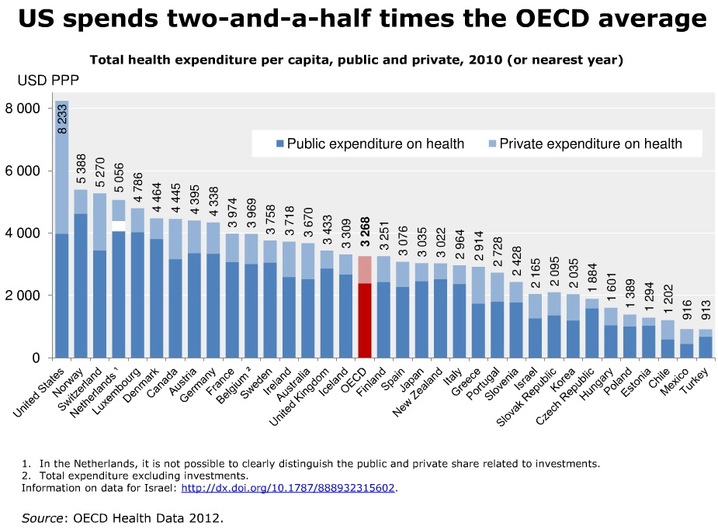
What this means is that Fournier’s preferred solution for dealing with this trend — higher taxes, fewer entitlements — is completely pointless. We have to fix the problem of rising prices, otherwise eventually a single tablet of aspirin will consume the entire federal budget. And the price problem is driven by awful policy design, not excessive generosity. America manages the rare trick of having very patchy and stingy social insurance that is simultaneously incredibly expensive. We spend more government money per person than Canada does — and the Canadians have universal single-payer coverage.
Fewer entitlements or higher taxes will get you a few years of breathing room before price increases eat up all the savings — and the whole point of Fournier’s column is that a couple decades of breathing room is still grounds for hair-on-fire panic.
Luckily, since the passage of ObamaCare, price increases have indeed slowed dramatically. That, plus a new projection that interest rates will stay low for a long time, accounts for the new CBO analysis showing slower debt growth. Just why this is happening is a matter of some dispute; I suspect it is partly the result of several programs in ObamaCare designed to bring prices down, and partly that health-care prices are already so high they’re running into resource constraints.
I think the fact that Fournier is patently uninterested in any of these things, and favors a policy that would accomplish nothing whatsoever on the deficit by his own standards, reveals that the pro-austerity school of punditry isn’t about the deficit at all. Instead, he says that his entitlement-cutting agenda is “going to happen sooner or later, painfully or more painfully.” As with David Gregory, the pain is the operative concept. The centrist definition of responsible politics holds that the American people must suffer a little more to keep the nation healthy. It’s only the “hateful partisans” who are keeping the wise, reasonable moderates from making those tough bipartisan compromises to slash social insurance and inflict pain.
But make no mistake: This has nothing to do with economics, and everything to do with the bizarre looking-glass ideology of “serious people” in Washington, D.C.
By: Ryan Cooper, The Week, July 24, 2014
July 25, 2014
Posted by raemd95 |
Deficits, Economy, Ideology | Affordable Care Act, Austerity, Conservatives, Economic Recovery, Health Care Costs, National Debt, Republicans, Unemployment |
Leave a comment
After initially threatening to sue President Barack Obama over a variety of issues, House Speaker John Boehner settled on just one: the delay of the Affordable Care Act’s employer mandate. The legality of that action, as law school professor Nicholas Bagley has pointed out, is questionable. But the lawsuit also implies that the executive branch should have limited discretion in implementing laws. And Republicans only have to look toward Governor Chris Christie to show how that doesn’t make much sense.
In 2013, Obama delayed for a year the employer mandate, which requires all businesses with 50 or more full-time employees to provide health insurance to their employees or pay a penalty. Infuriated, Republicans called the president’s unilateral action illegal. On this count, they may be right. But it will be nearly impossible for Boehner to convince the courts that the House has suffered concrete damage that gives them the constitutional authority to challenge the action. In all likelihood, the lawsuit is meaningless.
However, this case has implications beyond its legal importance. Simon Lazarus, the senior counsel at the Constitutional Accountability Center, testified on Wednesday before the House Rules Committee about the historic discretion afforded presidents to implement laws.
“The Administration has not postponed the employer mandate out of policy opposition to the ACA, nor to any specific provision of it,” he said, according to his prepared remarks. “It is ludicrous to suggest otherwise, and at best misleading to characterize the action as a ‘refusal to enforce’ at all. Rather, the President has authorized a minor temporary course correction regarding individual ACA provisions, necessary in his Administration’s judgment to faithfully execute the overall statute, other related laws, and the purposes of the ACA’s framers.” The key is that Obama delayed the employer mandate in order to prioritize the success of the entire law. It does not fundamentally change the legislation or attempt to undermine it.
Lazarus also gave examples when former presidents George W. Bush and Bill Clinton used their discretion in implementing legislation. Bush, for instance, delayed certain EPA regulations not out of technical need, but because he opposed the policies. That is a much graver offense than delaying part of the law in order to increase the chances of its success. The Bush administration actively tried to undermine it. “Such intentional refusals to enforce or implement laws … do violate the laws in question, and are, by definition, failures to faithfully execute the laws as required by the Constitution,” Lazarus said.
Christie used discretion similarly in a decision regarding Tesla’s ability to sell directly to its customers. Under New Jersey statute, direct sales of automobiles are illegal. Christie opposes that law, but must enforce it—except, as he told CNBC’s John Harwood Wednesday, he gave Tesla a one-year grace period.
“The fact is we looked the other way for a year, to allow Tesla to do what they are doing,” he said. “I can’t just pick and choose the laws to enforce. So I give [sic] them what I felt was a reasonable period of time to operate the way they were operating.”
After a year, Christie believed that he had to enforce the law—and Republicans around the country freaked out. A.J. Delgado, of the National Review, questioned Christie’s commitment to the free market. “[Y]ou’d expect Christie, who claims to believe in free markets, to recognize a protectionist swindle, as he did when he took on the state’s powerful public-school teacher unions,” he wrote.
Legally, Christie’s selective enforcement on the ban on direct automobile sales might be more justifiable than Obama’s delay of the employer mandate. Executives frequently prioritize certain laws based on their limited resources. Obama defied a specific deadline in the law. But the functional implications of them are the same. Christie and Obama both used their discretion in enforcing laws to improve their administration’s governance. For Obama, that meant delaying the employer mandate to ease the implementation of Obamacare. For Christie, it meant giving Tesla a year-long reprieve from the direct-sales ban to give the legislature time to change the law.
That’s not to say that executives should have unlimited authority to adjust legislation. But they should be able to use discretion in implementing laws so that they have the greatest chance of success. The House’s lawsuit threatens to eliminate that discretion.
By: Danny Vinik, The New Republic, July 17, 2014
July 21, 2014
Posted by raemd95 |
Chris Christie, House Republicans, John Boehner | Affordable Care Act, Employer Mandate, EPA Regulations, George W. Bush, GOP, Tesla |
Leave a comment
Serious lawsuits start with some specific legal grievance – a claim that someone was injured by a defective product, say, or that a search was unreasonable under the Fourth Amendment – and proceed from there. US House speaker John Boehner wants to sue the President of the United States – for no particular reason other than his alleged lawlessness – and fill in the details later.
The lawsuit, which a House committee will take up rather seriously on Wednesday, is a frivolous stunt that not only has no chance of succeeding but isn’t even intended to succeed. The belated choice of targets does provide a useful illustration of Republican priorities, though: most notably, registering more outrage at the Affordable Care Act and further attempting to legitimize various fake scandals wafting up from the conservative fever swamp.
Some of the GOP attacks on the Obama administration have had real substantive effects. This suit, however, is analogous to the endless House votes to repeal Obamacare – an impotent symbolic gesture by Republicans frustrated they were unable to deny access to health coverage to tens of millions of American citizens.
By speaking first in general terms about Obama’s alleged failure to “faithfully execute the laws” in favor of usurping the will of Congress, plus the president’s failure to do enough bombing of random foreign countries, Boehner allowed the Tea Party’s insatiable skree machine to fill in its own gibberish legalese. Why focus on one potential impeachable offense when the examples can be nearly infinite? Benghazi! Fast and Furious! Executive orders!
Now that Boehner has actually announced the basis for the lawsuit – and will spend the next two weeks getting it to the floor for another meaningless Obamacare vote – it turns out to be a narrow and almost certainly irrelevant one. The suit will focus on a claim that Obama acted illegally when the administration decided to effectively delay implementation of the employer mandate in the Affordable Care Act, by declining to penalize employers who didn’t comply in 2014.
In fairness, the argument isn’t unreasonable on its own terms, but to bring a legal challenge in federal court, a plaintiff must have “standing” – Boehner and Co must show that the House of Representatives has been directly injured or otherwise directly affected. Under existing precedents, that’s nearly impossible.
And even if the federal courts were to grant standing, for a lawsuit to proceed, there has to be an ongoing controversy. Since the employer mandate will almost certainly not be delayed another year, the issue is likely to be moot before the lawsuit gets very far, which will result in its getting thrown out. The American taxpayers will have funded a no-hope legal challenge because House Republicans needed to keep their base’s 24/7 scandal-invention machine going – not because there was an actual controversy.
It’s not clear what kind of bill the coming weeks might produce. Conservative legal experts will be happy to give testimony, some of which will be reflected in the final resolution. But the details are fundamentally irrelevant. The federal courts will almost certainly deny that they have jurisdiction, Boehner will have sent politically expedient signals to his base, and the successful implementation of Obamacare will proceed exactly as it would have – as if nobody had ever sued the President of the United States at all. As for the defective product that is the Republican-controlled House, well, the only remedy for the injuries they’ve inflicted is at the ballot box in November.
By: Scott Lemieux, The Guardian, July 15, 2014
July 16, 2014
Posted by raemd95 |
House Republicans, John Boehner, Tea Party | Affordable Care Act, Conservatives, Election 2014, Employer Mandate, Executive Orders, GOP, ObamaCare |
Leave a comment
The story on House Speaker John Boehner’s lawsuit against President Barack Obama is pretty simple: regardless of whether the administration overstepped, what’s at stake is whether the courts are being empowered at the expense of the elected branches of government.
For starters, there’s zero evidence that Obama has been unusual in his use of executive powers. If he’s overdone it, then all the recent presidents have done so, too. The idea that he’s some sort of tyrant who acts differently than other modern presidents is nonsense.
In fact, It’s perfectly normal for presidents and executive branch departments and agencies to make broad interpretations of law that look a lot like legislating. It’s how the system works, and pretty much how it always worked. Thus Richard Neustadt’s famous claim that the system isn’t “separation of powers,” but separated institutions sharing powers.
Nonetheless, there are rules constraining how laws may be interpreted, and it is possible that in specific instances, the administration may have acted beyond what the law allows.
Indeed, experts have made the case that this kind of overreach occurred with the delayed implementation of the employer mandate in the Affordable Care Act (which, apparently, is going to be central to the House Republicans’ lawsuit), though other experts disagree.
In any case, it would be unprecedented, and in fact would constitute a significant change to the constitutional system, if the courts allowed Congress to sue the president over the ACA delay.
The technical issue is “standing.” For the courts to consider a lawsuit, the person or group bringing the suit has to show they were harmed in some direct way. So, for example, in the recent recess appointment case, Noel Canning Corp. was able to show that it had directly been harmed by an action taken by members of the National Labor Relations Board who had been recess-appointed. Generally, the courts have ruled (Vox has a good explainer on this) that Congress isn’t eligible to sue the president just because it doesn’t like what he’s done.
What Boehner is claiming now is that Congress, or the House of Representatives in this case, should be able to sue the president for not following the law if no one else would be able to do so.
If that succeeds, however, the big winner in the long run wouldn’t be Congress. It would be the courts.
By the logic of Boehner’s own action (despite what he says), this isn’t about a tyrannical president refusing to obey the law. If House Republicans believed that Obama was an out-of-control dictator, then they couldn’t also believe that a court ruling would be sufficient to constrain him.
What’s actually happening is that the House doesn’t interpret the law in the same way as the president, and the question is how to resolve the variance. Normally, each branch has an opportunity to interpret the law (those separated institutions sharing powers again), but doctrines such as standing limit the courts’ ability to intervene.
If, however, they can intervene whenever a house of Congress is unhappy, then the courts get a a much more active role in determining what the laws say. And why just a house of Congress? What if the president sued Congress, for example, if it failed in its obligation to produce appropriations bills on time? Instead of a government shutdown, would we get an injunction and then a judicial act of appropriations, with someone appointed by Bill Clinton or Ronald Reagan making 302(b) allocations by judicial fiat? Or perhaps we’d wind up with individual senators jurisdiction shopping, looking for a friendly judge to overturn some fight they lost in committee or on the Senate floor. Those kinds of setbacks are common for senators and executive branch departments; the only thing that prevents the losers, or whole chambers that lost fights in conference, from directly appealing to the courts is that the courts have a doctrine against intervening.
So what can Congress do? If the problem were simply a president who failed to follow the law, then the only real choices would be either to live with it, or impeachment and conviction. But if the problem is merely that the president interprets a law in a way that Congress doesn’t like, then the obvious remedy, as presidency scholar Andrew Rudalevige said recently, is “for Congress to change the law to remove presidential discretion” (I argue the same here).
So put aside the question of whether the administration improperly interpreted the law (it might have). Put aside, too, the silliness of House Republicans attempting to force the president to impose a policy, the employer mandate, which no Republican actually wants to enforce. And put aside the reality that by the time this lawsuit is decided it may well be moot, at least if the mandate takes effect as currently planned. This is about enhancing judicial power at the expense of the elected branches, and it’s a very bad idea.
By: Jonathan Bernstein, Ten Miles Square, The Washington Monthly, July 12, 2014
July 13, 2014
Posted by raemd95 |
Federal Courts, John Roberts, U. S. Supreme Court | Affordable Care Act, Congress, Employer Mandate, Executive Orders, House Republicans, Impeachment |
Leave a comment


 mykeystrokes.com