Republican Budget Cuts Will Come Back to Bite Them
Something about the Republican dance with populism these days reminds me of one of those classic Twilight Zone episodes: Aliens come down to earth. They want to help us! (They even have a book called To Serve Man!) Wait a minute … they want to eat us! (It’s a cookbook.) From there things take a decidedly downward turn.
One suspects that Republicans may be in for a similarly demoralizing experience. Here’s why:
When NPR asked Sen. Jim DeMint this week why Republicans were pressing to reduce Social Security benefits (a subject that had long been considered off limits for politicians interested in re-election), he answered, “It is politically dangerous, but I think the mood of the country is different than it has been [at] any time in my lifetime.” The “mood” he’s talking about is the so-called “new populism,” the voter anger expressed everywhere from Tea Party rallies to voting booths in 2010.
When you think of traditional populism, it evokes images of regular people rising up against a remote, usually corporate, elite that’s run roughshod over their rights. Farmers and working people taking on runaway industrialists and robber barons. Traditionally, Democrats have been most receptive to these kinds of appeals. In response, they’ve pushed government to enact programs aimed at protecting those most vulnerable to the predations of more powerful interests.
For the new populists, government is the remote elite. Instead of unsafe working conditions or unfair lending practices, they’re protesting the ills of government spending and overreach, the wasting of taxpayer dollars. And if their efforts undo the kinds of programs that a more traditional brand of populism might embrace—those aimed at helping the less advantaged make their way—so be it. It’s populism Republican style. And Republicans look like they’re going to ride it for all its worth.
But what happens when you start cutting programs that are in and of themselves something of a check on potential populist anger? That’s one way to look at government programs: There’s a need that’s not being addressed, and rather than let it ferment, government, however clumsily, tries to fill the gap. Sometimes the proposed gap filler is ridiculous (Rep. Dennis Kucinich’s “Department of Peace” springs to mind). Other times, it becomes part of the very fabric of our country.
Take public schooling. Public schools reflect a societal judgment that children should have a chance to succeed without regards to wealth or socioeconomic background. To help get them there, we don’t give every kid a million dollars and say “have at it,” we offer them a tuition-free classroom with a curriculum designed to put them on an equal footing with everyone else when they enter the workforce. What they do from there is up to them.
It doesn’t always work out, of course. Some schools are better than others. So are some teachers. But wherever our various debates about education reform end up, public schools reflect a deeply held American value: that there are some public goods (like an educated workforce) that we, as a society, believe are worth individual (taxpayer) costs. That seems to have become lost in the current debate.
Take another look at what’s underway in Wisconsin. A centerpiece of Gov. Scott Walker’s budget is a $1 billion cut in education funding. That’s a big number that may sound appealing to people worked up about government spending today, but in September when they send their kids to schools with classroom sizes twice as big as a year before, they may begin to remember why they thought it was a good idea to fund education in the first place. Presto! New populists transformed into traditional populists. Only now their target has shifted from Democrats to Republicans. And you can imagine the same phenomenon playing out across a whole host of issues, from Social Security to shared revenue.
Republicans may have momentum on their side at the moment, but there’s a long way to go in the various budget battles playing out across the country. To be sure, Democrats can overplay their hand, too, by opposing any kind of spending restraint.
But one way or the other, populism is sure to play a role in determining how it all turns out. Which strain of populism wins? For Republicans, the answer is kind of like the difference between To Serve Man (they’re helping us!) and To Serve Man (oh wait, they’re eating us). And they had better hope they’ve got it right.
By: Anson Kaye, U.S. News and World Report, March 17, 2011
What Does The Tea Party Want?….The New Litmus Test
Jim VandeHei and Mike Allen argue that the Tea Party redefined the purpose of the GOP as opposition to spending:
The Republican Party is undergoing a messy but unmistakable 20-month transformation from fanatically anti-Obama to fanatically anti-spending, providing top party officials a new and intriguing playbook for recapturing the White House in 2012.
To understand the current evolution, flash back to late spring of 2009. The GOP was disoriented and adrift, its leadership void filled by the bombastic voices of Palin, Beck and Rush Limbaugh. There was no common conservative cause, beyond fear and loathing of Obama. No wonder swing voters were so down on them.
But the tea party, treated at first by the media as exotics, forced Republicans to focus almost exclusively on the size of government. By the time the 2010 elections rolled around, tea party activists and most independent voters were completely aligned on the need to cut, cut, cut.
Midterm election results showed that this approach offers the GOP its best – and maybe only – hope of keeping the interests of independents and tea party activists aligned enough to beat Obama.
The new litmus tests for GOP presidential hopefuls are support for repealing “Obamacare” and taking a cleaver to government spending. If a presidential candidate could harness the smaller-government conservatism, temper it enough to avoid a blatant overreach and articulate a vision for a prosperous future for the country, it’s not hard to imagine swing voters finding such a person appealing.
There’s a superficial appeal to this story. But the evidence that Tea Party activists want to cut spending — at least actual spending programs — is sparse. Polls show that Tea Party supports overwhelmingly oppose cuts to Social Security and Medicare. The main thrust of Tea Party opinion is not the belief that Obama has spent too much money, but the belief that Obama has spent too much money on people unlike them:
More than half say the policies of the administration favor the poor, and 25 percent think that the administration favors blacks over whites — compared with 11 percent of the general public.
They are more likely than the general public, and Republicans, to say that too much has been made of the problems facing black people.
Here’s another cut, showing the Tea Party’s greater comfort with inequality of opportunity and stronger belief that the government devotes too many resources to minorities:
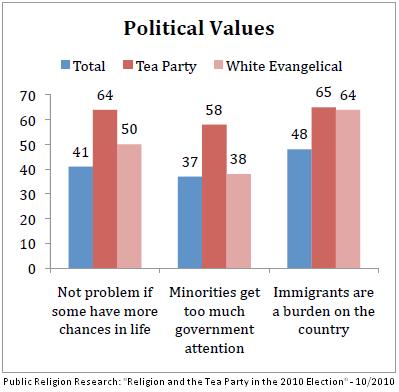
It’s a revolt against the composition of government much more than the level.
Now, it’s true that Republicans aren’t exactly translating this blueprint into action, but they’re not exactly flouting it, either. There is always a generalized antipathy toward spending amongst Republican and swing voters, but it disappears when the subject turns to actual government programs. Usually Republicans decide to just cut taxes for the rich instead. Here’s is the one part of the article proposing a defined policy change:
Even Ralph Reed, the Republican operative most tapped in to evangelicals, reflected the new GOP mindset when he gave this surprising wish list for the next presidential race: “In a perfect world, I’d like to hear the Republican nominee run on a platform that takes the capital gains tax to zero over five years.” Reed, who summoned several of the presidential candidates to Iowa for his Faith & Freedom Coalition this week, made it clear that Christian conservatives will still need to be catered to, but added that his side will understand the nominee’s need to focus on swing voters.
So an article putatively about the GOP redefining itself as an anti-spending party has one actual programmatic detail, and it’s: a zeroing out of the capital gains tax. In the name of appealing to swing voters — who, in fact, oppose tax cuts for the rich. Meet the new boss…
By: Jonathan Chait, The New Republic, March 14, 2011
Social Security Hysteria Rebutted, Yet again
The WaPo editorial board apparently despises old people as much as Alan Simpson, given what they’re willing to put on their op-ed pages. Unfortunately, though, Charles Krauthammer doesn’t disintegrate into quite the degree of gibberish as Simpson, though he’s a liar. He particularly attacks OMB director Jacob Lew, and Lew’s assertion that Social Security is solvent until 2037 and doesn’t add to the deficit. Krauthammer’s argument: the Treasury bonds Social Security funds are invested in are “worthless” and Lew’s arguing otherwise is “a breathtaking fraud” because the “Social Security trust fund is a fiction.”
Dean Baker refutes.
It’s nice that Mr. Krauthammer thinks that government bonds are worthless…. While he is welcome to believe anything he wants, the bonds held by the Social Security trust fund are backed by the full faith and credit of the U.S. government. Krauthammer may want to default on bonds that belong to the nation’s workers, but his desires are not the same as reality.Selling these bonds to fund Social Security no more raises the deficit than the decision of a rich person to sell bonds to finance their consumption raises the deficit. The deficit was incurred when the money was lent to the Social Security trust fund in the first place.
The size of the deficit, including the money borrowed from Social Security — the on-budget deficit — is reported in every budget document put out by the government (e.g. here and here). Krauthammer might try to learn a bit about how the budget works before he goes off ranting about Jack Lew and Social Security….
In reality, the projected shortfall in the program is relatively distant and minor. The country has far more urgent concerns, like putting 25 million unemployed or under-employed people back to work. This should be the focus of our political leaders right now.
And Jacob Lew defends his, and Social Security’s honor:
Krauthammer is correct when he writes that there is no “lockbox” that keeps the money sent in by workers for until they retire. By design, when more taxes are collected than are needed to pay benefits, funds are invested in Treasury bonds and are held in reserve for when revenue collected is not enough to pay the benefits due. Yet these Treasury bonds are backed by the full faith and credit of the U.S. government in the same way that all other U.S. Treasury bonds are, making them anything but ”worthless IOUs” as Krauthammer suggests. The government has just as much obligation to pay back the bonds in the Social Security trust fund as we do to any other bondholders.Responsibly honoring that obligation – one that we planned for and always knew was there –entails undertaking fiscal policies that would make it easier, not harder, to meet these obligations. When I last was OMB Director at the end of the Clinton Administration, the Congressional Budget Office estimated $5.6 trillion in budget surpluses over the next decade because of fiscally responsible measures that Democrats and Republicans, working together, had taken….
This is the most important point: the problem is not with Social Security, but in the near term the mismatch between what we take in and what we spend in the rest of the budget. Working people had payroll taxes taken from their salaries to pay for future benefits, and instead the money was used to pay for tax cuts and other initiatives. It is hardly fair now to say that those working people caused the problem just when they are ready to collect benefits.
Krauthammer’s argument is inside out. We should not blame Social Security for our current fiscal problems when it is the irresponsible fiscal behavior of the past that has presented the country with future challenges to fund our commitments, including Social Security over the next two decades.
That irresponsible fiscal behavior was unfortunately extended by the tax-cut deal and intensifed by the payroll tax holiday, making it even easier for Social Security to be the target of deficit peacocks and the Very Serious People who believe “shared sacrifice” means everybody but the rich and corporations sacrifice. That aside, Lew is absolutely correct. Social Security is not the problem. Massive tax cuts for the rich and two unsustainable wars are the problem.
By: Joan McCarter, Daily Kos, March 12, 2011
Social Security and The Deficit: Associated Press Passes Off Dishonest Editorial About Social Security Finances
The insidious ways that conservative narratives bleed into our mainstream economic discourse as objective truths is a dominant theme in my book, and this story by the Associated Press’s Stephen Ohlemacher — ostensibly a piece of reporting rather than opinion — is one of the most egregious examples I’ve encountered. Check out the lede:
“Sick and getting sicker, Social Security will run at a deficit this year and keep on running in the red until its trust funds are drained by about 2037, congressional budget experts said Wednesday in bleaker-than-previous estimates.”
Is it “sick”? Social Security has $2.5 trillion in T-Bills sitting in a trust fund, is financed through 2037 and if nothing were to change it would still be able to pay out higher benefits than it does today, indefinitely.
Is it getting sicker? Well, the 2000 Social Security Trustees’s report (PDF) projected that the trust fund would run out in … 2037. But the 1997 report (PDF) expected the trust fund to be depleted by 2029 — 8 years earlier than currently projected. So in that sense, it’s “healthier” today than it was 13 years ago. More from the AP’s thinly veiled editorial:
“The massive retirement program has been suffering from the effects of the struggling economy for several years. It first went into deficit last year but had been projected to post surpluses for a few more years before permanently slipping into the red in 2016.”
“This year alone, Social Security will pay out $45 billion more in retirement, disability and survivors’ benefits than it collects in payroll taxes, the nonpartisan Congressional Budget Office said.”
OK, this is just incredibly dishonest. Let me explain why:
When he says the program is “in the red” what he’s talking about is that current tax revenues being paid into the system have fallen below current benefit payments. Which should be unsurprising with wages stagnating and an unemployment rate of 9.4 percent.
But what’s unsaid is that the Social Security’s revenues aren’t limited to current tax receipts, thanks to the interest earned on those T-Bills in the trust fund. They earned 5.1 percent in 2008, and 4.8 percent in 2009. When you include that earned interest, as any honest reporter must do, the program has not “gone into the red,” and — if we define “going into the red” as total annual outlays exceeding total income, including interest income — it won’t until at least 2018, according to the Trustees’ latest report (PDF).
Yes, the Trust Fund grew last year, is growing this year, and will continue to grow for several more years, until it reaches a projected $4.2 trillion dollars. Back to the AP misinforming the public:
“That figure nearly triples – to $130 billion – when the new one-year cut in payroll taxes is included.”
“Congress has promised to replenish any lost revenue from the tax cut, but that’s hardly good news, either, adding to the federal budget deficit. In another sobering estimate, the congressional office said government red ink this year will increase to $1.5 trillion, the most in U.S. history.”
Could any ordinary citizen reading that possibly know that, by law, Social Security’s financing is separate from the rest of the federal budget, and that the program has not added a single penny to the deficit?
These are two wholly separate issues — there’s Social Security’s financing, which has been in surplus since 1983, and then there’s the federal budget, which is in deficit because of the downturn, tax breaks showered on the wealthy and trillions in war spending. (Note: unlike the Social Security program, we don’t have a War Trust Fund with its own dedicated revenue stream.)
The AP then turns the program’s greatest strength into a weakness. Behold the sleight-of-hand:
“Social Security has built up a $2.5 trillion surplus since the retirement program was last overhauled in the 1980s. Benefits will be safe until that money runs out. That is projected to happen in 2037 – unless Congress acts in the meantime.”
No, Congress could raise taxes to cover the shortfall anytime — nothing need be done in “the meantime.”
But more to the point, this narrative ignores the fact that the Trust Fund had a specific purpose: to ease the glut of baby-boomers entering the system. As I wrote in September, it “was a far-sighted act of governance.”
At the time, the oldest boomers were 37 years old, and the youngest were just 19. In 2037, when the fund is projected to be tapped out, the oldest baby boomers still kicking will be 91 and the youngest will be 73 years old. Not to be morbid, but given that the life expectancy of Americans is 78.1 years today, that means that the “glut” of baby-boomers receiving benefits will be receding in the nation’s rearview mirror. In other words, the trust fund will have done exactly what it was intended to do.
This point never seems to wind up in the conversation.
But it gets even worse, as Ohlemacher advances perhaps the most dishonest spin in the entire debate — that the trust fund is not a huge pile of T-Bills, but just “IOUs” — that the funds have been “borrowed” by the government.
“The $2.5 trillion surplus, however, has been borrowed over the years by the federal government and spent on other programs. In return, the Treasury Department has issued bonds to Social Security, guaranteeing repayment, with interest.”
Again, this conflates two wholly separate issues. Let’s run it down:
The national debt is (approximately) $14 trillion. None of that debt is a result of Social Security, which is fully funded and has run surpluses for years.
The federal government issued $14 trillion in T-bills to cover its budget shortfalls — that’s the national debt. It exchanged those $14 trillion in T-bills for cash (which it spent on programs other than Social Security). It must pay back that cash, with interest, as those T-bills are redeemed.
So, yes, it borrowed money — it borrows money by issuing Treasury Bills, which are held by individuals, institutions and governments. One of those institutions happens to be the Social Security Administration — $2.5 trillion of those T-Bills were exchanged for cash paid into Social Security by workers (and the interest is earned). Which is good, as it’s a safe investment for the surpluses that have been generated. They couldn’t just stick those trillions under a mattress.
But those T-Bills could just as easily have been exchanged for cash from China, or from private pension funds — there would be no difference at all. That would have happened if there had never been a Social Security program in the United States. The $14 trillion in debt would be exactly the same — it doesn’t matter who holds the T-Bills.
All of the above is why the deficit has nothing to do with SS — they are two completely separate issues being conflated by the “entitlement crisis” crowd. And no “neutral” reporter should ever write a story that simply carries their water for them.
By: Joshua Holland | Sourced from AlterNet, January 27, 2011
Social Security-Raising False Alarms
If there’s a better government program than Social Security, I’d like to know what it is. It has gone a long way toward eliminating poverty among the elderly. Great numbers of them used to live and die in ghastly, Dickensian conditions of extreme want. Without Social Security today, nearly half of all Americans aged 65 or older would be poor. With it, fewer than 10 percent live in poverty.
The Center on Budget and Policy Priorities tells us that close to 90 percent of people 65 and older get at least some of their family income from Social Security. For more than half of the elderly, it provides the majority of their income. For many, it is the only income they have.
When you see surveillance videos of some creep mugging an elderly person in an elevator or apartment lobby, the universal reaction is outrage. But when the fat cats and the ideologues want to hack away at the lifeline of Social Security, they are treated somehow as respectable, even enlightened members of the society.
We need a reality check. Attacking Social Security is both cruel and unnecessary. It needs to stop.
The demagogues would have the public believe that Social Security is unsustainable, that it is some kind of giant contributor to the federal budget deficits. Nothing could be further from the truth. As the Economic Policy Institute has explained, Social Security “is emphatically not the cause of the federal government’s long-term deficits, since it is prohibited from borrowing and must pay all benefits out of dedicated tax revenues and savings in its trust funds.”
Franklin Roosevelt couldn’t have been clearer about the crucial role of the payroll taxes used to finance Social Security. They gave the beneficiaries a “legal, moral and political right” to collect their benefits, he said. “With those taxes in there, no damn politician can ever scrap my Social Security program.”
There has always been feverish opposition on the right to Social Security. What is happening now, in a period of deficit hysteria, is that this crucial retirement program is being dishonestly lumped together with Medicare as an entitlement program that is driving federal deficits. Medicare costs are a serious problem, but that’s because of the nightmarish expansion of health care costs in general.
Beyond Medicare, the major drivers of the deficits are not talked about so much by the fat cats and demagogues because they were either responsible for them, or are reaping gargantuan benefits from them, or both. The country is drowning in a sea of debt because of the obscene Bush tax cuts for the rich, the wars in Afghanistan and Iraq that have never been paid for and the Great Recession.
Mugging the nation’s grandparents by depriving them of some of their modest, hard-earned Social Security retirement benefits is hardly an answer to the nation’s ills. And, believe me, those benefits are modest. The average benefit is just $14,000 a year, which is less than the minimum wage would pay. With employer-provided pensions going the way of the typewriter and pay telephones, the income from Social Security is becoming more precious by the day.
“If we didn’t have Social Security, we’d have to invent it right now,” said Roger Hickey, co-director of the Campaign for America’s Future. “It’s perfectly suited to the terrible times we’re going through. Hardly anyone has pensions anymore. People’s private savings have taken a huge hit, and home prices have been hit hard. So the private savings that so many seniors and soon-to-be seniors have counted on have just been wiped out.
“Social Security is still there, and it’s still paying out retirement benefits indexed to wages. It’s the one part of the retirement stool that is working.”
The deficit hawks and the right-wingers can scream all they want, but there is no Social Security crisis. There is a foreseeable problem with the program’s long-term financing, but it can be fixed with changes that do no harm to its elderly beneficiaries. One obvious step would be to raise the cap on payroll taxes so that wealthy earners shoulder a fairer share of the burden.
The alarmist rhetoric should cease. Americans have enough economic problems to worry about without being petrified that their Social Security benefits will be curtailed. A Gallup poll taken recently found that 90 percent of Americans ages 44 to 75 believed that the country was facing a retirement crisis. Nearly two-thirds were more fearful of depleting their assets than they were of dying. The fears about retirement are well placed — most Americans do not have enough to retire on. But there should be no reason to believe that Social Security is in jeopardy.
The folks who want to raise the retirement age and hack away at benefits for ordinary working Americans are inevitably those who have not the least worry about their own retirement. The haves so often get a perverse kick out of bullying the have-nots.
By: Bob Herbert, Op-Ed Columnist, The New York Times, January 24, 2011
Share This Blog


 Unknown Feed
- An error has occurred; the feed is probably down. Try again later.
 mykeystrokes.com

You must be logged in to post a comment.