Republican Budget Cuts Will Come Back to Bite Them
Something about the Republican dance with populism these days reminds me of one of those classic Twilight Zone episodes: Aliens come down to earth. They want to help us! (They even have a book called To Serve Man!) Wait a minute … they want to eat us! (It’s a cookbook.) From there things take a decidedly downward turn.
One suspects that Republicans may be in for a similarly demoralizing experience. Here’s why:
When NPR asked Sen. Jim DeMint this week why Republicans were pressing to reduce Social Security benefits (a subject that had long been considered off limits for politicians interested in re-election), he answered, “It is politically dangerous, but I think the mood of the country is different than it has been [at] any time in my lifetime.” The “mood” he’s talking about is the so-called “new populism,” the voter anger expressed everywhere from Tea Party rallies to voting booths in 2010.
When you think of traditional populism, it evokes images of regular people rising up against a remote, usually corporate, elite that’s run roughshod over their rights. Farmers and working people taking on runaway industrialists and robber barons. Traditionally, Democrats have been most receptive to these kinds of appeals. In response, they’ve pushed government to enact programs aimed at protecting those most vulnerable to the predations of more powerful interests.
For the new populists, government is the remote elite. Instead of unsafe working conditions or unfair lending practices, they’re protesting the ills of government spending and overreach, the wasting of taxpayer dollars. And if their efforts undo the kinds of programs that a more traditional brand of populism might embrace—those aimed at helping the less advantaged make their way—so be it. It’s populism Republican style. And Republicans look like they’re going to ride it for all its worth.
But what happens when you start cutting programs that are in and of themselves something of a check on potential populist anger? That’s one way to look at government programs: There’s a need that’s not being addressed, and rather than let it ferment, government, however clumsily, tries to fill the gap. Sometimes the proposed gap filler is ridiculous (Rep. Dennis Kucinich’s “Department of Peace” springs to mind). Other times, it becomes part of the very fabric of our country.
Take public schooling. Public schools reflect a societal judgment that children should have a chance to succeed without regards to wealth or socioeconomic background. To help get them there, we don’t give every kid a million dollars and say “have at it,” we offer them a tuition-free classroom with a curriculum designed to put them on an equal footing with everyone else when they enter the workforce. What they do from there is up to them.
It doesn’t always work out, of course. Some schools are better than others. So are some teachers. But wherever our various debates about education reform end up, public schools reflect a deeply held American value: that there are some public goods (like an educated workforce) that we, as a society, believe are worth individual (taxpayer) costs. That seems to have become lost in the current debate.
Take another look at what’s underway in Wisconsin. A centerpiece of Gov. Scott Walker’s budget is a $1 billion cut in education funding. That’s a big number that may sound appealing to people worked up about government spending today, but in September when they send their kids to schools with classroom sizes twice as big as a year before, they may begin to remember why they thought it was a good idea to fund education in the first place. Presto! New populists transformed into traditional populists. Only now their target has shifted from Democrats to Republicans. And you can imagine the same phenomenon playing out across a whole host of issues, from Social Security to shared revenue.
Republicans may have momentum on their side at the moment, but there’s a long way to go in the various budget battles playing out across the country. To be sure, Democrats can overplay their hand, too, by opposing any kind of spending restraint.
But one way or the other, populism is sure to play a role in determining how it all turns out. Which strain of populism wins? For Republicans, the answer is kind of like the difference between To Serve Man (they’re helping us!) and To Serve Man (oh wait, they’re eating us). And they had better hope they’ve got it right.
By: Anson Kaye, U.S. News and World Report, March 17, 2011
The Right’s Criticism of Obama On Japan And The Budget Ring Hollow
President Obama’s not acting as a leader. That’s what the right will tell you. On Saturday, the president talked about women’s history month and the need for women to receive the same on the dollar as a man. (Note to self: we obviously haven’t come a long way baby, Gloria Steinem better keep that bra handy to be burned again). And then, the president had the audacity to go golfing! And select his picks for the NCAA tournament! The shame of it!
Those on the right will argue that the president is not leading this nation, nor his Congress because he didn’t speak on the budget, hasn’t presented himself before Congress on the budget and didn’t address Japan or Libya in his Saturday radio address. And of course, how dare he take a day off during all of this that is going on in the world!
What they won’t tell you is how that radio address is usually prerecorded, often days before. What they won’t tell you is how the president met with Democratic leaders in the Senate regarding the budget last week. What they won’t tell you is that just 24 hours before this radio address, the president spoke of Japan and of Libya. What they won’t tell you is how the United States has sent money, resources, and our Navy, arguably the best in the world, to assist Japan at this time. What they won’t tell you is how the president has a leader in Secretary of State Hillary Clinton, who is discussing along with our allies internationally, the U.N. and NATO our next steps in Libya; which even a Republican Senator, Richard Lugar, stated we must approach very cautiously or we end up in a longterm military problem in Libya, which we clearly can’t afford being involved in two wars already.
What does the right want from this man? If the president had spoken about Japan on Saturday as well as Friday would that have stopped their nuclear power plants from having four explosions, two fires, and leaking radiation at 400 times the level a human should be exposed to it? Would he have stopped the 140,000 people in a 20 mile radius who were told to stay home, work, please don’t go outside? Maybe if he had spoken about Japan a few weeks ago he could have single handedly stopped the earthquake and tsunami, right!?!! And of course, speaking about Libya, he could stop the madman at the helm, their leader, their dictator!?!
Nah, he can’t do that. He’s just the president folks; although with the enormous responsibilities the right lay upon his shoulders you’d think he was God; who I am told, took the seventh day off. The question is, did he go golfing?
By: Leslie Marshall, U.S. News and World Report, March 16, 2011
What Does The Tea Party Want?….The New Litmus Test
Jim VandeHei and Mike Allen argue that the Tea Party redefined the purpose of the GOP as opposition to spending:
The Republican Party is undergoing a messy but unmistakable 20-month transformation from fanatically anti-Obama to fanatically anti-spending, providing top party officials a new and intriguing playbook for recapturing the White House in 2012.
To understand the current evolution, flash back to late spring of 2009. The GOP was disoriented and adrift, its leadership void filled by the bombastic voices of Palin, Beck and Rush Limbaugh. There was no common conservative cause, beyond fear and loathing of Obama. No wonder swing voters were so down on them.
But the tea party, treated at first by the media as exotics, forced Republicans to focus almost exclusively on the size of government. By the time the 2010 elections rolled around, tea party activists and most independent voters were completely aligned on the need to cut, cut, cut.
Midterm election results showed that this approach offers the GOP its best – and maybe only – hope of keeping the interests of independents and tea party activists aligned enough to beat Obama.
The new litmus tests for GOP presidential hopefuls are support for repealing “Obamacare” and taking a cleaver to government spending. If a presidential candidate could harness the smaller-government conservatism, temper it enough to avoid a blatant overreach and articulate a vision for a prosperous future for the country, it’s not hard to imagine swing voters finding such a person appealing.
There’s a superficial appeal to this story. But the evidence that Tea Party activists want to cut spending — at least actual spending programs — is sparse. Polls show that Tea Party supports overwhelmingly oppose cuts to Social Security and Medicare. The main thrust of Tea Party opinion is not the belief that Obama has spent too much money, but the belief that Obama has spent too much money on people unlike them:
More than half say the policies of the administration favor the poor, and 25 percent think that the administration favors blacks over whites — compared with 11 percent of the general public.
They are more likely than the general public, and Republicans, to say that too much has been made of the problems facing black people.
Here’s another cut, showing the Tea Party’s greater comfort with inequality of opportunity and stronger belief that the government devotes too many resources to minorities:
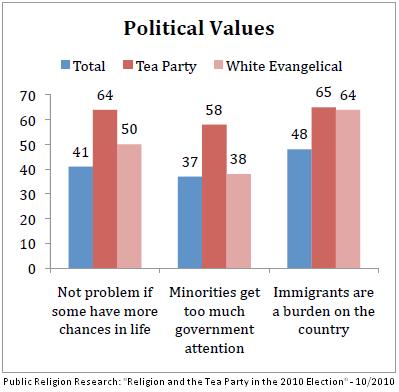
It’s a revolt against the composition of government much more than the level.
Now, it’s true that Republicans aren’t exactly translating this blueprint into action, but they’re not exactly flouting it, either. There is always a generalized antipathy toward spending amongst Republican and swing voters, but it disappears when the subject turns to actual government programs. Usually Republicans decide to just cut taxes for the rich instead. Here’s is the one part of the article proposing a defined policy change:
Even Ralph Reed, the Republican operative most tapped in to evangelicals, reflected the new GOP mindset when he gave this surprising wish list for the next presidential race: “In a perfect world, I’d like to hear the Republican nominee run on a platform that takes the capital gains tax to zero over five years.” Reed, who summoned several of the presidential candidates to Iowa for his Faith & Freedom Coalition this week, made it clear that Christian conservatives will still need to be catered to, but added that his side will understand the nominee’s need to focus on swing voters.
So an article putatively about the GOP redefining itself as an anti-spending party has one actual programmatic detail, and it’s: a zeroing out of the capital gains tax. In the name of appealing to swing voters — who, in fact, oppose tax cuts for the rich. Meet the new boss…
By: Jonathan Chait, The New Republic, March 14, 2011
School of Glock-Get Your Graduate Degree Here
It’s been nearly nine weeks since that tragic shooting in Tucson, and you may be wondering whether there’s been any gun legislation proposed in the aftermath.
Well, in Florida, a state representative has introduced a bill that would impose fines of up to $5 million on any doctor who asks a patient whether he or she owns a gun. This is certainly a new and interesting concept, but I don’t think we can classify it as a response to Tucson. Jason Brodeur, the Republican who thought it up, says it’s a response to the health care reform act.
A sizable chunk of this country seems to feel as though there is nothing so secure that it can’t be endangered by Obamacare. It’s only a matter of time before somebody discovers that giving everyone access to health insurance poses a terrible threat to the armed forces, or the soybean crop, or poodles.
Brodeur’s is one of many, many gun bills floating around state legislatures these days. Virtually all of them seem to be based on the proposition that one of the really big problems we have in this country is a lack of weaponry. His nightmare scenario is that thanks to the “overreaching federal government,” insurance companies would learn who has guns from the doctors and use the information to raise the owners’ rates.
However, it turns out that the health care law has a provision that specifically prohibits insurers from reducing any coverage or benefits because of gun ownership. A St. Petersburg Times reporter, Aaron Sharockman, looked this up. I had no idea, did you? Apparently Senate Majority Leader Harry Reid himself stuck this in to make the gun-lobby folks happy.
Which they really aren’t. The gun lobby will never be happy, unless the health care law specifically requires every American to have a pistol on his or her person at all times.
Great idea! thought State Representative Hal Wick of South Dakota, who tossed in a bill this year requiring every adult citizen to purchase a gun. Actually, even Wick admitted this one wasn’t going anywhere. It was mainly a symbolic protest against the you-know-what law.
Actual responses to the Tucson shooting — that is, something that might actually stop similar tragedies in the future or reduce the carnage — seem to be limited to a proposal in Congress to ban the sale of the kind of ammunition clip that allowed the gunman to fire 31 shots in 15 seconds. That bill is stalled at the gate. Perhaps Congress has been too busy repeatedly voting on bills to repeal the health care law to think about anything else. But, so far, the gun-clip ban has zero Republican supporters, which is a problem given the matter of the Republicans being in the House majority.
Meanwhile in the states, legislation to get more guns in more places (public libraries, college campuses) is getting a more enthusiastic reception.
The nation’s state legislators seem to be troubled by a shortage of things they can do to make the National Rifle Association happy. Once you’ve voted to allow people to carry guns into bars (Georgia), eliminated the need for getting a permit to carry a concealed weapon (Arizona) and designated your own official state gun (Utah — awaiting the governor’s signature), it gets hard to come up with new ideas.
This may be why so many states are now considering laws that would prohibit colleges and universities from barring guns on campus.
“It’s about people having the right to personal protection,” said Daniel Crocker, the southwest regional director for Students for Concealed Carry on Campus.
Concealed Carry on Campus is a national organization of students dedicated to opening up schools to more weaponry. Every spring it holds a national Empty Holster Protest “symbolizing that disarming all law-abiding citizens creates defense-free zones, which are attractive targets for criminals.”
And you thought the youth of America had lost its idealism. Hang your head.
The core of the great national gun divide comes down to this: On one side, people’s sense of public safety goes up as the number of guns goes down; the other side responds to every gun tragedy by reflecting that this might have been averted if only more legally armed citizens had been on the scene.
I am on the first side simply because I believe that in a time of crisis, there is no such thing as a good shot.
“Police, on average, for every 10 rounds fired, I think, actually strike something once or twice, and they are highly trained,” said Bill Bratton, the former New York City police commissioner.
Concealed Carry on Campus envisions a female student being saved from an armed assailant by a freshman with a concealed weapon permit. I see a well-intentioned kid with a pistol trying to intervene in a scary situation and accidentally shooting the victim.
And, somehow, it’ll all turn out to be the health care reform law’s fault.
By: Gail Collins, Op-Ed Columnist, The New York Times, March 9, 2011
Share This Blog


 Unknown Feed
- An error has occurred; the feed is probably down. Try again later.
 mykeystrokes.com

You must be logged in to post a comment.