Gunning Down Immigrants — And Other Democratic Experiments
Here in Washington, the immigration debate is in stalemate. But in Kansas, there has been a breakthrough.
This striking achievement came about this week during a meeting of the state House Appropriations Committee on efforts in Kansas to shoot feral swine from helicopters. Republican state Rep. Virgil Peck suddenly had an idea. “Looks like shooting these immigrating feral hogs works,” he commented, according to a recording posted by the Lawrence Journal-World. “Maybe we have found a [solution] to our illegal immigration problem.”
Brilliant! Shooting immigrants from helicopter gunships! Why didn’t they think of that in Congress?
There are a few logistical problems with Peck’s idea, including the fact that Kansas isn’t a border state. But maybe Oklahoma and Texas will grant overflight rights for immigrant-hunting sorties.
Peck, the Republican caucus chairman for the state House, later suggested his brainstorm was a joke, although he also defended himself: “I was just speaking like a southeast Kansas person.”
Kansans may be surprised to learn that the immigrant-shooting idea was offered in their names, but they wouldn’t be the only Americans getting unwelcome news from their state legislators now that many Tea Party types have come to power.
When Louis Brandeis called state legislatures “laboratories of democracy,” he couldn’t have imagined the curious formulas the Tea Party chemists would be mixing in 2011, including: a bill just passed by the Utah legislature requiring the state to recognize gold and silver as legal tender; a Montana bill declaring global warming “beneficial to the welfare and business climate of Montana”; a plan in Georgia to abolish driver’s licenses because licensing violates the “inalienable right” to drive; legislation in South Dakota that would require every adult to buy a gun; and the Kentucky legislature’s effort to create a “sanctuary state” for coal, safe from environmental laws.
In Washington, the whims of the Tea Party lawmakers have been tempered, by President Obama and Senate Democrats, but also by House Republican leaders who don’t want the party to look crazy. Yet these checks often do not exist in state capitols. Though many of the proposals will never become law, the proliferation of exotic policies gives Americans a sense of what Tea Party rule might look like.
Wisconsin Gov. Scott Walker’s attempt to strip public-sector unions of their power has gained national attention, as have various states’ efforts to imitate Arizona’s immigration crackdown. Arizona, meanwhile, moved on to an attempt to assert its authority to nullify federal law; the last time that was tried, we had the Civil War.
Less well known is what’s going on in Montana. Legislators there have introduced several bills that would nullify federal law, including health-care reform, the Endangered Species Act, gun laws and food-safety laws. Under one legislative proposal, FBI agents couldn’t operate in the state without the permission of county sheriffs. Legislators are also looking into a proposed resolution calling on Congress to end membership in the United Nations.
A “birther” bill, similar to proposals in various other states, would require presidential candidates — they’re talking about you, Obama — to furnish proof of citizenship that is satisfactory to state authorities. Montana has also joined the push in many states to restore the gold standard, and a Montana House committee approved legislation invalidating municipal laws against anti-gay discrimination.
Then there’s House Bill 278, authorizing armed citizens’ militias known as “home guards.” With the home guards mobilized, Montana would no longer have to fear a Canadian invasion. And while Montana repels the barbarians from Alberta, New Hampshire is contemplating a state “defense force” to protect it from the marauding Quebecois.
Some of the proposals are ominous: South Dakota would call it justifiable homicide if a killer is trying to stop harm to an unborn child.
Some are petty: Wyoming, following Oklahoma, wants to ban sharia law, even though that state’s 200-odd Muslims couldn’t pose much of a sharia threat.
Some are mean-spirited: Iowa would allow business owners to refuse goods and services to those in gay marriages.
Some are fairly harmless: Arizona took actions to make the Colt Single Action Army Revolver the official state firearm and to create a Tea Party license plate.
And some are just silly: A Georgia bill would require only “pre-1965” silver and gold coins for payment of state debts.
Even if the Tea Party gets its way in the legislature, it won’t be easy to stop residents of Georgia from using their greenbacks — at first. But compliance will undoubtedly increase once the state calls in those helicopter gunships from Kansas.
By: Dana Milbank, The Washington Post, March 15, 2011
Government by the Week: Is A Government Shutdown The End-Game For The GOP?
Parents have begun arranging alternative child care for their preschoolers, uncertain of whether their Head Start program will be there when they need it. The Social Security Administration is unable to open new hearing offices to handle a backlog of appeals. The Pentagon has had to delay equipment repairs. There is chaos throughout the federal government, as Robert Pear reported in The Times on Tuesday, because a riven Congress has forced agencies to operate on a week-by-week basis.
Yet, on Tuesday, the House passed another short-term spending bill. This one keeps things going for all of three weeks. The Senate will almost certainly join in shortly to avoid an impending shutdown on Friday, the result of the stopgap bill from two weeks ago.
These slipshod exercises in governance were choreographed by House Republicans, who knew that neither the Senate nor President Obama would ever accept their original proposal to gut nonsecurity discretionary spending with $61 billion in cuts through September, including riders to end financing for Planned Parenthood and the health care law. They had hoped to use the pressure of a potential shutdown to achieve much of their goal, but, so far, all they have accomplished is a cut of about $10 billion, mostly from earmarks or programs that the president himself proposed to cut. (The new bill cuts $6 billion.)
House Republican leaders, who say they do not want a government shutdown, have, so far, held off their more fanatical freshmen, who want to slash everything in sight. But the leadership cannot do so forever, and the evidence of that was clear on Tuesday. More than 50 Republicans refused to go along with the three-week resolution because it did not cut enough. Several specifically complained that it allowed financing for Planned Parenthood and the health care law to continue.
This is not a group that cares much for pragmatic compromise, and the three weeks are just a timeout. Representative Mike Pence of Indiana, a Republican who voted no on the new bill, spoke for many of his colleagues when he said the budget could not be resolved without a willingness to shut down government. “By giving liberals in the Senate another three weeks of negotiations,” he said, “we will only delay a confrontation that must come.”
He is absolutely right about that. If Democrats, including the president, do not draw a clear line soon, making their priorities and their limits unmistakable, they will be harried by these kinds of votes for years. Even in the unlikely case that an agreement is reached in three weeks to finance the government through September, a different vote will be necessary just a few weeks from now to raise the debt ceiling. Republicans have already vowed to vote that down — even though it could be financially disastrous — if they do not get their way. And then there is the vote for the fiscal 2012 budget, which begins Oct. 1, and then the year after that.
At some point, Mr. Pence will get his confrontation. If Republicans continue to press for cuts of tens of billions from discretionary spending, setting back the economic recovery largely for ideological purposes, Democrats will have to say no, even if that results in a short-term shutdown. The American people will be able to figure out who is at fault. Responsible governing means agreeing quickly to a deal to finish out the fiscal year, and then starting a serious talk about entitlement programs and taxes — the real causes of a soaring deficit.
By: The New York Times, Editorial, March 15, 2011
Swing Voters Swing Because They’re Uninformed
One of my hobbyhorses is to track the movements of the Oscillating Low-Information Voter .
He is not a bad person. He may be hard-working and incredibly brilliant. He may be rich or poor or, more likely, somewhere in between. He may, in fact, be a she.
What Oscillating Low-Information Voters have in common is they pay very little attention to politics. Again, this does not imply stupidity—only ignorance. The Low-Information Voter is thus a different animal than the rational non-voter , who may keep up with the news but concludes his vote is statistically meaningless.
For whatever reason, the Low-Information Voter is simply uninformed.
His ideological preferences are transactional, and thus fluid: “What have the guys I just put in charge done for me lately?”
So what is this highly-prized, “independent” bloc of voters up to now?
A recent ABC News/Washington Post poll reveals exactly what I always expect. The Oscillating Low-Information Voter is oscillating! Polling analyst Gary Langer explains:
The drop in trust to handle the economy has occurred chiefly among independents, now drawing away from the GOP after rallying to its side. As recently as January, 42 percent of independents preferred the Republicans in Congress over Obama to handle the economy. Today just 29 percent say the same, and there’s been a rise in the number who volunteer that they don’t trust either side.
The “bottom line,” according to online political tipsheet The Note, is that “voters want results, not rhetoric.”
That would be the charitable way of putting it.
I think it’s more accurate to say that such voters are all-too-easily swayed by political rhetoric.
This is precisely the quality that makes “swing voters” swingable.
By: Scott Galupo, U.S. News and World Report, March 15, 2011
The GOP’s Penny-wise, Pound-Foolish Spending Cuts
Let’s say that for every dollar you gave me, I gave you a crisp $10 bill in return. Good deal, right? Almost too good. But before you start to ask questions, I’ll remind you that this is my thought experiment. Perhaps I just love dollar bills. Or perhaps I just love you. At any rate, there are no strings attached, and you can take advantage of it more than once.
Now let’s say that you’re in debt and you need to get your finances in order. Do you start handing me more dollar bills? Or fewer?
If you’ve got any sense, you’ll give me more. Converting dollar bills into $10 bills is an excellent way to pay off your credit card. Except, it seems, if you’re a House Republican.
On March 1, House Republicans voted to cut $600 million from the budget of the Internal Revenue Service for the remainder of 2011, and they want even deeper cuts in 2012. Perhaps that doesn’t surprise you: Republicans don’t like spending — at least when they’re not in power — and they don’t like taxes. Why would they fund the IRS?
Well, as the Associated Press reported, “every dollar the Internal Revenue Service spends for audits, liens and seizing property from tax cheats brings in more than $10, a rate of return so good the Obama administration wants to boost the agency’s budget.” It’s an easy way to reduce the deficit: You don’t have to cut heating oil for the poor or Pell grants for students. You just have to make people pay what they owe.
But deficit reduction is not the GOP’s top priority. It’s a bit lower on the list, somewhere between “get Styrofoam cups back into Congress” — an actual push the Republicans took up to thumb their nose at Nancy Pelosi’s environmental policies — and make “Sesame Street” beg for money. In fact, if you listen to Speaker John Boehner, he’ll tell you himself. “The American people want us to focus on creating jobs and cutting spending,” he has said. And that comment wasn’t a one-off: “Our goal is to cut spending,” he said in another speech.
Cutting spending is related to, but in important ways different from, cutting deficits. For one, it rules out tax increases. That’s how Republicans can lobby to make the Bush tax cuts permanent, at a cost of $4 trillion over 10 years, and yet say they’re fulfilling their campaign promises by making much smaller cuts to non-defense discretionary spending. If you add up what Republicans have offered since the election, the policies they’ve endorsed would increase deficits but also decrease spending, at least in the short term. The IRS example shows that spending cuts don’t always reduce the deficit. But it’s worse even than that: Spending cuts don’t always reduce government spending.
There are three categories of spending in which cuts lead to more, rather than less, spending down the line, says Alice Rivlin, former director of both the Congressional Budget Office and the Office of Management and Budget. Inspection, enforcement and maintenance. The GOP is trying to cut all three.
Let’s begin with the costs of cutting inspection — for example, the Food and Drug Administration and the Agriculture Department. Together, the agencies are charged with ensuring that the nation’s food is safe. That’s increasingly crucial as our interconnected, industrialized system makes contaminated food a national crisis rather than a local problem. In recent years, we’ve seen massive recalls stemming from E. coli in spinach, salmonella in peanut butter and melamine in pet food. Each required the recall of thousands of tons of food and alerts to consumers who, in many cases, were screened or treated.
The problem was bad enough — and the people and pets sick enough— that Congress passed a bipartisan food-safety bill during last year’s lame-duck session. But now Republicans want big cuts in the agencies’ budgets, meaning fewer inspectors and a higher chance of outbreaks and food-borne illness. And those don’t come cheap. They show up in our health-care costs, disability insurance and tax revenue, not to mention in the pain and suffering and even death they cause.
Next up: enforcement. As any budget wonk will tell you, cracking down on “waste, fraud and abuse” won’t cure all our fiscal ills. But waste, fraud and abuse do happen, particularly in Medicare and Medicaid, where they can be costly. Republicans are looking for big reductions in the Department of Health and Human Services, meaning fewer agents to conduct due diligence on health-care transactions. Costs will go up, not down.
Then there’s deferred maintenance. In 2009, the Society of Civil Engineers gave America’s existing infrastructure a grade of D. They estimated that simply maintaining America’s existing stock would require up to $2.2 trillion in investment. But Republicans have been cool to Obama’s calls to increase infrastructure investment. Just “another tax-and-spend proposal,” Rep. John Mica (R-Fla.) said when the initiative was announced. But a dollar in maintenance delayed — or cut — isn’t a dollar saved. It’s a dollar that needs to be spent later. And waiting can be costly. It’s cheaper to strengthen a bridge that’s standing than repair one that’s fallen down.
And there are plenty of examples beyond that. Republicans have proposed massive cuts to the Securities and Exchange Commission, which would make another financial crisis that much likelier. They’ve proposed cuts to the National Oceanic and Atmospheric Administration, which conducts tsunami monitoring. In their zeal to cut spending, they’re also cutting the spending that’s there to prevent overspending. Just as you have to spend money to make money, you also have to spend money to save money — at least sometimes.
There are all sorts of reasons Republicans are being penny-wise and pound-foolish. Cutting $100 billion in spending in one year sounded good on the campaign trail but turned out to be tough in practice. Curtailing the IRS and cutting the Department of Health and Human Services — and, particularly, its ability to implement health-care reform — is a long-term ideological objective for Republicans.
Whatever the reason, the effect will be the same: a higher likelihood of pricey disasters, an easier time for fraudsters, and bigger price tags when we have to rebuild what we could’ve just repaired.
By: Ezra Klein, The Washington Post, March 15, 2011
What Does The Tea Party Want?….The New Litmus Test
Jim VandeHei and Mike Allen argue that the Tea Party redefined the purpose of the GOP as opposition to spending:
The Republican Party is undergoing a messy but unmistakable 20-month transformation from fanatically anti-Obama to fanatically anti-spending, providing top party officials a new and intriguing playbook for recapturing the White House in 2012.
To understand the current evolution, flash back to late spring of 2009. The GOP was disoriented and adrift, its leadership void filled by the bombastic voices of Palin, Beck and Rush Limbaugh. There was no common conservative cause, beyond fear and loathing of Obama. No wonder swing voters were so down on them.
But the tea party, treated at first by the media as exotics, forced Republicans to focus almost exclusively on the size of government. By the time the 2010 elections rolled around, tea party activists and most independent voters were completely aligned on the need to cut, cut, cut.
Midterm election results showed that this approach offers the GOP its best – and maybe only – hope of keeping the interests of independents and tea party activists aligned enough to beat Obama.
The new litmus tests for GOP presidential hopefuls are support for repealing “Obamacare” and taking a cleaver to government spending. If a presidential candidate could harness the smaller-government conservatism, temper it enough to avoid a blatant overreach and articulate a vision for a prosperous future for the country, it’s not hard to imagine swing voters finding such a person appealing.
There’s a superficial appeal to this story. But the evidence that Tea Party activists want to cut spending — at least actual spending programs — is sparse. Polls show that Tea Party supports overwhelmingly oppose cuts to Social Security and Medicare. The main thrust of Tea Party opinion is not the belief that Obama has spent too much money, but the belief that Obama has spent too much money on people unlike them:
More than half say the policies of the administration favor the poor, and 25 percent think that the administration favors blacks over whites — compared with 11 percent of the general public.
They are more likely than the general public, and Republicans, to say that too much has been made of the problems facing black people.
Here’s another cut, showing the Tea Party’s greater comfort with inequality of opportunity and stronger belief that the government devotes too many resources to minorities:
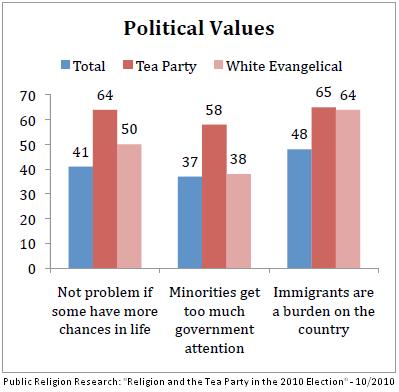
It’s a revolt against the composition of government much more than the level.
Now, it’s true that Republicans aren’t exactly translating this blueprint into action, but they’re not exactly flouting it, either. There is always a generalized antipathy toward spending amongst Republican and swing voters, but it disappears when the subject turns to actual government programs. Usually Republicans decide to just cut taxes for the rich instead. Here’s is the one part of the article proposing a defined policy change:
Even Ralph Reed, the Republican operative most tapped in to evangelicals, reflected the new GOP mindset when he gave this surprising wish list for the next presidential race: “In a perfect world, I’d like to hear the Republican nominee run on a platform that takes the capital gains tax to zero over five years.” Reed, who summoned several of the presidential candidates to Iowa for his Faith & Freedom Coalition this week, made it clear that Christian conservatives will still need to be catered to, but added that his side will understand the nominee’s need to focus on swing voters.
So an article putatively about the GOP redefining itself as an anti-spending party has one actual programmatic detail, and it’s: a zeroing out of the capital gains tax. In the name of appealing to swing voters — who, in fact, oppose tax cuts for the rich. Meet the new boss…
By: Jonathan Chait, The New Republic, March 14, 2011
Share This Blog


 Unknown Feed
- An error has occurred; the feed is probably down. Try again later.


You must be logged in to post a comment.